
One of our clients expanding into India had new hires with verbal start dates and no entity ready to employ them. The setup had stalled on the director’s signatures and proof of address. To protect those start dates, we partnered with an Employer of Record to hire the team temporarily. Once the entity was established, the client went through a complex transition to move everyone onto it.
For an operations leader planning a hiring wave, that is what a document delay costs: a temporary employment arrangement, then a migration off it, on top of the setup you had planned. The intake phase of the UBO notarization and apostille process is where the parent company’s documents and the IDs of its directors and ultimate beneficial owners (UBOs) are collected and certified. It is normally the number one indicator of how quickly a foreign setup will move.
Key Takeaways
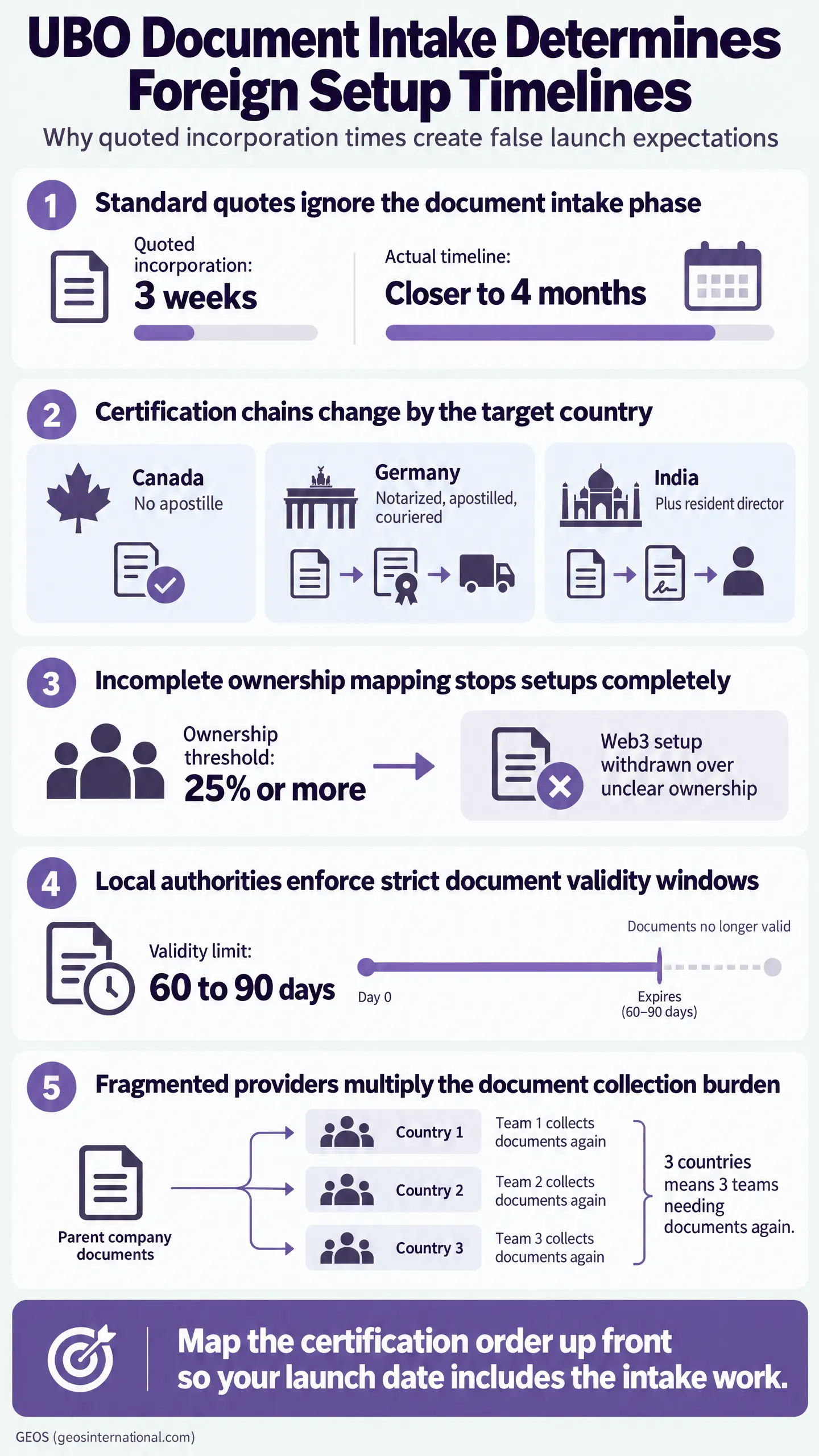
- Standard timelines for foreign entity setups often omit the document intake phase, making a quoted three-week French setup inaccurate once ultimate beneficial owner certifications and translations are included.
- A United Kingdom entity setup bypasses wet signatures and apostilles, allowing completion in one to two weeks, though a November 2025 Companies House rule mandates identity verification for new directors.
- Establishing a German GmbH requires opening a local bank account and depositing at least €12,500 of the €25,000 minimum share capital before the incorporation application can be filed.
- Public notaries frequently demand unlisted incorporation documents, such as a Spanish notary requiring additional proof of entity status for a United States limited liability company functioning as a disregarded entity.
- Singapore enforces strict anti-money laundering regulations requiring ownership documentation for ultimate beneficial owners, which previously forced the cancellation of a Web3 client’s setup due to an opaque holding structure.
- Local government authorities typically restrict the validity of submitted incorporation documents and proofs of address to 60 to 90 days, a timeline that is not reset by adding an apostille.
- The 2026 European Commission EU Inc. proposal targets a 48-hour digital registration for under €100, but foreign parent companies will still face analog hurdles for apostilles, translations, and bank setups.
Why Does the Document Intake Phase Determine Foreign Entity Setup Timelines?
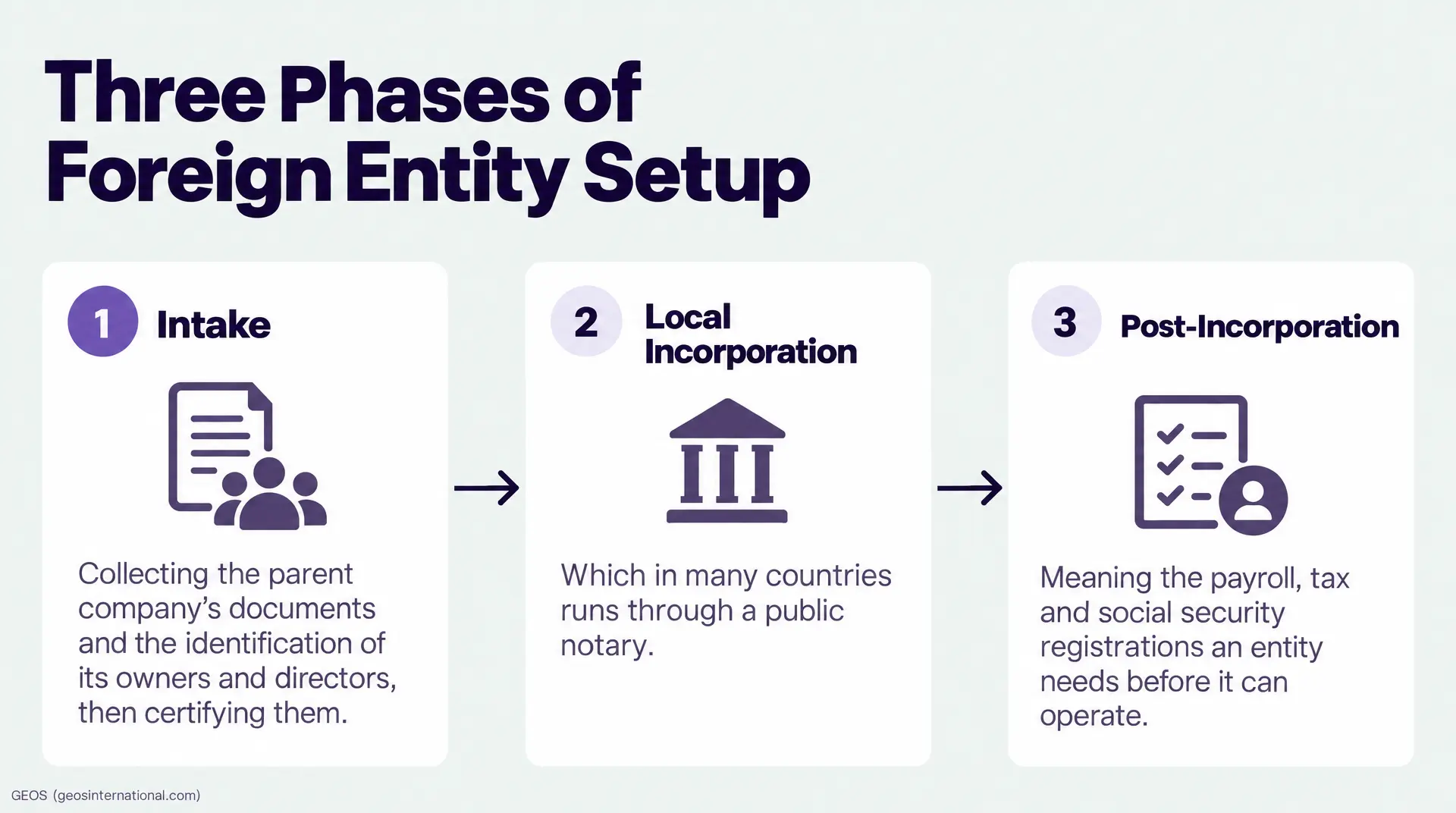
At GEOS International, we break a foreign setup into three phases. Phase one is intake: collecting the parent company’s documents and the identification of its owners and directors, then certifying them. Phase two is the local incorporation, which in many countries runs through a public notary. Phase three is post-incorporation, meaning the payroll, tax and social security registrations an entity needs before it can operate.
Quoted timelines normally leave out phase one. When someone says an entity in France can be incorporated in three weeks, that figure usually covers the time from lodging the application to the government processing it. Before that clock starts, documents have to be collected from every UBO and owner of the parent. The parent’s own documents have to be notarized, apostilled, couriered to France and translated, and the French incorporation documents have to be drafted from them. A launch plan built on the three-week number has been hooked into a false promise, and the gap shows up later as missed dates and added costs.
The UK is a rare exception, because a UK setup needs no wet signatures, notarization or apostilles. We budget one to two weeks for intake, incorporation and director verification, then about a week for HMRC registrations. Under the Companies House rollout, new directors have had to verify their identity on incorporation or appointment since 18 November 2025. Existing directors have been phased in through each company’s next confirmation statement over a 12-month transition. For directors of established entities who didn’t know about it, or who found the online process hard, it has been a significant nuisance. For most other countries, I would plan on something closer to four months, and depending on the country, a setup can take as long as 12.
What Is the 2026 UBO Notarization and Apostille Checklist for Foreign Setups?
Why Map Country-Specific Certification Chains in the UBO Notarization and Apostille Checklist?
When I say a document is certified, that can mean up to four separate actions. It may need to be notarized. It may then need an apostille, a certificate that authenticates the origin of a public document. The apostille confirms the signature or seal on the document and the capacity in which the signer acted, which for a notarized document means the notary. It says nothing about whether the contents are true. The original may also have to be couriered into the target country and given a sworn translation there.
This gets complicated because the target country, the parent company’s home jurisdiction and the documents the parent actually has all change which documents need which actions, and in what order. For foreign subscribers and directors, India’s incorporation guidance distinguishes notarization for documents from Commonwealth countries, notarization plus an apostille for Apostille Convention countries, and consular authentication for certain others. A US parent setting up in Mexico, Singapore and the UK will produce a different set of documents for each country, certified in a different combination and a different order. It is the complexity of variability, and one generic list won’t hold across all three.
At the light end, incorporating a foreign-owned entity in Canada doesn’t require the parent’s documents to be notarized or apostilled. US incorporation asks far less of the parent’s UBOs than most countries, because the scrutiny falls only on the directors of the US subsidiary. At the heavy end, a German GmbH is slowed by having the parent’s key documents notarized, apostilled and physically couriered in. In the Netherlands, a US parent’s documents are notarized, apostilled, translated and couriered before the appointment with the public notary. Mexico needs the notarized, apostilled and translated documents couriered in, plus a local legal representative who can wet sign employment contracts. India needs notarized documents, powers of attorney and a resident director.
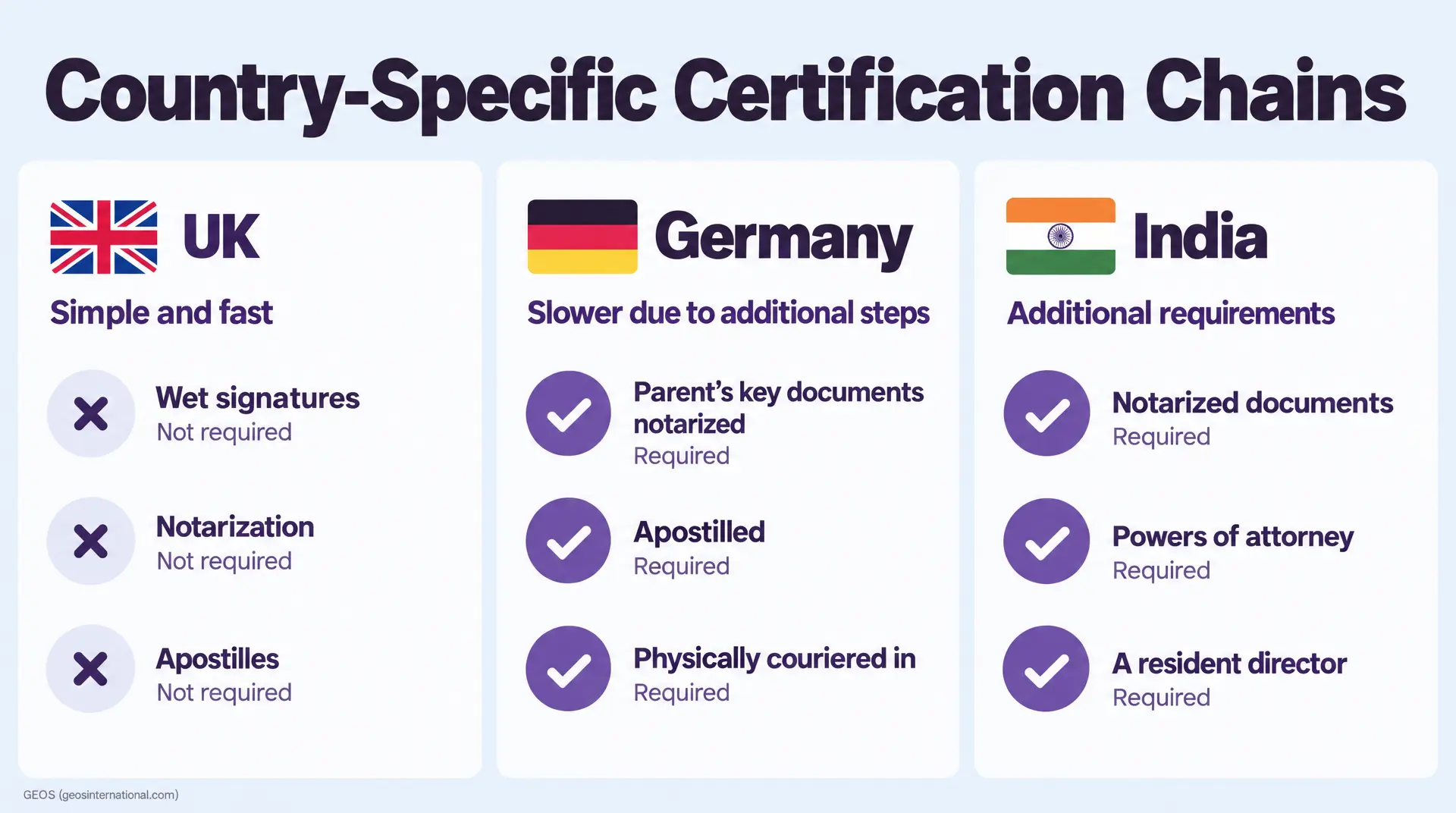
For a US parent in 2026, UBO notarization and apostille requirements run from none in the UK and Canada to a full chain with translation and couriering in Mexico.
|
Country (subsidiary) |
Notarization and apostille steps for US parent documents |
Resident director or local representative required |
Step required before registration can be filed |
|---|---|---|---|
|
United Kingdom |
None: no wet signatures, notarization or apostilles |
No residence rule for directors, UK registered office required |
Companies House identity verification for new directors, required since 18 Nov 2025 |
|
Canada (federal CBCA corporation) |
None: parent documents need no notarization or apostille |
No, unless the company decides to set up a Federal Corporation |
No separate pre-filing step: NUANS name search is built into online filing |
|
Singapore |
No general rule from ACRA, the filing agent verifies parent documents in due diligence |
Yes: at least 1 director ordinarily resident in Singapore (Companies Act s145) |
Engage a Corporate Service Provider for name reservation and due diligence |
|
Germany (GmbH) |
Notarize, apostille, courier originals, German translation case by case |
No residence or nationality rule for managing directors |
Notarial deed and bank deposit certificate for at least €12,500 of €25,000 share capital, if cash-funded |
|
Netherlands (BV) |
Notarize, apostille, translate, courier before the civil-law notary appointment |
No nationality or residence rule for managing directors but will be required for VAT registration. |
Civil-law notary deed of incorporation, notary registers BV and UBOs with KVK |
|
Mexico |
Notarize, apostille, Spanish translation by authorized perito traductor, courier in |
Yes: local legal representative able to wet sign employment contracts |
Secretaría de Economía name authorization, then deed before a notary or public broker |
|
India |
Notarize and apostille (Apostille Convention route), plus powers of attorney |
Yes: at least 1 director in India 182+ days per financial year, prorated in first year |
MCA-registered Digital Signature Certificate for each e-signing director and subscriber |
There was no shortcut to mapping these chains. It took us hundreds of hours across the 80+ countries we cover, along with hundreds of meetings I held with local tax and legal experts. Local partners still liaise with each government and lodge the applications, and our platform shows the client the whole sequence from beginning to end.
Before the first document is collected, ask whoever runs the setup, for each country, “Which of our documents must be notarized, apostilled, couriered and translated, and in what order?” Then ask, “Which steps need a wet signature, specialized letterhead or a live KYC video call, and when will our directors and UBOs be needed for them?” I have seen busy executives setting up several entities at once become overwhelmed by exactly these items, down to the format each country accepts for proof of address.
Having the full sequence up front also lets steps run at the same time. Many local providers send each step by email once the previous one is done, so every step is a surprise and the elapsed time is the sum of all of them. Running several countries that way is like playing basketball with a blindfold, hearing each move called out only after the last one.
Which Parent Company Documents Are Required for the UBO Notarization and Apostille Checklist?

The baseline is the parent’s Certificate of Good Standing and Articles of Incorporation, or their equivalents in its home jurisdiction. They feed directly into the incorporation application, so everything downstream waits on them. A frequent cause of early delay is that the company can’t find them. Often an outside lawyer set up the parent years ago, drafted its administrative documents as well, and the paperwork has since been lost or forgotten. Confirm who holds yours now and when each was issued.
Why Map Every Ultimate Beneficial Owner for the UBO Notarization and Apostille Checklist?
The first platform dedicated to streamlining entity setup and management.
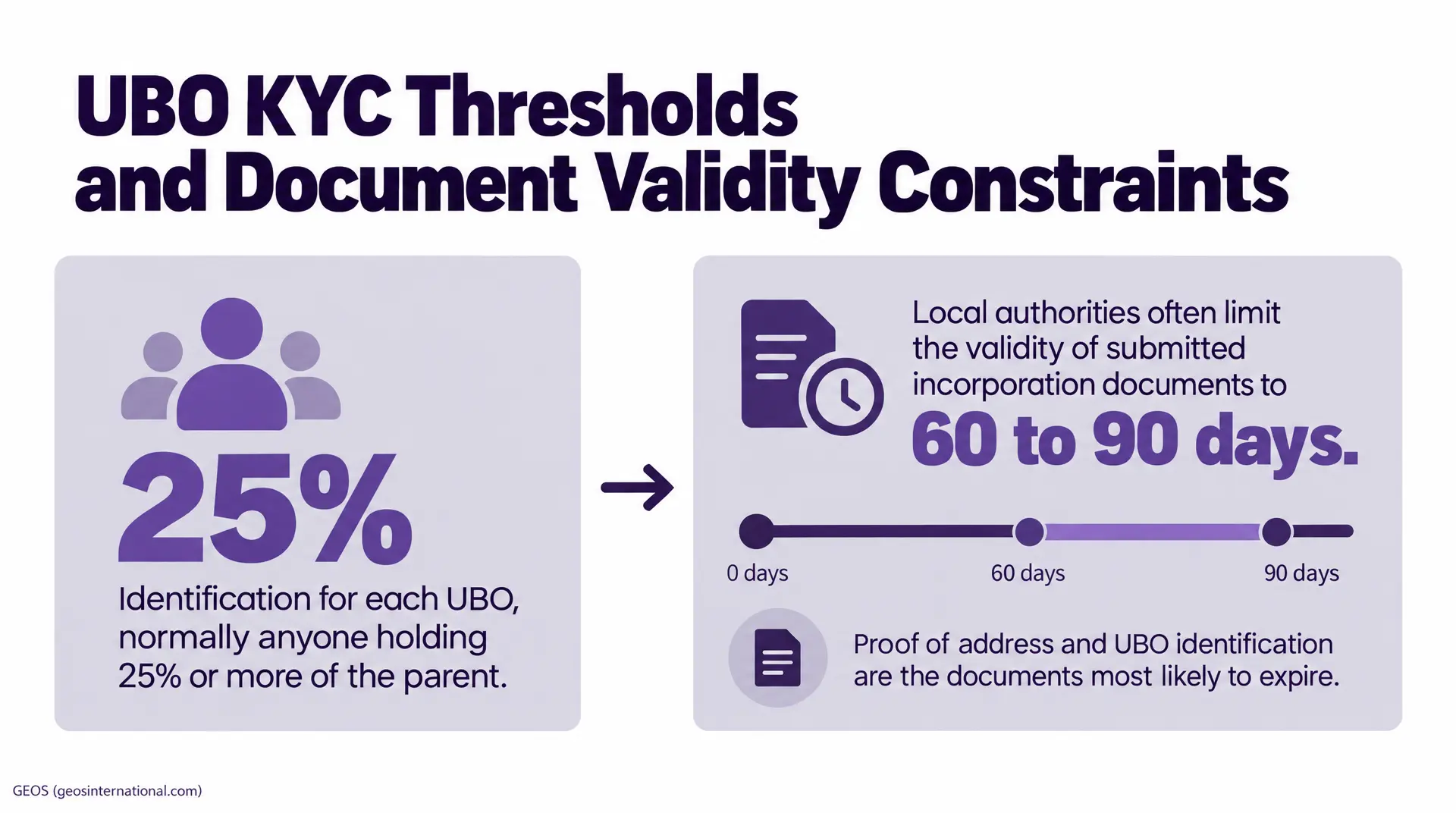
Each country you enter needs to verify that the ownership behind the new subsidiary is clean, for KYB and KYC (know your business, know your customer) and anti-money laundering (AML) purposes. In practice that means general information and identification for each UBO, normally anyone holding 25% or more of the parent. The exact test varies by country. Singapore’s corporate regulator, for example, identifies controllers by criteria that include more than 25% of the shares or voting power, or significant influence or control. It counts rights held indirectly, and a controller can be a company as well as a person.
When a fund or holding company sits above the parent, most countries accept official documentation showing that no individual UBO exists. Some keep going up the chain, layer by layer, until they understand how the ownership is structured. If the full structure is documented before intake begins, those requests don’t turn into a second round of collection.
A Singapore setup ended over this. A Web3 client had an unclear ownership structure, and when we requested additional documentation to clarify it, they weren’t willing to provide it. Without it, the setup couldn’t meet Singapore’s AML and KYB minimum requirements, and it was withdrawn by mutual agreement.
Why Brief Silent Investors on KYC Requirements for the UBO Notarization and Apostille Checklist?

When a UBO causes a severe delay, it is typically a silent investor with no role in daily operations who resists handing over personal identification. To prevent that, we arm the client’s executive team with the messaging before the request goes out: these are non-negotiable anti-money laundering requirements, mandated by the local government. Even for an easy country, investors should expect the request, because we run our own KYC and KYB checks on every new client under our AML policy.
How Do Document Validity Windows Affect the UBO Notarization and Apostille Checklist?
Local authorities often limit the validity of submitted incorporation documents to 60 to 90 days. Proof of address and UBO identification are the documents most likely to expire or cause a snag, and the reasons tend to be mundane. A UBO may be in the middle of a move and unable to produce a refreshed proof of address, or may not have a current driver’s license to scan and notarize. Proof of address was one of the items that held up the India setup.
An apostille doesn’t reset that clock. Global Affairs Canada, for example, says the apostilles it issues do not expire. The destination country can still have its own requirements for the age of the underlying document. If certification and couriering run longer than the target country allows, a proof of address gathered on day one has to be refreshed and certified again. Each document’s issue date needs to be planned against the date the notary will review the file.
Why Do Public Notaries Request Additional Documents Beyond the UBO Notarization Checklist?
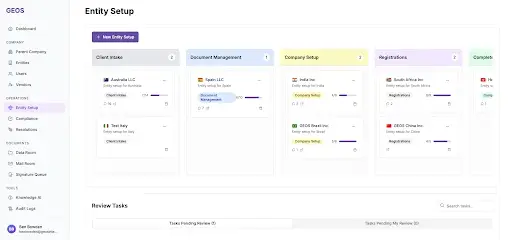
Being laissez-faire with how documents are notarized leads to immediate rejections from public notaries. A correct package still doesn’t guarantee a smooth review, because notaries and local officials aren’t consistent and often ask for additional documents or certifications that weren’t on the original list.
In Spain, the public notary on a US-based client’s setup asked for a document proving the parent LLC was an official entity in the US. That LLC functioned as a disregarded entity for tax purposes, so it didn’t have the certificates a Spanish private limited company would have. We produced an alternative document and reasoned with the notary on how to proceed. The setup went ahead, though it did cause delays.
On a Spanish setup where the client was moving independent contractors into full-time employment, the notary rejected the initial incorporation application and asked for extensive additional documentation. Because we knew where Spanish setups tend to stall, we could help the client manage the budget and give the affected workers an accurate revised timeline.
How Can Companies Reuse the UBO Notarization and Apostille Package for Foreign Bank Accounts?
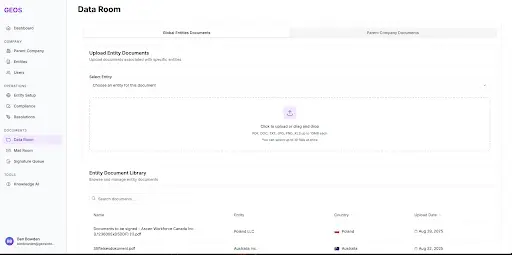
The same ownership documents go to the bank, and in some countries the bank comes before incorporation. A cash-funded German GmbH can file its registration application only once at least €12,500 of its €25,000 minimum share capital has been paid in. A bank has to open the account and issue a deposit certificate before that. For one US-based client expanding into Germany, the first bank rejected the application because the client had no EU citizen directors, and we sourced an alternative banking partner. On one Indian setup, an initially responsive bank just went silent, and restarting with a new bank significantly delayed the client’s share capital deposit and local payroll.
Once the package exists, it should live in one place. We collect parent company and UBO documents once during intake and store them in our platform, which speeds up every subsidiary after the first, although some countries will still ask for different or refreshed documents.
My business partner and I have both been clients of PwC. Its teams are split by geography, so three countries means three teams, each needing the parent’s documents and context again. That model can still suit a Fortune 100 or publicly traded company, and for a single country, a local lawyer or accountant with experience serving foreign clients can be a good partner. It gets hard when several countries run at once through separate providers, because the client ends up owning the project management from beginning to end.
How Will the 2026 EU Inc. Proposal Impact Foreign Entity Registration Timelines?

The European Commission’s EU Inc. proposal, presented on 18 March 2026, sets out fully digital registration within 48 hours for no more than €100. As of late October 2026, it is still in the EU legislative process, so those terms are proposals and a launch plan can’t rely on them yet. The 48 hours would apply to registration, which is the stage quoted timelines already measure. I see the proposal as an extremely positive step, and its value to a foreign parent will depend on how it handles country-specific operations like VAT, taxes and payroll. I expect bank KYB, physical notary appointments and country-specific apostille and translation requirements to be the most stubborn analog hurdles against it. I wouldn’t pause a European expansion to wait for it, because the wait is likely to be long and the cost in lost market share significant.
Automation has the same limit. Domestic citizens can incorporate in Singapore in a single day, while a realistic timeline for a foreign-owned subsidiary there is two weeks to two months. We use AI in our platform for project management and for presenting information, and I expect the certification chain itself to stay AI resistant for a while.
For a 2026 launch plan, whether the date holds still depends on one condition: a complete, correctly certified and still-valid package reaching the notary and the bank in each country when the plan assumes it will. If it would help, we can map the document package and certification order for each of your target countries against your parent company’s structure, so the date you commit to the business includes the intake work that quotes usually leave out.
Frequently Asked Questions
How do shifting beneficial ownership thresholds complicate a multi-country intake strategy?
Collecting documents based on a flat 25% rule causes delays. The FATF confirms 25% isn’t universal. Singapore identifies controllers through indirect rights or significant influence, including corporate entities. Map specific local ownership definitions before starting the UBO notarization process to avoid costly re-submissions.
Does an apostille guarantee our UBO documentation will clear local compliance and notary checks?
No. An apostille only authenticates a document’s origin and signature, not its legal truth. Destination authorities also enforce strict freshness rules. For example, France requires a corporate director’s Kbis extract to be under three months old. Stale apostilled documents will trigger immediate public notary rejections.
How does originating from a non-Apostille Convention country impact the document certification timeline?
It extends timelines by forcing consular authentication. India’s guidelines require an apostille for Convention countries, but mandate complex consular authentication for others. This replaces a standardized process with unpredictable embassy timelines, severely threatening your fixed commercial launch and local hiring deadlines.
Can we initiate operational registrations, like tax and payroll, before the UBO apostille process finishes?
Rarely. Most operational unlocks are hard-blocked by certified incorporation documents. Mexico’s SAT demands apostilled and translated documents for RFC tax registration. Even when early registration is allowed, like UK employer PAYE, you cannot register more than two months before your first staff payday.
How do local share capital requirements dictate the sequencing of our UBO notarization package?
The same UBO documents required for incorporation must clear bank KYB first to unlock capital deposits. To incorporate a German GmbH, you must prove cash payments reaching at least €12,500. If your UBO package isn’t formatted for the bank’s specific compliance checks, your entire incorporation stalls.