
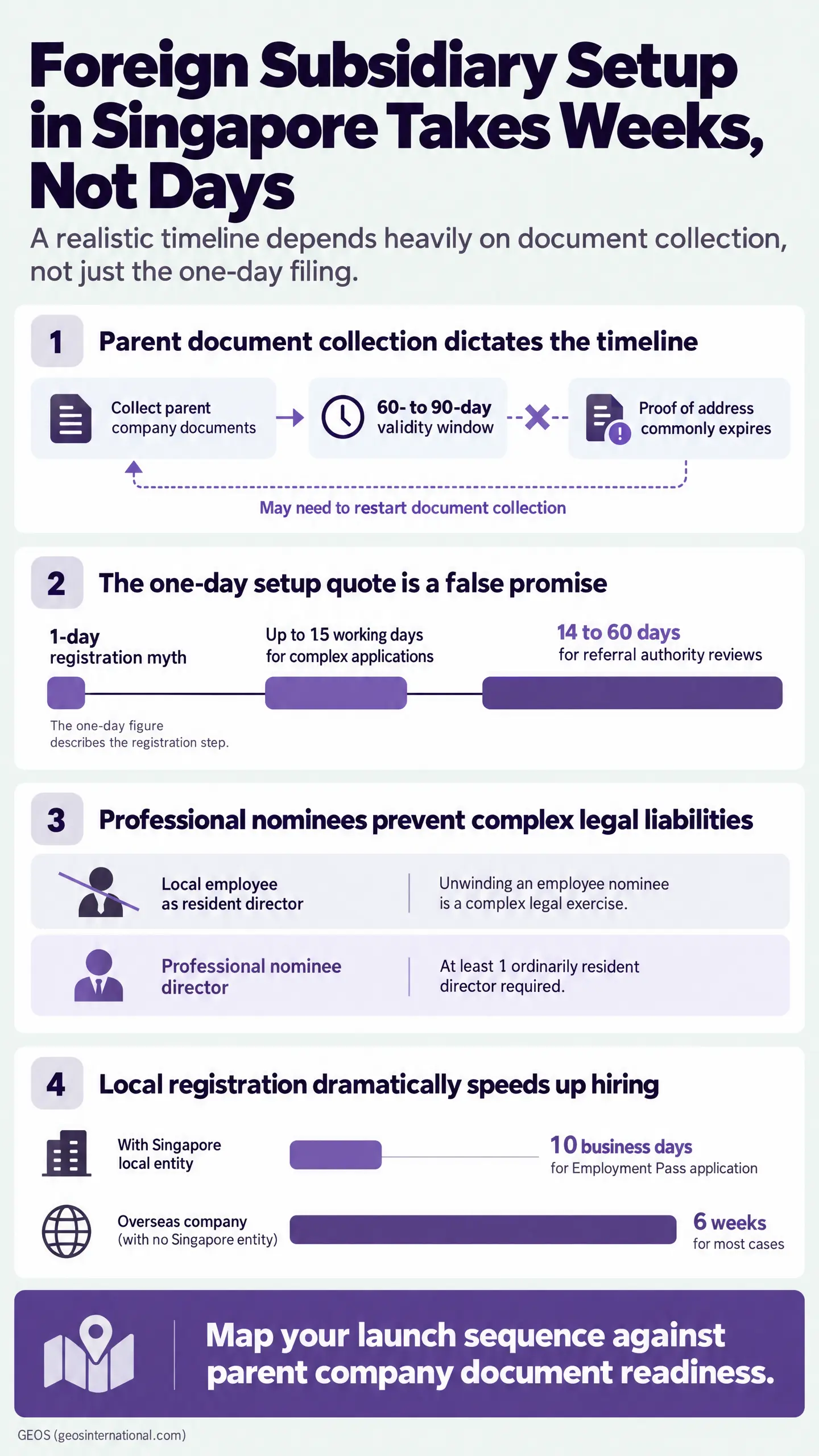
Singapore has a reputation for one-day company registration. For a Singapore citizen or resident, that can be close to accurate. For a foreign company setting up a subsidiary as a non-resident, it does not hold. In my experience, a realistic timeline for a foreign company, from the day a client says go to the day the entity is live, is between two weeks and two months. If a regional launch, a first hiring wave or a client contract start date is already on the calendar, the plan has to be built on that range.
The same pattern holds in every country. Incorporating as a citizen is much easier than incorporating as a foreigner, and at GEOS International we specialize in the foreign case. Measured that way, Singapore is one of the easiest countries in the APAC region. It is also probably the most popular one our clients choose for an APAC hub. Most of the other countries we work in take closer to four months.
With a launch two months after kickoff, the fast end of the Singapore range leaves about six weeks of margin and the slow end leaves none. Where a project lands within that range depends on a few conditions, and the largest of them shows up at the very start, during intake. For that reason I would count a timeline for Singapore subsidiary registration from the day intake begins and treat the government filing as one step in the middle.
Key Takeaways
- A realistic timeline for foreign companies registering a Singapore subsidiary spans two weeks to two months, compared to four months for most other jurisdictions in the APAC region.
- Expiration of owner address proofs during the 60-to-90-day validity window is the most common cause of timeline delays for foreign entities undergoing Singapore’s anti-money laundering checks.
- Singapore’s Accounting and Corporate Regulatory Authority requires one ordinarily resident director, and since June 9, 2025, business-appointed nominees must be vetted by a registered corporate service provider.
- The Inland Revenue Authority of Singapore uses a subsidiary’s Unique Entity Number for corporate income tax, and this same identifier is required to secure a Central Provident Fund Submission Number for payroll.
- Foreign companies establishing a Singapore subsidiary only trigger compulsory Goods and Services Tax registration once their taxable turnover exceeds S$1 million within a calendar year.
- The Singapore Ministry of Manpower prohibits Employers of Record from securing foreigner work passes, but a registered local entity can process an Employment Pass in 10 business days.
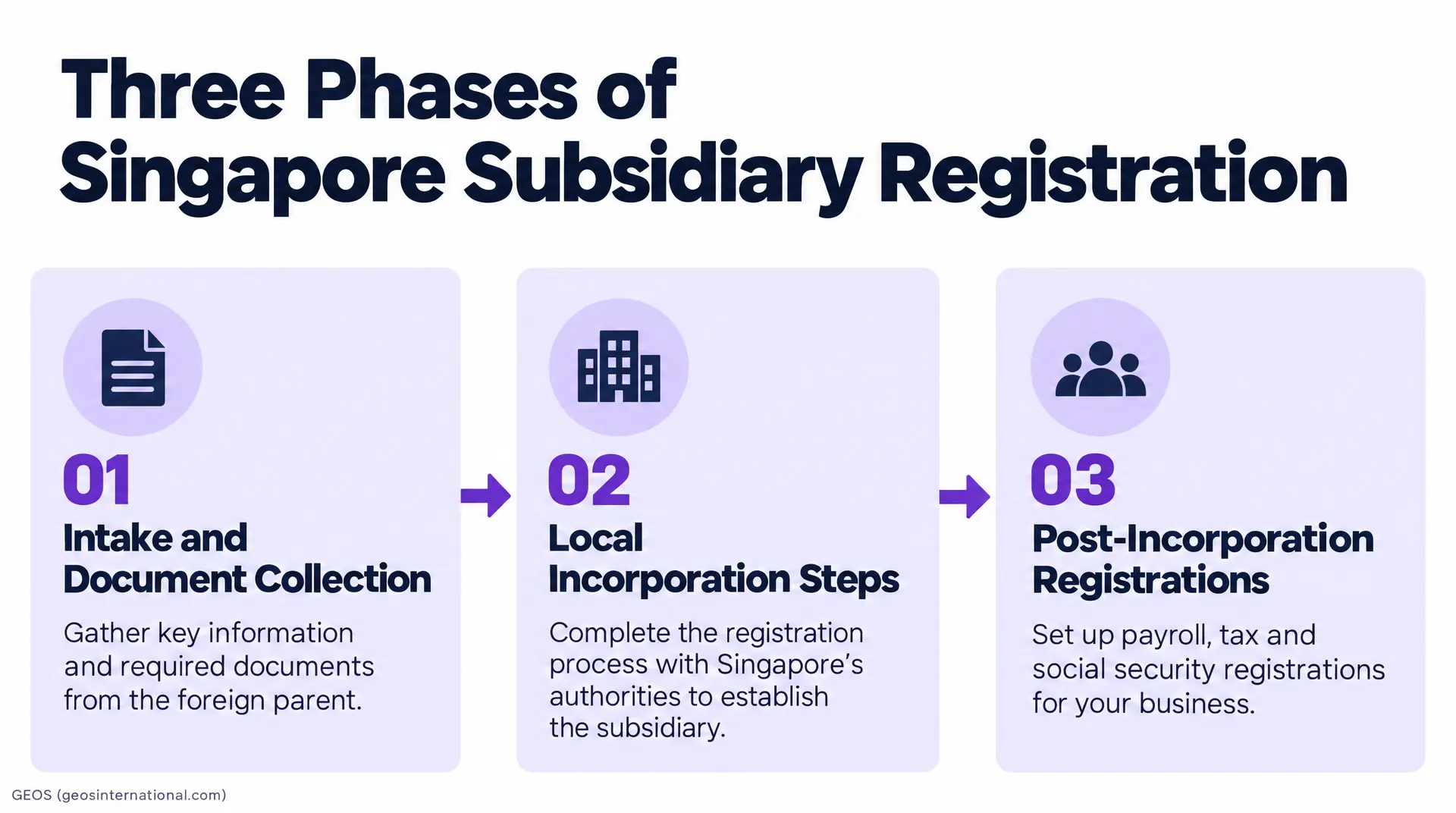
What Are the Three Phases of Singapore Subsidiary Registration for Foreign Companies?
I break every foreign setup into three phases: intake and document collection, the local incorporation steps, and the post-incorporation registrations for payroll, tax and social security.
What Parent Company Documents Are Required During the Intake Phase of Singapore Subsidiary Registration?
The first platform dedicated to streamlining entity setup and management.
Compared to other countries in the APAC region, Singapore is pretty light and easy when it comes to what it asks for. The standard package still applies: the parent company’s formation documents, a certificate of good standing or its equivalent, and information on who owns the parent company. The parent is normally the owner of the Singapore subsidiary, so its owners go through KYC and KYB checks under anti-money laundering (AML) policy. Singapore is generally strict on that point.
This phase is normally the number one indicator of whether the whole project moves quickly or slips. If the parent documents or the owner verification are delayed, the incorporation application can’t be drafted, and the documents can’t move on to notarization and apostille. In many of the countries we work in, authorities only accept documents within a 60- to 90-day validity window. Proof of address for owners and directors is the document that most commonly expires while the rest of the package is being gathered. When it does, the collection process restarts.
What Are the Resident Director and ACRA Filing Requirements for Singapore Subsidiary Registration?

Singapore’s company registrar, ACRA, requires every company to have at least one ordinarily resident director. A nominee is only needed when there is no other eligible resident director. That describes most of the foreign companies we work with, because they have no executive or lawyer in Singapore to appoint. A similar requirement applies in Mexico, India, Australia, New Zealand and the UAE, regardless of what the business does there.
There is often a returnable deposit, like a safety deposit, for the nominee director. We have not seen it delay a project, but it is usually unexpected on the client side, so I would budget for it from the first week.
The one-day figure describes the registration step. ACRA’s own guidance says most local-company registrations are approved soon after payment. It also says a complex application can take up to 15 working days, and one that needs a referral authority’s approval can take 14 to 60 days. Referral authorities are the agencies that review certain proposed names and business activities. If your name or activity is one they review, the government step alone can run past the fast end of my range.
A team that plans around a one-day quote has been hooked into a false promise. The quote leaves out the intake before the filing and everything after it, and the missed timelines and added costs show up later. When you compare providers, ask each one which day their timeline starts on and what the entity will be able to do on the day it ends.
What Are the Post-Registration Banking, Tax, and Payroll Requirements for a Singapore Subsidiary?
ACRA’s post-registration guide treats a corporate bank account as strongly encouraged rather than a condition of registration, and it can be opened once the company exists. Opening one usually involves identity checks on directors and owners, and most directors may need to be physically present in Singapore.
For Singapore, Airwallex is a really good option, especially as it is headquartered there. The Monetary Authority of Singapore lists its Singapore entity as a major payment institution, which is a different category from a bank, so I would call it a bank account in air quotes. Whichever account you use, check it against every payment the entity has to make. Across the countries we work in, inadequate banking rails for share capital, payroll and tax payments often lead to compliance snags and fines for new foreign entities.
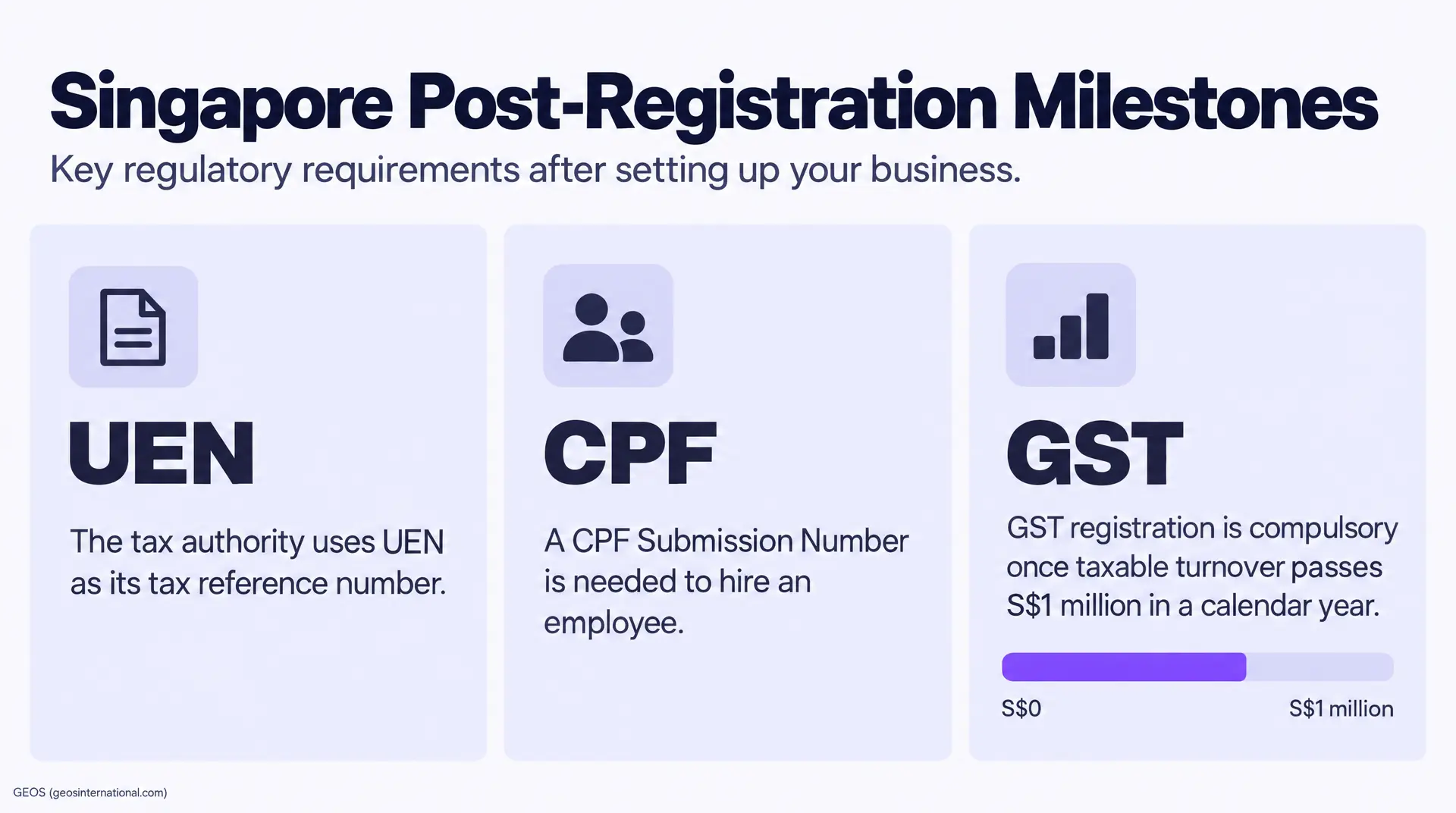
In many of the countries we work in, the entity can’t actually do anything until it has a tax ID and a payroll registration. In Singapore, part of that gap closes when the company is registered. A company that needs no extra licences or permits can start business immediately after registration. The tax authority, IRAS, uses the company’s Unique Entity Number (UEN) as its tax reference number for corporate income tax. A CPF Submission Number, the employer reference for Central Provident Fund contributions, is needed as soon as the company intends to hire its first employee. The application uses the UEN.
What remains depends on why you are in Singapore. I ask that first about any market, because hiring, tax and a goal like signing a commercial lease each carry a different timeline. For a hiring wave, the CPF Submission Number and the first payroll sit on the critical path. For a contract with a local client, the account that receives the money is what sits there.
GST registration is generally compulsory only once taxable turnover passes S$1 million in a calendar year, or is reasonably expected to in the next 12 months. Unless your Singapore revenue is expected to approach that level, GST can sit on the compliance calendar as a threshold to watch. For a foreign company, the accounting and tax that keep the lights on from a compliance perspective are still often the more complicated part once the entity is running. Across APAC, local accounting partners are often used to domestic clients and unaware of the tasks that apply only to foreign-owned entities.
What Are the Legal Requirements for Appointing a Resident Nominee Director for a Singapore Subsidiary?

In Singapore, a nominee is still a director in law. ACRA says a director cannot be merely nominal, and directors must act in the company’s best interests and meet its filing and record-keeping duties. Since 9 June 2025, a nominee director appointed by way of business also has to be arranged through a registered corporate service provider. That provider has to assess the nominee as fit and proper.
I would argue that a professional third-party director is cheaper and faster than naming someone from your own team. We had to unwind exactly that for a client who had appointed a local employee as resident director simply to check the compliance box. When the employee left the company and wanted to shed the liability, removing them became a complex legal exercise. We then appointed one of our local directors in their place.
In Singapore we work with a dependable, pre-vetted director on behalf of our clients, and we have not had a client end up with the wrong person in that seat. Our directors are typically local lawyers or CPAs who help with the bank account and the compliance work. They take on personal liability in the role, which is why it carries an annual fee. The network comes from our team’s decade-plus in global expansion. Over that time we worked with local directors who did not work out before finding ones who did.
How Do Anti-Money Laundering KYC Checks on Parent Company Owners Impact Singapore Subsidiary Registration?
ACRA’s Bizfile application asks for the company’s shareholders and controllers, and for any nominee director and the person who nominated them. So an ownership structure that can’t be explained clearly holds up the filing as well as the bank’s checks.
We worked with a Web3 company whose ownership structure was unclear. We asked for additional documents so they could meet the minimum KYC, KYB and AML requirements, and they were unwilling to provide them. They withdrew from the Singapore setup, and they understood why it had to end there.
Singapore’s ownership checks are strict, but they are consistent with what other countries ask for. Across the countries we work in, severe delays are often caused by owners, typically silent investors, who resist providing personal identification. We give the client’s executive team messaging that explains these are non-negotiable anti-money laundering requirements set by the local government. If your parent company has owners who are hard to reach, I would raise it before intake begins. It is the condition most likely to push you toward the two-month end of the range.
What Challenges Arise When Registering a Singapore Subsidiary Alongside Other Foreign Entities?

When Singapore is one of several entities set up at once, the same few executives sign and verify for all of them, and the complexity compounds with each country. Major delays often come from those executives being overwhelmed by local variations, such as an ad-hoc KYC video call, a specific wet signature or a proof of address in a particular format. Without one view across countries, it is like playing basketball with a blindfold and relying on four teammates to tell you when to step forward, pass and move.
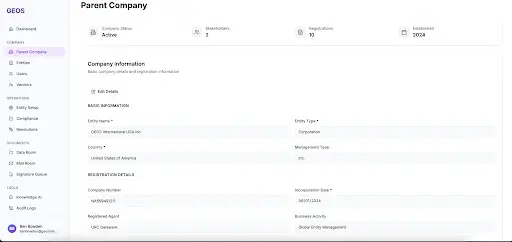
GEOS International has mapped the setup process for more than 80 countries. Each project’s full sequence sits on the platform before work begins. Steps that need a wet signature, specialized letterhead or a live KYC video verification are flagged in advance. Clients can then hit steps concurrently rather than getting hit with the next immediate step by email. Behind the platform, a single account team works with the local legal and tax experts, so your operations team isn’t coordinating each of them directly.
How Should Foreign Companies Align Singapore Subsidiary Registration with Operational Launch Dates?
For an operations leader, the date to plan around is the day the entity can do what the launch needs. If the only reason for Singapore is to employ one or two people, an Employer of Record (EOR) may be the better tool for now, and we refer clients to EOR partners in that case. If the reasons include signing local contracts or recognizing revenue, I would set up the entity from the start.
When first hires are due before the entity can employ them, an EOR can act as a bridge. We did this in India when a client’s director signatures and proof of address were delayed. We worked with an EOR partner to hire the team temporarily, so the employees kept the start dates they had already been given verbally. Converting them to the entity afterwards was a complex transition of its own.
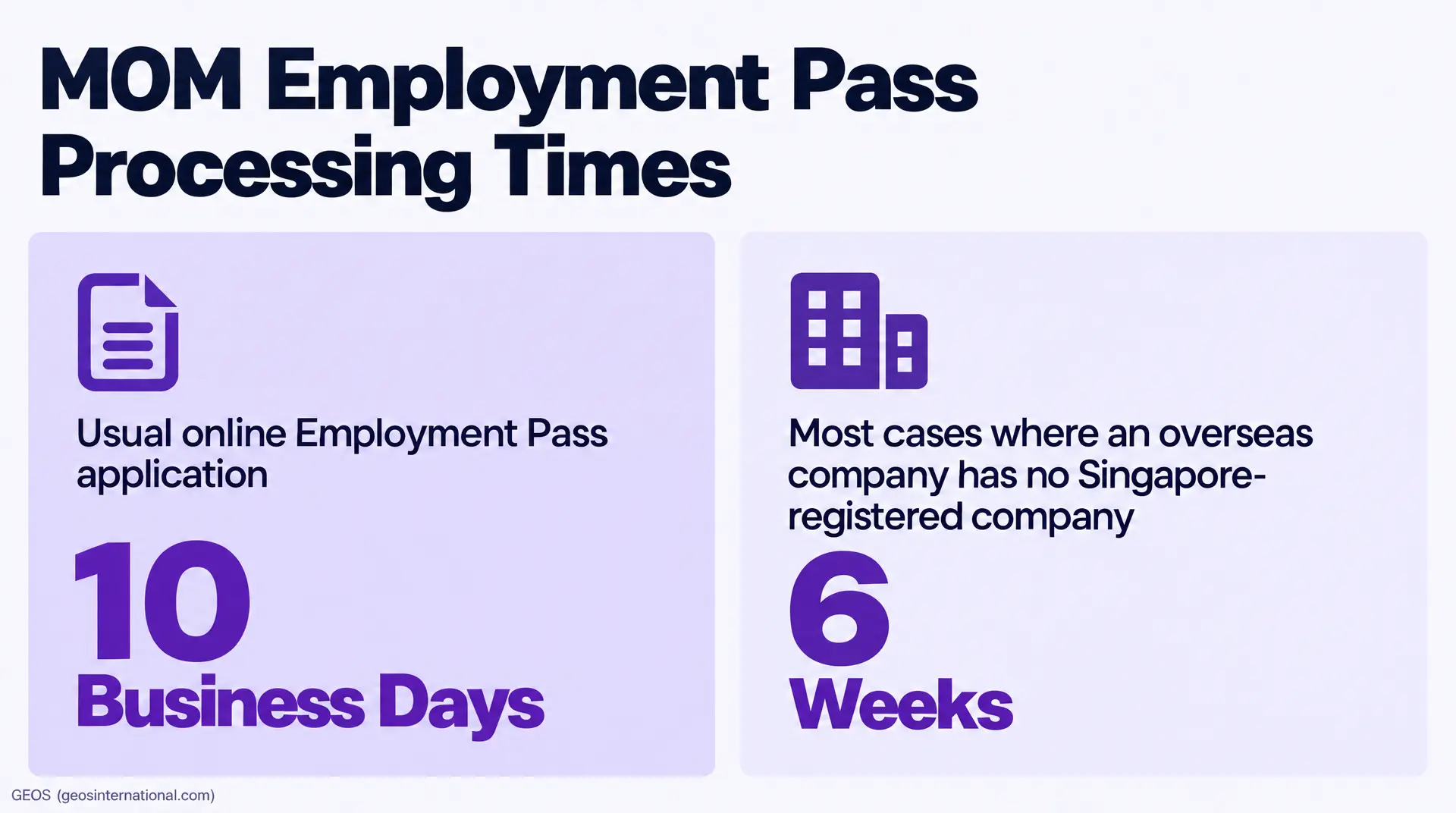
Singapore’s Ministry of Manpower (MOM) says an EOR cannot apply for work passes for foreigners who would be based in Singapore while working for an overseas company. That limits the EOR route here, whether you use it as the main tool or as a bridge. For an extended stay, those people need a regular work pass through the company they work for. MOM’s published processing times are 10 business days for a usual online Employment Pass application and six weeks for most cases where an overseas company has no Singapore-registered company. If relocations are part of your hiring wave, registering the entity first puts them on the shorter of those two clocks.
Wherever you have your own tax-paying entity, local officials view keeping employees on an EOR alongside it as a much worse posture than an EOR with no entity at all. For that reason I would close the bridge as soon as your own payroll is live.
The condition that decides your Singapore date is how quickly your parent company and its owners can produce a complete, verified document package, because the application and everything after it wait on that package. If you already have a Singapore launch or hiring date fixed, I’m happy to walk through the full sequence against that date with you and show where the time is likely to go.
Frequently Asked Questions
Do we need to register for GST before invoicing our first enterprise client in Singapore?
Not necessarily. Singapore GST registration is only compulsory when your taxable turnover exceeds S$1 million for the calendar year, or is expected to shortly. Until you hit that threshold, GST is just a compliance milestone to watch, letting you sign contracts and issue invoices immediately after registration.
How long does it take to secure an Employment Pass for a relocated country manager?
Once your subsidiary is registered, the Ministry of Manpower typically processes online Employment Pass applications within 10 business days. Without a registered local entity, that timeline stretches to six weeks. If relocations drive your launch, registering the subsidiary first is the only way to protect those start dates.
When is our first corporate income tax filing due after incorporating the subsidiary?
Companies generally file their corporate income tax by 30 November each year. However, IRAS ensures you have a buffer, giving companies at least 11 months after closing their accounts to file. It gives your finance team ample breathing room during the messy first year of cross-border operations.
Does a resident nominee director have the authority to interfere with our local operations?
Legally, they carry full responsibility. ACRA explicitly states a director cannot be an inactive or ‘sleeping’ nominal role. While a pre-vetted professional director will not interfere with commercial decisions, they are liable for compliance. Treat them as a compliance partner, not a powerless placeholder, to avoid friction.
Will appointing a third-party resident director trigger additional compliance checks for our subsidiary?
Yes. Since 9 June 2025, any nominee director appointed by way of business must be arranged through a registered corporate service provider. This provider is legally bound to assess the nominee as fit and proper under strict AML regulations, adding a necessary layer of vetting to your launch timeline.