
The concept of a Nominee Director is crucial to global expansion across multiple jurisdictions.
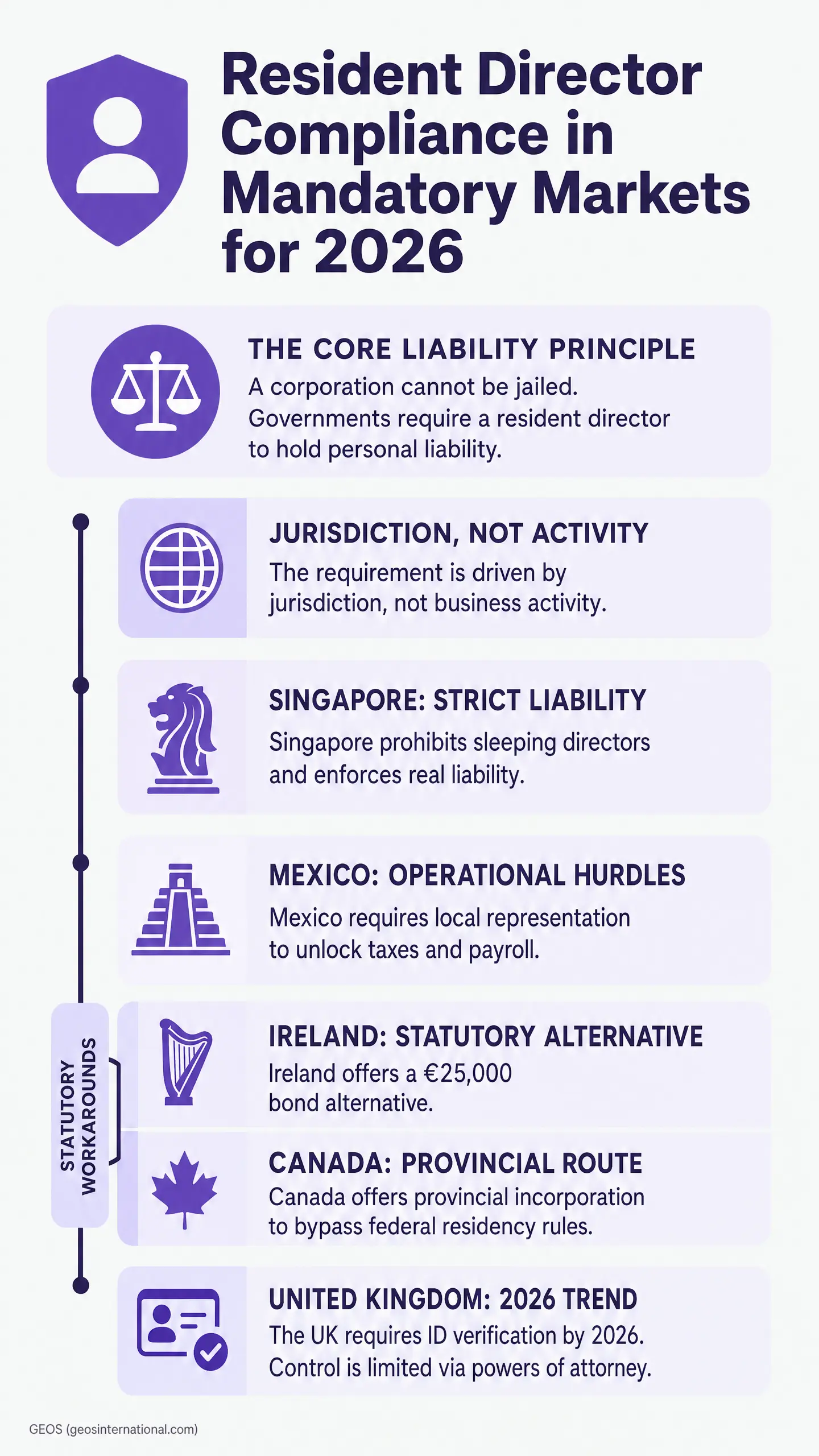
The requirement pays no attention to what your subsidiary actually does. Importing goods, employing a local team, recognizing revenue – none of it is the driver. The state only wants a body within reach of its courts before it will let a foreign owner incorporate.
A company that appoints its cheapest available name to clear the box has misread the entire transaction. It is renting a stranger’s personal liability – exposure that reaches two years in jail and a five-year ban in Singapore, where the regulator has stated in writing that the ‘sleeping director’ does not exist.
Key Takeaways
- Singapore’s ACRA regulator explicitly prohibits inactive nominee directors, enforcing full legal responsibility with penalties reaching S$5,000 in fines, up to two years in jail, and a five-year directorship ban.
- Foreign subsidiaries can bypass Ireland’s default EEA-resident director requirement by securing a €25,000 surety bond under Section 137 of the Companies Act.
- Foreign companies can avoid Canada’s federal 25% resident director requirement by incorporating in Ontario, which repealed its provincial residency mandate through Bill 213 in July 2021.
- Activating corporate operations in Mexico requires a local representative registered in the RFC tax system and access to six specific banks, including Banamex, to process SUA social security remittances.
- The UK Companies House mandated identity verification for new corporate directors in November 2025, requiring an estimated six to seven million existing individuals to verify by mid-November 2026.
- New Zealand corporate law allows foreign entities to fulfill local director requirements by appointing an individual who lives in Australia and serves as a director of an Australian-incorporated company.
- Appointing a temporary nominee director for three to six months can bypass multi-month UK bank onboarding delays for fully foreign-owned entities before the director is cleanly removed via legal resolution.
Why Do Resident Director Requirements Depend on Country Jurisdiction Rather Than Business Activity?
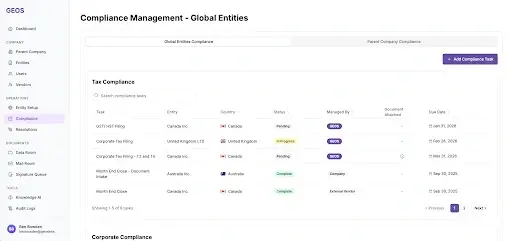
The first misconception I correct with almost every new client: they assume the director requirement is triggered by what their entity does. Importing goods, employing a local team, recognizing revenue – none of that is the driver. Needing a local resident director is far less applicable to the local business activity and far more applicable to the compliance requirements of the country itself.
That distinction changes how you plan. You cannot scope your way around this by narrowing what the entity does in year one. Either the jurisdiction demands a local director for a foreign-owned subsidiary or it doesn’t, and your job is to know which one you’re dealing with before you commit a launch date to anyone.
The first platform dedicated to streamlining entity setup and management.
What Are the Actual Statutory Requirements for Resident Directors in Mandatory Markets?
Most content on this topic recycles the same list of “mandatory markets” without anyone reading the underlying law. In my experience, those lists are wrongfully quoted almost every time. The actual rules are more specific than the lists suggest, and the specifics are where your timeline lives or dies.
Singapore is genuinely strict: ACRA requires every local company to have at least one locally resident director. India runs a presence test rather than a residency label – the Companies Act, 2013 requires at least one director who stays in India for at least 182 days during the financial year. Australia requires at least one director who ordinarily resides in Australia. New Zealand carries a detail almost nobody catches: the required director must live in New Zealand, or live in Australia while also serving as a director of an Australian-incorporated company. That Australian alternative can save a company an entire appointment.
Then there are the markets everyone gets wrong. The UAE shows up on nearly every “mandatory resident director” list online, still the Ministry of Economy itself states the Commercial Companies Law does not require an LLC partner or manager to be a UAE resident. The real answer there depends on entity type, mainland versus free zone, and licensing – a bespoke calculation per country, never a blanket rule. Canada is similarly misquoted. Under the federal CBCA, at least 25% of directors must be resident Canadians, and a board with fewer than four directors needs at least one. People compress that into “Canada requires a Canadian director,” which is only true federally – and, as I’ll cover below, entirely avoidable.
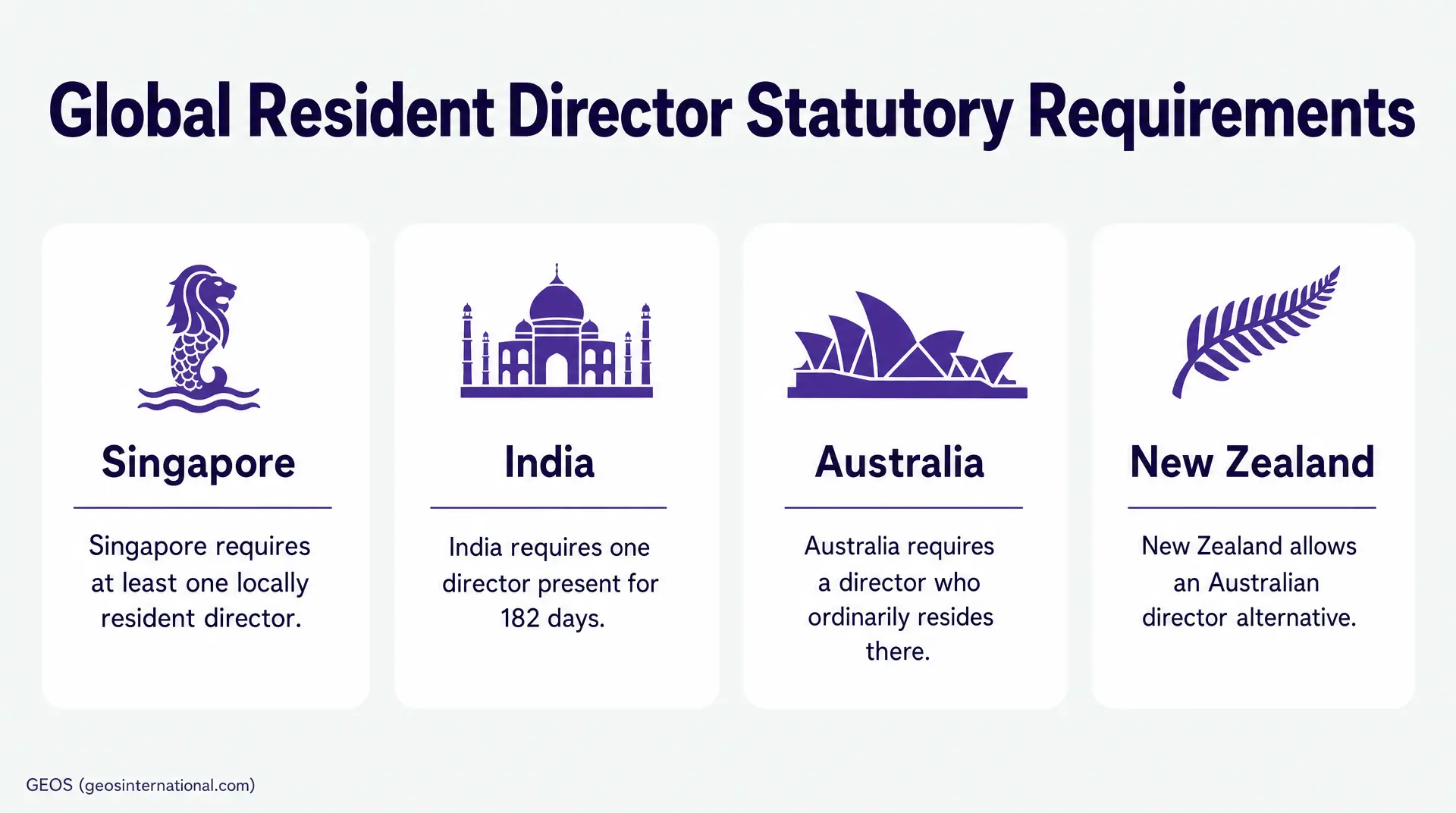
The lesson for anyone planning 2026 market entries: verify the requirement against the actual statute for your specific entity type. Blanket lists will cost you either an unnecessary annual director fee or a failed incorporation.
Why Does Corporate Operational Activation in Mexico Require a Local Resident Representative?
Mexico produces the most expensive version of this mistake, and it runs in the opposite direction. Read the corporate statute and you’d conclude you’re in the clear. The General Law of Commercial Companies handles administration through temporary, revocable mandataries who can be shareholders or outsiders, with no blanket residency language anywhere. Companies see that, skip the local appointment, and get pretty far into the incorporation steps.
Then they try to operationalize, and the activation layer stops them. SAT requires that the legal representative of a foreign-resident entity registering for a tax ID must themselves be registered in the RFC, with authority evidenced through a notarized power of attorney. Payroll adds another wall. The SUA payment medium for social security remittances is restricted to six named banks – Banamex, HSBC, and Inbursa among them – and in my experience only one or two of those will willingly work with foreign-owned entities. On top of that, employment contracts in Mexico need to be wet-signed locally.
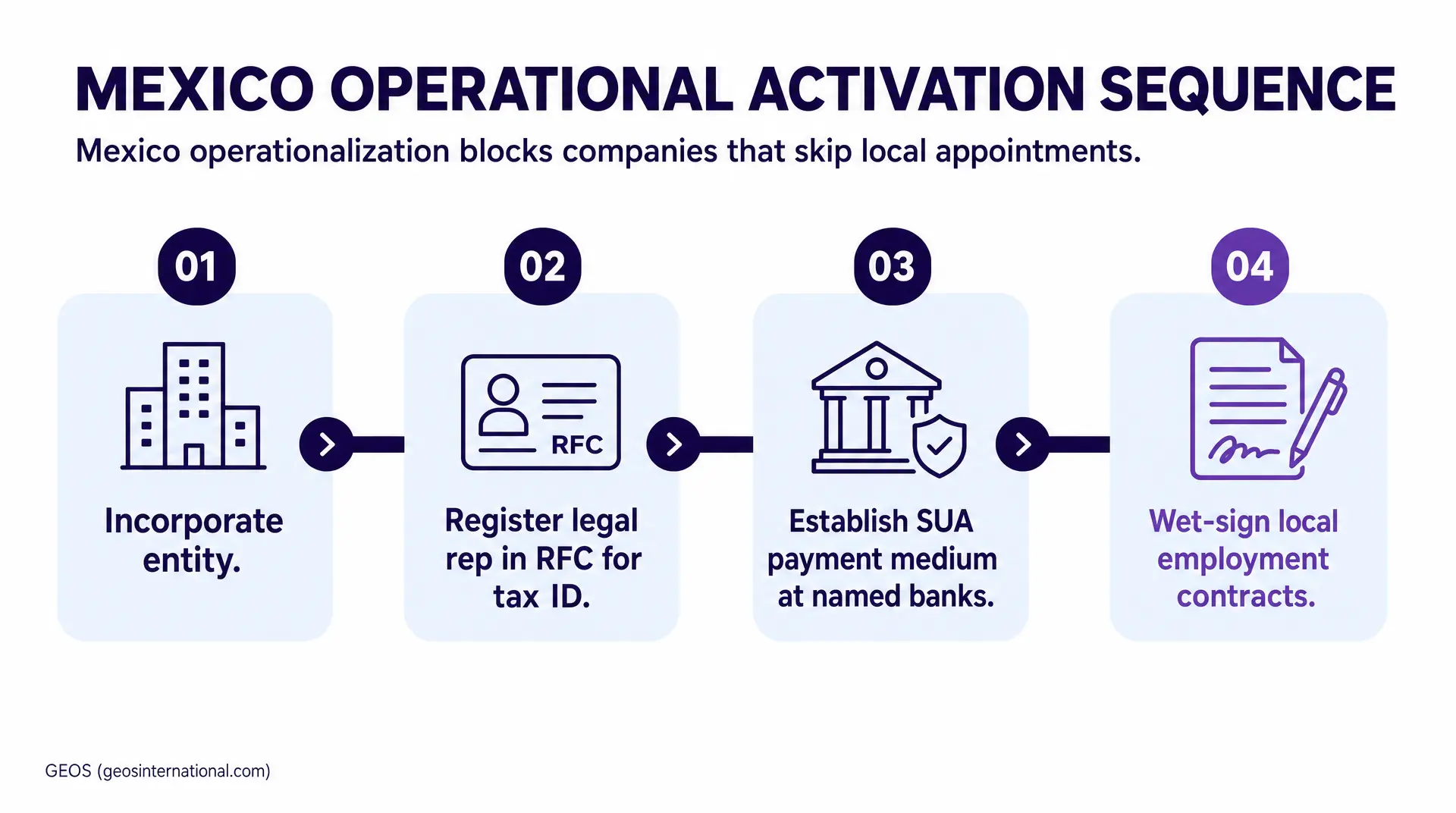
So the sequence plays out the same way every time. The company gets deep into setup, reaches the point of hiring, and realizes it cannot physically employ anyone. There’s no local representative, no tax activation, no rails to make the social security payments, no signed contracts. Appointing that person at a later step is a lot harder than doing it at the start. This is the gap between a legally incorporated entity and an operational one, and I’ve watched it swallow entire launch quarters.
What Legal Liabilities Do Resident Nominee Directors Face in Strict Jurisdictions Like Singapore?

The next thing operations leaders underestimate is what the appointed individual actually signs up for. A persistent belief exists that a nominee director is a figurehead – a name on a form. Singapore’s regulator has put that idea in writing and killed it: ACRA states a person cannot be an “inactive director,” “nominee director,” or “sleeping director” – every director remains fully responsible under the legislation, with penalties reaching S$5,000 in fines, up to two years in jail, and a five-year directorship ban.
That personal exposure is exactly why professional resident director services carry an annual fee. The individual, typically a vetted local lawyer or tax expert, is accepting genuine legal liability on behalf of your subsidiary. Anyone offering that at a suspiciously cheap price should worry you, because they either don’t understand the exposure or don’t intend to actually perform the role.
I’ve cleaned up both failure modes. One client appointed a local employee as director simply to check the compliance box. The employee later left the company and, understandably, had no interest in carrying director liability for a business they were no longer associated with. Removing a former employee from a director role became a genuinely sticky legal situation, and we ultimately resolved it by appointing one of our vetted local directors in their place. It would have been faster, cheaper, and more efficient to do that from the start.
The second failure mode is the absent professional. We took over a client with multiple entities in Latin America whose previous nominee directors had gone completely inactive – nobody was keeping the lights on from a compliance perspective. We audited the footprint, remediated the gaps, restored the entities to good standing, and reduced the client’s annual costs in the process. A director who has disappeared is an unmonitored liability sitting on your corporate registry.
How Can Foreign Subsidiaries Limit Nominee Director Control Using Powers of Attorney?

Every board and General Counsel raises the same concern: that this appointed person now holds power over the subsidiary. Structured correctly, they don’t. We set up every appointment so the individual has no decision-making power or control over the company. They are appointed as a director, and it does not go past that. The mechanics are legal documents – powers of attorney and resolutions that explicitly limit their authority and, where the role is temporary, put that temporary nature in writing.
The temporary structure deserves its own mention, because it solves problems even in markets with no ongoing director requirement. The UK is my standing example. No nominee is required there as a compliance matter, but traditional bank onboarding for 100% foreign-owned entities can stall a setup for months. In those cases we can appoint a temporary nominee director for three to six months for that one specific purpose, with a power of attorney strictly limiting their control, and then lodge the proper resolutions to remove their association with the entity once the account is established. The principle applies everywhere: engineer the exit on the day of the appointment. A director you cannot cleanly remove is a legal problem you’ve pre-paid for.
What Are the Statutory Alternatives to Appointing a Resident Director in Ireland and Canada?
Part of doing this properly is recognizing when a director service is being sold to you unnecessarily. Ireland is the clearest case. The default rule requires one EEA-resident director, but Section 137 of the Companies Act provides a statutory alternative: the requirement simply does not apply where the company holds a €25,000 bond, issued by an approved surety in the prescribed form for a minimum of two years. I strongly advise clients to take the bond. It’s cheaper, and it’s cleaner from a governance perspective, because you avoid adding an unrelated individual to your company entirely. Ireland even offers a second exemption, the Section 140 certificate, for companies that can demonstrate a real and continuous link with economic activity in the state – more relevant once operations have matured.
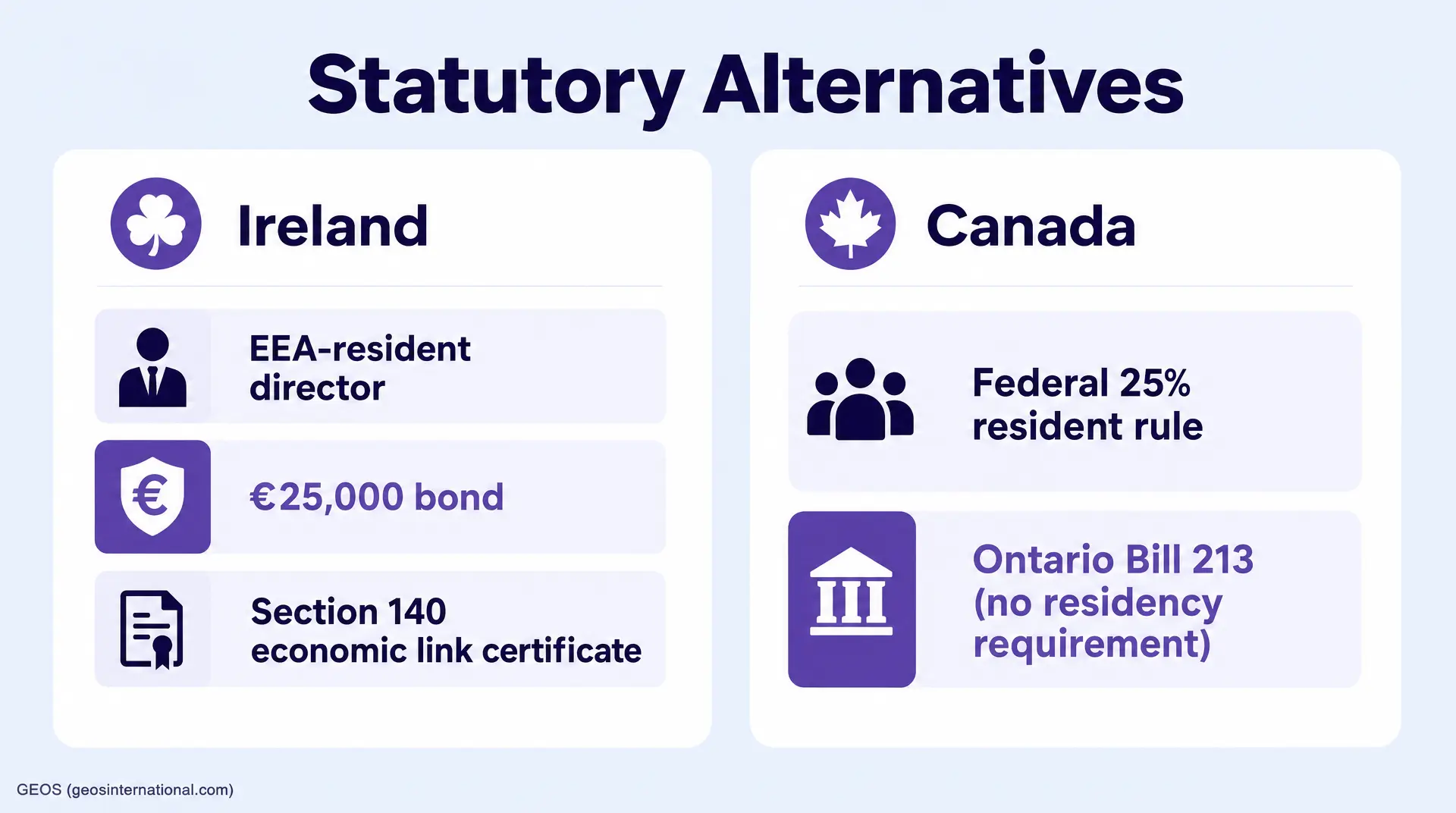
Canada has an even simpler answer. The federal 25% residency rule only applies if you incorporate federally. Ontario repealed its provincial director-residency requirements through Bill 213, effective July 5, 2021, which means a provincial Ontario incorporation allows a fully foreign board. I’ve heard the counterargument that federal incorporation offers nationwide name protection, and I consider it moot. Name protection means nothing if you can’t satisfy the residency rule in the first place, and reserving a name provincially later is very easy.
How Are Government Corporate Registries Mandating Director Identity Verification in 2026?

The regulatory direction heading into 2026 is unambiguous – more verification and more accountability attached to the named individuals behind entities. The UK is the live example. Companies House identity verification became a legal requirement on November 18, 2025. New directors must verify before incorporation or appointment. Existing directors confirm verification with their next annual confirmation statement during a 12-month transition, and Companies House estimates 6 to 7 million individuals need to verify by mid-November 2026.
For a foreign-owned UK subsidiary, that is an administrative hurdle with real teeth. Miss the verification window for a director or UBO and you can cost the entity its good standing over a task nobody on your team knew existed. We actively walk clients through this process on gov.uk, because in a setup run through a local lawyer and scattered email threads, this is precisely the kind of requirement that surfaces as a surprise. Expect other jurisdictions to follow the UK’s lead. This space carries nuance that’s changing at a pretty rapid basis, and a director appointment made in 2024 under old assumptions may carry new verification obligations by the end of 2026.
Why Must Resident Director Appointments Be Sequenced First During Foreign Subsidiary Incorporation?
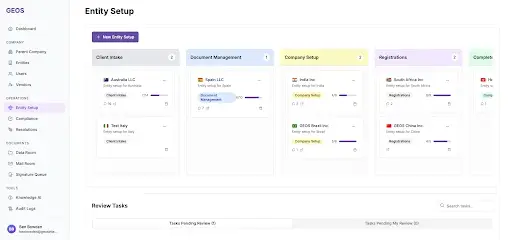
Between our founding team at GEOS, we’ve spent well over a decade in this space and set up thousands of entities. Along the way we worked with local directors who didn’t work out and eventually found the ones who did. That produced the pre-vetted network of local lawyers, tax experts, and CPAs we now deploy for clients in mandatory markets – with the liability priced honestly, the control limitations papered from day one, and the appointment sequenced into the correct step of the setup. Our platform maps every step of incorporation and ongoing compliance per country, so the director requirement shows up exactly where it belongs in your timeline rather than four months in, when you’re staring at employment contracts nobody is legally able to sign.
Setting up a foreign subsidiary is effectively a permanent decision. In mandatory markets, the resident director is the gate you pass through to make it – stop or go. Verify the requirement against the actual statute, take the statutory alternative where one exists, appoint a professional rather than a warm body, and paper their exit before they arrive. Handle it that way and this requirement becomes a routine line item instead of the reason your market entry misses its year.
Frequently Asked Questions
Will a professional resident director sign a multi-year commercial lease for our physical warehouse?
No. A professional resident director fulfills strict statutory compliance, but they will rarely assume the massive financial liability of a commercial real estate lease. Instead, you must execute specific powers of attorney granting your own operational leaders the legal authority to sign those binding multi-year agreements directly on the subsidiary’s behalf.
Does appointing a local director automatically grant domestic Importer of Record (IOR) status to reduce tariffs?
Not automatically. While the director satisfies corporate registry demands, activating IOR status requires subsequent registrations with customs authorities. For instance, in Mexico, your legal representative must be locally registered to secure the domestic tax ID required to legally optimize cross-border import duties and clear physical inventory without crushing tariff penalties.
Can our Employer of Record (EOR) act as our resident director to sign local supply chain contracts?
Absolutely not. This is a common commercial roadblock. An EOR is strictly a human resources vehicle. They cannot act as your corporate director, absorb import tariffs, or legally execute commercial leases for physical retail spaces. To unlock supply chain operations, you must incorporate a fully operational domestic legal entity.
If we launch physical operations in both Australia and New Zealand, do we need two separate resident directors?
No, you can strategically consolidate. New Zealand corporate law explicitly allows a director who lives in Australia – provided they are also a current director of an Australian-incorporated company. Structuring your trans-Tasman expansion this way eliminates an entirely unnecessary local appointment, saving your operations team an annual professional director fee.
How do emerging identity verification rules impact physical launch deadlines?
Unplanned identity verification mandates will completely derail your physical supply chain timelines. For example, the UK’s Companies House rollout requires mandatory director verification before incorporation. If this step delays your entity activation, you legally cannot clear customs or execute commercial leases, leaving expensive physical inventory stranded at the border.