
Germany is one of the first markets I discuss with scale-up founders planning Europe. The market is large. The talent is strong. The commercial upside is real. In practice, many boards give a simple mandate: open Germany quickly enough to support hiring, sales, or a broader EU buildout.
The economics explain why Germany stays high on the list. The country generated $4.66 trillion in GDP in 2024. DigitalService reports that about 585,000 people founded new businesses in Germany in 2024, 3,568 start-ups were launched in 2025, and roughly one-third of those start-ups integrate AI into their business model.
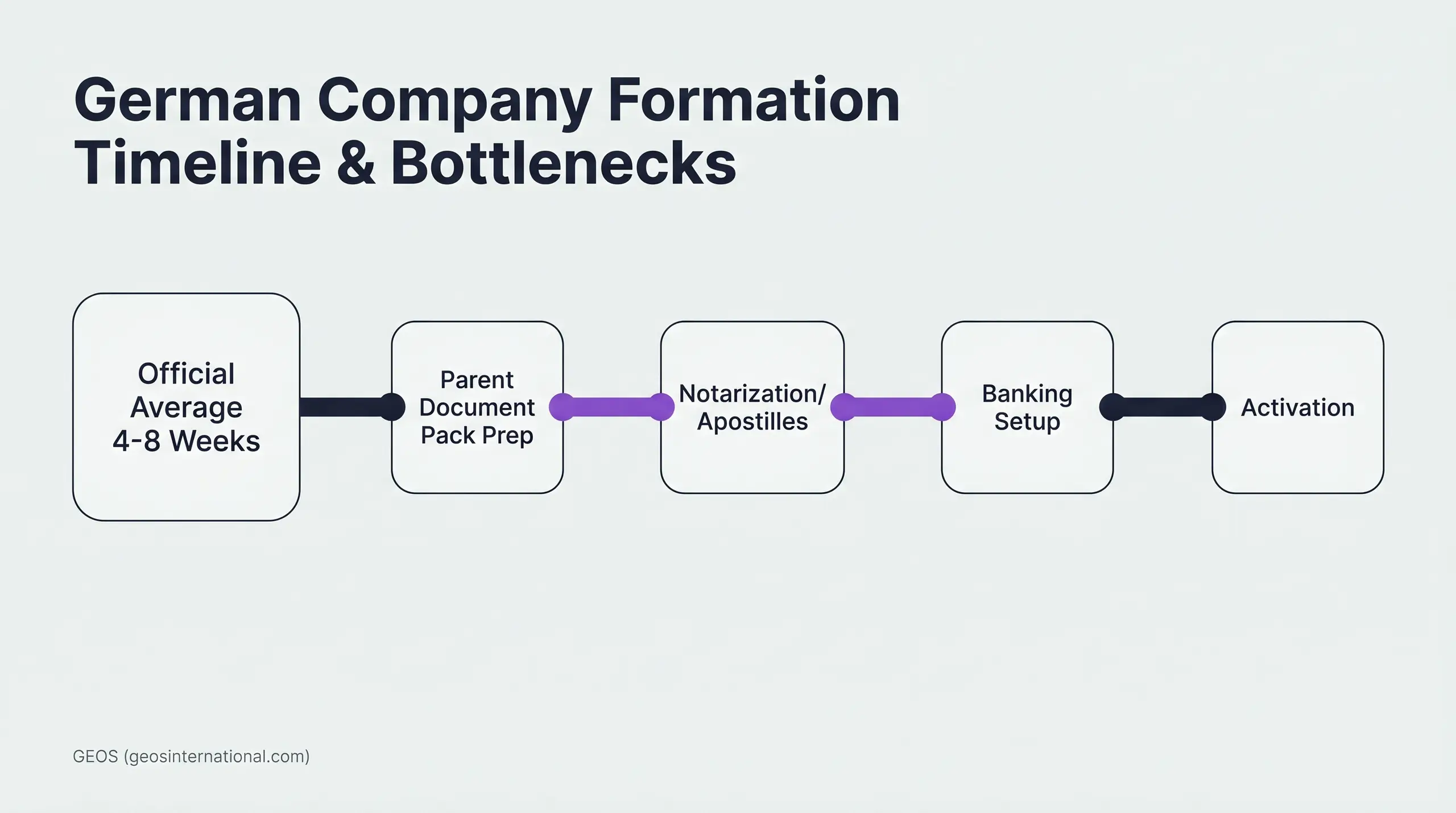
What still gets underestimated is the mechanics of foreign-owned setup. The official average for establishing a German GmbH currently sits at 4 to 8 weeks. Germany also launched a program in October 2025 aimed at 24-hour fully online registration. Even so, the same government source still describes company formation as a bureaucratic and time-consuming process. For foreign parent companies, that description still holds.
At GEOS, we have mapped entity setup and management across 80+ countries. Germany is one of the markets we see most often. I approach formation the same way I approach sales: as an act of mutual problem solving. The objective comes first. Then the structure. Then the process. Germany moves well when those pieces are sequenced properly.
Step 1: Define What Germany Needs to Do for the Business

I always start with the operating goal, not the entity form. That is where a lot of expansion work goes off track. A company should know whether Germany is being used for direct hiring, local commercial contracting, an EU hub, internal payroll infrastructure, or a broader long-term market presence.
I usually reduce that discussion to three questions. Which country is being entered. Why that country is being entered. And what infrastructure already exists to support the move. Those answers shape everything that follows.
In my experience, there are often five to seven different ways to solve an international expansion problem. Some companies are still validating the market. In those cases, an independent contractor model, an Employer of Record, or a lighter local setup may be appropriate for a period of time. Other companies already need tighter control over employment terms, stronger local credibility, or the ability to distribute equity. That is when an owned entity becomes much easier to justify.
I tend to be direct on this point. I do not like symbolic expansion. Germany becomes worth the effort when there are multiple concrete business reasons behind the move and a realistic commitment to maintaining the infrastructure once it is live.
Step 2: Choose the Right Entity Form
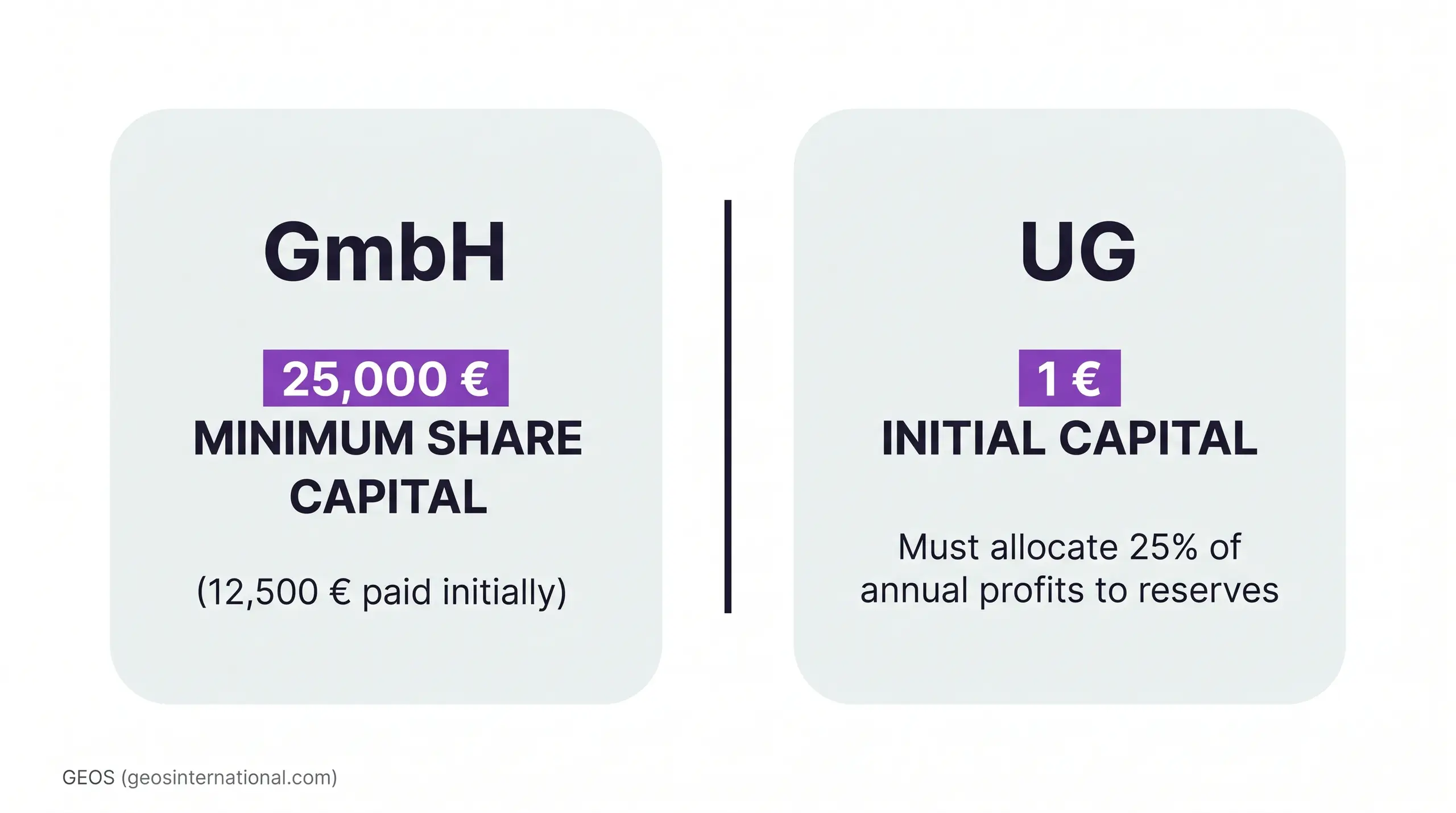
For most foreign-owned subsidiaries, the core decision is between the GmbH and the UG. The choice is usually straightforward once the business objective is clear and the capital plan is realistic.
GmbH
The GmbH is the standard route and the structure most founders ask about first. German law requires a minimum share capital of €25,000 for a GmbH. At formation, €12,500 can be paid in initially.
That legal rule is only part of the picture. In practice, foreign founders need to think about the banking stage immediately, because the bank deposit workflow and the deposit certificate are central to moving the incorporation forward. I do not treat share capital as a simple budget line. In Germany, it is part of the project path.
UG
The UG is the more startup-friendly alternative. It can be formed with €1 of initial capital. It must also allocate 25% of annual profits to reserves until its equity reaches €25,000.
I discuss the UG most often with founders who want to enter Germany early but prefer to preserve cash while the operation is still proving itself. For some scale-ups, that is a disciplined way to enter the market without forcing a larger upfront capital decision than the business needs.
Many foreign groups still choose the GmbH because it is the most common entity type and the most familiar route. The UG tends to make sense when Germany matters strategically, but the company wants a more gradual capital path.
Step 3: Prepare the Foreign Parent Document Pack Early

For foreign-owned groups, setup speed is usually decided during intake. The first real test is not the filing. It is the document pack.
That package typically includes parent company records, ownership information, UBO identification, and proof of address. The exact list can vary based on the structure, but the pattern is consistent. If those materials arrive late, everything behind them moves late as well.
I have seen European setups stall because an owner did not want to provide personal documentation or clear ownership information. Sometimes the issue is privacy. Sometimes the shareholder is distant from the day-to-day business. Either way, there is no avoiding that information for entity formation or for banking.
This is one of the least visible blockers in cross-border work. Founders focus on the legal form. Local teams focus on the file they are trying to move. The delay often sits inside the foreign parent itself. When directors or owners do not provide the required documents quickly, local applications can expire and the process can start from scratch.
Step 4: Handle Notarization, Apostilles, and Couriering Early
Germany still requires a meaningful amount of physical coordination. Important parent company documents often need to be notarized, apostilled, and couriered to Germany. For foreign groups, that remains a real dependency in 2026.
This is where modern expectations collide with the reality of global compliance. Germany’s digital formation push is positive. The direction is clearly better than it was. But a foreign-owned subsidiary is still working through document formalities, local review, and manual checkpoints that software alone cannot remove.
At GEOS, this is one of the main issues we try to solve through process mapping. If the workflow is received piecemeal by email or phone calls, every step becomes a surprise. Founders think they are close to the finish line, then discover there are still document certifications, couriers, and local dependencies sitting in the queue.
My view here is very simple. Technology should organize the process. It should create visibility. It should reduce the black box. It cannot erase the fact that last-mile legal and compliance work is still rooted in manual processes.
Step 5: Treat Banking as a Core Workstream

In Germany, the bank account is often the real bottleneck. Founders tend to focus on the incorporation documents first. I focus just as much on banking, because the file often cannot move in a practical sense until the capital can be deposited and the bank issues the required certificate.
This stage causes more delays than many first-time entrants expect. Some companies instinctively want to work with the largest traditional German banks. In my experience, approaching them as a 100% foreigner entering the country often creates immediate friction. The bank may ask for a very large amount of documentation. It may move slowly. In some cases, it simply does not have a defined onboarding process for a foreign-owned structure.
That is why, at GEOS, we consistently refer clients to more innovative German and FinTech banking options. The goal is not novelty. The goal is to find a bank that can actually work with a foreign parent, receive the capital, and issue the deposit certificate needed to progress the incorporation.
This is also where ownership transparency becomes unavoidable. If the UBO picture is incomplete, or if one shareholder is reluctant to provide documentation, the bank stage becomes the entire project. I have seen that happen. It is one of the clearest reasons official formation windows do not tell the full story for foreign groups.
Step 6: Plan for Activation, Not Just Incorporation
Once the documents and banking path are in place, the legal incorporation can move. Many providers stop the clock there. I do not think that is good enough for an operating company.
A subsidiary can be incorporated and still be unable to do much. If the purpose of Germany is hiring, the company still needs the post-incorporation tax and payroll setup that makes employment possible. If the goal is commercial activity, the business still needs the registrations and administrative readiness that allow it to operate without friction.
This distinction matters because many fast quotes only refer to one part of the timeline. They omit the front-end document collection. They omit the bank compliance process. They omit the post-incorporation steps that determine whether the company is actually usable. That is why these timelines are wrongfully quoted almost every time.
At GEOS, we include those dependencies upfront because they are what founders ultimately care about. The real metric is time to entity activation. A paper entity that cannot hire, contract, or support payroll is only partially built.
Step 7: If the Team Starts on EOR, Plan the Graduation Path Now
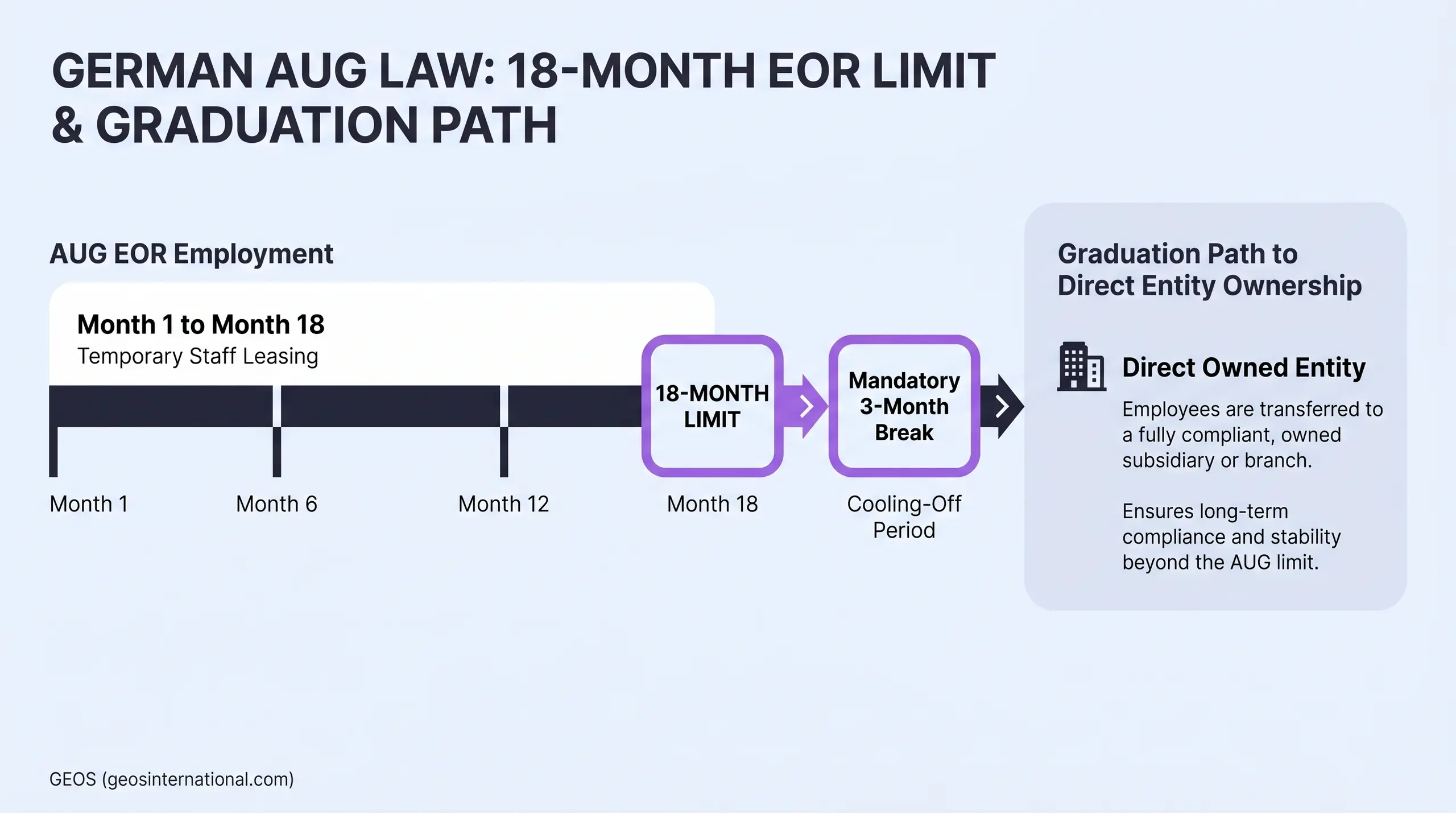
Germany also has a very clear message for companies hiring through an Employer of Record. I view EOR as a useful tool at the beginning of a global expansion journey. It is often the right answer when headcount is low and the company is still validating the market.
My time on the EOR side made that progression very clear. EOR solves an important early problem. It does not solve the long-term infrastructure question.
Germany is more explicit than most countries about where that model ends. Under AUG law, EOR employment is limited to 18 months, followed by a mandatory three-month break. The policy objective is straightforward. German officials want foreign companies to use that period to decide whether they are prepared to invest directly in the market.
For companies that have reached critical mass in Germany, direct ownership often starts to justify going direct and getting a better ROI. Monthly EOR fees compound as headcount grows. Control over benefits, equity, and local HR policy remains limited compared with an owned entity. Permanent establishment questions also become harder to ignore as local activity scales.
The difficult part of the EOR-to-entity transition is usually the employment continuity. Employees are moving from one legal employer to another. That requires careful communication, local documentation, payroll timing, and decisions around benefits or accrued entitlements. I also do not accept the idea that EOR eliminates all liability. In most contracts, the risk is shared more than founders expect.
Step 8: Put German Compliance Under One Visible Operating Model
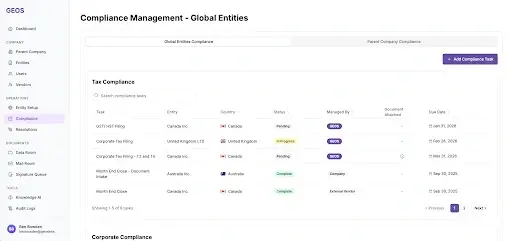
The work does not end when the entity goes live. After formation, the business still has to keep the lights on from a compliance perspective. That means annual corporate secretarial work, document governance, and support for the corporate changes that happen as the company grows.
The Local Boutique Route
Founders usually default to one of two provider models. The first is the single-market local boutique. It may be the cheapest route, but it often requires the client to own the project management from beginning to end. The workflow becomes a black box in terms of the steps that need to be taken, and the foreign parent is left putting blind trust into the local vendor.
That model can work for a single jurisdiction if the company has strong internal bandwidth. It starts to break down quickly when the business expands into multiple countries. A local German provider may be perfectly capable inside Germany and still leave the parent company with no system for the rest of Europe or beyond.
The Big Four Route
The second model is the Big Four comfort blanket. I have been on the client side of PwC, so I understand why companies buy that perceived safety. The challenge is that these firms are often fragmented by region, expensive, and still inefficient for a scale-up that needs speed and visibility.
A founder may think one global brand solves the coordination problem. In practice, the work often gets restarted across different country teams. The parent company keeps resharing the same context. The process remains heavy. The overhead remains high.
The Operating Model That Scales
The cost of fragmentation becomes serious once the company has more than a handful of entities. We helped one client with more than 30 international entities untangle years of backlog because local firms had been invoicing subsidiaries directly with no centralized oversight. That clean-up was so complex it required a dedicated full-time hire on the client side. In another case, we moved a client with four global subsidiaries away from a Big Four provider by giving them transparent pricing and a more usable system of record.
Those examples are not Germany-specific, but the operating lesson applies directly to Germany as well. Without one visible workflow, global entity management starts to feel like playing basketball with a blindfold. Information sits in local inboxes. Invoices come from different vendors. The parent company ends up playing catch up in terms of what was missed.
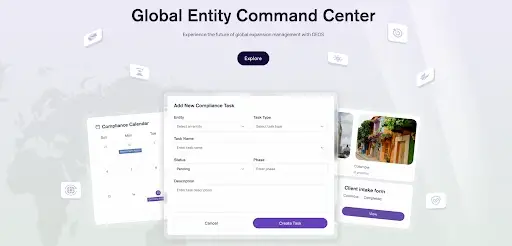
This is the model we built GEOS around. Centralize the entity data, the documents, the deadlines, and the local accountability under one umbrella. That layer can work with pre-vetted partners or with a client’s existing local vendors. The point is oversight. The point is visibility. Technology should organize the work, but communication still needs a human layer. That is why we still rely on standing meetings, Slack channels, and direct service alongside the platform.
Final View
Germany remains one of the strongest markets in Europe for companies that are serious about hiring, selling, or building a long-term operating presence. The market size is there. The startup energy is there. The opportunity is real.
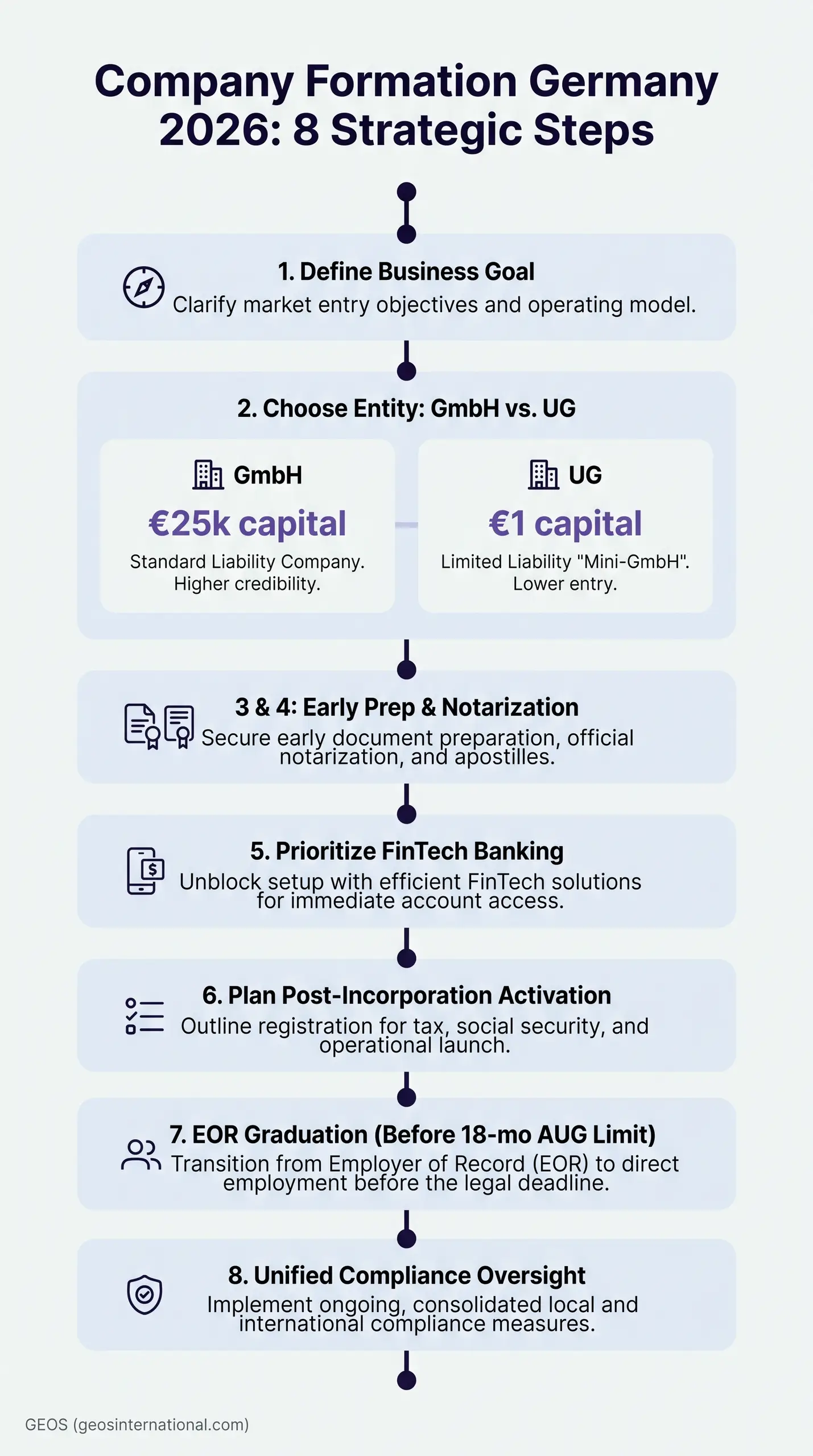
In my experience, successful German company formation depends on sequence. Start with the business objective. Choose the right entity form. Move the UBO and parent company documents early. Treat notarization, apostilles, and couriering as real dependencies. Solve the banking path before the project is under pressure. Then plan for activation, not just incorporation.
If the company is already using an EOR in Germany, the AUG timeline should be treated as an operational clock. The graduation path needs to be mapped before the legal limit becomes a problem. Once the entity is live, the compliance model needs to be visible enough to support growth without creating a black box.
That is how I think about global expansion more broadly. It is an act of mutual problem solving. The best answer is rarely the cheapest quote or the fastest promise. It is the path that matches the company’s real objective, keeps the workflow visible, and gives the business control once the entity is live. In this area, a B-plus plan executed today, with the right sequence and visibility, is far more useful than an A-plus plan built on assumptions.
Frequently Asked Questions
Can our foreign parent company bypass delays using Germany’s new 24-hour online registration?
No. While Germany launched a 24-hour online formation project in October 2025, foreign-owned entities still face manual compliance. You are bound by notarizations, apostilles, and UBO checks. The government itself still calls the process ‘bureaucratic and time-consuming.’ Expect 4 to 8 weeks.
How do we accelerate the corporate bank account opening for a foreign-owned subsidiary?
Skip legacy German banks. They frequently trap foreign-owned setups in endless compliance loops. We accelerate this by routing founders directly to specialized German FinTechs that understand cross-border UBOs. This ensures your €12,500 GmbH deposit clears fast so your formation isn’t held hostage.
Does holding a German UG instead of a GmbH hurt our enterprise sales credibility?
Yes. If you are selling into Germany’s $4.66 trillion economy, optics matter. A UG signals you only had €1 to incorporate. Enterprise procurement teams notice. If your mandate is aggressive market capture, fund the €12,500 upfront for a GmbH to establish immediate commercial trust.
What is the timeline to transition our engineering team from a German EOR to our new GmbH?
It requires precision. Once the GmbH is fully activated – meaning tax IDs and local payroll are live, typically month three – you execute a synchronized offboarding. Employees must sign local contracts before their 18-month EOR limit hits to prevent a mandatory break in employment.
Can the foreign CEO skip the physical public notary appointment in Germany?
Yes, but it requires airtight logistics. You can grant a Power of Attorney (PoA) to a local representative. However, that PoA must be notarized, apostilled in your home country, and physically couriered to Germany. If those manual steps lag, your timeline derails.