
Ten employees on an Employer of Record at around $500 per person per month cost a company $5,000 a month, or $60,000 a year, before any margin built into the currency conversion. The EOR to entity break-even analysis by country does not come out the same everywhere. If those 10 people are in the UK, I would argue the company is at or past its break-even point. A UK entity can be set up for a fraction of that, so the question is whether running it costs less than the fees you would stop paying. If the same 10 people are in France, on cost alone I would normally keep them on the EOR, because the break-even there is closer to 40 or 50 employees.
EOR is the best solution for the beginning, and perhaps the middle, of a global expansion journey that has a beginning, middle and end. Once a company has reached critical mass in a country, EOR becomes inefficient from a financial and a control perspective. I would argue it is very over-leveraged in countries where an entity is easy to set up. I think the largest EOR firms know it is not a permanent solution, because many of them have built global payroll products for clients who move to their own entities. GEOS International partners with a lot of them, because they tend to stay away from entity setup and management, which is the work we do.
Key Takeaways
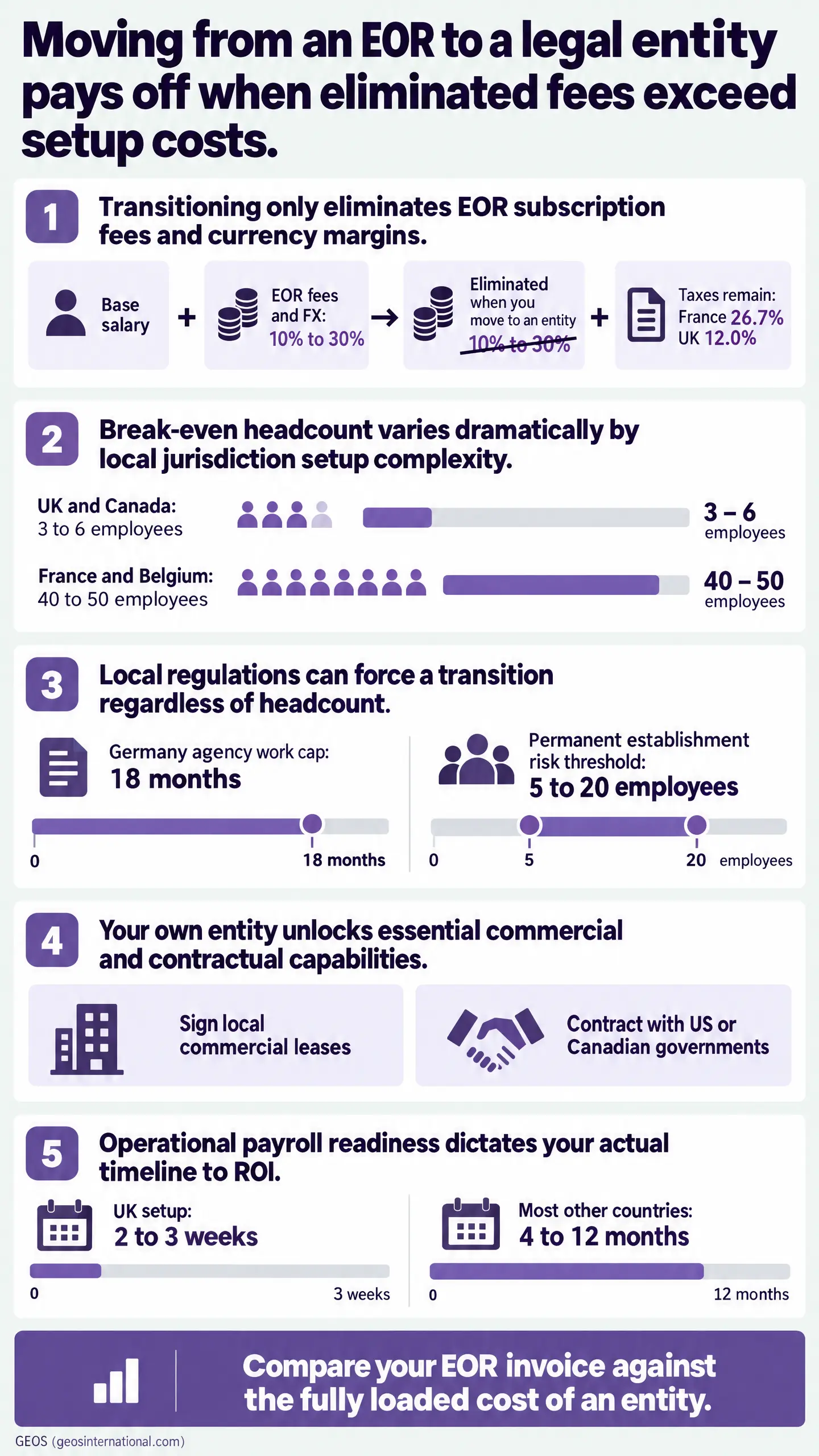
- The break-even point for transitioning from an Employer of Record to a legal entity ranges from three to six employees in the UK to 40 to 50 employees in France.
- Employer of Record invoices frequently obscure foreign exchange margins and statutory payroll costs, which typically add 10% to 30% to base salaries.
- Transitioning employees off an Employer of Record onto a proprietary legal entity often increases benefits costs because companies lose access to large-group insurance rates.
- Germany’s temporary agency work law caps Employer of Record assignments at 18 months, forcing companies to establish a legal entity regardless of their local headcount.
- Employer of Record contracts generally provide shared rather than complete legal protection, utilizing indemnification clauses that pass liability back to the client for operational disputes.
- Achieving operational payroll readiness takes two to three weeks for a UK entity, while most other global jurisdictions require four to twelve months of setup.
- Incorporating a legal entity in Ontario eliminates the requirement for 25% resident Canadian directors that applies to federal Canadian corporations.
The first platform dedicated to streamlining entity setup and management.
What Costs Shift When Transitioning from an Employer of Record to a Legal Entity?
An EOR invoice bundles two kinds of cost. One is the cost of employing someone in that country: payroll, social security contributions, payroll taxes, and benefits that are either statutory or needed for a competitive offer. The other is what the EOR charges for itself, which is the subscription fee and the margin it adds on currency conversion. The bills are normally very complicated, multi-page, multi-line items that hide how FX is translated and where margin is added. Statutory payroll costs and FX typically add 10% to 30% to base salaries.
Only the second group goes away when you move. Of the costs the invoice hides, the most common culprit is the amount of money spent on the FX. A US company hiring in Western Europe is often taken aback by the payroll taxes, which you pay whether the EOR or your own entity is the employer. OECD figures for 2025 put employer social security contributions for a single worker on the average wage at 26.7% of labor costs in France, 12.0% in the UK and 7.5% in the US.
Benefits can also cost more on your own entity. One company moved more than 10 employees off a US EOR onto its own entity and hit a major cost shock. At that headcount it no longer qualified for the large-group insurance rates the EOR had leveraged, so matching its employees’ existing benefits became significantly more expensive.
My first question to an operations leader planning this move is how many EOR employees they have in the target country. From that headcount we calculate the monthly subscription cost and move backwards to understand the total ROI. The entity side has to be fully loaded: setup, corporate secretarial work and annual filings, a registered address, accounting and tax, your own payroll, and your own benefits, including locally expected perks such as meal vouchers.
Companies frequently underestimate the entity side because those costs are scattered across several vendors. Across multiple countries, managing independent local vendors can equal two or three full-time jobs just to handle the incoming invoices and actions.
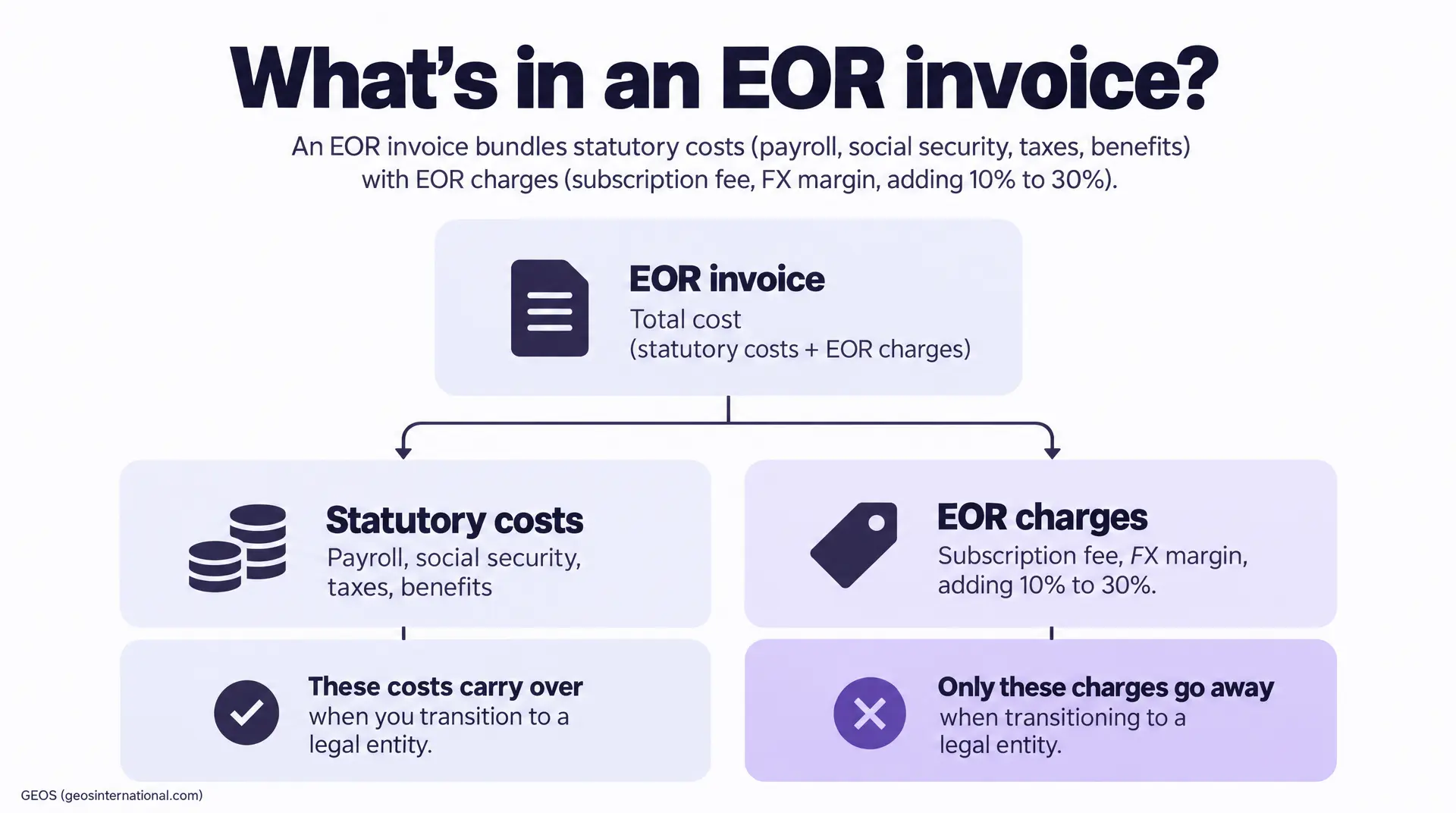
Only the EOR fee and FX margin go away when employees move to your own entity, while payroll taxes stay, benefits can rise, and setup, running and vendor costs are added.
|
Cost |
On an EOR |
On your own entity |
After the move |
|---|---|---|---|
|
EOR subscription fee |
Around $500 per employee per month (2026 list prices $399 to $699) |
None, stops once your entity runs its first payroll |
Goes away |
|
EOR FX conversion margin |
Margin added on conversion, usually not itemized (one EOR’s terms allow up to 3%) |
No EOR FX margin |
Goes away |
|
Employer social security and payroll taxes |
Passed through, e.g. France 26.7%, Belgium 21.4%, UK 12.0%, Netherlands 11.2%, US 7.5% of labor costs (2025, average-wage single worker) |
Same statutory rates |
Stays |
|
Employee benefits (statutory and competitive) |
Priced on the EOR’s large-group insurance rates |
Your own plans and local perks such as meal vouchers, can cost more at small headcounts |
Stays, can rise |
|
Entity setup costs (one-off) |
No setup cost |
Incorporation, notarization, apostilles, translations, UBO identity documents |
New cost |
|
Entity running costs (recurring) |
No entity to maintain |
Corporate secretarial work, annual filings, registered address, accounting and tax, payroll |
New cost |
|
Local vendor management |
Handled by the EOR |
Separate local vendors per country, can equal 2 to 3 full-time jobs across several countries |
New cost |
What Is the Employer of Record to Legal Entity Break-Even Headcount by Country?
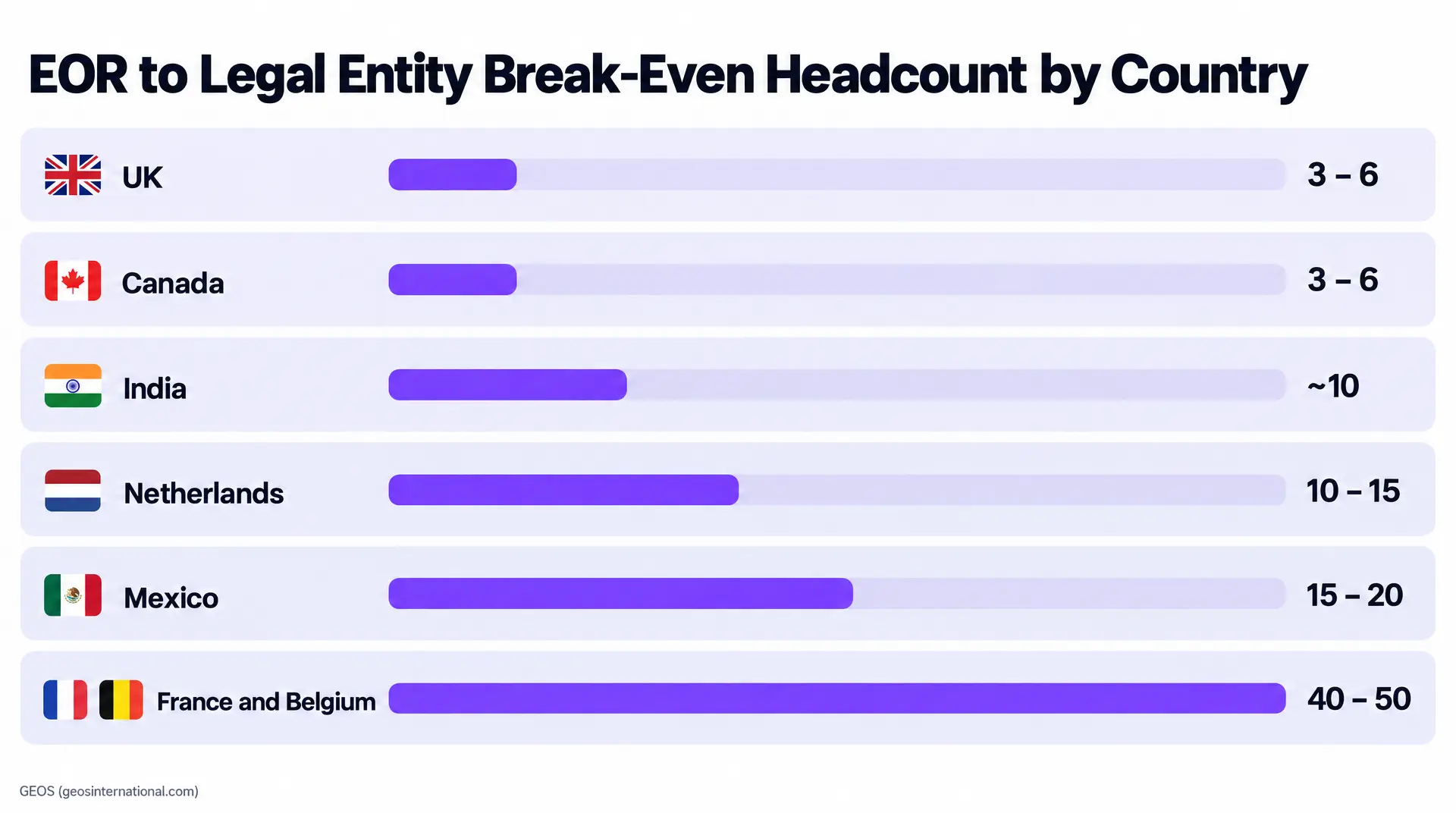
Because the entity side depends so heavily on the jurisdiction, the break-even is a bespoke calculation per country. These are my working estimates, and your own EOR terms, salaries and entity services will move them.
| Country | Break-even (EOR employees) | Main driver |
|—|—|—|
| United Kingdom | 3 to 6 | No wet signatures, notarization or apostilles |
| Canada | 3 to 6 | Fast incorporation, no notarization or apostilles |
| India | Around 10 | Simple incorporation, heavy setup around it |
| Netherlands | 10 to 15 | Notary approval, complex ongoing tax and accounting |
| Mexico | 15 to 20 | Heavy ongoing tax, accounting and employment requirements |
| France and Belgium | 40 to 50 | Far more time, cost and effort to set up and maintain |
In Canada, incorporating is exceptionally fast, but managing taxes takes more work. Foreign directors without Canadian tax identifiers can struggle to access the CRA’s online business account and end up dealing with phone trees and long lag times. We appoint an authorized Canadian representative with a Social Insurance Number to handle this. I would incorporate in Ontario rather than federally, because Ontario has removed its resident-director requirement and a federal corporation generally needs 25% resident Canadian directors.
In India, you need notarized documents and a resident director, meaning at least one director who stayed in India for 182 days or more in the previous calendar year. You also need a traditional bank account on the Indian rails, so that Provident Fund pension payments and Tax Deducted at Source (TDS) remittances are recognized by local officials. One client had run payroll through a global payroll provider’s patchwork solution before moving to its own subsidiary, and we needed a local tax partner to make its provident fund payments whole. Companies normally move there at around 10 employees, often because they intend to scale a large team to run a global command center, or GCC.
Despite the 10 to 15 break-even, in my experience most foreign companies set up their own entity in the Netherlands while still under 10 employees. Public notary approval can cause delays, and the ongoing tax and accounting filings need a specialized local CPA. I would keep a traditional Dutch bank account for corporate tax and social security payments, even if a FinTech account handles everyday money movement.
In Mexico, the ongoing tax, accounting and employment requirements are heavy, and salaries are calculated more like a day rate than an annual salary. Without a local legal representative appointed as director, you cannot wet sign employment contracts or set up the social security bank rails, and companies often find this out far into the incorporation. Only six traditional banks can process the mandatory social security payments, so a FinTech account will not work for payroll.
Building an EU team through a French entity is a lot more difficult, expensive and slow than through Ireland or some Eastern European countries. If a company needs a French entity only to hire three people, we tell them to use an EOR and refer them to one of our EOR partners. Belgium, Brazil and Japan are notoriously difficult places to set up an entity, and for one or two employees an EOR is the best bet.
In the US, incorporation is cheap and fast, but the complexity compounds once you hire. Every state an employee lives in needs its own registrations, a registered agent and a local payroll setup. If you plan to hire across more than fifteen to thirty states, a PEO or an EOR becomes highly beneficial.
Which Regulations and Contracts Force a Transition from an EOR to a Legal Entity?

Several situations shift that sort of mathematical equation a lot earlier. In Germany, the temporary agency work law (AÜG) caps the assignment of the same agency worker to the same client at 18 months. Earlier assignments count toward that limit unless the gap between them was longer than three months, and collective agreements can set a different maximum. Whether the law applies depends on how your EOR arrangement is classified, but where it does, the deadline arrives regardless of headcount. In Germany and Austria, a company can also face regulatory action for labor leasing without a license.
As a working estimate, I would place the start of permanent establishment risk at five to twenty EOR employees in one country, depending on that country’s local stance. Under the OECD’s 2025 model treaty guidance, an employee’s home used for less than 50% of their working time would generally not count as the company’s fixed place of business. A full-time remote employee working from home is above that line, so the answer then turns on the facts.
An EOR works solely as an employment vehicle. Your own entity gives you the standing to sign commercial leases, contract with government agencies and enterprise customers, recognize revenue locally, pursue tax optimization, and import or export goods. We worked with a travel experience company whose programs let families live abroad for about a year while working remotely. It had to set up local entities first so it could sign the commercial leases for its facilities in the countries where it offered those programs. Foreign companies in the defense space need locally owned entities to contract with the US or Canadian governments. If the reason for entering a country includes anything beyond employing one or two people, I would explore an entity from the start.
Your own entity also gives you control over benefits and HR policies, and lets you grant equity without the separate contractor agreement or vehicle an EOR arrangement requires, which is administratively burdensome and legally shaky. Unless the permanent establishment risk is serious, these factors normally work alongside headcount, making the entity’s ROI more attractive and turning that needle even more.
What Is the 2026 Status of the EU-Inc Proposal for European Legal Entity Incorporation?

The European Commission’s EU-Inc proposal includes registration within two days for a maximum of €100. The Council adopted its negotiating position in October 2026, but EU-Inc is not law yet, and negotiations with the European Parliament come next. I see it as a positive step, and once it is in force I expect it to change the break-even point in Europe. I do not expect it to remove country-specific registrations for VAT, payroll and social contributions, and I think bank KYB, notary appointments, apostilles and translations will remain the most stubborn analog hurdles. I would not pause a European expansion to wait for it, because the opportunity cost in lost market share is significant.
Why Do Employer of Record Contracts Provide Shared Legal Liability Rather Than Complete Protection?

One argument for staying on an EOR is that it carries the legal risk. That liability protection exists in concept, but most EOR contracts make it a shared liability. Indemnification clauses pass it back to the client when the client’s own actions cause the dispute, since the client controls and works closely with the employee. For the model, I would treat the EOR’s protection as largely theoretical, and it does nothing about permanent establishment risk.
We worked with a company that terminated an employee in Canada right before she returned from maternity leave. It led to a lawsuit, and the EOR provider did not shield the client at all, arguing that the client’s actions caused it.
What Is the Timeline Difference Between Legal Entity Incorporation and Operational Payroll Readiness?
The savings begin in the month your own entity runs its first payroll, and the EOR fees continue until then. An entity can be incorporated and still unable to pay anyone, because it has no tax ID or payroll registration yet. Global payroll providers often run their own checklist right before payday and halt the run if your local tax and pension registrations are not in place.
The UK is a rare case where a fast timeline is accurate. I would budget one to two weeks for intake, incorporation and online director verification, then about a week for HMRC and PAYE registrations. PAYE can be registered no more than two months before your first payday and has to be in place before it, which sets the window for your transfer date. A traditional bank account can still take months for foreign owners, although Revolut can often handle a UK subsidiary’s finances end to end.
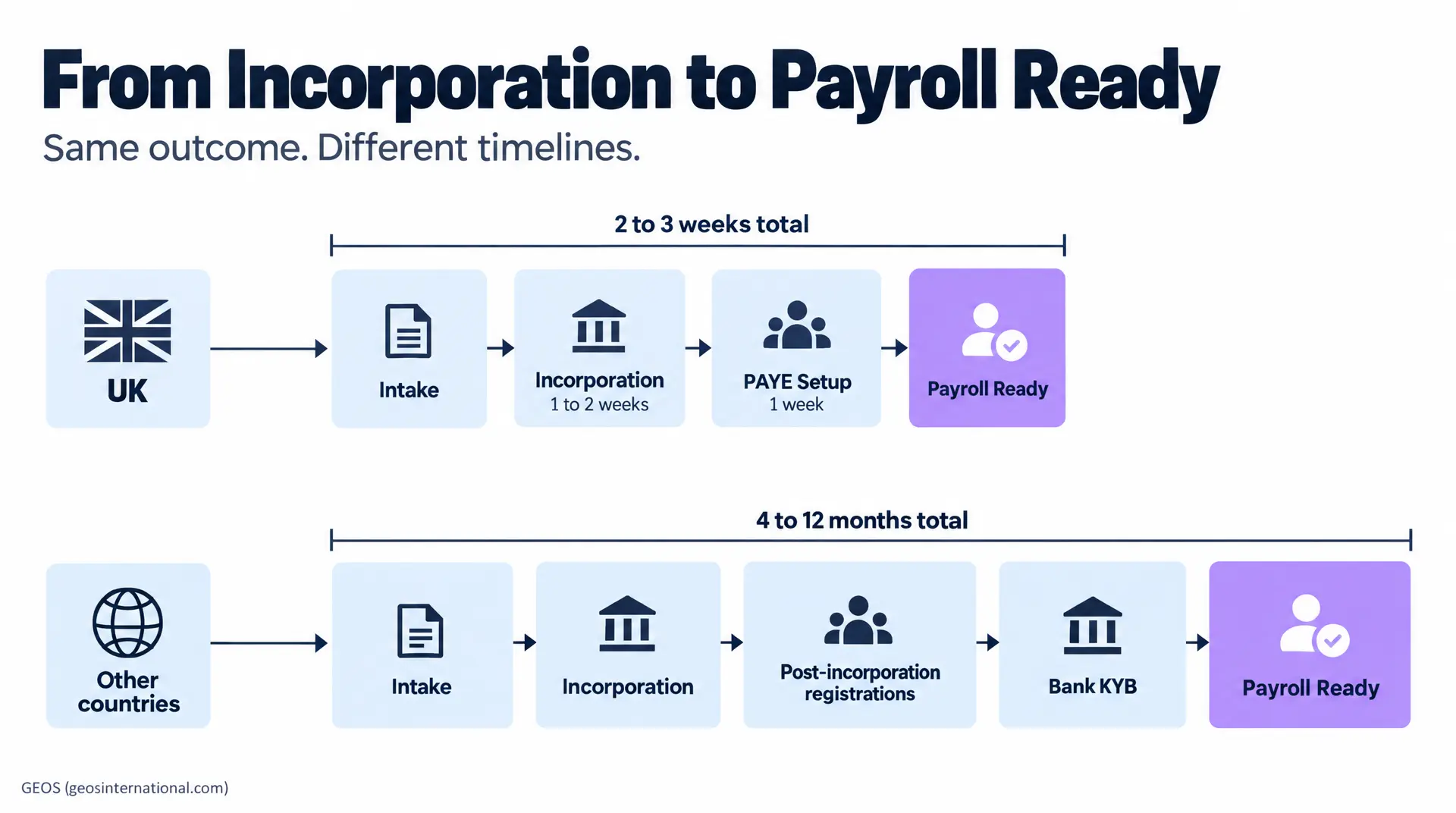
In most other countries four months is more representative, and setup can run to twelve. In a complicated country, a quoted three-week timeline usually means the client is being hooked into a false promise, because it covers government processing and leaves out intake, post-incorporation registrations and bank KYB. Intake is the best indicator of the overall timeline. Proof of address and IDs for ultimate beneficial owners (UBOs) are the documents most likely to expire against 60 to 90-day validity windows, and silent investors sometimes resist providing identification. We give the client’s executives the messaging to explain that these are non-negotiable anti-money laundering requirements set by local governments. When a client’s Indian entity stalled on director signatures and proof of address, we bridged the team through an EOR partner so their start dates held, then converted them.
The move itself is a heavy lift from an operational perspective. Each employee resigns from the EOR contract and signs a new one with your entity, with continuity in between. You decide how to honor seniority and accrued vacation, replace the EOR’s benefits package, and set up local HR and banking. The EOR cannot make those decisions for you, and it will not generally draft your employment contracts or help your employees through the change. The biggest mistake founders make is not telling employees about the change of legal vehicle in advance, which causes panic when they are suddenly asked to resign.
Keep the window in which you pay both the EOR and your own payroll as short as possible. There is no reason to run both for longer than the move requires, full stop. Once the entity is live, do not keep EOR employees in that country, because local officials see that as a worse compliance posture than an EOR with no entity at all.
For each country you are weighing, the decision turns on one comparison. The EOR fees and FX margin you would stop paying have to exceed the fully loaded cost of running your own entity, counted from the month it can run payroll. A lease, a government or enterprise contract, a tax need or a regulatory clock can settle it earlier. If you are working through this for a specific country, I’m happy to go through your current EOR invoice, your hiring plan and the setup steps for that jurisdiction with you.
Frequently Asked Questions
How do statutory labor costs skew the EOR break-even analysis in high-tax countries?
Your break-even threshold depends heavily on local employer contributions. According to OECD’s 2026 data, employer social security takes up 26.7% of labor costs in France, compared to 12.0% in the UK. These statutory costs remain post-EOR, meaning high-tax jurisdictions require a much larger headcount to justify the fixed entity overhead.
Why do post-incorporation gaps frequently derail EOR transition deadlines?
Incorporation is just paperwork. Operational readiness pays the bills. A company might incorporate online in the UK for £100 in 24 hours, but you cannot run payroll until PAYE is registered. Failing to map out these secondary milestones – like tax IDs and pension enrollments – creates a ‘black box’ delay that blows past hard market launch dates.
How do resident director mandates alter entity setup timelines in markets like Canada and India?
Statutory residency rules force complex workarounds that delay operational readiness. Under the CBCA, Canadian federal corporations generally require 25% resident-Canadian directors, though incorporating provincially in Ontario circumvents this. In India, you must appoint a director who spent at least 182 days locally the prior year. Securing pre-vetted nominees is critical to hitting commercial deadlines.
Will the proposed EU-Inc framework standardize the EOR to entity break-even point across Europe?
Not immediately. While the Council adopted a negotiating position in October 2026 for a two-day setup, it is not yet law. Even when enacted, it will not remove country-specific payroll and VAT registrations. You must still model break-even around local post-incorporation hurdles like bank KYB and notary delays.
Why are traditional bank accounts a strict prerequisite for operationalizing entities in certain jurisdictions?
You cannot always rely on agile FinTech accounts to replace EOR infrastructure. In Mexico, only six traditional banks process mandatory social security payments. Similarly, India requires accounts on local rails to remit Tax Deducted at Source (TDS) and Provident Fund payments. Without these established, your entity remains functionally paralyzed and unable to legally assume payroll.