
A client of ours expanding into India had employees with verbal start dates and an entity setup that had stalled on the director’s signatures and proof of address. To save those start dates, we partnered with an Employer of Record (EOR) to hire the team temporarily. Once the entity was established, the employees went through a complex transition onto it.
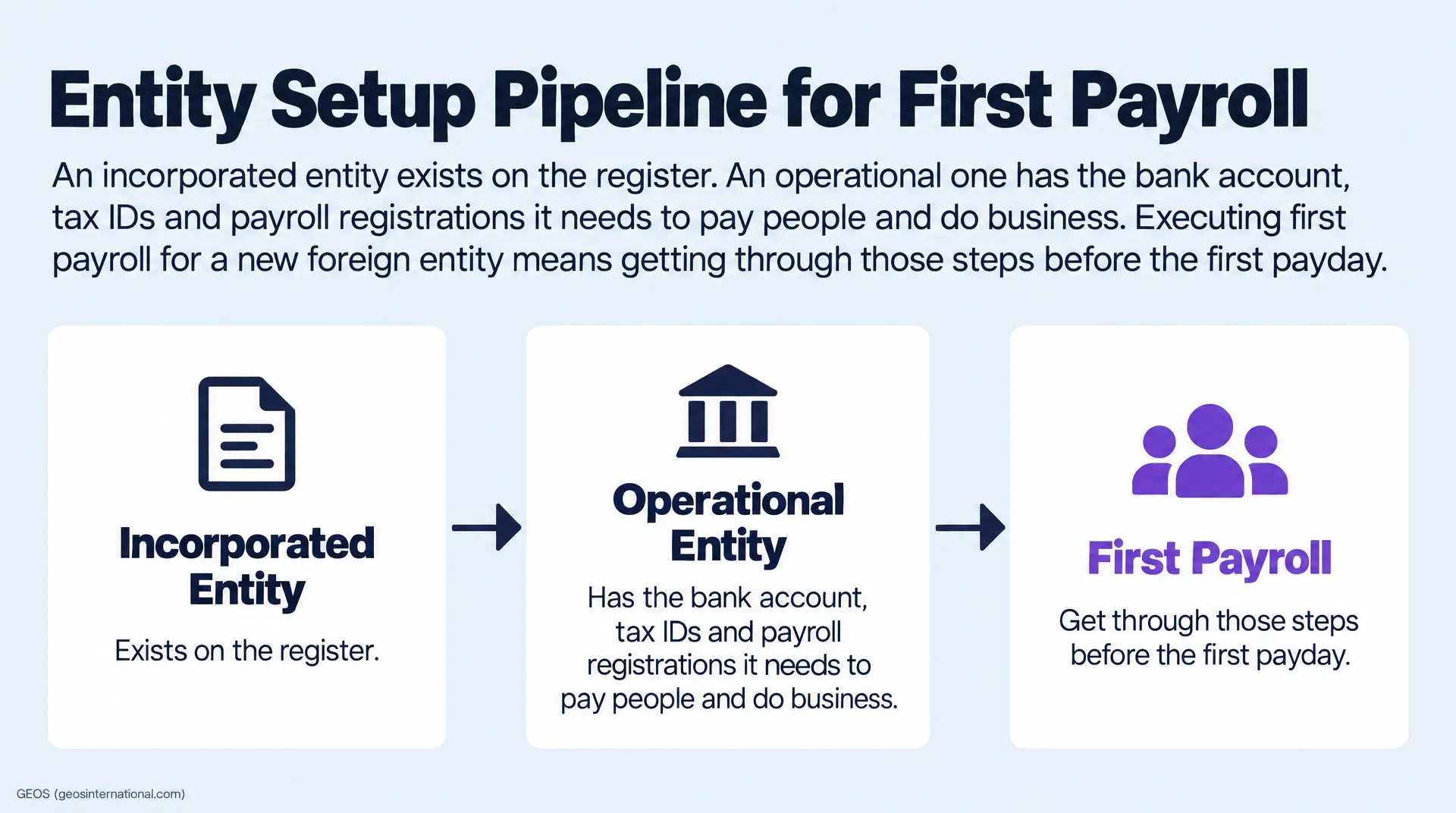
For an operations leader, the first payday in a new country is normally tied to a fixed date, such as a hiring wave or a client contract start. Incorporation is a very good milestone on the way, and it’s indicative of a major step forward in being able to run payroll. But there’s a difference between an entity being incorporated and an entity being operational. An incorporated entity exists on the register. An operational one has the bank account, tax IDs and payroll registrations it needs to pay people and do business. The steps between the two vary per country. Executing first payroll for a new foreign entity means getting through those steps before the first payday.
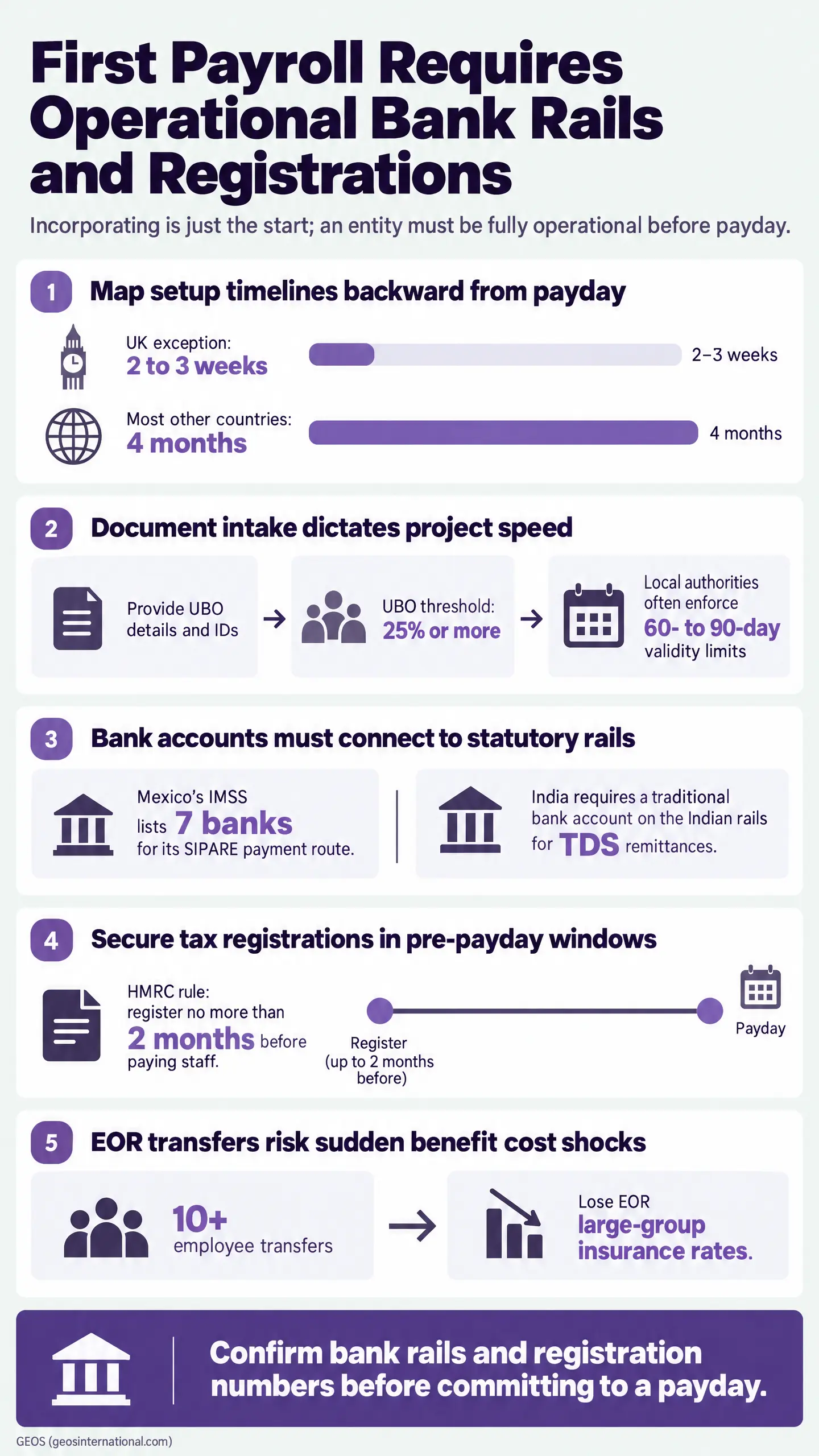
Key Takeaways
- Setting up an operational foreign entity realistically takes four months in most countries, compared to just three weeks for intake, incorporation, and tax registration in the United Kingdom.
- FinTech accounts typically fail for Mexican payroll because only a select few traditional banks connect directly to the IMSS SIPARE system for mandatory social security remittances.
- Appointing a temporary nominee director with a power of attorney for three to six months bypasses major KYC delays when opening UK corporate bank accounts for foreign-owned entities.
- Foreign directors cannot directly access the Canada Revenue Agency online business portal and must appoint an authorized Canadian representative holding a Social Insurance Number to complete payroll registrations.
- Baseline international anti-money laundering checks require the parent company’s Certificate of Good Standing, Articles of Incorporation, and identification for ultimate beneficial owners holding 25% or more.
- Foreign directors without Social Security Numbers can accelerate US Employer Identification Number acquisition by faxing the SS-4 form directly to the IRS rather than applying for an ITIN.
- Jurisdictions including Mexico, India, Australia, Singapore, and the UAE mandate resident directors for foreign entities, requiring professional third-party appointments to maintain compliance without transferring operational control.
How Do You Map the Setup Timeline for a New Foreign Entity’s First Payroll?

Working backward from a fixed payday, I’d first map every step of the incorporation, the registrations and the bank account setup, with specific dates for that country. The map also needs a cushion for delays, such as a slow government registration or a document found missing at intake. Mapping it all upfront lets you hit steps concurrently rather than getting hit with the next immediate step by email.
A three-week incorporation quote may only cover the time from the application being lodged to the government processing it. Those quotes generally leave out the intake, the post-incorporation tax registrations and the bank’s KYB (Know Your Business) checks. The UK is a rare case where a short timeline is accurate. There, I’d budget one to two weeks for intake, incorporation and director verification on gov.uk, then another week for the registrations with HMRC, the UK tax authority. For most other countries, four months is a more representative starting point.
In my experience, major delays often occur when busy executives set up several entities at once. They get overwhelmed by the compounding variance of local requests, such as ad-hoc KYC (Know Your Customer) video calls, specific wet signatures and proof of address in a particular format. Without one view across all of it, it’s like playing basketball with a blindfold on, moving only on what your four teammates call out.
The dates should also reflect local patterns, such as communication with partners in Spain often dropping off completely in August and December. For a client moving independent contractors onto direct employment in Spain, the public notary rejected the initial incorporation application and demanded extensive additional documentation. Because we knew the local bottlenecks upfront, we could help the client manage the budget and give the affected workers an accurate revised timeline.
What Are the Required Intake Documents for Foreign Entity AML and KYB Checks?
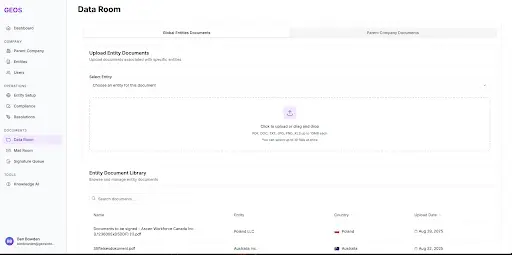
The initial document gathering is the greatest indicator of how long the whole project will take. For baseline anti-money laundering (AML) and KYB checks, it normally means three documents:
– the parent company’s Certificate of Good Standing
– its Articles of Incorporation
– identification for each ultimate beneficial owner (UBO)
We treat a UBO as anyone holding 25% or more. That is a common threshold, but the Financial Action Task Force’s guidance expects countries to set their own, so the target country’s rule decides whose ID you need. Some jurisdictions also keep going up the chain through holding companies or funds until their due diligence is satisfied.
Companies frequently can’t easily access their own foundational documents. Often an external lawyer drafted them years ago, and they were lost or forgotten. UBOs are typically silent investors who may resist handing over personal identification. We arm the client’s executive team with messaging that explains these are AML requirements mandated by local governments. Local authorities also often enforce 60- to 90-day validity limits. Proof of address and UBO IDs are the documents most likely to expire, often for reasons as mundane as a UBO being in the middle of a move or not having a current driver’s license.
The sequence of notarizing, apostilling, couriering and sworn in-country translation also changes with where the parent company is from and where the entity is going. Public notaries will normally reject documents immediately if notarization was handled in a laissez-faire way.
How Do You Set Up Foreign Corporate Bank Accounts for Statutory Payroll Payments?
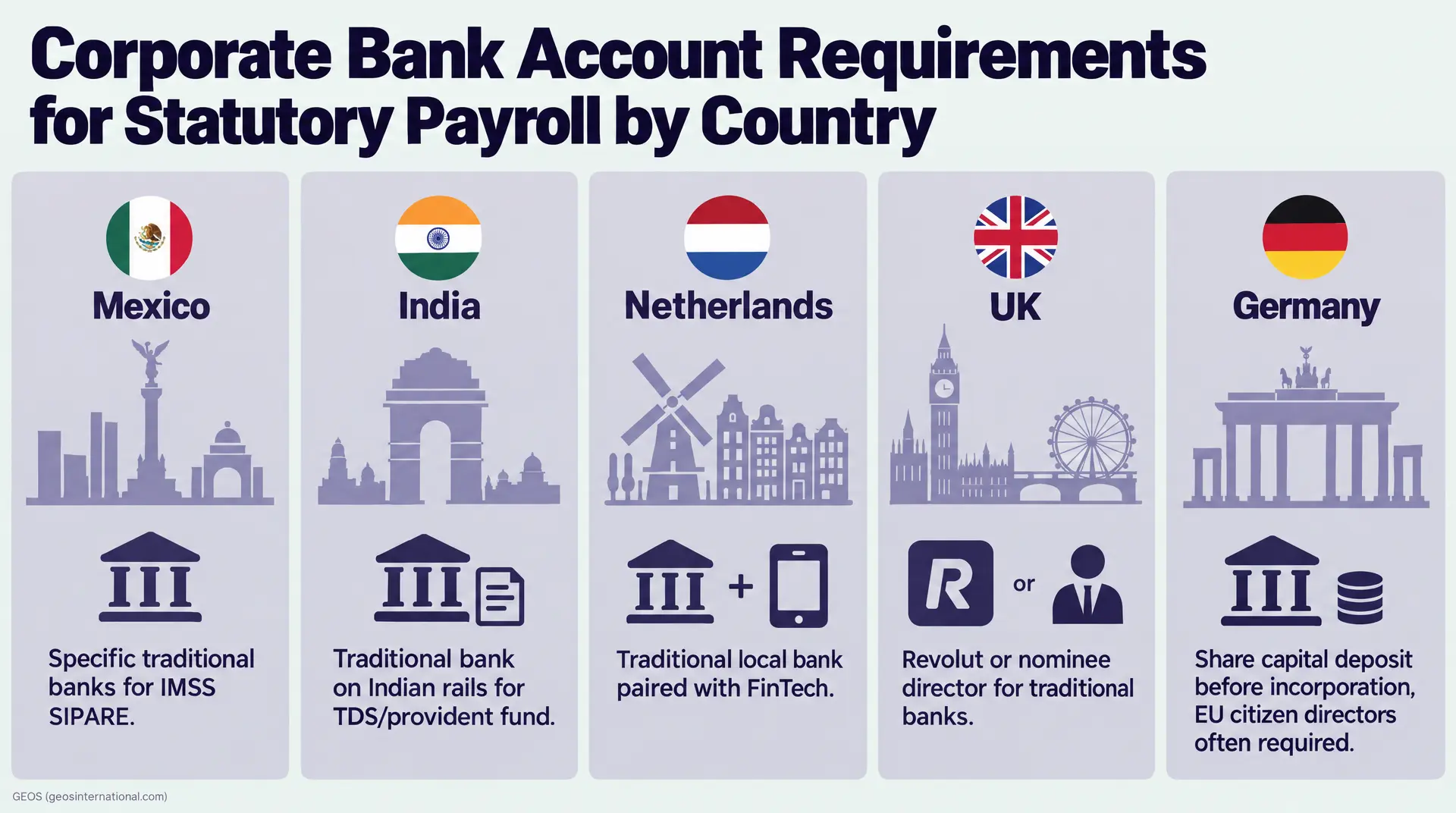
By rails, I mean a bank’s ability to make payments into a specific government system, such as social security, pensions or tax. In some countries the bank account is opened as part of incorporation, so it may already exist. Whether it can make the payments payroll needs is a separate question, and the answer differs by country:
– Mexico: Only a handful of traditional banks own the actual rails to make the social security payments for payroll runs, and FinTech accounts typically fail here. An FAQ from IMSS, Mexico’s social security institute, lists seven banks for its SIPARE payment route. I’d confirm the current list, and that the bank offers the service, before opening the account.
– India: Payroll needs a traditional bank account on the Indian rails so that Tax Deducted at Source (TDS) remittances and provident fund pension payments are legally recognized. I’d confirm separately that the account can make each of those payments.
– Netherlands: I’d keep a traditional local bank for corporate tax and mandatory social security payments alongside payroll. We often recommend pairing it with a FinTech account for day-to-day money movement.
– United Kingdom: Revolut is often capable of handling the entity’s finances end to end. A traditional bank can take a few months for foreign owners because of KYB and KYC checks. One way through is a temporary nominee director for three to six months. A power of attorney limits their control, and resolutions are lodged to remove them once the account is established.
– Germany: The share capital deposit has to be made before the incorporation application. Large traditional banks often refuse foreign-owned entities or require EU citizen directors. When one rejected a US client of ours for lacking EU citizen directors, we sourced an alternative banking partner.
During one setup in India, a local bank that had been responsive just went silent. We restarted the application with a new bank, which significantly delayed the share capital deposit and the client’s ability to run local payroll.
What Mandatory Tax and Social Security Registrations Are Required to Run Foreign Payroll?
The first platform dedicated to streamlining entity setup and management.
With the account in place, the minimum requirement is the set of registrations that let the entity run payroll at all. These are the social security and payroll registrations, plus the registrations for making pension payments.
For a new foreign entity, the registrations needed before first payroll and the 2026 tax and social security deadlines differ by country, with German contributions due before the month worked ends.
|
Country |
Registrations before first payroll (issuing body) |
Payroll tax payment due |
Social security contributions due |
|---|---|---|---|
|
United Kingdom |
PAYE (HMRC), before first payday but no more than 2 months ahead |
PAYE by the 22nd of the next tax month (19th by post) |
Employer Class 1 National Insurance paid with PAYE by the 22nd of the next tax month |
|
United States |
EIN (IRS), plus state withholding and unemployment accounts where employees live or work |
15th of the following month in the first calendar year, unless the $100,000 next-day rule applies |
Social Security and Medicare (FICA) deposited with income tax by the 15th of the following month |
|
Canada |
Business Number and payroll program account (CRA), before the first remittance is due |
15th of the month after paying employees (new regular remitter) |
CPP contributions and EI premiums remitted with income tax by the 15th of the following month |
|
India |
TAN (Income-tax Department), EPFO at 20 or more employees, ESIC at 10 or more |
TDS by the 7th of the following month (March deductions by April 30) |
EPF and ESI within 15 days after month-end, paid separately from TDS |
|
Mexico |
RFC (SAT) and IMSS Registro Patronal, workers registered within 5 business days of hiring |
ISR withholding by the 17th of the following month |
IMSS by the 17th of the following month, paid via SIPARE at authorized banks |
|
Germany |
Tax number (Finanzamt, via ELSTER) and Betriebsnummer (Bundesagentur für Arbeit) at first hire |
Wage tax by the 10th day after the filing period, quarterly or annual if annualized tax is €5,000 or less |
Estimated amount by the third-to-last banking day of the month worked, paid to the Krankenkasse |
In the UK, companies often hit delays at the HMRC tax and PAYE payroll registrations. The usual cause is that they first have to decide who their local accounting and tax representation will be. HMRC expects employers to register before the first payday, but no more than two months before paying staff. If the PAYE reference hasn’t arrived by payday, HMRC’s guidance is to run payroll anyway. You save the Full Payment Submission and send it once the reference comes through. Some codes still arrive by physical mail, so the registered address needs someone scanning and acting on government mail before deadlines pass.
In Canada, the Canada Revenue Agency’s online business account isn’t accessible to non-residents. Without an authorized Canadian representative who has a Social Insurance Number, a foreign director is left dealing with phone trees and long lag times. We appoint one for clients to handle the initial tax and payroll registrations.
In the US, the Employer Identification Number (EIN) is the main time-consuming step when every director is foreign and none has a Social Security Number. I’d skip applying for an Individual Taxpayer Identification Number (ITIN), because that process is too slow. Instead, fax the SS-4 form directly and call the IRS for a status update if a week passes. During a government shutdown, with major IRS processing delays, that meant faxing SS-4 forms repeatedly and persistently calling the right departments. Once people are hired, the complexity compounds. Each state an employee lives in brings its own registrations, registered agent and payroll setup.
What Infrastructure Details Do Global Payroll Providers Require Before a First Foreign Payday?
Global payroll providers are very useful because they bring their services and know-how to many countries. In most cases, though, they rely on the client to have the infrastructure underneath the payroll run in place: the entity, the registrations and the accounts.
Often, shortly before payday, the provider asks for the registration numbers and the account details for pension payments. If the client doesn’t have them, payroll doesn’t run until they do. The provider is working through its own checklist. It may not share that checklist proactively, and it may assume everything is in place. When you sign with a provider, I’d ask: which registration numbers and account details will you need from us for the first payroll in this country, and by what date? Their answer belongs in the dated map.
A client in India used a band-aid solution through a global payroll provider, and it caused complex compliance issues with their provident fund. We worked with a local tax partner to reconcile the roundabout payments and make the subsidiary’s provident fund contributions whole again.
What Are the Local Employment Contract and Resident Director Requirements for Foreign Entities?

From an HR and employment compliance perspective, the entity needs an employment contract that is compliant and acceptable for hiring locally. It also needs an employee handbook for minimum compliance. Beyond that, the offer needs what people expect locally, such as meal vouchers, to practically hire anyone.
In Mexico, a local legal representative has to wet-sign employment contracts. Salaries are also calculated more like a day rate than an annual salary, which complicates payroll and ongoing accounting. Companies often get far into incorporation before realizing they need a local director appointed. Without one, they can’t set up the social security bank rails or wet-sign contracts.
Resident directors are mandatory in countries including Mexico, India, Australia, New Zealand, Singapore and the UAE. I would argue a professional third-party director from the start is cheaper and faster than appointing someone from your own team. We structure ours so they have no decision-making power or control over the company. One client of ours had appointed a local employee as resident director to check a compliance box. When the employee left and wanted to shed the liability, removing them became a complex ordeal. We handled the removal and appointed one of our vetted local directors in their place.
How Do You Transfer Employees from an Employer of Record to a Foreign Entity?
When the first payroll moves people off an EOR, your notice has to cover several items:
– the EOR’s payroll lead time
– social insurance un-enrollment
– deposit reconciliation
– any work permit transfers
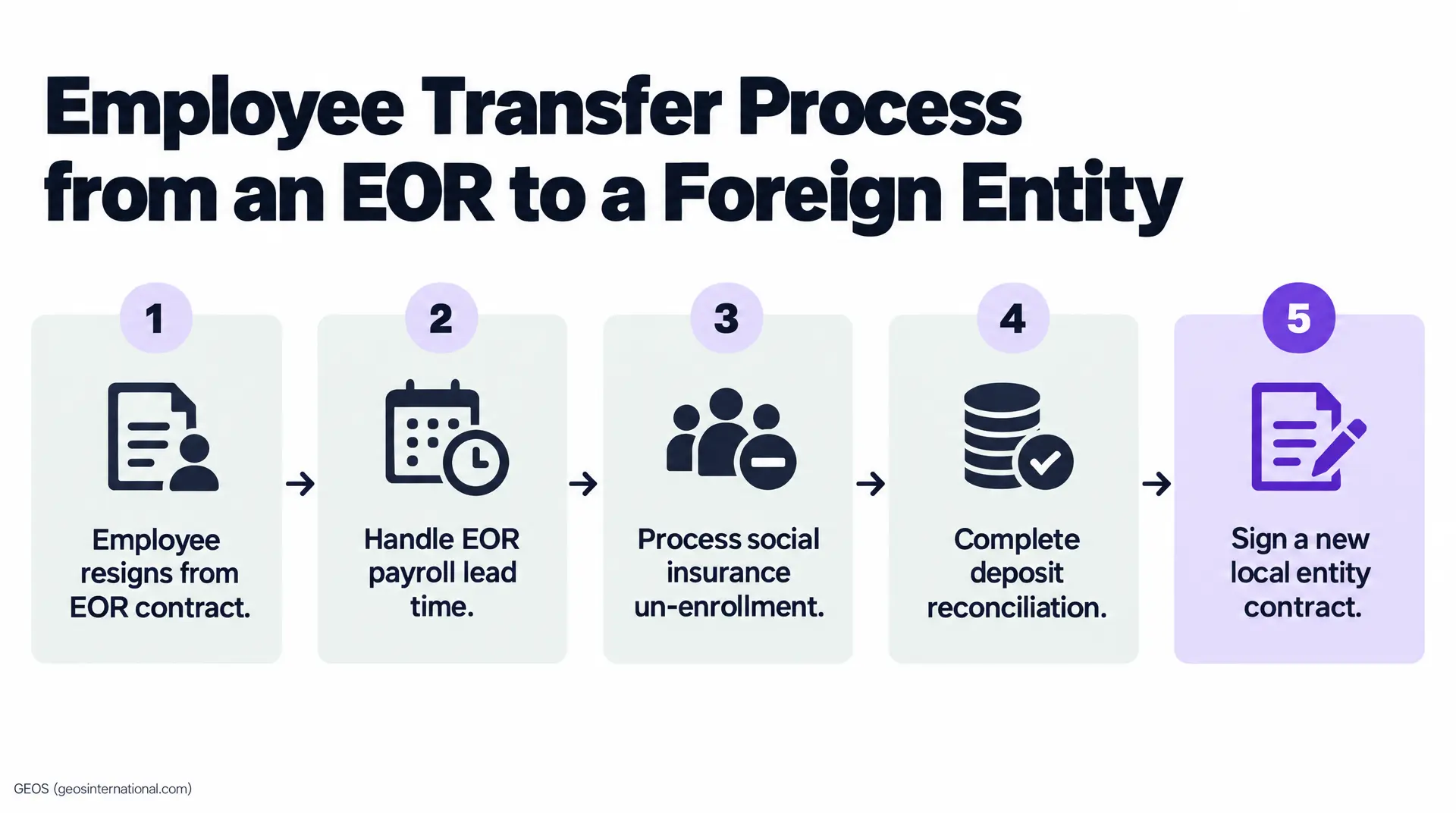
Each employee resigns from their current contract and signs a new one, with continuity in between. The EOR can’t decide for you how to honor seniority, benefits or vacation accruals, and it generally won’t draft your new contracts. In my view, the biggest mistake is failing to tell employees about the change of legal vehicle in advance. Being suddenly asked to resign can make people panic.
One company moving more than 10 employees from a US EOR onto its own entity hit a major cost shock on benefits. At that headcount it no longer qualified for the large-group insurance rates the EOR had used. Matching the employees’ existing benefits cost significantly more.
Keep the window where you pay both the EOR and your own payroll as short as possible. There’s no reason to run both longer than the transfer requires, full stop. Once the entity is paying taxes locally, I’d also avoid keeping anyone on the EOR in that country. Local officials view that as a worse posture than using an EOR with no entity at all.
How Do You Confirm Statutory Tax Remittances for a Foreign Entity’s First Payroll Run?

Paying employees and remitting the taxes on that payroll correctly are separate steps, and in the UK they have separate deadlines. The report of employee payments and deductions is due to HMRC on or before each payday. Monthly PAYE has to be paid by the 22nd of the next tax month.
Before they became our client, a UK company had been running payroll for quite a while. Then letters arrived from HMRC saying their PAYE tax payments weren’t being made properly, and warning of major fines if the issue wasn’t addressed right away. The good news is that the UK offers many ways to make that payment. That makes it easier to fix than in countries with a more restrictive payment route, such as social security in Mexico.
For a first payday in a given country, I’d want two things confirmed before committing to the date. The bank account has to be able to make that country’s statutory payments. The registration numbers have to exist before the payroll provider asks for them. At GEOS International, we map that full sequence into our platform for each of the more than 80 countries we cover. If you have a payday fixed in a new country, I’m happy to walk through the sequence behind it with you.
Frequently Asked Questions
When must a UK entity declare pension compliance?
You face strict post-start deadlines. The Pensions Regulator demands compliance within five calendar months of your duties start date. This requires your PAYE reference, making sequential setup critical.
Must we fund the full €25,000 share capital to activate a German GmbH?
No. For a cash formation, registration can proceed after at least 25% of each share is paid, totaling a minimum of €12,500. This deposit must clear before establishing payroll infrastructure.
When does an Indian subsidiary trigger mandatory provident fund (EPF) contributions?
The threshold is 20 or more employees for specified establishments. Once triggered, compliance is time-sensitive. EPFO requires dues remitted within 15 days of the month close to avoid penal damages.
Can we hire in the Netherlands before completing local tax registrations?
Absolutely not. The government strictly requires that you register with the Tax Administration before hiring. This provides your payroll-tax number, which is a hard prerequisite for executing a compliant first payday.
What is the true timeline to secure an IRS EIN for a foreign-owned US entity?
While the IRS estimates four business days by fax or four weeks by mail for international applicants, these aren’t guaranteed. Build a significant buffer into your launch map, as delays here halt all state payroll setups.