
If you build the business case for consolidating entity vendors from the invoices alone, you are likely to miss much of the return. The biggest cost I see companies paying is one the invoices make hard to spot: work bundled into a standard monthly fee that the entity doesn’t need.
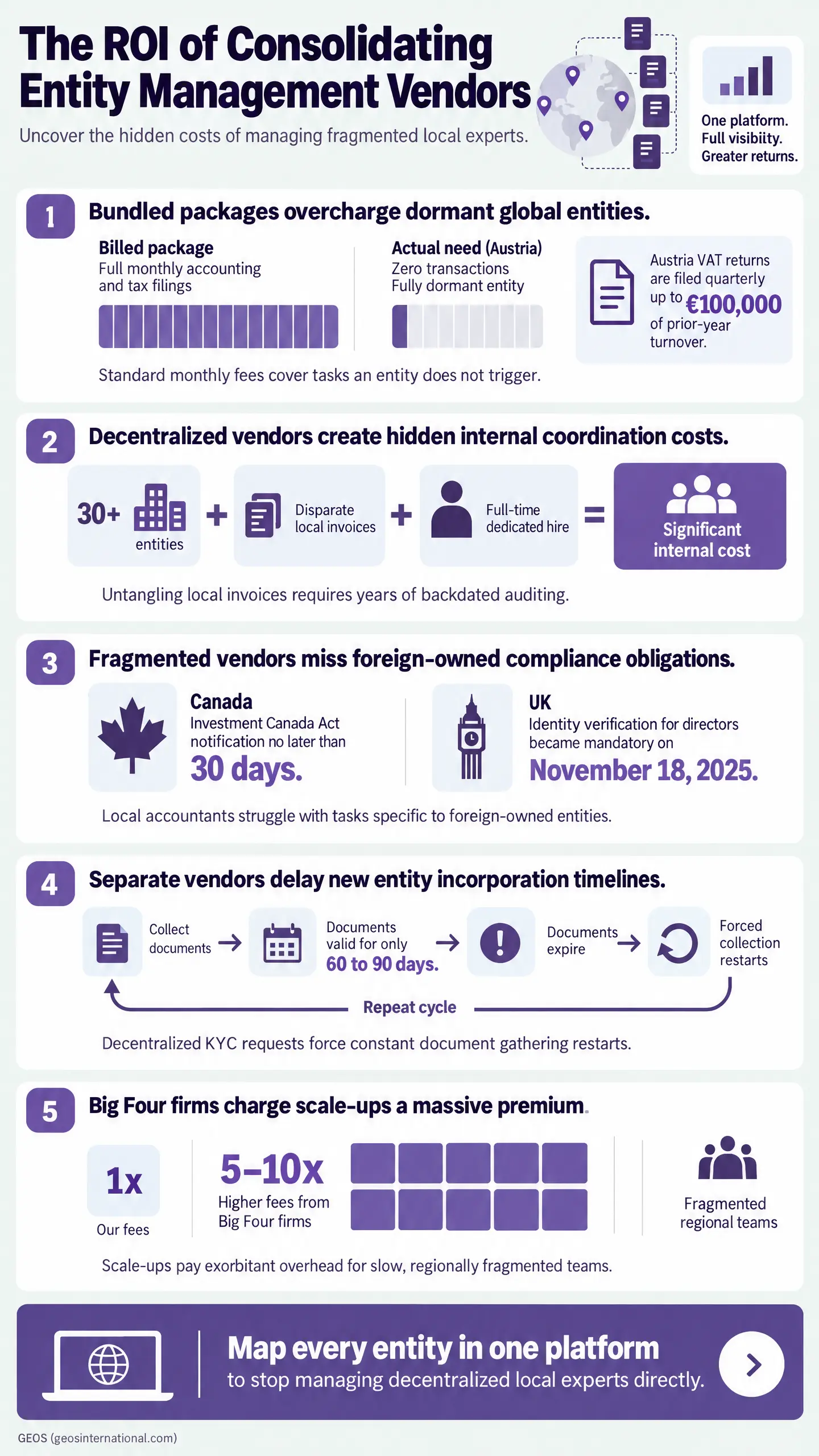
One of our clients had a subsidiary in Austria that was being billed for monthly VAT filings, full monthly accounting and tax filings. The entity had been set up months before and was fully dormant, so no transactions, nothing. It still needed a monthly fee for basic nil filings and some country-contextualized accounting. Once we worked that out with the client, the fee came out a lot lower than what they had been paying. Mapping the entity’s actual requirements in the GEOS platform also made it much clearer how to manage it from then on.
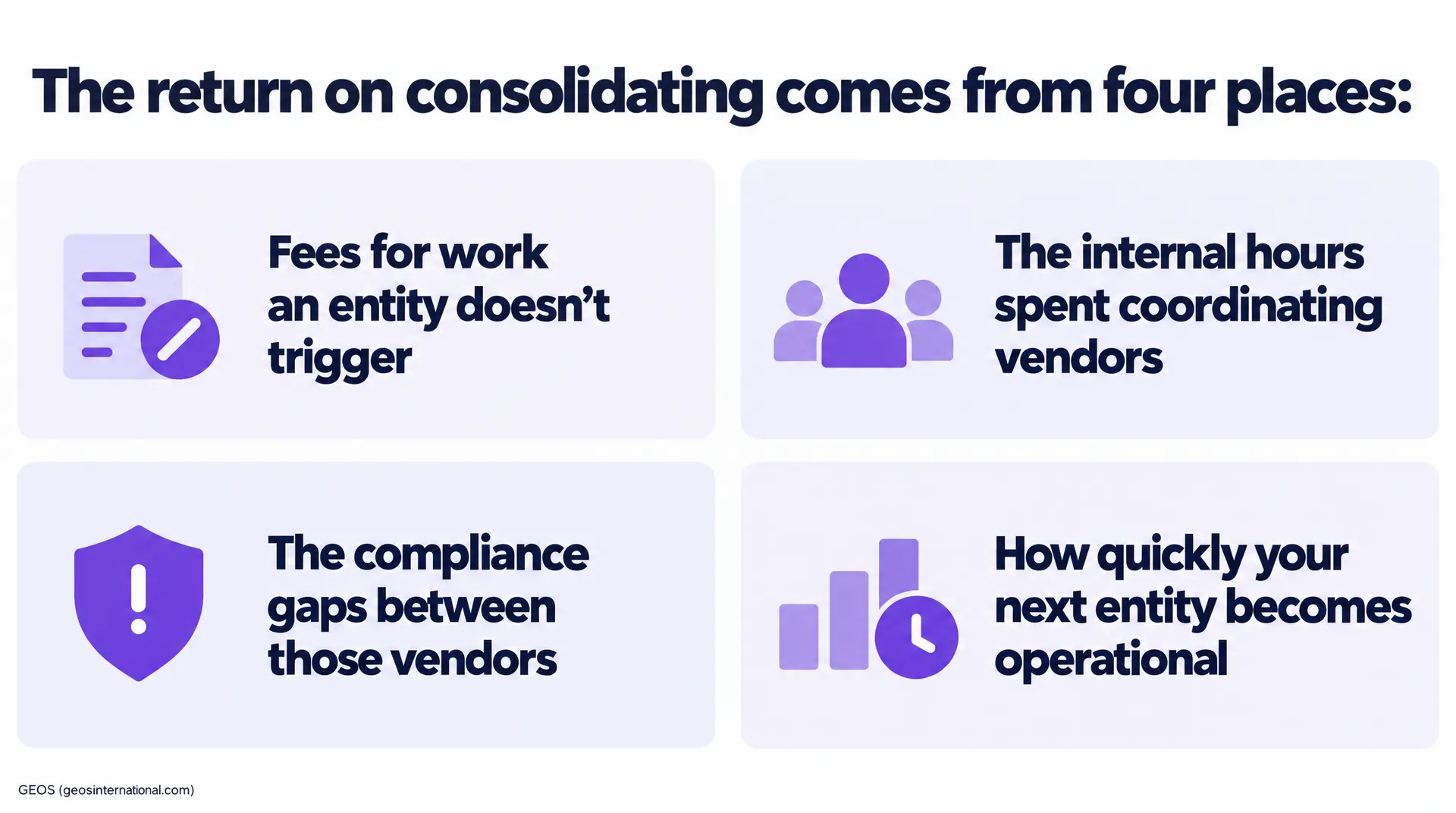
In my view, the return on consolidating comes from four places: fees for work an entity doesn’t trigger, the internal hours spent coordinating vendors, the compliance gaps between those vendors, and how quickly your next entity becomes operational. Only the first shows up on a vendor bill, and even that one is hard to read unless you know what each entity should be paying for.
By consolidating, I mean one system of record for every entity, one map of what each entity owes, and one account team that deals with the local experts on your behalf, so your own team stops managing each of them directly. Because I believe it is virtually impossible to find a single provider that handles tax, legal and payroll across dozens of countries, the local experts underneath can stay wherever they perform well.
Key Takeaways
- Local accounting firms frequently overbill dormant foreign subsidiaries by applying bundled monthly fees for unused services, such as full VAT filings, rather than charging reduced rates for basic nil filings.
- Global compliance requirements vary strictly by jurisdiction and revenue, with Austria requiring quarterly VAT returns for turnover up to €100,000, while Mexico mandates monthly VAT calculations due by the 17th.
- Managing decentralized local compliance vendors across multiple international jurisdictions typically requires two to three full-time internal employees strictly to process fragmented invoices and coordinate mandatory legal actions.
- Decentralized compliance management frequently causes foreign-owned entities to miss localized legal obligations, such as Canada’s 30-day Investment Canada Act notification deadline or the UK’s November 18, 2025 identity verification mandate.
- International entity incorporation faces frequent delays because local authorities enforce strict 60 to 90-day validity limits on submitted documents, forcing companies to restart the collection of beneficial owner address proofs.
- Big Four global accounting firms typically charge five to ten times more for corporate compliance than specialized platforms like GEOS International, while still fragmenting service delivery across disconnected regional teams.
- The GEOS International platform consolidates vendor management by mapping compliance tasks across over 80 countries, providing a centralized system of record for global subsidiaries starting at $49 per month per entity.
How Do Bundled Compliance Packages Cause Overbilling for Dormant Global Entities?
Local accountants, and even the large global consulting firms, often set up a subsidiary and then bill a standard monthly fee that covers all accounting, all tax filings and all compliance tasks for that country. The package covers those tasks whether or not the entity triggers them. Accounting firms frequently charge dormant entities for bundled monthly work such as VAT filings, when all they need is a reduced fee for basic nil filings.
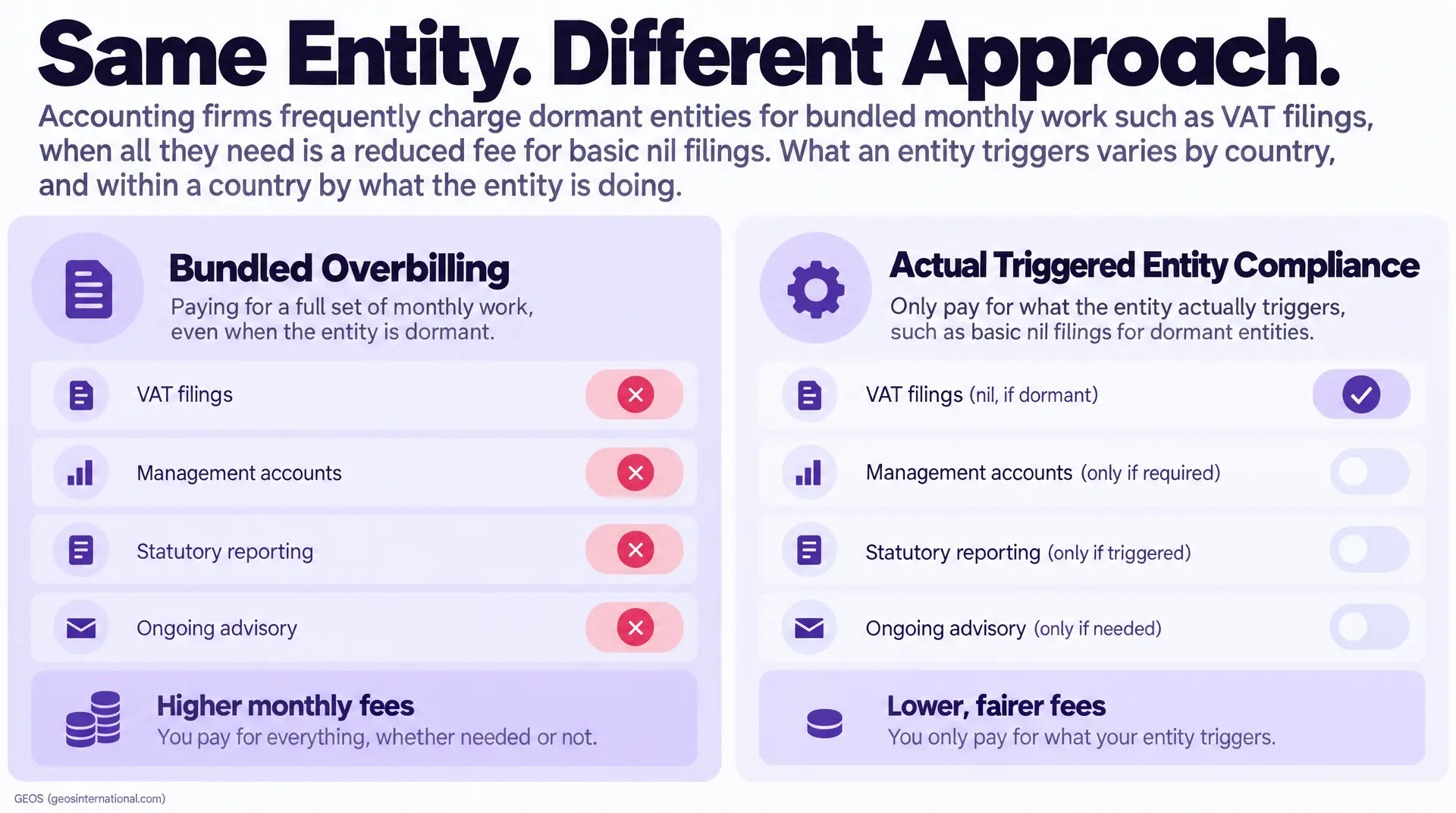
What an entity triggers varies by country, and within a country by what the entity is doing. In Mexico, annual requirements differ drastically between an entity that is completely dormant, one that is hiring and paying local employees, and one that is actively recognizing revenue. The VAT schedule alone differs from one country to the next. In Austria, VAT returns are filed quarterly up to €100,000 of prior-year turnover and monthly above that, and qualifying small businesses may be exempt from them altogether. Mexico’s general rule is that VAT is calculated for each calendar month, with the return due by the 17th of the following month, subject to specified exceptions. A package that bundles all of this can be accurate for one entity and include work another doesn’t need, and a team at headquarters can’t tell which without a map of what each entity triggers.
Legacy firms make that harder when the invoice shows one or two generic items such as “corporate compliance,” with no breakdown of the work completed. A client had been working with one of the well-known global consulting firms on a few entities and paying exorbitant fees across all of them, with minimal activity. When they asked the firm what it was all for, they were never given a clear answer. After seeing how our platform maps things out, they moved all of their ongoing compliance to us and saved a good amount in fees.
I would say the most obvious warning sign is an operations leader who can’t tell you what the company pays per subsidiary and what those fees are for. If you can’t answer that clearly, or point to a platform that maps it out for you, that is an issue in itself. In Ireland, to surface fees that aren’t obvious, I would ask the provider for a compliance calendar covering every accounting, tax and corporate secretarial task. I would also confirm that the registered address is a physical one, since virtual PO boxes are not accepted.
What Are the Hidden Internal Costs of Managing Decentralized Global Compliance Vendors?

For a single-country setup, local accountants and lawyers can be highly knowledgeable and positive to work with, and they are often the cheapest option. Relying on them becomes extremely difficult when you expand into several countries at once, and at that point much of the cost moves inside your company. Someone on your team has to own the project management, work out what each bill is for, catch overbilling and find out week to week whether anything is happening at all.
When single-market vendors leave foreign clients in the dark, it is usually because they lack the resources, the technology and the experience with foreign-owned companies to provide proper visibility. Updates are received piecemeal by email or phone calls, and the coordination falls to you. Hourly billing adds to it, because a model that charges by the hour ends up incentivizing dependency. In Spain, communication from local partners often drops off completely in August and December.
Managing independent local resources across multiple countries often equates to two or three full-time jobs just to handle the incoming invoices and the actions they require. Beyond a handful of entities, I believe local accountants and spreadsheets become practically untenable without a full-time internal team. Managers juggling disparate vendors without a central view often lose so much visibility that they end up blindly paying the bills, which leads to overbilling and compliance issues over time. I would argue those hours belong in the same comparison as the vendor fees.
A company with more than 30 entities had completely lost visibility into its compliance costs because local firms were invoicing the subsidiaries directly. Untangling it meant years of backdated auditing and unverified vendor invoices, and it was complex enough to require a dedicated full-time hire working alongside us. We deployed our platform to support that new global compliance manager.
How Do Fragmented Local Vendors Create Compliance Gaps for Foreign-Owned Entities?

Running a footprint without one map is like playing basketball with a blindfold on, moving and passing only on the instructions your four teammates call out. You aren’t aware of what needs to be done in the other countries, and when an entity’s compliance is divided among several parties, some obligations end up with no owner.
Some obligations exist only because the owner is foreign. Local accounting partners in APAC and Latin America often struggle with them because they are used to servicing domestic companies and unaware of the tasks specific to foreign-owned entities. In Canada, domestic accountants often miss the Investment Canada Act notification for the same reason. A non-Canadian that starts a new Canadian business generally has to file it no later than 30 days after the investment is implemented, subject to specific exemptions. Other obligations are recent. Identity verification for directors and people with significant control of UK companies became mandatory on November 18, 2025, and missing it can easily cost a foreign-owned entity its good standing.
Some gaps involve the people formally attached to an entity. In Peru, the departure of a client’s second shareholder, a former employee, left the subsidiary with one shareholder instead of the legally required two. We drafted and submitted the documentation to add a new shareholder and restored the entity’s good standing with local officials. A client with multiple entities in Latin America had nominee directors who were inactive. We audited those entities, restored their compliance and significantly reduced the client’s annual costs at the same time.
Government mail is another gap. When the registered address sits with a compliance partner that scans each letter into the same system as the entity’s tasks, notices get acted on before their deadlines. We also use it to catch corporate changes we weren’t told about, before an annual filing is rejected.
How Does Vendor Consolidation Accelerate New Global Entity Incorporation and KYC Processes?
The first platform dedicated to streamlining entity setup and management.
Consolidation also changes how quickly your next entity becomes operational, which matters when a launch date, a contract start or a hiring wave depends on it. Major delays often occur when busy executives set up several entities at once and each country asks for something slightly different: an ad hoc KYC video call, a specific wet signature, a uniquely formatted proof of address. With a separate vendor in each country, those requests arrive one email at a time, and your parent company documents and context get re-shared with every new team.
We map the whole process upfront, from notarization and bank KYB before incorporation to the tax and payroll registrations that make the entity operational afterward. Your team can see in advance when it will be needed and work several steps concurrently. That matters most in document gathering, which is the greatest indicator of how long an incorporation will take. Local authorities often enforce 60 to 90-day validity limits on submitted documents, and the proof of address for UBOs or directors is the one that most commonly expires and forces the collection to restart.
Why Are Big Four Global Firms Often Inefficient for Scale-Up Entity Management?

Moving every entity to one large global firm looks like consolidation. For a Fortune 500 or publicly traded company it is often the better choice, because those companies have the internal mechanisms and in-house tax expertise to work with that model. For a privately held scale-up, in my opinion, it usually isn’t ideal, and you pay a premium for the brand.
My business partner, others on our team and I have been PwC clients ourselves. It is convenient to have one partner guiding you across jurisdictions, with tax, legal, compliance and regional experts under one logo and one umbrella. The challenge is that the teams are still fragmented by region. Working with a firm like that in Austria, Mexico and a third country effectively means three or four different teams with little central communication between them. You restart the process and give new context to each one. At Borderless AI, where I was VP of Sales, I was part of the task force that set up the company’s own entities around the world so it could legally provide EOR services. Partnering with one of the Big Four on that project showed me the friction of the traditional process firsthand.
Paying the premium does buy a degree of safety and compliance. My concern is that a scale-up ends up largely paying for that glut, meaning the overhead of a very large machine that is slow to move and slow to introduce technology where this space needs it. Firms in this category charge on average five to ten times what we do. A client managing four subsidiaries through a Big Four firm cancelled that engagement and moved its compliance operations to GEOS International after seeing the platform’s usability and our transparent pricing.
What Is the Process for Migrating Global Entities to a Consolidated Compliance Platform?
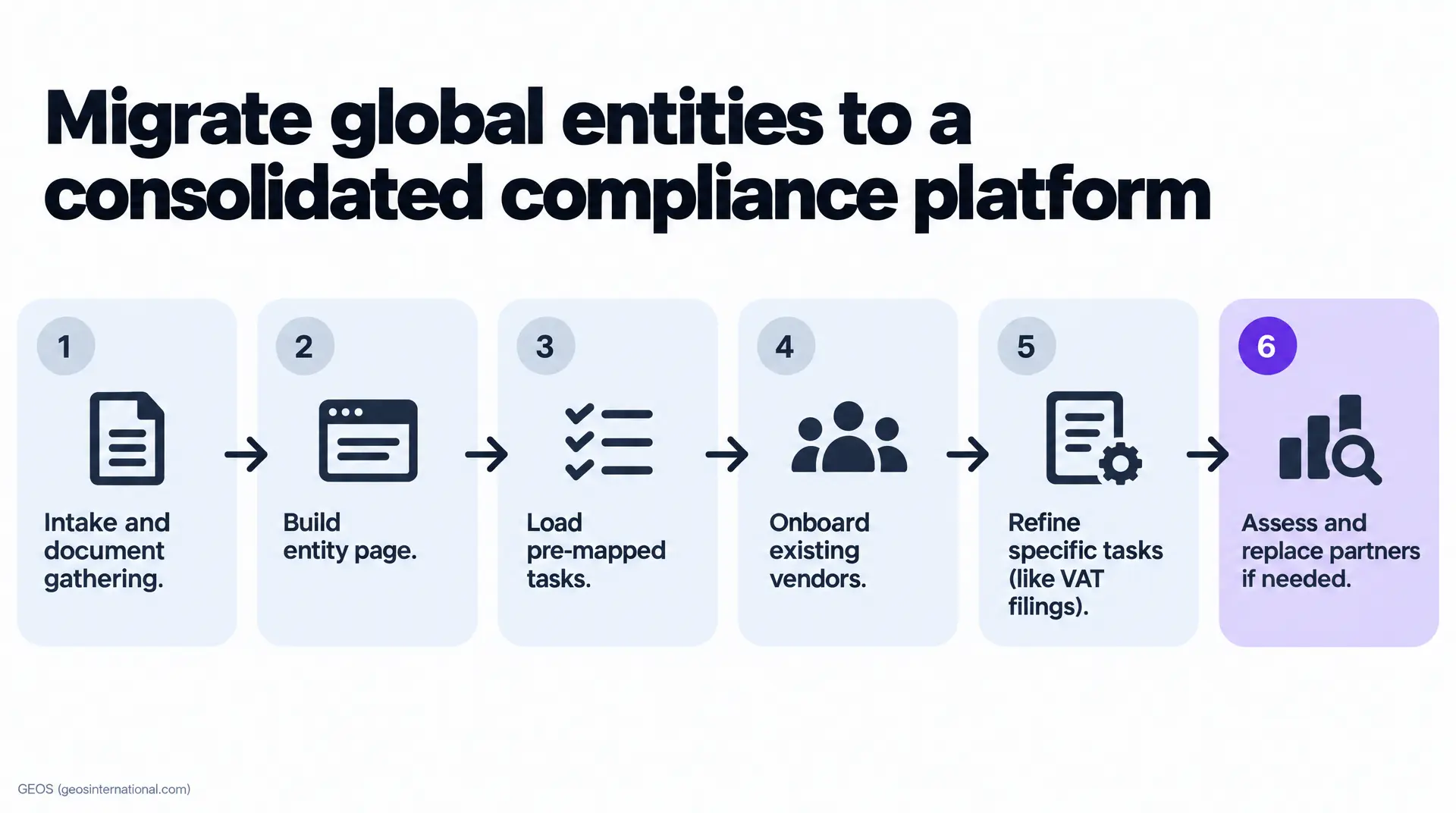
When we bring an existing footprint onto GEOS International, the sequence normally runs like this:
1. The client completes an intake on each entity and what it’s for, then sends every document on file for us to organize. 2. We build a page for each entity in the platform with its major attributes. 3. We load the pre-mapped compliance tasks for an entity in that country and when each one is due. 4. We onboard the client’s existing vendors and assign their tasks, so tax tasks go to the tax partner and HR and payroll tasks go to the payroll partner. Each vendor gets automated notifications and prompts for completion and receipts. 5. We work through the last 5 to 10% of tasks that are specific to the client, such as the VAT filings that follow a VAT registration once a threshold is hit, until the task list is fully accurate. 6. We assess each existing partner with the client on performance, efficiency and price, then either take over more of the work ourselves or replace that partner from our pre-vetted network.
We built the platform so a client can plug in the vendors it already trusts, whether that’s a single-market accountant or a Big Four firm, without losing the global view. Our team spent hundreds of hours documenting what it takes to set up and maintain an entity in each of the 80-plus countries we cover, which lets us compare an existing partner’s work against our mapping on the client’s behalf. That adds a safety layer that wasn’t there before. We still run standing meetings, Slack channels and email with clients alongside the platform.
On the cost side, our pricing is per entity, so a client with 10 entities can apply a different tier to each based on what it needs in that country. The Access tier is $49 a month per entity, or $5,880 a year across 10 entities, and your team administers the system of record, compliance calendar and task management itself. Core is quoted per country. On Core, we map the entity on your behalf, take care of its non-tax annual filings and act as the equivalent of a corporate secretary, keeping the lights on from a compliance perspective. A company with good providers in Canada and Mexico and nothing working in Singapore could keep the first two, with us coordinating them, and have us replace its providers in Singapore entirely.
How Do Companies Calculate the ROI of Consolidating Global Entity Management Vendors?
The return depends on how far your current fees and internal hours have drifted from what each entity actually requires. A footprint of active entities with well-performing local vendors will normally see it mainly in coordination time, in fewer gaps and in how quickly the next entity becomes operational. A footprint carrying dormant entities on full monthly packages, or paying a global firm’s premium for a handful of subsidiaries, is likely to see it on the invoices as well.
If it would help to see your entities mapped one by one, with each fee set against the tasks it covers, I’m happy to walk through that with you.
Frequently Asked Questions
Beyond vendor invoices, how much internal time does managing decentralized local compliance actually consume?
The internal drain is massive. The World Bank estimates a standard medium-sized company spends 234 hours annually on tax compliance alone. That completely excludes the project-management burden of chasing scattered global vendors. I believe those lost operational hours represent the biggest hidden ROI in vendor consolidation.
How do strict document validity windows cause sudden delays during multi-country entity setups?
Authorities enforce tight validity windows. Australia’s ASIC mandates constitutional documents be dated within three months of filing. Fragmented vendors cause disjointed communication, letting KYC documents expire. This forces a complete restart, derailing market launch dates. Consolidation maps these prerequisites upfront so you never miss a deadline.
Why does securing payroll capability often bottleneck our market entry even after formal incorporation?
Incorporation is only step one. True operational status requires secondary registrations that fragmented legal vendors often ignore. For example, you must separately register UK entities with HMRC and set up PAYE before your first payday. A consolidated approach ensures these critical post-incorporation plumbing tasks run concurrently.
If we pause operations in a foreign market, can we completely sever our local vendor contracts to cut costs?
No, because dormant entities still carry statutory obligations. A UK company dormant for tax must still file annual accounts with Companies House. If permanently shutting down, you must deregister within 30 days. Consolidating your footprint allows you to downgrade to basic maintenance fees without creating severe compliance gaps.
Will the proposed ‘EU Inc.’ framework eventually eliminate the need to coordinate local compliance vendors across Europe?
Not entirely. While the pending EU Inc. proposal targets 48-hour registrations by late 2026, it doesn’t erase national employment and social-law regimes. You will still need a unified operational system to navigate complex local HR and compliance frameworks once the regional entity is legally formed.