
A newly formed BV can be legally alive and operationally dead. The notary signs it into existence on a single cent of capital, and it still cannot pay a salary on the right rails or file a corporate return in the format the Tax Administration expects.
The incorporation runs cleaner than most of Western Europe, and that is exactly what fools foreign teams into believing the whole project will run clean.
The signed deed only opens the work: banking decides whether you are operational or merely incorporated, and accounting is where the surprise costs live.
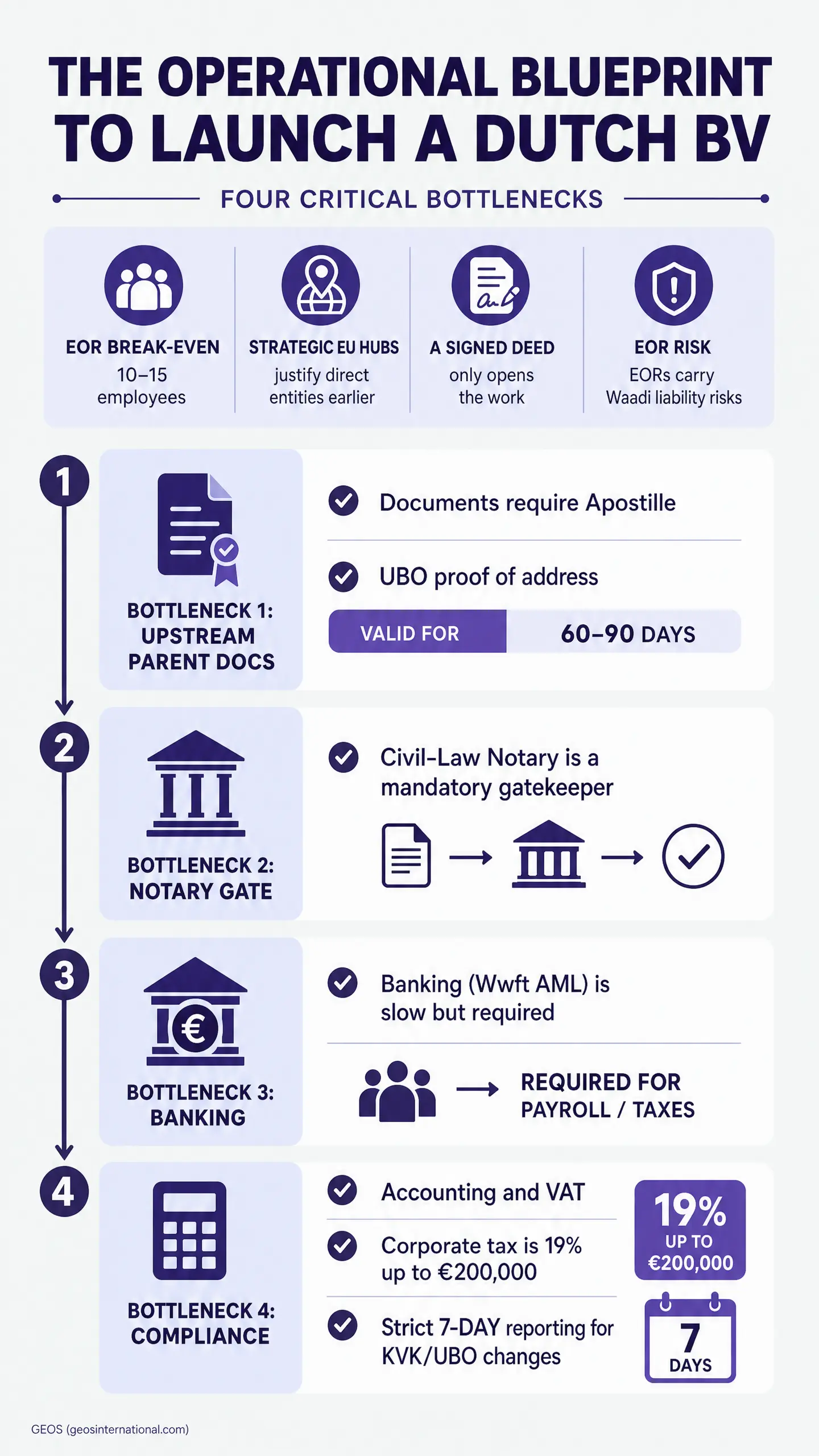
Key Takeaways
- The financial break-even point for converting from an Employer of Record to a Dutch BV is 10 to 15 employees, though EU VAT advantages often justify earlier incorporation.
- Under the Dutch Waadi framework, the Tax Administration can hold the hiring company directly liable if an Employer of Record supplier fails to pay payroll taxes or VAT.
- Registering directly as a foreign employer in the Netherlands yields a payroll tax number within a week but delays employee-insurance sector affiliation for up to eight weeks.
- Proof of address documents for Ultimate Beneficial Owners cannot exceed 60 to 90 days of age during Dutch BV formation, making document expiration a frequent notary bottleneck.
- Dutch corporate income tax rates for 2026 are 19% on profits up to €200,000 and 25.8% above that, requiring local ledger formats for returns due before June 1.
- The Dutch Business Register requires companies to report corporate changes, such as the departure of an Ultimate Beneficial Owner, within exactly seven days without the possibility of legal deferrals.
How Do You Determine If a Dutch Entity Is the Right Vehicle Over an EOR?
The purely financial break-even for converting from an EOR to your own Dutch entity lands around 10 to 15 employees. In practice, I have not personally seen a foreign company reach that number on an EOR in the Netherlands. They either keep the team small or elect to incorporate while still under 10, because the reason for being there was never only headcount.
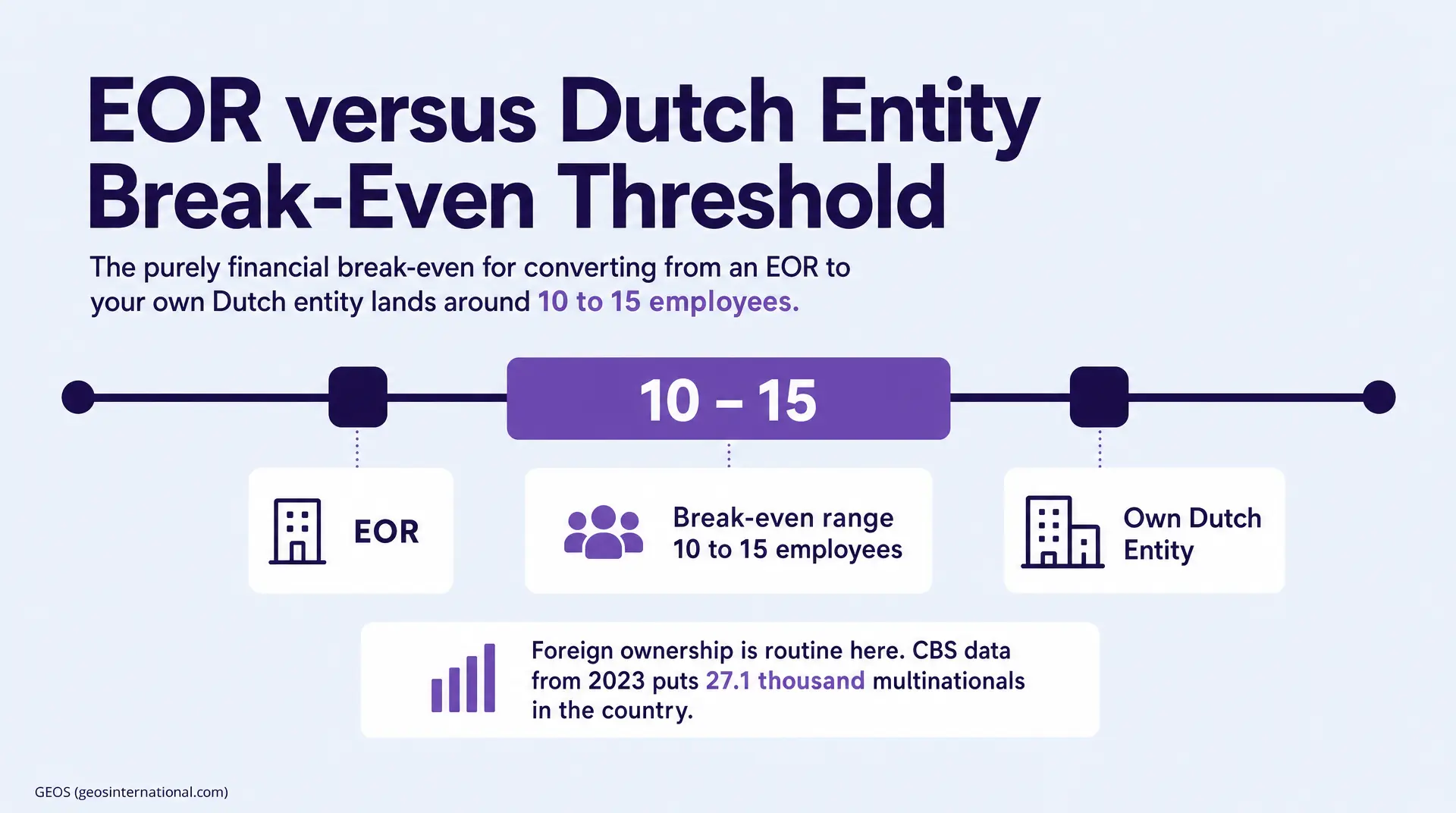
Foreign ownership is routine here. CBS data from 2023 puts 27.1 thousand multinationals in the country, employing roughly one in three business-economy workers, and Rotterdam moved 428.4 million tonnes of cargo in 2025. That depth cuts both ways. Dutch notaries, banks, and CPAs have processed foreign-owned BVs many times over, and the authorities know exactly what to scrutinize.
If your reason for entering includes an EU hub, EU VAT advantages, selling locally, or contracting directly with Dutch enterprise clients, the headcount math shrinks fast. Any one of those objectives can justify going direct well before you reach 10 people.
What Are the Legal and Operational Cautions Before Committing to a Dutch Entity?

The first is that an EOR carries more exposure than the sales deck implies. In the Netherlands, an EOR operates inside the Waadi framework as a supplier of workers. Business.gov.nl is explicit that the supplier must be registered in the KVK Business Register, that you as hirer must check that registration, and that mandatory certification for staff suppliers starts on 1 January 2027. If the supplier fails to pay payroll tax or VAT, the Tax Administration may hold the hirer liable. That is the Dutch version of a point I make about EORs everywhere: liability protection exists in concept, and the paperwork routes it back to you.
The second is about shortcuts. Some companies attempt a foreign employer registration to run direct Dutch payroll without a BV. I typically advise against it. Per the Belastingdienst’s registration guidance, the payroll taxes number arrives within about a week, but employee-insurance sector affiliation can take up to eight weeks. You absorb that wait without gaining an entity that can sign a lease or a local contract. And once you have a tax-paying Dutch entity, do not keep an EOR running beside it. Local officials view that as a much worse posture than using an EOR with no entity at all.
Why Must Parent Company Documents Be Moved First During Dutch Entity Formation?
The first platform dedicated to streamlining entity setup and management.
Fast timelines quoted for the Netherlands start the clock when the application is lodged. The upstream work is left out, and that is where foreign parents lose weeks.
For a US parent, the notary’s file includes the parent’s corporate documents, a decision on how many directors you are appointing, and the Dutch incorporation documents we draft for the deed. The parent documents must be legalized with an apostille in the US and couriered over. One friction point is lighter here than in Germany or Spain: English-language documents generally do not need translation for use in the Netherlands, provided they are original and complete, including annexes. Missing annexes are a quiet reason files get bounced.
UBO identification runs in parallel. Business.gov.nl lists the indicators as more than 25% of shares or voting rights, statutory directorship, or effective control, with foreign UBOs registered regardless of residence or nationality. If your parent sits under a venture fund and two holding companies, settle who meets those indicators before you request anyone’s passport.
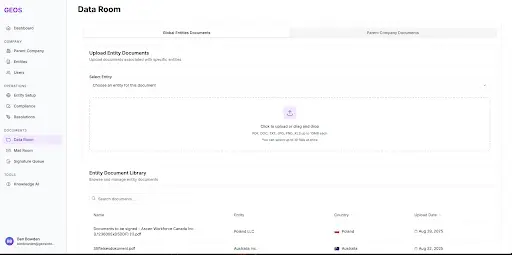
The document that most often causes the biggest snag is proof of address for UBOs and directors. It has to be within 60 to 90 days old when used. I have watched a UBO who is disconnected from the day-to-day sit on the request out of privacy concerns, and by the time the rest of the file is ready the utility bill has expired and collection restarts. If GEOS or any provider is acting on your behalf, the power of attorney sits in the same critical path with the same signing bottleneck. Sequence the Dutch documents to land inside that validity window relative to the notary date, and the rest of the file tends to hold.
Why Is the Civil-Law Notary the Critical Path in Dutch BV Incorporation?

A Dutch BV cannot be self-incorporated. Business.gov.nl sets out the mechanics: a civil-law notary executes a notarial deed with at least €0.01 in starting capital, and the KVK and Tax Administration registrations follow from that deed. The notary’s review is a legal gate, and it is the main caveat to an otherwise straightforward process.
Three things go wrong at this gate. The notary is difficult to schedule. The notary rejects the initial application. Or the notary asks for amendments to specific documents inside the file. The third is the expensive one, because an amendment that touches a parent document can send you back through the apostille and courier loop. Notaries and local officials are not always consistent in what they request, and an additional certification nobody flagged is a common surprise.
This is why the notary relationship carries more weight in the Netherlands than in most markets we work in. A notary who regularly handles foreign-owned BVs will tell you what to fix before the appointment instead of after it. We have built those relationships for exactly that reason. When you evaluate a provider, ask which notary they use and how often that notary sees a US or Canadian parent.
In our mapping, the Netherlands also does not carry the resident director requirement we plan around in Mexico, India, or Singapore. Your bottleneck is a calendar slot and a clean deed.
Why Must You Establish Dutch Corporate Banking Rails Before Running the First Payroll?

Once the deed is executed, post-incorporation registrations are relatively simple, and payroll is a well-trodden path for foreign companies. Banking is where I ask ops leaders to slow down.
My recommendation is a traditional Dutch bank account for two flows: local payroll payments that ensure social security contributions are actually made, and corporate tax payments. A FinTech account may be the better tool for day-to-day money movement. For many Dutch subsidiaries we land on a hybrid, with FinTech for operational transfers and the traditional bank reserved for payments an authority needs to recognize.
Expect the traditional onboarding to be slow, and understand why. Dutch banks work under anti-money-laundering obligations, the Wwft, that De Nederlandsche Bank’s guidance spells out: verify the customer and its UBOs, understand the ownership and control structure, establish the purpose of the relationship, and monitor it continuously. The UBO package you assembled for the notary should be ready for the bank on day one.
What Happens to Dutch Payroll Tax Payments If Corporate Bank Onboarding Stalls?
The honest nuance is that Dutch payroll-tax payments can be made from a foreign account. The Tax Administration warns that payments from abroad usually need additional processing time, may carry extra charges, and remain your responsibility to land on time. In practical terms, a stalled bank shifts the timing risk onto your team rather than blocking you outright, and a late first payroll is a bad way to introduce yourself to a tax authority this attentive.
I have seen what the patchwork alternative costs elsewhere. A US client expanding into India stalled on their bank application, ran payroll through a workaround to hit a start date, and ended up with long-term problems in their provident fund and pension payments. Start the Dutch KYB the day the deed is signed, and do not run a first payroll on a workaround.
Why Must Corporate Accounting Books Follow Dutch Format From the First Invoice?
Here the Netherlands earns its tier-two rating. The setup is manageable. The ongoing accounting and corporate tax work is where foreign companies get caught off guard.
The pattern is consistent. A US headquarters treats the Dutch entity as simple, runs a few invoices through it, and defers proper bookkeeping under the BV. Then corporate tax season arrives. The Netherlands has very specific requirements for how those filings are calculated, made, and reviewed, and books kept in a US ledger format do not translate cleanly. The team ends up reconstructing a year of records under deadline.
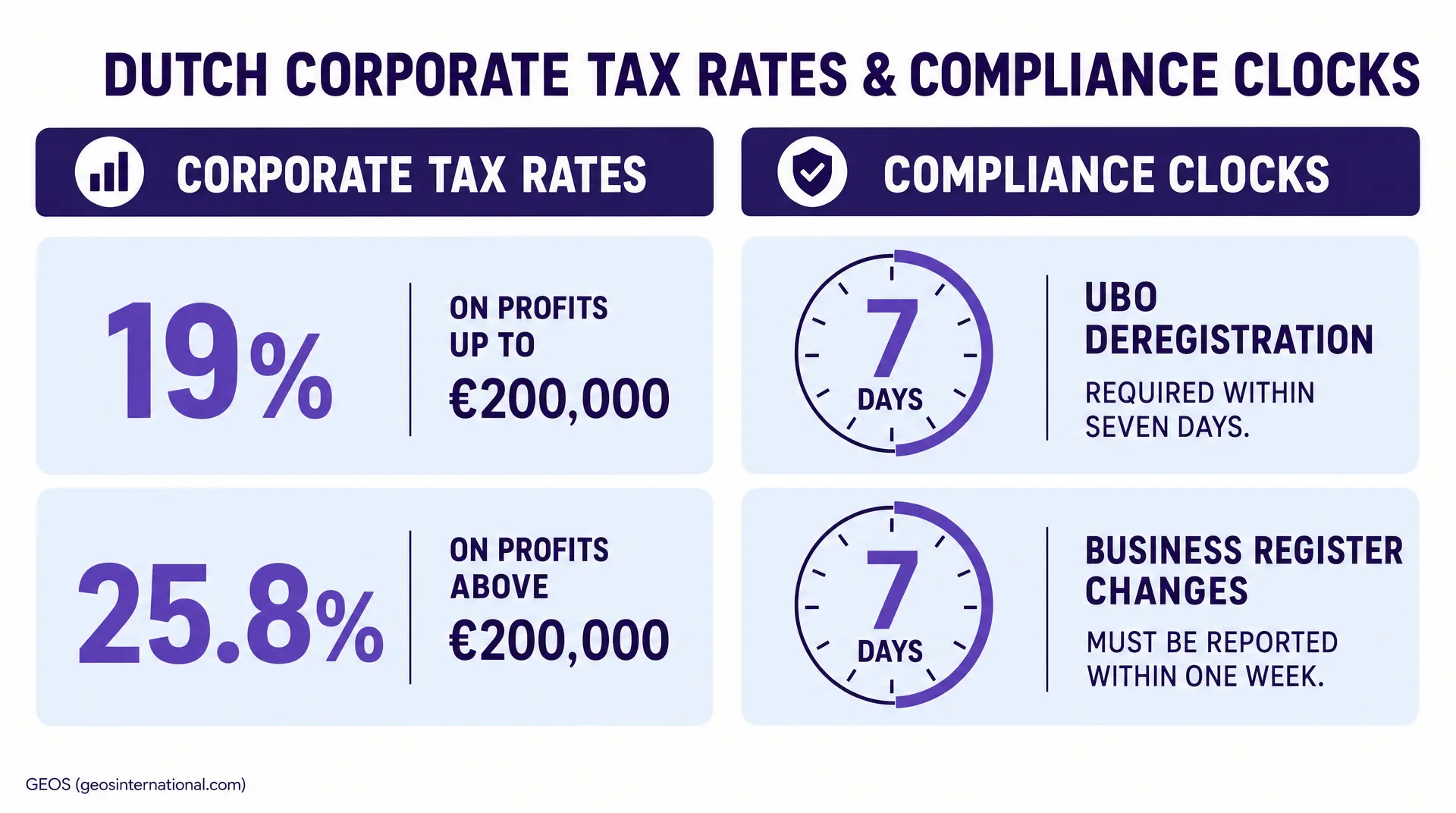
The obligations are concrete. For 2026, corporate income tax is 19% on profits up to €200,000 and 25.8% above that. For a calendar-year company, the return is due before 1 June of the following year. Records must be retained for seven years. Annual financial statements go to KVK no later than eight days after adoption and at most 12 months after year end. VAT returns run quarterly, and a Netherlands-established company files within one month after the period, even in a quarter with no Dutch activity. The Tax Administration itself notes that processing backlogs can delay refund requests.
How Do Tax Authorities Scrutinize Large Corporate VAT Reclaims in the Netherlands?
That last point connects to the clearest Dutch example I can give. A client set up a Dutch entity and, right afterwards, submitted a relatively large VAT reclamation for a past purchase. In some countries that would have gone through quietly. In the Netherlands, the level of scrutiny was very high and the authorities pushed back hard. Getting it approved triggered a significant amount of additional tax and accounting paperwork. It succeeded in the end, after a lot of unplanned work. If VAT reclamation is part of your business case, run it as its own workstream and keep that cash out of your launch budget until it clears.
I strongly recommend a Dutch CPA who understands local filing protocol and, just as important, what the Tax Administration will push back on in how the books are kept. That is a different skill from bookkeeping. Engage them before the first transaction runs through the BV. Waiting for the first return is how the reconstruction problem starts.
Who Should Own Post-Launch Corporate Secretarial and Compliance Tasks in the Netherlands?
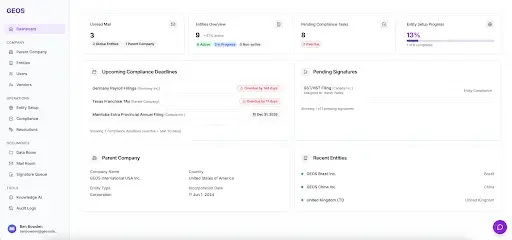
Corporate secretarial work in the Netherlands is more of a spiritual role than a named seat, but someone has to own it. That covers the annual non-tax filings and every change to the entity, whether a registered address move, a director swap, an amendment to the articles, or a redistribution of shares. Those changes come with hard clocks. Business Register changes must be reported to KVK within one week. When a person stops being a UBO, KVK requires deregistration within seven days and states it has no legal power to grant a deferral.
Those clocks turn a routine departure into a compliance problem. I have cleaned up the aftermath elsewhere: a client’s Peruvian entity where a departed shareholder left it below the legally required two, and a client whose former employee stayed on record as a local director long after leaving. In both cases the fix was documentation, and in both cases the delay was the damage. With a seven-day UBO window, the same lapse in the Netherlands becomes a KVK issue within a week.
The failure mode for ops leaders is the black box. You get a bill from a Dutch firm, you pay it, and you hope. You are playing with a blindfold. My standard is that every compliance task has a named owner, a due date, and a receipt on completion. Our platform enforces that by prompting whoever holds the task, our team or your existing Dutch accountant, to submit proof when it closes. If your current Dutch vendor performs, keep them and plug them in. If not, replace them.
What Are the Primary Time Bottlenecks When Launching an Operational Dutch BV?
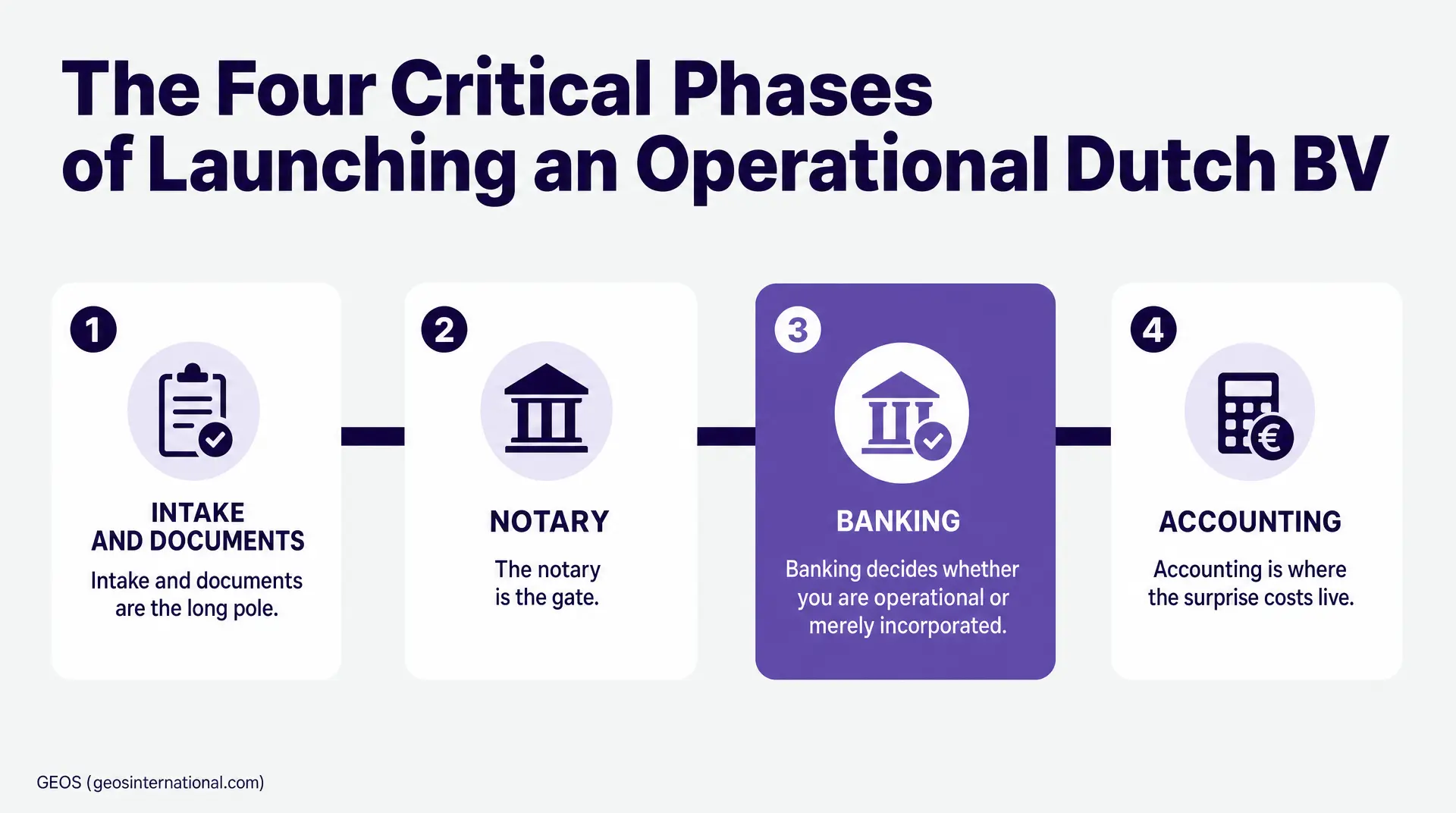
I will not hand you a single number for how long a Dutch BV takes to become operational. The honest answer depends on how fast your UBOs move, how soon we get in front of a notary, and how long the bank takes. What I can tell you is where the time goes. Intake and documents are the long pole. The notary is the gate. Banking decides whether you are operational or merely incorporated. Accounting is where the surprise costs live. Plan your market-entry date around those four facts and it stops being a hope and becomes a schedule.
Frequently Asked Questions
When can a new Dutch BV legally execute its first local payroll?
Incorporation is only step one. While the Belastingdienst typically issues your payroll taxes number within one week, your employee-insurance sector affiliation can take up to eight weeks. Additionally, the Return to Work Fund contribution letter takes four weeks. Plan your hiring waves around these hard operational timelines, not just the notary date.
What operational risks arise from delaying post-launch updates to the Dutch Business Register?
The clocks are unforgiving. You have exactly one week to report changes to the KVK, and seven days to deregister a departing UBO. The KVK explicitly states they cannot grant deferrals. Missing these windows isn’t just an administrative error. It can trigger direct business liability for the entity. Assign named owners to these tasks immediately.
Can we bypass quarterly Dutch VAT filings during our initial low-revenue setup phase?
Generally, no. You must file quarterly even with zero activity. However, if your initial annual turnover remains under €20,000, you can apply for the small-business VAT scheme (KOR). This exempts you from charging VAT or filing returns, but remember: you cannot reclaim VAT on your setup costs and investments while participating.
Will our Dutch subsidiary’s cross-border enterprise contracts incur the standard 21% VAT?
Not necessarily. The Netherlands operates on three VAT rates: 0%, 9%, and standard 21%. Crucially for operational setups, the 0% rate can apply to specific cross-border transactions. Map your invoicing structure with a Dutch CPA early to optimize cash flow and prevent unnecessary 21% tax friction on international deals.
Does hiring temporary operational staff via local agencies bypass Dutch entity compliance?
Absolutely not. Temporary staff suppliers fall under the strict Waadi framework. If the agency providing your workers fails to remit their required payroll tax or VAT, the Dutch Tax Administration can hold you – the hirer – legally liable for those missing amounts. Always verify your vendor’s KVK Business Register certification before signing any contractor agreements.