
When I was in the EOR space, we worked with a US company that wanted to hire an employee in Japan. That is a pretty common request, and for one or two hires in Japan, an EOR is still what I would recommend. In Japan, people tend to stay with one employer for the long term, and there is less turnover than in many other countries. Letting an employee go is very difficult from the employer’s side, which is a major cultural mismatch for a company used to at-will employment. Under Article 16 of the Labor Contract Act, a dismissal is invalid if it lacks objectively reasonable grounds or is not considered socially acceptable. The company let the employee go without realizing it was violating Japanese labor law, and that triggered a massive lawsuit. The EOR was the legal employer throughout. Because the company’s own actions led to the lawsuit, the company was eventually liable for everything.
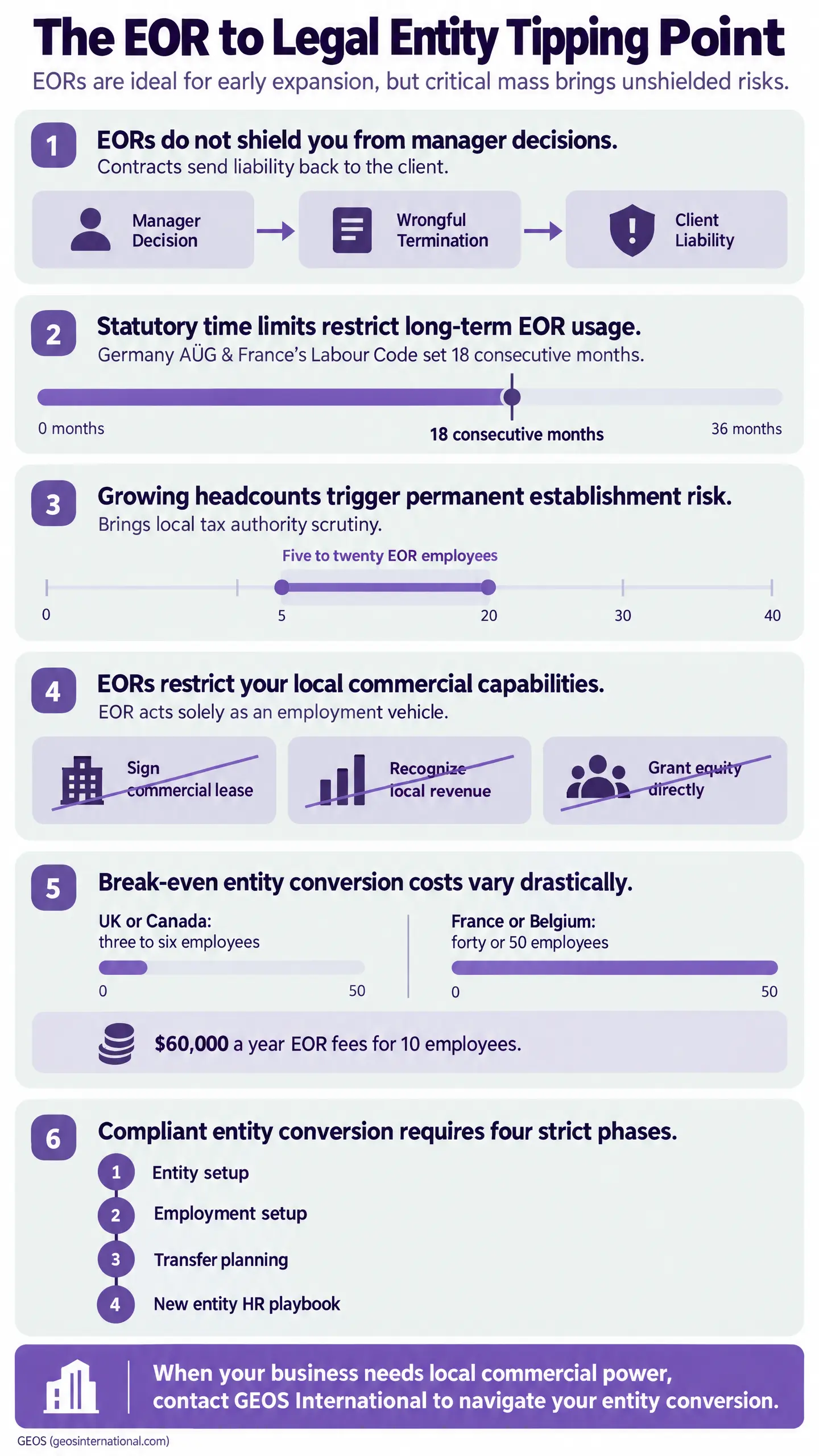
The co-employment trap is the assumption that because the EOR is the employer on paper, it also carries the legal risk. In the co-employment model of EOR, the contract normally sends liability back to whoever controls the work, and that is your company.
Key Takeaways
- In an Employer of Record model, Master Services Agreements typically pass legal and financial liability for wrongful termination disputes back to the client company directing the daily work.
- German and French labor laws generally limit temporary Employer of Record assignments to 18 consecutive months, after which the client company can legally default to the direct employer.
- Companies using an Employer of Record typically trigger permanent establishment tax risks when their local headcount reaches between five and twenty employees, depending on the specific country.
- The financial break-even point for converting from an Employer of Record to an owned legal entity ranges from three to six employees in the UK to 40 to 50 in France.
- Hidden expenses in Employer of Record contracts, including foreign exchange conversion margins and statutory payroll taxes, typically add 10% to 30% to the base salaries of international employees.
- Employer of Record agreements function strictly as employment vehicles, legally preventing client companies from signing commercial leases, recognizing local revenue, or directly granting equity to international staff.
How Do Master Services Agreements Allocate Legal Liability in Employer of Record Models?

An EOR lends you its local infrastructure, and I know that infrastructure from the inside. At Borderless AI, where I was VP of Sales, I was part of the internal task force that set up the company’s own entities around the world so it could legally provide EOR services. When you hire through an EOR, your employee signs an employment contract with the provider, and you sign a master services agreement, or MSA, with it. Your managers direct that person’s work day to day, so from a practical perspective they are effectively your employee.
Because you control the work, the EOR almost always uses the MSA to indemnify itself against issues that arise from your actions. The language often provides sweeping indemnification across many scenarios. The liability is shared in principle, and the EOR carries some inherent risk as the employer on paper. In practice, the agreement passes liability and indemnity back to you when a dispute comes from a decision you made.
From a liability perspective, wrongful termination disputes are a more common and immediate risk than EOR tax penalties, and they often turn into large joint lawsuits. US-based companies are used to at-will employment at home. As a result, they are often hit with major severance bills they did not expect when they let international employees go. Before you sign or renew an EOR agreement, ask your legal team which clauses indemnify the provider for decisions your managers make, starting with terminations.
When Is an Employer of Record the Best Compliance Strategy for Global Expansion?
The first platform dedicated to streamlining entity setup and management.
In most countries, an EOR is cheaper, faster and much easier to manage than an entity for your first employee. For one or two hires in Belgium or Brazil, where setting up an entity is notoriously difficult, it is the best bet. When a company tells us it needs an entity in France because it wants to hire three employees, we tell it to use an EOR and refer it to one of our EOR partners. Hiring people abroad as contractors and treating them as full-time employees is risky but common. I would argue that an EOR at low headcount is a significantly safer compliance strategy than that.
Every company has a global expansion journey that has a beginning, middle and end in each country. EOR is the best solution for the beginning and perhaps the middle. Once a company has reached critical mass in a country, risks appear that an EOR does not protect you from.
What Are the Statutory Time Limits for Employer of Record Assignments Under Labor Leasing Laws?
German law looks at the same control. The Act on Temporary Agency Work, the AÜG, defines temporary agency work to include workers who are integrated into the user company’s organization and subject to its instructions. That describes how an EOR employee normally works with you. Agencies the AÜG covers generally need a permit. Whether a given EOR arrangement counts as temporary agency work depends partly on how the work is actually arranged.
Where an arrangement is unlicensed or otherwise invalid, the AÜG deems an employment relationship to arise with the user company in specified cases. That means the client can end up as the employer by law. Mass tax penalties on EOR platforms are rare. In Germany and Austria, though, companies that unknowingly engage in labor leasing without a license can face severe regulatory action.
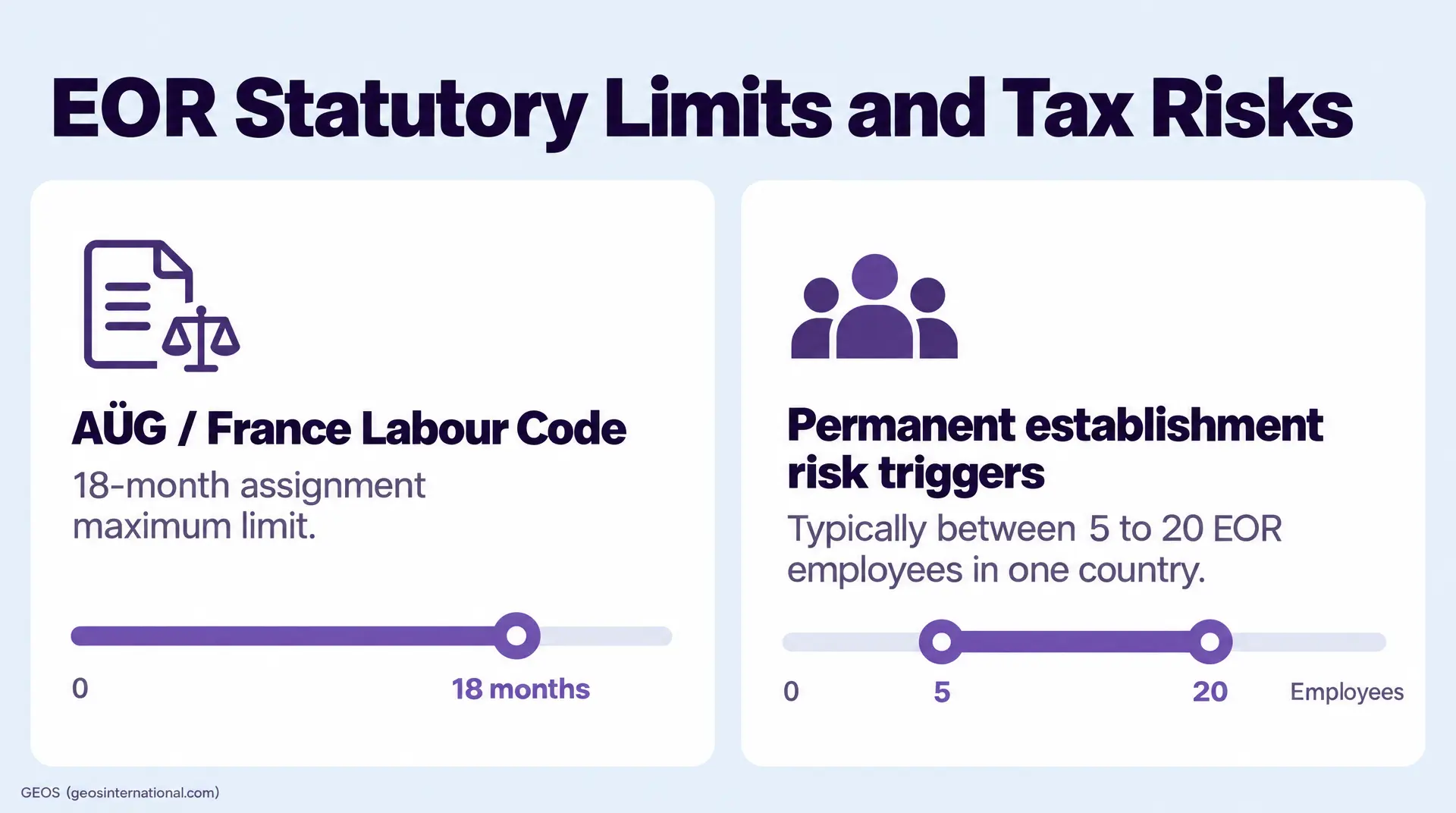
Where the AÜG applies, it generally limits the assignment of the same worker to the same company to 18 consecutive months. An earlier assignment still counts if the gap was three months or less, and qualifying collective agreements can set different maximums. France’s Labour Code sets 18 months as the default maximum for temporary-work assignment contracts where no branch agreement sets another rule. Whether either regime reaches your arrangement depends on how it is classified. Put that question to a local employment lawyer before you plan to keep anyone on an EOR past 18 months.
Technically, the only fully compliant way to employ someone in another country is a direct employment relationship through your own subsidiary. Most EORs either don’t have the necessary staffing license or operate where no formal laws yet regulate the arrangement.
When Do Employer of Record Employee Headcounts Trigger Permanent Establishment Tax Risks?

Permanent establishment, or PE, is when a country treats your activity there as a taxable presence of the parent company. There is no general headcount trigger for PE in the OECD Model Tax Convention. Its Article 5 centers on tests such as a fixed place of business and certain dependent-agent activity. The bilateral treaty and local law still have to be checked.
In practice, I would put the point where companies begin to face PE risk somewhere between five and twenty EOR employees in one country, depending on that country’s stance. Whether it becomes a problem depends on the local authorities and on whether the situation comes to their attention. Nike is a high-profile public example of the severe PE risk that comes with relying heavily on international contractors.
Most EOR contracts pass indemnity back to the client and still leave the parent company exposed to PE. For that reason, I describe what an EOR offers as liability protection in concept. I also advise strongly against keeping staff on an EOR in a country where you already operate a tax-paying entity. Local officials see that as a much worse posture than using an EOR with no entity at all.
What Commercial Business Capabilities Are Restricted When Using an Employer of Record Model?

I think of EOR solely as an employment vehicle. It gives you no ability to sign a commercial lease, recognize revenue locally, pursue tax optimization or contract directly with enterprise and government organizations in that country. A need to import or export goods can also shift the mathematical equation toward your own entity a lot earlier than headcount costs alone would.
Equity has the same limit. Granting equity to someone employed through an EOR takes a separate contractor agreement or vehicle outside the employment relationship, which is a lot shakier in terms of making it defensible. If your reason for entering a country includes anything beyond employing one or two people, I would skip the EOR stage and explore an entity from the start.
How Do Break-Even Headcount Costs for Employer of Record to Entity Conversions Vary Globally?
From a cost perspective, the advertised price is not telling the total story. EORs charge a nominal fee of around $500 per employee per month. At 10 employees, that is $60,000 a year in fees alone, before statutory benefits, payroll taxes and statutory bonuses.
In Mexico, salaries are calculated more like a day rate than an annual salary, and the year-end bonus, the aguinaldo, is set in days as well. Article 87 of the Federal Labour Law requires at least 15 days’ salary, paid before December 20. That works out to a minimum of roughly 4% on top of annual base pay.
What is often misbudgeted is the cost for money movement abroad. You send your EOR partner USD, and it keeps an FX margin when it converts the funds into Mexican pesos. Hidden expenses like FX translation and statutory payroll taxes typically add 10% to 30% on top of base salaries.
Owning the entity has its own costs: entity compliance, payroll, benefits, tax compliance and a registered address. I don’t treat the comparison purely as a financial equation of saving money. The operational effort in that country goes into it, and so does the ability to offer equity and bespoke benefits compliantly. That makes the break-even a bespoke calculation per country:
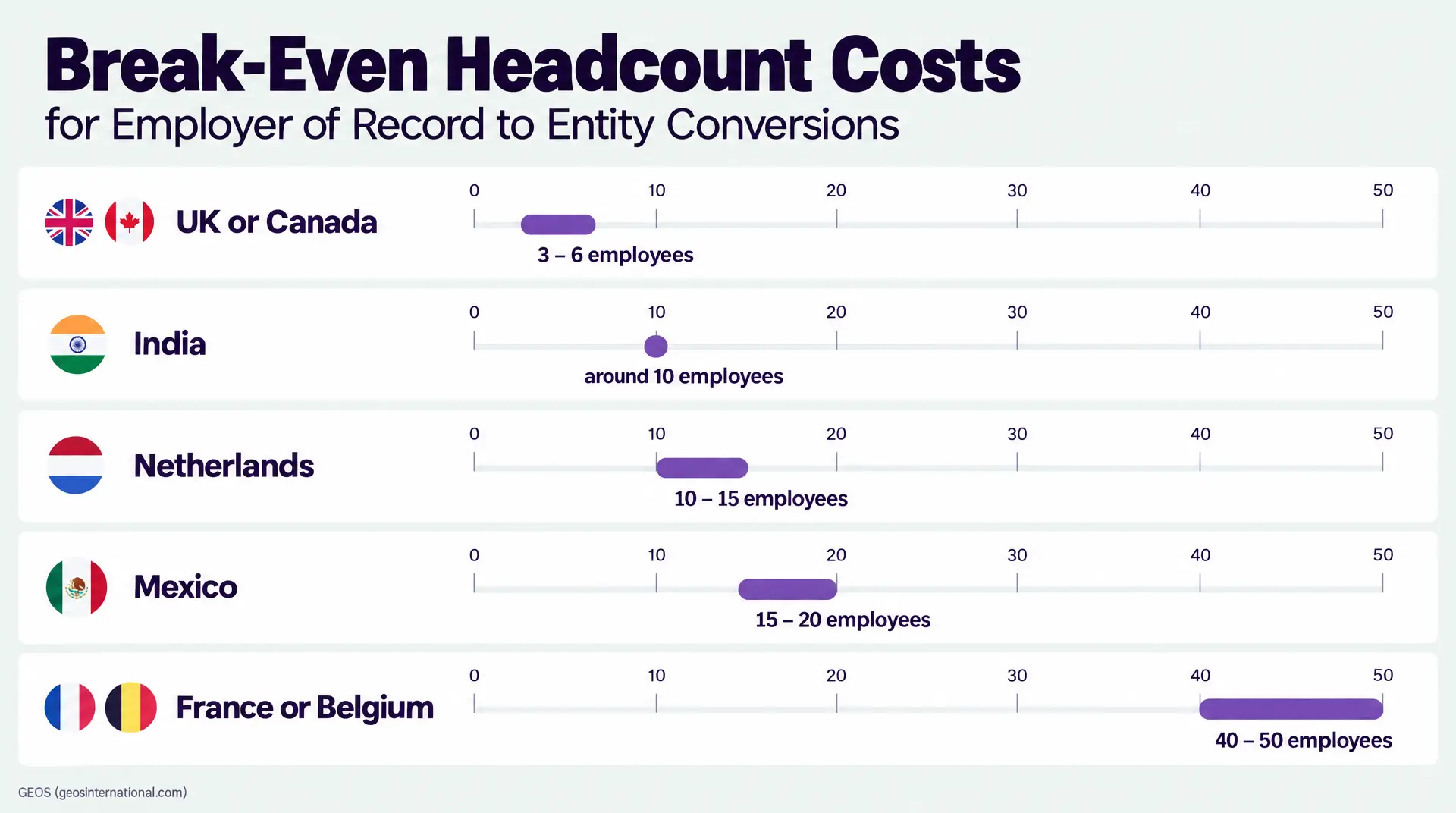
– UK or Canada: closer to three to six employees, I would argue. – India: around 10, often with plans to scale into a global command center. – Netherlands: around ten to fifteen. – Mexico: around fifteen to twenty, because of its ongoing tax, accounting and employment requirements. – France or Belgium: closer to forty or 50.
Compare those figures with the five-to-20 range where I would expect PE risk to begin. In the UK or Canada, the cost case for your own entity normally arrives first. In France or Belgium, it may not arrive until 40 or 50 people, which is well past that range. In those countries, I would argue the cost comparison alone shouldn’t set the timing.
The calculation does not always favor the entity. One company I recall moved more than 10 employees from a US EOR to its own entity and hit a major cost shock. At that headcount, it no longer qualified for the large-group insurance rates the EOR had leveraged. Matching its employees’ existing benefits became significantly more expensive.
What Are the Phases of an Employer of Record to Legal Entity Conversion Process?
Moving workers off an EOR is a lengthy process. Each employee ends their contract with the EOR and signs a new one with your entity, with continuity in between, and a lot of companies rush it. It usually breaks down on communication. I believe the biggest mistake in this transition is failing to explain the change of legal vehicle in advance. Employees can panic when they are asked to resign while they keep working for you. When employees know what the process looks like and what is required from them, and the company takes its time, it usually goes smoothly.
Benefits need the same care. I worked with a company moving employees across eight to ten US states in the other direction, from its own entity onto an EOR. It repeatedly missed its transition deadlines because of complications and employee pushback over changes to their benefits packages.
An EOR that offers to manage your move internally can’t make those calls for you. It can’t help your employees navigate the process. It can’t decide how you honor their seniority, benefits and vacation accruals, and it generally won’t handle drafting your own employment contracts. At GEOS International, we run the conversion in four phases:
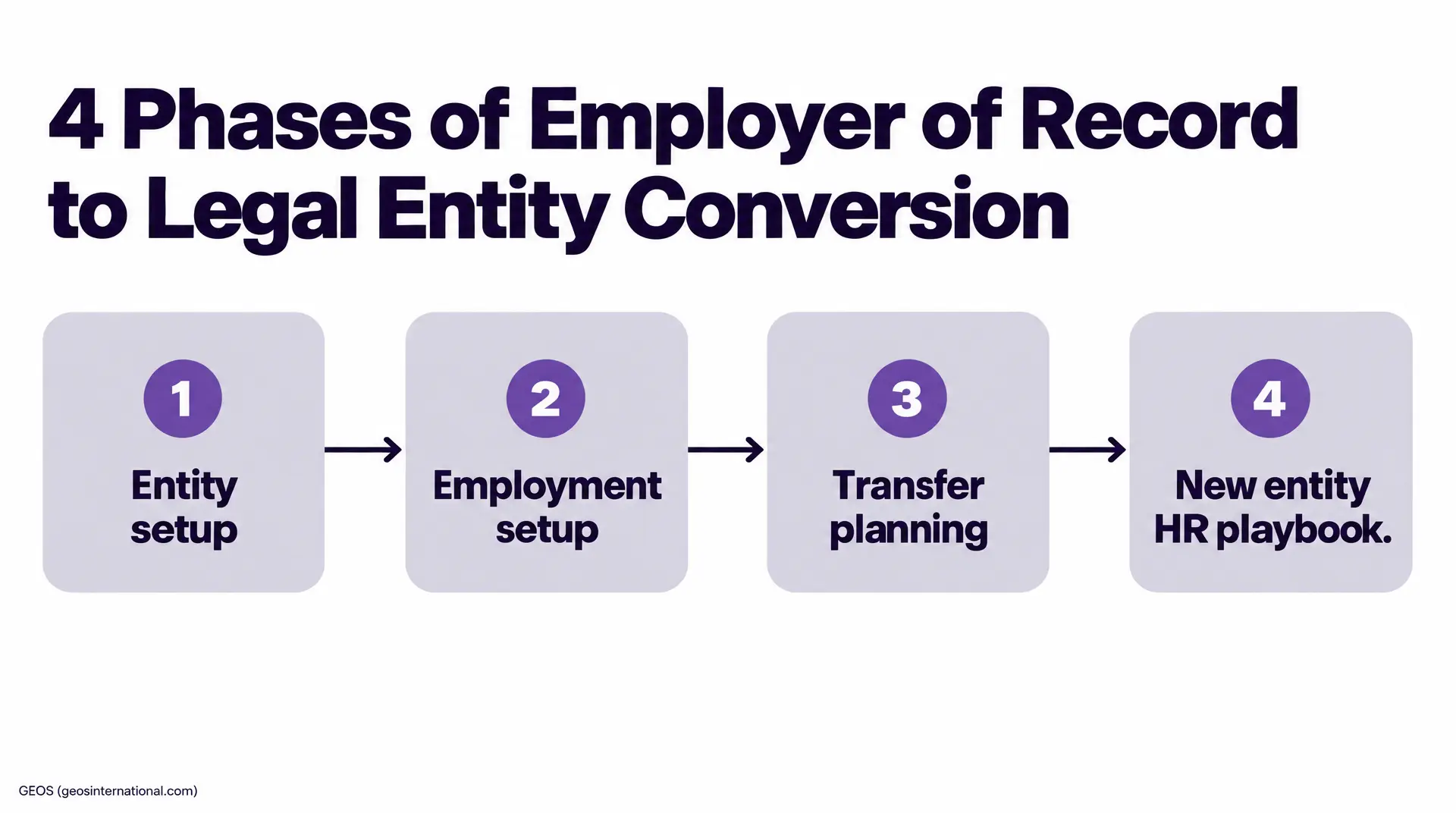
1. Entity setup: planning and setup activities, normally four to twelve months of project management across vendors. 2. Employment setup: local tax registrations, private pension accounts, local bank accounts, insurance and benefits, and the employment contracts and related documents. 3. Transfer planning: notice to the current EOR covering payroll lead time, social insurance un-enrollment, deposit reconciliation and work permit transfers, plus the employee communication plan and an assessment of the legal transfer mechanisms. 4. New entity HR playbook: onboarding employees to the new entity, running the first payroll and setting up an HR playbook for ongoing local compliance.
In Mexico, the employment setup needs a local legal representative to wet-sign employment contracts. Mandatory social security payments can only go through six traditional banks with the right rails, so a FinTech account typically won’t get payroll running. Companies often get far into incorporation there before realizing they can’t do either without a local director. Until those pieces are in place, the entity is incorporated but not operational, and the transfer date has to follow the operational date.
An EOR can also be part of the plan. During one entity setup in India, delays in getting the director’s signatures and proof of address stalled the process. We partnered with an EOR to hire the client’s team temporarily, which kept the start dates the employees had been given verbally. Once the entity was established, we converted them to it.
For each country where you have people on an EOR, the condition I would test is whether the business there still only needs to employ people. While that holds and the team is small, the EOR is doing what it was built for. The liability left to manage is the one your own managers’ decisions create. The answer changes once the business needs to contract, lease or recognize revenue locally. It also changes when a time limit like the AÜG’s applies to your arrangement, and when headcount moves into the range where PE can come to the attention of local authorities. At that point, your own entity is the compliant employment vehicle.
EOR-to-entity conversion is a dedicated service at GEOS International, and we partner with a number of EOR companies because our work is complementary to theirs. If you have a team on an EOR in a country where those conditions are starting to apply, I’m happy to walk through what the move would involve there and how long it would realistically take.
Frequently Asked Questions
Does using an Employer of Record shield my company from U.S. federal employment tax liability?
Not automatically. The IRS states liability depends on third-party arrangement facts. Even with an outsourced provider handling payroll, you might remain solely or jointly liable for federal employment taxes. You cannot assume the EOR’s paperwork completely severs your corporate tax exposure.
Can an EOR eliminate contractor misclassification risks if we just change the contract label?
No, a contract label never overrides operational reality. The IRS analyzes behavioral and financial control to determine worker status. If your managers dictate daily tasks and schedules, the worker is effectively your employee, leaving your company exposed to misclassification liabilities despite the EOR agreement.
What are the exact liability risks if our EOR provider lacks a required German labor-leasing permit?
The regulatory blowback hits you directly. Under Germany’s AÜG, using an unlicensed provider legally deems an employment relationship to exist directly with your company. You can face joint and several liability for unpaid remuneration and severe regulatory penalties for unauthorized temporary agency work.
Does the OECD Model Tax Convention grant a 12-month grace period before EOR workers trigger Permanent Establishment?
That is a dangerous misconception. The OECD’s 12-month rule specifically applies to building sites or construction projects. For EOR workers, Permanent Establishment hinges on dependent-agent activity, which can trigger corporate tax liabilities from day one depending on local enforcement.
Are we exposed to strict statutory time limits for EOR assignments in Singapore?
Unlike European labor-leasing laws, Singapore focuses on provider licensing. The Ministry of Manpower requires activity-based licenses for employment agencies. While there is no maximum EOR engagement duration, utilizing an unlicensed provider creates immediate operational friction and legal compliance risks for your local expansion.