
We worked with a client whose managing director was in charge of all of the company’s global entities. When the company needed to set up some new entities and formalize its process, it realized the managing director hadn’t been keeping good tabs on everything. Documents were hard to find. Invoices at each local subsidiary were probably higher than they should have been, and late filings and penalty fees were looming.
It wasn’t necessarily the managing director’s fault. They had a lot of other responsibilities, and this work hadn’t been put on their plate, so it didn’t get much attention. In my experience, in-house corporate secretarial work often looks like this: one person who everyone internally assumes knows about incorporation, handling it alongside everything else.
For most privately held scale-ups with more than a handful of entities, I would argue for a split rather than choosing in-house or outsourced corporate secretarial services. Ownership and visibility stay inside the company, and the local execution goes to partners, decided country by country.
Key Takeaways
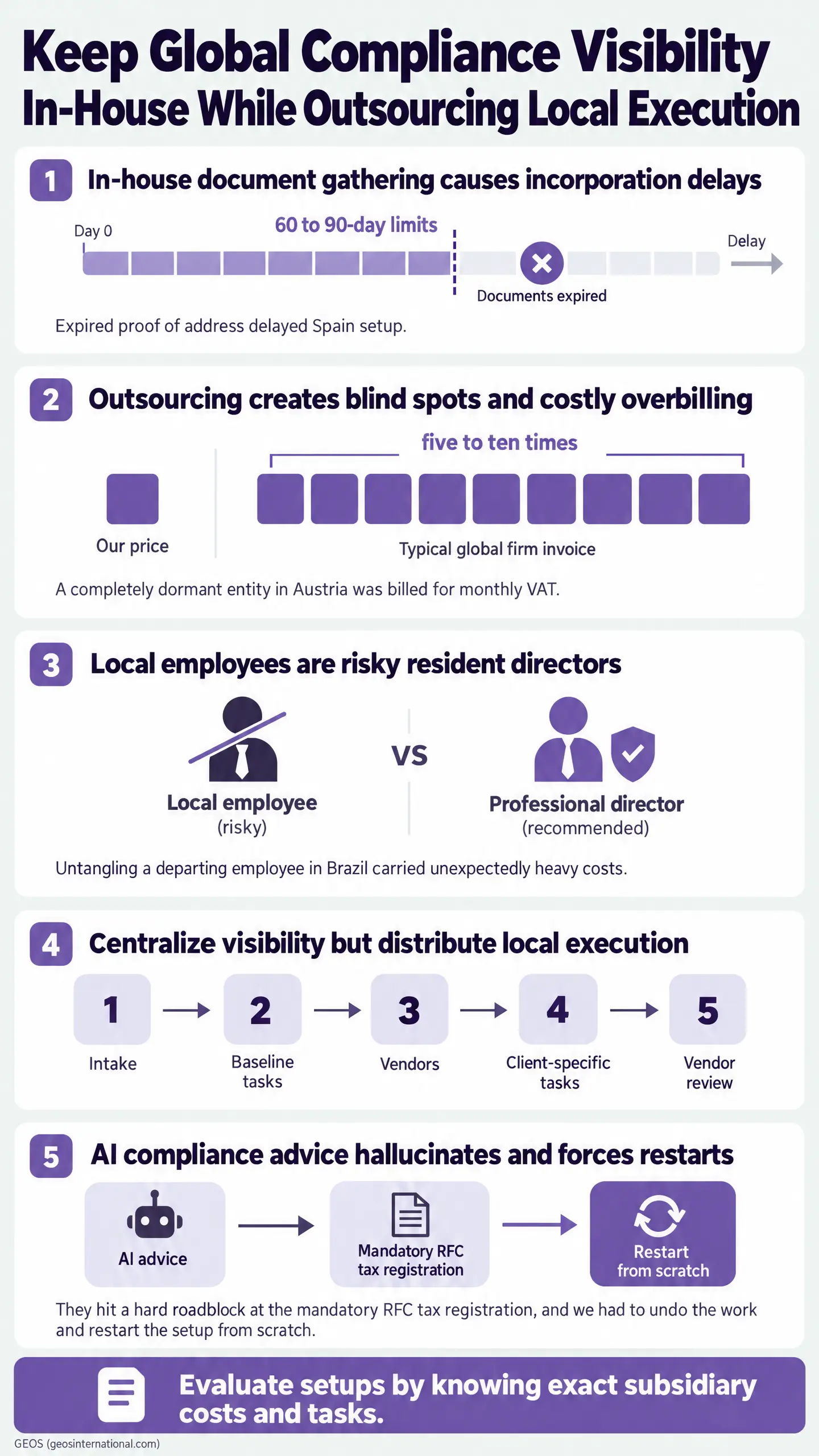
- Local authorities frequently delay global incorporations by enforcing 60 to 90-day validity limits on submitted documents, particularly proofs of address and Ultimate Beneficial Owner identification.
- The UK Companies House identity verification mandate left approximately 10% of live companies non-compliant within its first year of enforcement.
- Appointing local employees as resident directors in markets like Brazil and Peru creates expensive legal entanglements upon their departure, making third-party professional directors a financially safer choice.
- Accounting firms frequently overbill dormant entities for full monthly VAT and accounting services instead of moving these subsidiaries to cheaper, legally required basic nil filings.
- Relying on artificial intelligence for compliance advice causes severe setup failures, such as missing Mexico’s local director requirement and failing mandatory RFC tax registrations.
- The proposed EU-Inc corporate law aims for a two-day, €100 online registration but will not eliminate analog bottlenecks like bank KYB, notary appointments, and apostille requirements.
What Are the Core Responsibilities of a Corporate Secretary for Global Entity Compliance?

A corporate secretary is a role that varies by country. Broadly, it’s the individual or firm responsible for keeping the lights on from a compliance perspective. That covers the corporate annual filings and the high-level corporate matters of an entity, separate from tax, accounting and payroll. It normally includes changes, from updating an address or adding or removing a director to amending the bylaws or redistributing shares.
Sometimes the role has to be held by a named natural person, but most of the time it’s more of a spiritual role. Singapore sits at the formal end. Every company there needs a company secretary, appointed within six months of registration, who can’t be the company’s sole director. Australia sits at the other end, where a proprietary company doesn’t have to appoint a secretary at all.
What Parent Company Documents and Validity Windows Are Required for Global Entity Incorporations?
For an operations leader, the records behind this role are the inputs to whatever launches next: the next incorporation, bank account or VAT registration.
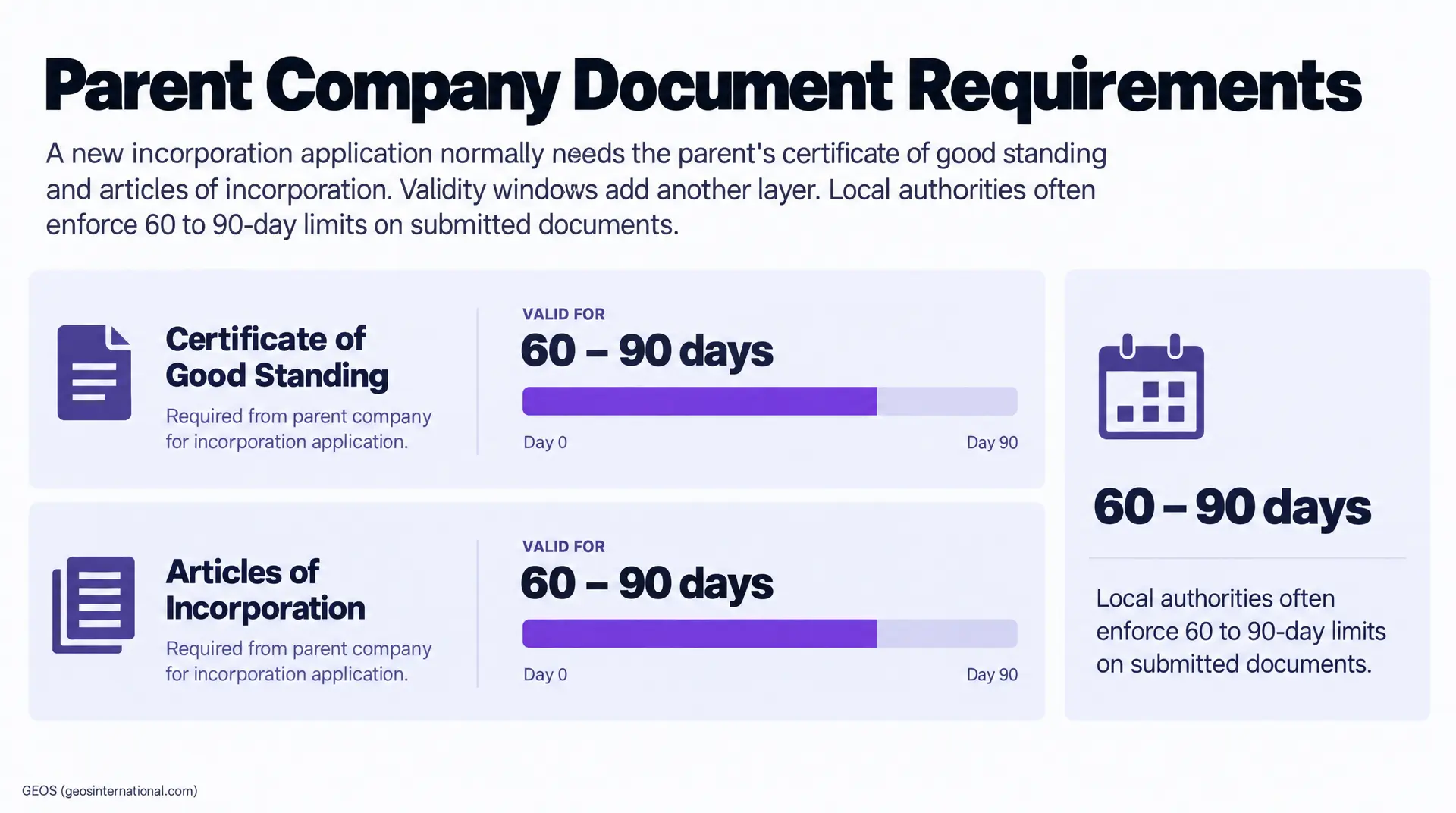
When the work sits with one busy person in-house, the first thing to break is often access to the parent company’s own documents. A new incorporation application normally needs the parent’s certificate of good standing and articles of incorporation. Sometimes an outside lawyer drafted them years ago and they’ve since been lost or forgotten. In the US, the certificate on file may simply be outdated, which means requesting a new one from Delaware.
Signed board resolutions are required for many things, sometimes including opening a bank account in a new country. We recently had a client who needed to register for VAT in the Netherlands and at first couldn’t find the KVK register their registration required. Luckily, it was readily available to them in the GEOS International platform.
Validity windows add another layer. Local authorities often enforce 60 to 90-day limits on submitted documents. The ones that most commonly expire are proofs of address and IDs for ultimate beneficial owners, meaning the individuals who ultimately own or control the parent. A client setting up in Spain needed director proofs of address from the last 90 days. The one on hand was older than that. It took a lot longer than expected for the director to send a new one, and the incorporation application was delayed.
Each of these pushes back the business deadline behind it. The document-gathering phase is, in my experience, the best single indicator of how long an incorporation will take.
When Should Publicly Traded Companies Keep Corporate Secretarial and Compliance Work in-House?

There’s one profile where I’d keep corporate secretarial and compliance work entirely in-house. It’s a publicly traded company with a very large in-house legal team, especially one with expertise in the country in question. It’s also the profile where I’d consider a Big Four firm a reasonable fit.
Even then, keeping up with every local requirement is very difficult, especially when a new business requirement comes up in a country where the team has no experience.
Rules also change on entities that already exist. Companies House identity verification for directors of UK companies became mandatory on 18 November 2025. It was phased in over 12 months, with existing directors’ deadlines tied to their company’s confirmation statement. It became a significant nuisance for directors of established entities who weren’t aware of it, or who weren’t tech-savvy enough to complete it easily. A year in, Companies House reported that around 90% of live companies had complied. That left roughly one in 10 behind on a rule that applied to companies already on the register.
What Are the Disadvantages of Outsourcing Corporate Secretarial Services to Local and Global Firms?
A local accountant or lawyer in each country is normally the cheapest path, and for a single-country setup these firms can be knowledgeable and good to work with. Across several countries at once, it becomes extremely difficult.
The black box clients run into here usually comes from limited resources, technology and experience with foreign-owned entities. Domestic Canadian accountants, for example, often miss the Investment Canada Act notification, because they don’t realize it’s required of foreign owners. A non-Canadian establishing a new Canadian business generally has to file it within 30 days of implementation, unless an exemption applies. Hourly billing also ends up incentivizing dependency. In Spain, communication with local partners often drops off completely in August and December.
Global firms such as PwC bring tax, legal, compliance and regional specialists under one logo and one umbrella. I’ve seen that model as a PwC client. I also saw it at Borderless AI, when we set up the company’s own entities with one of the Big Four.
Their teams are still split by geography, so three countries can mean three teams. Each one needs the parent company’s documents and context again, and your people end up acting as project manager. Invoices can be one or two generic line items such as “corporate compliance,” at on average five to ten times our price. I would concede that the premium buys more safety than the cheapest option. For a privately held scale-up, though, much of it pays for the glut of a very large machine.
Either way, the parent company’s team often only knows compliance in its home country and hopes the local providers are doing what’s needed, which isn’t always the case. Without a central view, that’s like playing basketball with a blindfold on, moving only on what your four teammates shout at you. Teams in that position often end up blindly paying the bills.
The five ways to run corporate secretarial services for foreign subsidiaries, in-house or outsourced, differ most in who keeps a central view of tasks and costs.
|
Corporate secretarial model |
Best fit |
Cost |
Main risk |
|---|---|---|---|
|
In-house: one employee alongside other duties |
Very small footprint, untenable past a handful of entities |
No dedicated salary, but UK late accounts penalties of £150 to £1,500 (2026) |
Lost parent documents, late filings and unchecked local invoices |
|
In-house legal and company secretarial team |
Publicly traded companies with a large legal team and local expertise |
Full-time salaries, US compliance officer median $80,730 a year (May 2025) |
Missed rule changes, like UK director ID verification (mandatory 18 November 2025) |
|
Outsourced to local accountants or lawyers |
Single-country setups |
Lowest, S$300 to S$328 a year for a Singapore entry plan (2026) |
No cross-country view, missed foreign-owner filings like Canada’s Investment Canada Act notice |
|
Outsourced to a global (Big Four) firm |
Publicly traded companies wanting one firm across countries |
Premium price, often billed as one or two generic line items |
Separate teams per country, so your own team still project-manages |
|
Hybrid: in-house visibility, outsourced local execution |
Privately held scale-ups with more than a handful of entities |
Per-entity fees tied to listed tasks, tracked per subsidiary |
Outdated master task list or unreliable local partners and resident directors |
How Do Corporate Secretarial Filing Requirements and Invoices Differ for Dormant Subsidiary Entities?
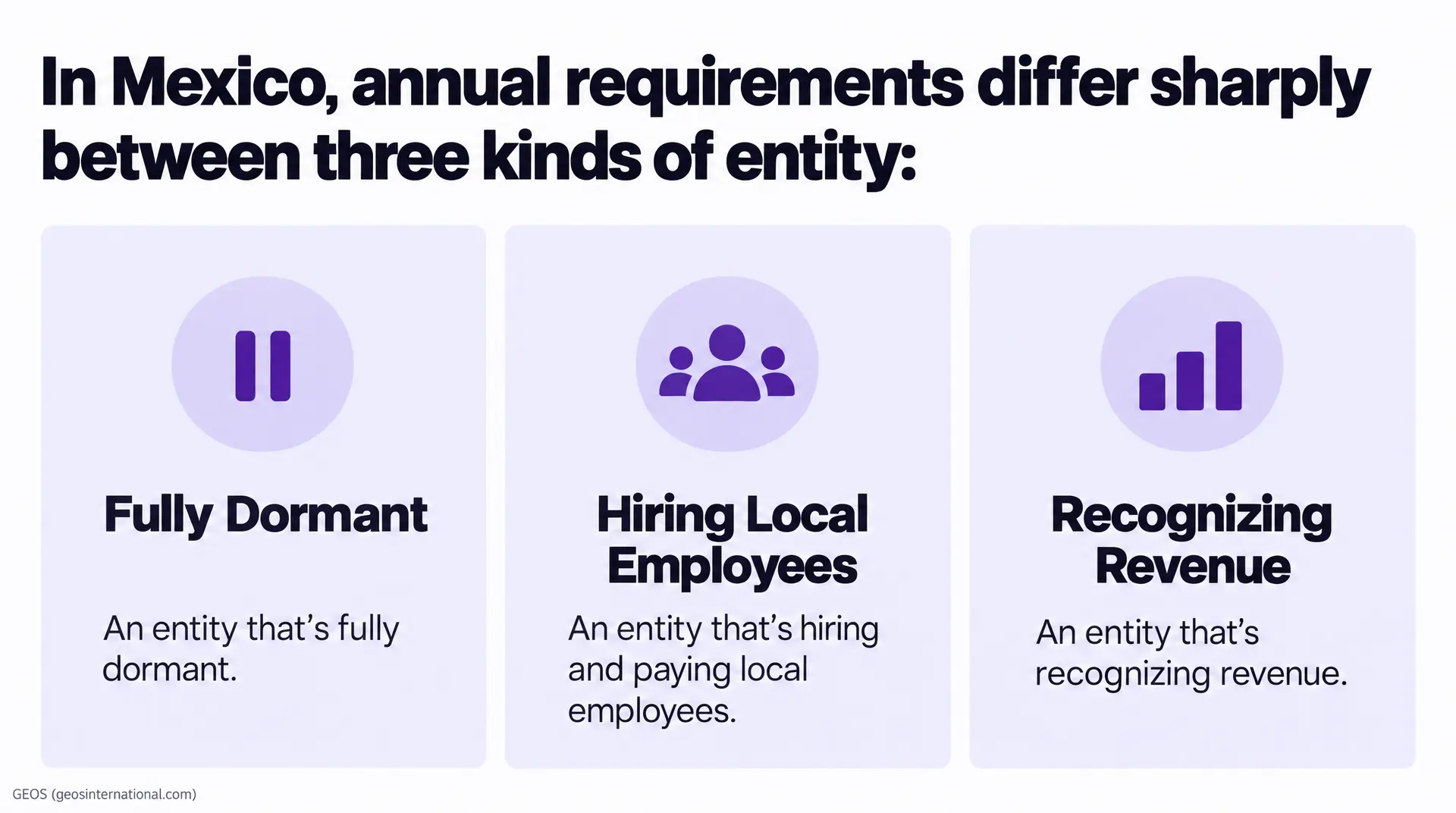
What an entity has to file depends on what it’s doing. In Mexico, annual requirements differ sharply between three kinds of entity: one that’s fully dormant, one that’s hiring and paying local employees, and one that’s recognizing revenue. Accounting firms frequently bill a flat rate that assumes full activity.
One client’s completely dormant entity in Austria was being billed for monthly VAT and full accounting. We mapped what was actually required and moved them to a much lower fee covering only the mandatory basic nil filings.
A US-based client had three largely dormant entities, two in Latin America and one in APAC. Their previous partner was billing them heavily without clear answers on what work was being done, and they moved to us. A client previously with a global firm was being overbilled, and our audit found their Costa Rican entity out of compliance. We completed a shareholder transfer to restore its good standing.
When I review corporate secretarial invoices, I look closely at ongoing accounting charges on entities with very few monthly transactions. I also check whether billed tax filings are legally required yet, or only apply after a VAT registration that hasn’t happened.
Why Are Professional Resident Directors and Centralized Registered Addresses Critical for Global Entities?
The first platform dedicated to streamlining entity setup and management.
Resident director requirements are non-negotiable in markets such as India, Singapore, Australia, New Zealand and the UAE. In Mexico, the role that matters in practice is a local legal representative, who represents the entity to tax officials and wet-signs employment contracts. Most companies don’t have an executive or a lawyer they can appoint, and using a local employee gets complicated when that person leaves.
A client expanding into Brazil appointed a local employee as resident director to avoid professional fees. When that employee later left, untangling them from the entity carried unexpectedly heavy costs, and we replaced them with a vetted professional director. In Peru, a client’s legally required second shareholder was a former employee who had left. We drafted and submitted the documentation to add a new shareholder and restore the entity’s good standing.
A third-party director from the start is the safer choice, as long as that person is dependable. We audited a client with multiple entities in Latin America whose previous nominee directors were inactive. We then restored compliance while significantly reducing their annual costs.
Government mail goes to the registered address. I’d have a centralized compliance partner act as that address, with mail collected, scanned and acted on before deadlines pass. A client had lost track of the provider that originally incorporated their two UK entities. They moved both registered addresses to our mail-scanning service. Mail about an unfiled tax return turned up immediately, and that return had been silently accumulating penalties. They resolved it before more penalties and fees built up.
Why Should Scale-Ups Keep Global Corporate Compliance Visibility in-House While Outsourcing Local Execution?
Past a handful of entities, running compliance through local accountants and spreadsheets becomes practically untenable without a full-time internal team. Self-managing local vendors across several countries can amount to two or three full-time jobs just to handle incoming invoices and the actions they require. We supported a company with over 30 entities that had completely lost visibility into its compliance costs, because local firms were invoicing the subsidiaries directly. Untangling years of backdated work and unverified invoices took a newly hired global compliance manager working full-time alongside us.
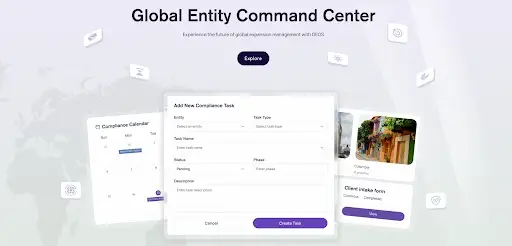
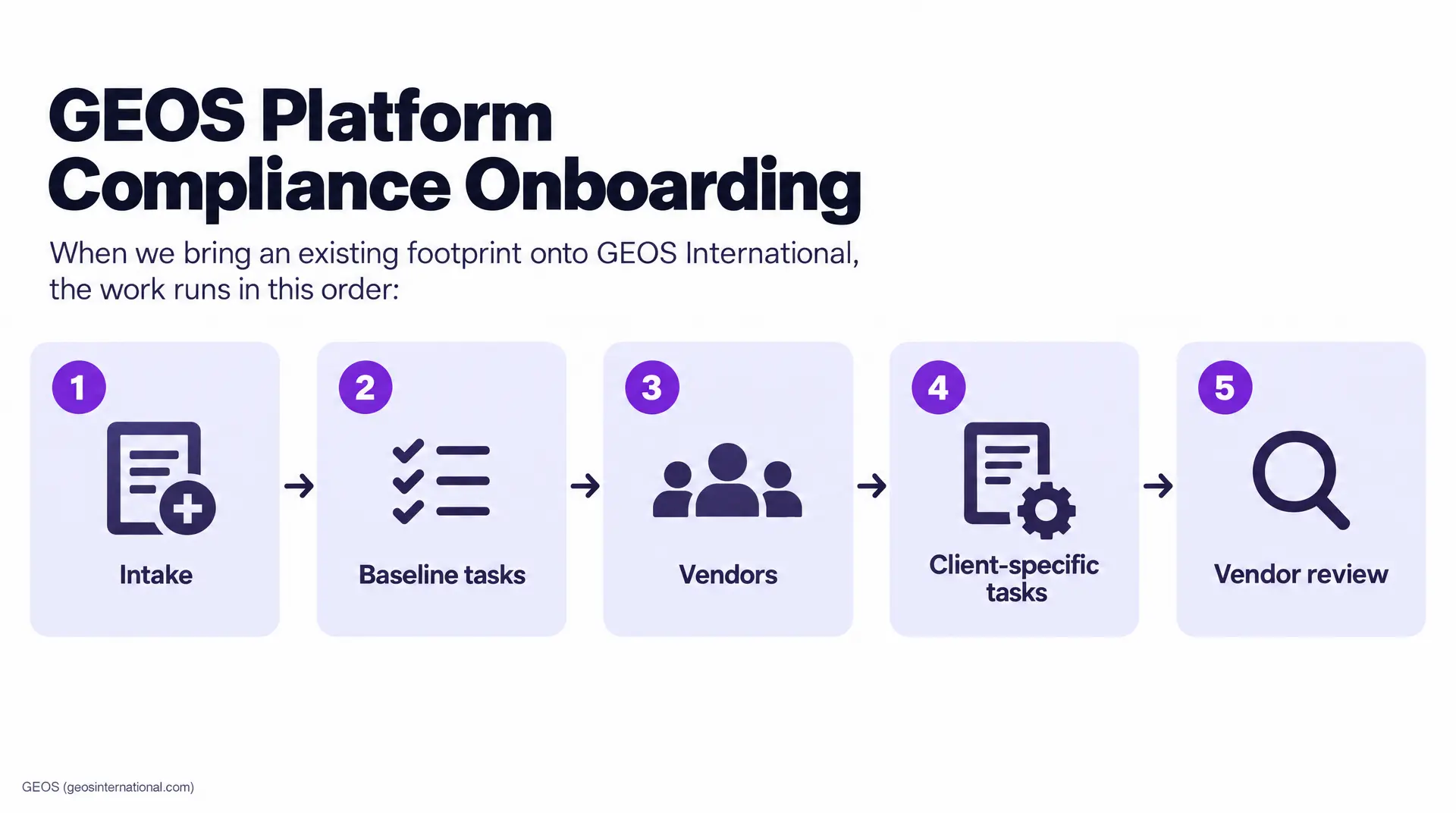
It’s also virtually impossible to find one provider that handles tax, legal and payroll across dozens of countries. So in the model I’d recommend, what stays in-house is visibility. That means a master list of compliance tasks for every entity, the parent documents in one place, and a clear view of what each subsidiary costs. The filings, statutory roles and local liaison with notaries and government offices go to partners. When we bring an existing footprint onto GEOS International, the work runs in this order:
1. Intake: each entity’s details and purpose, plus every document on file, organized into an entity page.
2. Baseline tasks: our pre-mapped compliance tasks for that country, with due dates.
3. Vendors: the client’s existing partners, onboarded and assigned their tasks, such as tax tasks to the tax partner.
4. Client-specific tasks: the last 5 to 10%, such as VAT filings after a VAT registration, confirmed with the client and their vendors.
5. Vendor review: whether each partner works well, works efficiently and charges the right price. Then we decide whether to keep them, shift work to us or replace them from our pre-vetted network.
Vendors get automated notifications and close tasks with receipts. That leaves an audit trail between what was billed and what was done.
Pricing is per entity, so the in-house versus outsourced decision can be made entity by entity. On the Access tier, at $49 a month per entity, your team runs its own compliance on the platform. On Core, we act as the corporate secretary in that country and handle the non-tax annual filings, with your tax and payroll vendors in the same workflow.
What Are the Limitations of AI and Proposed EU-Inc Law for Global Entity Compliance?

AI is useful as a project management tool and for presenting information. As a source of compliance advice, it frequently hallucinates, because accurate and current compliance information is rarely published on government portals or anywhere else online. An in-house team leaning on AI still needs enough domain expertise to spot those errors quickly. A client of ours followed AI advice that they didn’t need a local director in Mexico. They hit a hard roadblock at the mandatory RFC tax registration, and we had to undo the work and restart the setup from scratch.
EU-Inc, the proposed EU corporate law for innovative companies, is past the announcement stage. In October 2026, the Council of the EU adopted its negotiating position, describing online registration within two days for a maximum of €100. Negotiations with the European Parliament were still pending, so it isn’t a route you can use yet. I see it as a positive step, and I expect it to change the EOR-to-entity break-even point in Europe.
A two-day registration would cover the legal incorporation. The country-specific registrations for VAT, payroll and social contributions that make an entity operational would remain. I expect bank KYB, notary appointments, and apostille and translation requirements to be the most stubborn analog hurdles. I wouldn’t pause European expansion to wait for it, given the opportunity cost in market share.
How Can Operations Leaders Evaluate the Cost and Task Visibility of Global Compliance Setups?
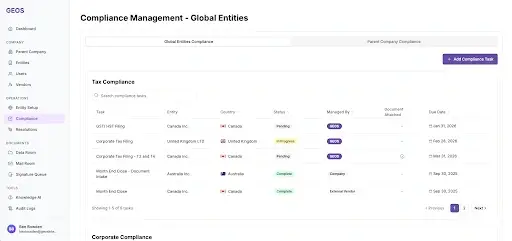
I’d judge any setup, in-house or outsourced, by whether the operations leader can say exactly what the company pays for each subsidiary and which specific tasks those fees cover. When they can’t, that’s the most obvious warning sign I know that a global compliance setup is broken, whoever is doing the work.
If you’d like to test your own footprint against that, we’re glad to map each entity’s filings, task owners and costs with you, alongside the vendors you already use.
Frequently Asked Questions
Why does a technically incorporated entity still miss our commercial launch deadlines?
Incorporation is just step one. An entity cannot hire or contract locally without tax and bank registrations. In Mexico, obtaining a functional tax ID requires apostilled and translated powers of attorney. Outsourcing to a coordinated partner ensures these operational prerequisites do not quietly derail your commercial deadlines.
Is a Big Four firm the most efficient outsourced option for multi-country entity activation?
Rarely for scale-ups. While they offer safety, Big Four teams remain geographically siloed. Expanding into three countries means managing three disconnected teams, forcing your operations leaders to act as project managers. You pay a massive premium to fund their internal bloat without gaining a centralized operational view.
Can we appoint our own executives to bypass professional resident director fees?
It is highly risky. Key markets strictly require local residency. India demands a director who stayed 182 days the previous year, and Singapore issues up to a S$1,000 fine for compliance failures. Appointing local employees creates massive leverage issues if they resign. Outsourced professional directors protect continuity.
Can we rely on legal AI to manage in-house corporate compliance across borders?
No. While AI aids project management, relying on it for cross-border compliance is dangerous. A recent study revealed hallucination rates between 17% and 33% in major legal AI tools. Trusting automated outputs for statutory requirements inevitably triggers blocked tax registrations and catastrophic market launch delays.
What is the true risk of managing fragmented local corporate secretaries internally?
The primary risk is missing obscure local rules that silently destroy timelines. Without centralized visibility, internal teams overlook mandates like Canada’s 30-day post-implementation notification for foreign owners, or UK late-filing penalties reaching £1,500. Consolidating execution with a single outsourced partner eliminates these expensive operational blind spots.