
Founders ask me for the single month the law forces them off an Employer of Record, something clean enough to drop into a board deck. That number is a comfort, and in most of the world it does not exist.
Germany is the one market that wrote it down, at eighteen months, and founders still misread it – planning to incorporate at month 14 while the entity clock has been running since they hired employee number one.
Every other market builds the pressure silently, on headcount and local sales, until a tax authority assesses the back taxes it has decided you always owed. The liability your provider swore to absorb travels, through the indemnity clause you never read, straight back to you.
Key Takeaways
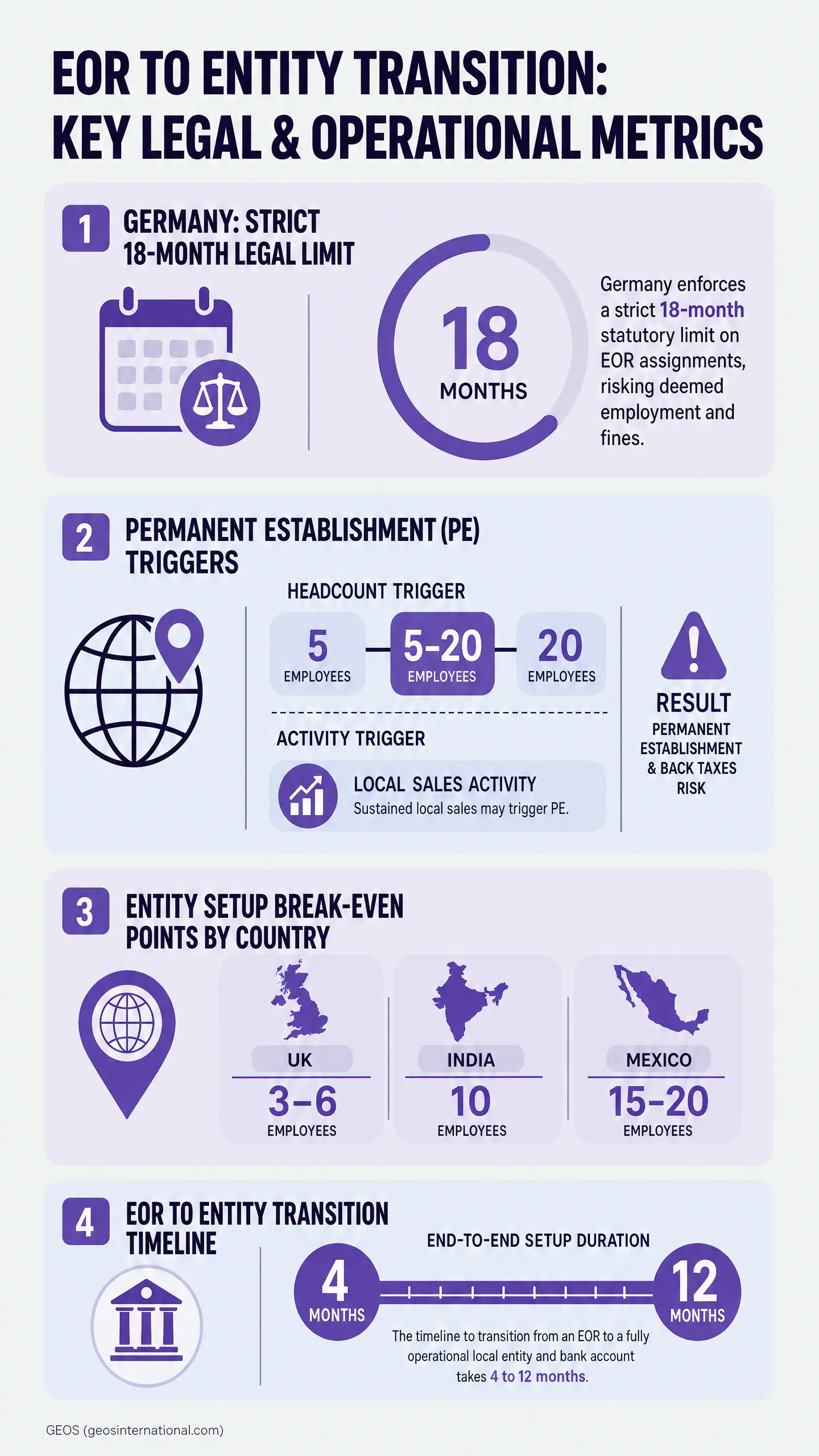
- Germany enforces a strict 18-month statutory limit on Employer of Record assignments under the AUG, with violations triggering up to €30,000 in fines and automatic direct employment classification.
- Employer of Record indemnity clauses transfer wrongful termination liability directly to the client, creating significant financial exposure under strict frameworks like Japan’s Labor Contract Act Article 16.
- Deploying an Employer of Record sales team that habitually negotiates local contracts creates permanent establishment tax exposure for the parent company under OECD post-BEPS rules.
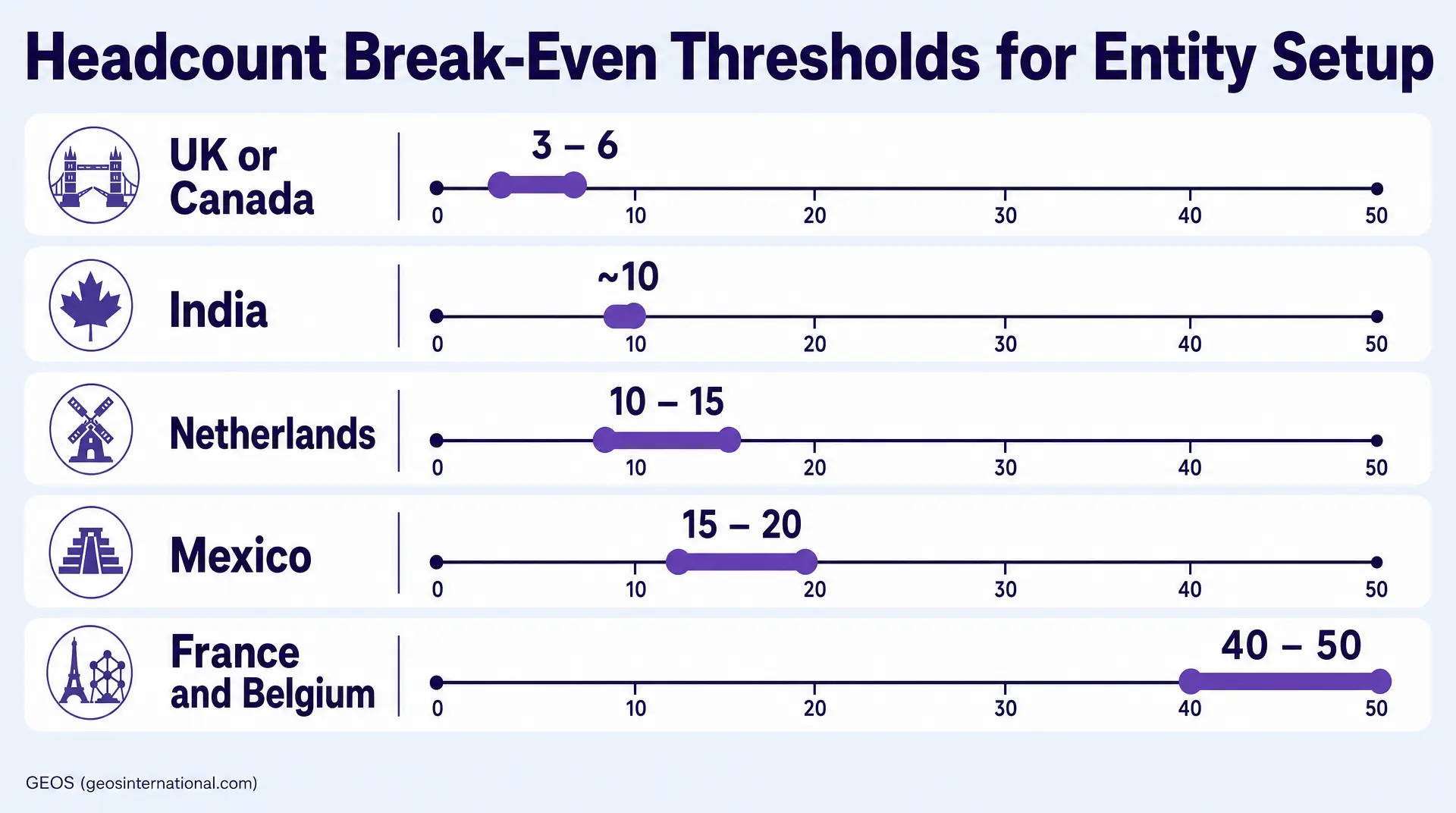
- The headcount threshold for transitioning from an Employer of Record to a local entity is three to six employees in the UK and Canada, but scales to fifteen to twenty in Mexico.
- Transitioning US employees from an Employer of Record to a local entity significantly increases health insurance costs because small-group plans cannot match the enterprise-scale premiums secured by the global provider.
- Establishing a compliant local payroll in Mexico requires routing mandatory social security payments through IMSS-authorized traditional banking channels, rendering FinTech accounts invalid for this process.
What Is the Statutory Time Limit for Employer of Record Assignments in Germany?

Germany’s AUG is the cleanest statutory limit I know of. The same worker can be assigned to the same user company for 18 consecutive months. A break of three months or less does not reset the clock, and prior assignments count in full even if a different agency placed the worker. Some collective agreements stretch the cap to 24 months, and a US software company hiring engineers in Berlin should not plan around that exception. Austria comes at the same activity from a different angle, treating it as a licensed trade under GewO §135, so the exposure there is labor leasing without a license rather than running past a calendar.
The fine for exceeding the German limit runs up to €30,000, and that is the smaller problem. The larger one is that the assignment contract can be deemed invalid and an employment relationship with the user undertaking is deemed to arise. In practical terms, German law can treat your company as the direct employer of someone in a country where you have no entity, no payroll registration, and no bank account able to pay them. You become an employer by operation of law with none of the infrastructure that makes employment compliant.
What Are the Employer of Record Time Limit Rules in France and Singapore?

France shows up on nearly every list of countries with an EOR time limit, and the actual rule deserves a closer look. Under Article L1251-12-1 of the Code du travail, a temporary assignment contract may not exceed 18 months including renewals, absent a branch agreement. That is temporary-work law. Whether your provider’s structure falls inside it depends on how the provider is licensed and how the arrangement is papered, and assuming you are exempt is the wrong default.
Singapore is the opposite error. The Ministry of Manpower regulates through employment-agency licensing, with licenses lasting up to three years, and publishes no fixed EOR tenure cap. Singapore’s real pressure comes from its permanent establishment posture, which I cover below.
Why Does the German 18-Month Employer of Record Limit Fail to Cover Entity Setup?
Founders hear 18 months and assume they can start the German entity at month 14. The mechanics defeat that plan. A GmbH needs your parent company documents notarized, apostilled, and couriered to Germany. Minimum share capital is €25,000, and while the registration can be filed once €12,500 has been paid in, you still need a German bank to accept the deposit and issue the certificate before the notary can lodge anything.
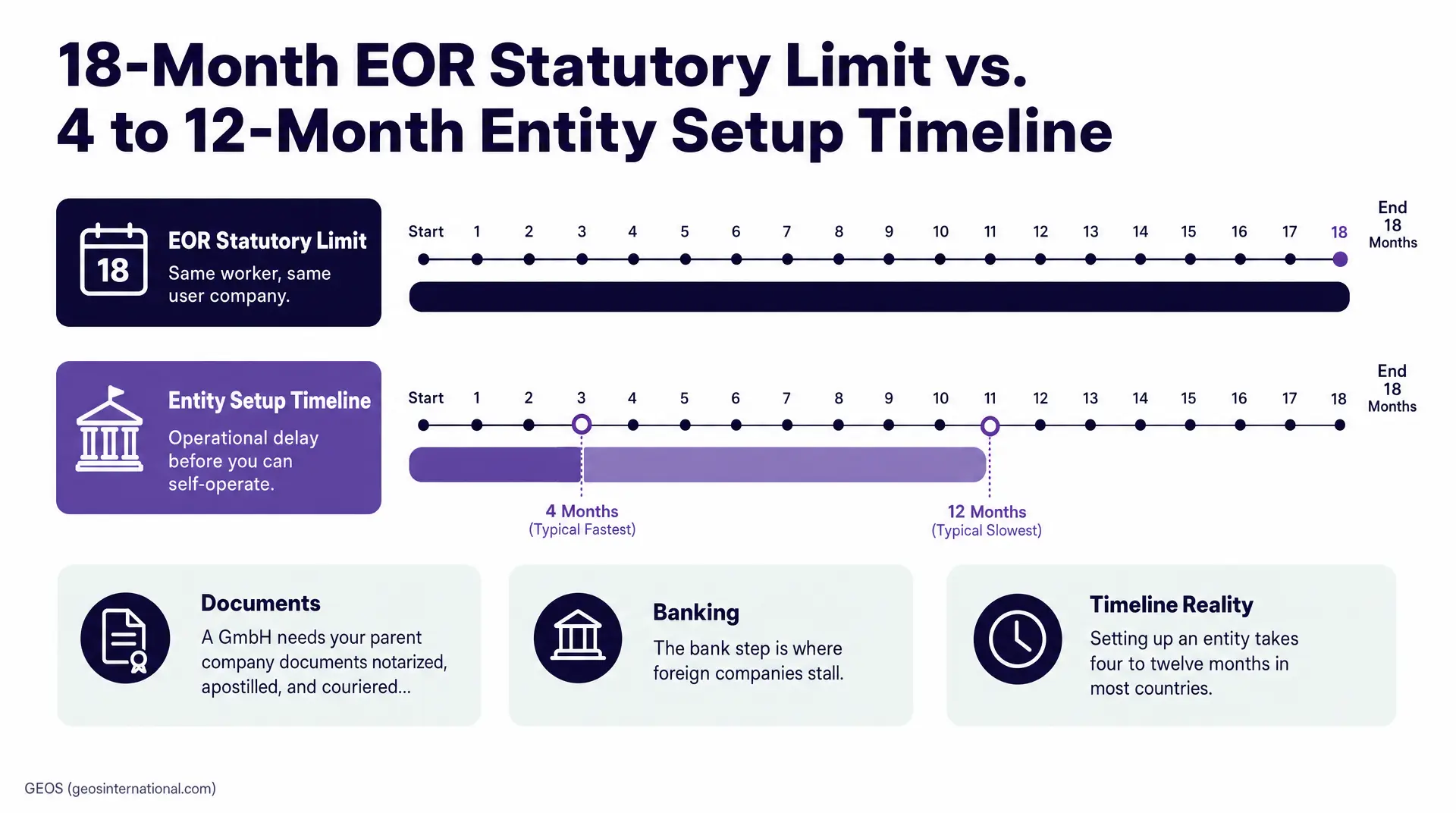
That bank step is where foreign companies stall. Traditional German banks frequently refuse foreign-owned entities, and some will only proceed if a director holds EU citizenship. We had a US-based client whose first bank rejected the application on exactly that basis. We sourced an alternative banking partner and kept the setup moving, but that detour eats weeks you may not have inside the cap. In Germany, the entity clock starts the day you hire EOR employee number one.
How Do Employer of Record Headcount and Sales Trigger Permanent Establishment Risk?
The first platform dedicated to streamlining entity setup and management.
Companies do not get sued over permanent establishment, at least not in the way founders picture it. A local tax authority decides you have been operating as though you had a taxable presence without declaring one, then assesses back taxes and penalties. It arrives as a crackdown rather than a fight back and forth.
Headcount is one trigger among several. How you sell, how you market locally, and who signs contracts all feed the same analysis. The OECD Model Tax Convention treats a PE as either a fixed place of business or a person acting on behalf of the enterprise who habitually exercises authority to conclude contracts. The commentary then declines to hand you a threshold, stating that it is not possible to lay down a precise frequency test.
What I can tell you from watching this play out is that exposure becomes real somewhere between five and twenty EOR employees in a single country, and the range depends on that country’s local stance. Germany and Singapore sit at the aggressive end. Fifteen engineers in Poland building product look very different to a tax office than five account executives in Singapore closing regional deals. A local sales team that habitually plays the principal role leading to contracts the parent signs without material changes is precisely the pattern the post-BEPS rules target. If your EOR team functions as a sales office, assume the clock is running.
When the assessment lands, it lands on you. EOR agreements carry very specific liability clauses that pass these penalties directly to the client. The provider employs your people on paper. The tax consequences of how you chose to do business remain yours.
How Do Employer of Record Indemnity Clauses Expose Startups to Wrongful Termination Liability?

The pitch from an EOR rep is that they absorb the legal risk. Read the indemnity section before repeating that to your board. The co-employment model creates shared liability in concept. When the client made the decision that caused the problem, the contract passes liability and indemnity straight back to the client.
I have watched this happen in Japan. A US-based company had employees on an EOR there and let one go for reasons that made sense to the business. Japanese employment culture is built around long-term commitment to one employer, and the law reflects it. Under Article 16 of the Labor Contract Act, a dismissal is invalid if it lacks objectively reasonable grounds and is not considered socially appropriate. A change in business direction does not clear that bar. The employee filed a large lawsuit, and it pulled the EOR provider and the company into a long, expensive dispute.
This is the liability that actually shows up. Mass tax penalties on EOR platforms are rare. Wrongful termination claims are common, and they are exactly the exposure your own entity, your own local contracts, and your own HR playbook let you control.
At What Headcount Does Entity Setup Become More Cost-Effective Than an Employer of Record?
The advertised $500 to $600 per employee per month is not telling the total story. FX translation, money movement costs, and mandatory statutory payroll contributions typically add 10 to 30% on top of base payroll. OECD Taxing Wages 2026 puts employer social security contributions for an average-wage worker at 26.7% of labor costs in France, 17.3% in Germany, 12.0% in the UK, and 7.5% in the US. You owe those contributions either way. The EOR bills them on top of the flat fee, which is why the number founders quote to their board is the smallest number on the invoice.
Against that, weigh what your own entity, payroll, benefits, and compliance would cost in that specific country. In the UK or Canada the break-even can be three to six employees, because setting up and maintaining an entity there is fast and cheap. India sits closer to ten, and most companies crossing that line intend to run a Global Command Center anyway. The Netherlands is ten to fifteen. Mexico is fifteen to twenty, because payroll is calculated more like a day rate than an annual salary, a local legal representative must wet sign employment contracts, and the ongoing tax and accounting burden is heavy. France and Belgium can stretch to forty or 50.
Headcount is one input. If your reason for being in a country includes signing a commercial lease, recognizing local revenue, contracting directly with enterprise or government clients, or issuing equity on compliant terms, an EOR cannot get you there at any headcount. Those objectives mean you skip the EOR phase and set up the entity right off the bat. Once that entity is live and paying tax, shut the EOR down in that country. Local officials read an EOR running alongside a tax-paying entity as a much worse posture than an EOR with no entity at all.
What Is the Timeline for Transitioning from an Employer of Record to a Local Entity?
Setting up an entity takes four to twelve months in most countries. The UK is the genuine outlier. GOV.UK puts online registration at £100 with the company usually registered within 24 hours, nothing requires a wet signature or an apostille, and a fully operational entity in three to four weeks is realistic. Everywhere else, incorporation is only the first phase. You then have to set up your own employment infrastructure, and that is a heavy lift from an operational perspective.
Payroll needs a bank account on the right rails. In Mexico, social security payments must run through IMSS-authorized banking channels, a short list of traditional banks, and a FinTech account fails that test every time. In India, provident fund contributions and TDS remittances need a traditional account on Indian rails. I have watched a client there resort to a patchwork payroll solution while their bank application stalled. It created long-term compliance problems with their provident fund and pension scheme that far outlasted the delay they were trying to avoid.
Then comes the transfer itself. Your employees resign from their EOR contracts and sign new agreements with your entity, with continuity in between. You decide how to honor accrued vacation and seniority. You replace the EOR’s benefits package with something above and beyond what is statutory, because that is what your people have grown used to.
Why Do US Health Benefit Costs Increase When Transitioning from an EOR to an Entity?

That last step produces the sharpest surprise, and the US is where I have seen it hit hardest. A company moved more than 10 employees off a US EOR and onto their own entity. The EOR had thousands of employees across its client base and qualified for group insurance rates a 10-person company cannot touch. KFF’s 2025 survey puts average employer-sponsored premiums at $9,325 for single coverage and $26,993 for family coverage, so matching a strong plan at small-group pricing is a five-figure line per employee. Both the employees and the company felt it.
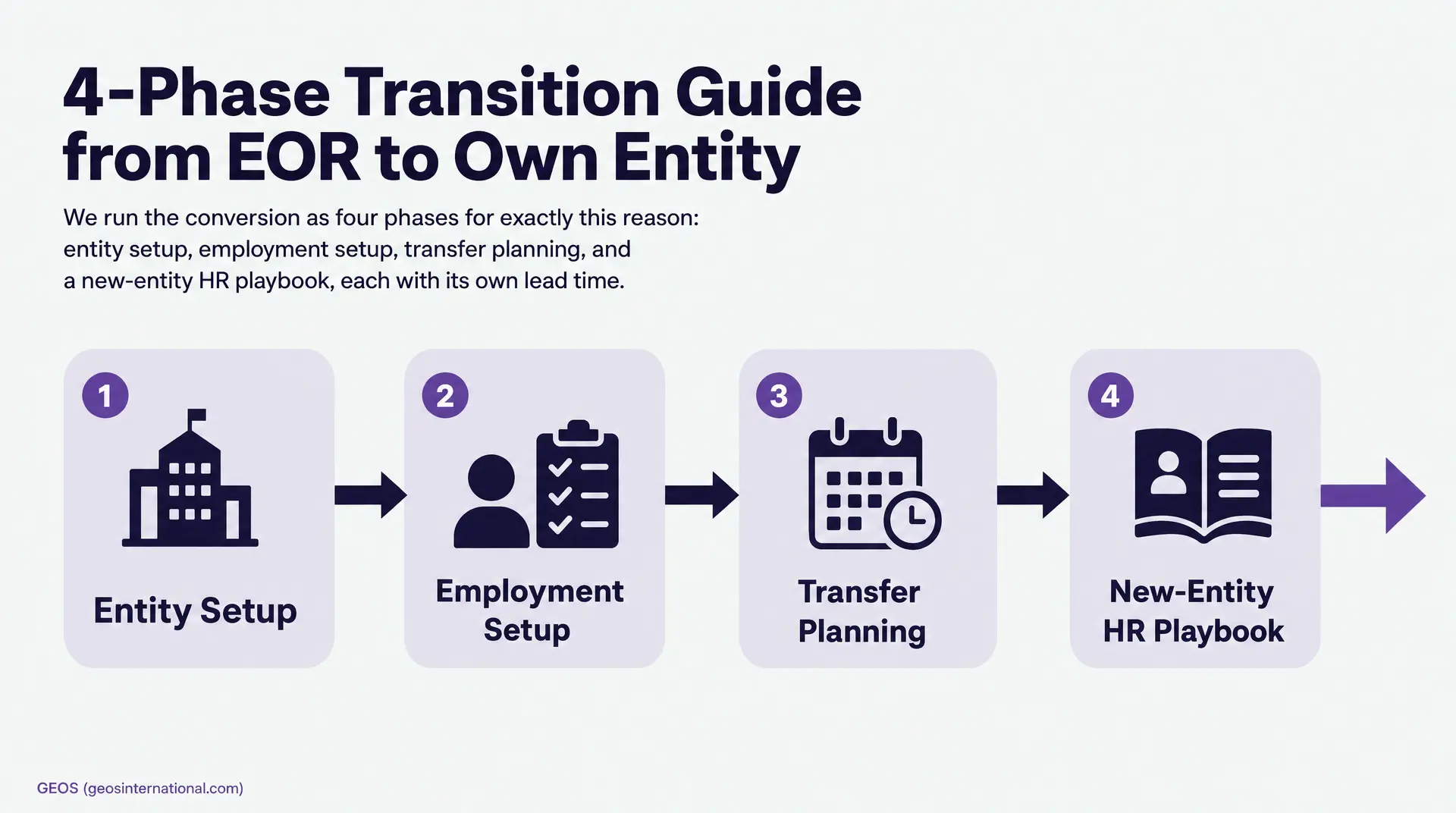
None of that is work your EOR provider will do for you. They will process the offboarding. They will not decide how you handle seniority or accruals, and they will not draft your local employment contracts. We run the conversion as four phases for exactly this reason: entity setup, employment setup, transfer planning, and a new-entity HR playbook, each with its own lead time.
Why Should Startups Define an Employer of Record Exit Strategy Before Hiring First Employees?

The companies that get this right decide the exit before they enter. We had a client setting up in India whose incorporation stalled on director signatures and proof of address documents, with new hires holding verbal start dates. We brought in an EOR partner to hire the team temporarily, preserved every start date, and ran the conversion once the entity was live. That is EOR used deliberately, with a defined purpose and a defined end. Most of the largest EOR providers have invested heavily in global payroll products, which is their own confirmation that EOR has an expiry date built into the model.
Before you hire that first EOR employee, answer three questions. Which countries, why, and what infrastructure and partners do you have in place to support the eventual entity. If the answer to why includes anything beyond employing a couple of people, the entity conversation starts today.
So when your board asks how long you can legally stay on an EOR, give them the accurate answer. In Germany, 18 months, backed by a fine and a deemed employment relationship if you miss it. Almost everywhere else, the deadline is whatever date your local activity, your headcount, and your true cost per employee make the status quo indefensible. Start the entity when you have reached critical mass, and give yourself the full four to twelve months to do it properly.
Frequently Asked Questions
Does switching our provider reset the EOR legal time limit clock?
No, you cannot game the system by swapping vendors. Under Germany’s AUG, prior assignments by another agency count in full if the break does not exceed three months. The law tracks the worker’s tenure at your company, not the name on the invoice.
How do breached EOR legal time limits impact M&A or Series C due diligence?
Board-level diligence exposes unauthorized permanent establishments and misclassified workers. If you breach an EOR legal time limit, the ensuing liabilities – back taxes, penalties, and broken IP assignment chains – sit on your cap table. Acquirers will either kill the deal or aggressively discount your valuation to absorb that compliance risk.
Why are EOR arrangements subject to labor-leasing time limits in the first place?
Regulators view EORs as labor leasing. ILO Convention No. 181 defines agencies as firms supplying workers to a third-party user enterprise that dictates tasks. Consequently, local governments apply their strict temporary agency laws – and explicit legal time limits – directly to your EOR headcount.
Do EOR legal time limits apply if we only hire software engineers, not sales teams?
Yes. While non-revenue roles like engineers might temporarily delay permanent establishment tax risks under OECD rules, statutory employment caps ignore job functions. Germany’s 18-month limit applies equally to a senior backend developer and a junior sales rep. You cannot code your way out of labor leasing laws.
What is the worst-case scenario if we ignore a statutory EOR time limit?
Fines are rounding errors. The real threat is deemed employment. In Germany, breaching the limit triggers fines up to €30,000 and legally forces an employment relationship directly with your parent company. You instantly become an employer in a foreign jurisdiction without the banking or payroll infrastructure to actually pay them.