
We have a number of international e-commerce clients, based in Europe and Australia, that had been selling into the US through their foreign parent company. With the introduction of tariffs and the wider economic uncertainty, it became more attractive for them to set up a US subsidiary and run their US sales through it, which changed their tax position locally. Most of them chose the same structure: a US LLC that files its taxes as a corporation.
For a foreign parent, the choice between an LLC and a C-Corp matters mainly because of how an LLC is taxed by default. Once that is settled, the cost and timeline of a US subsidiary depend mostly on the steps after formation. When you start hiring, they also depend on the states your employees live in.
Key Takeaways
- Foreign parent companies often choose a US LLC structure but file IRS Form 8832 to be taxed as a corporation, avoiding the double taxation risks of pass-through disregarded entities.
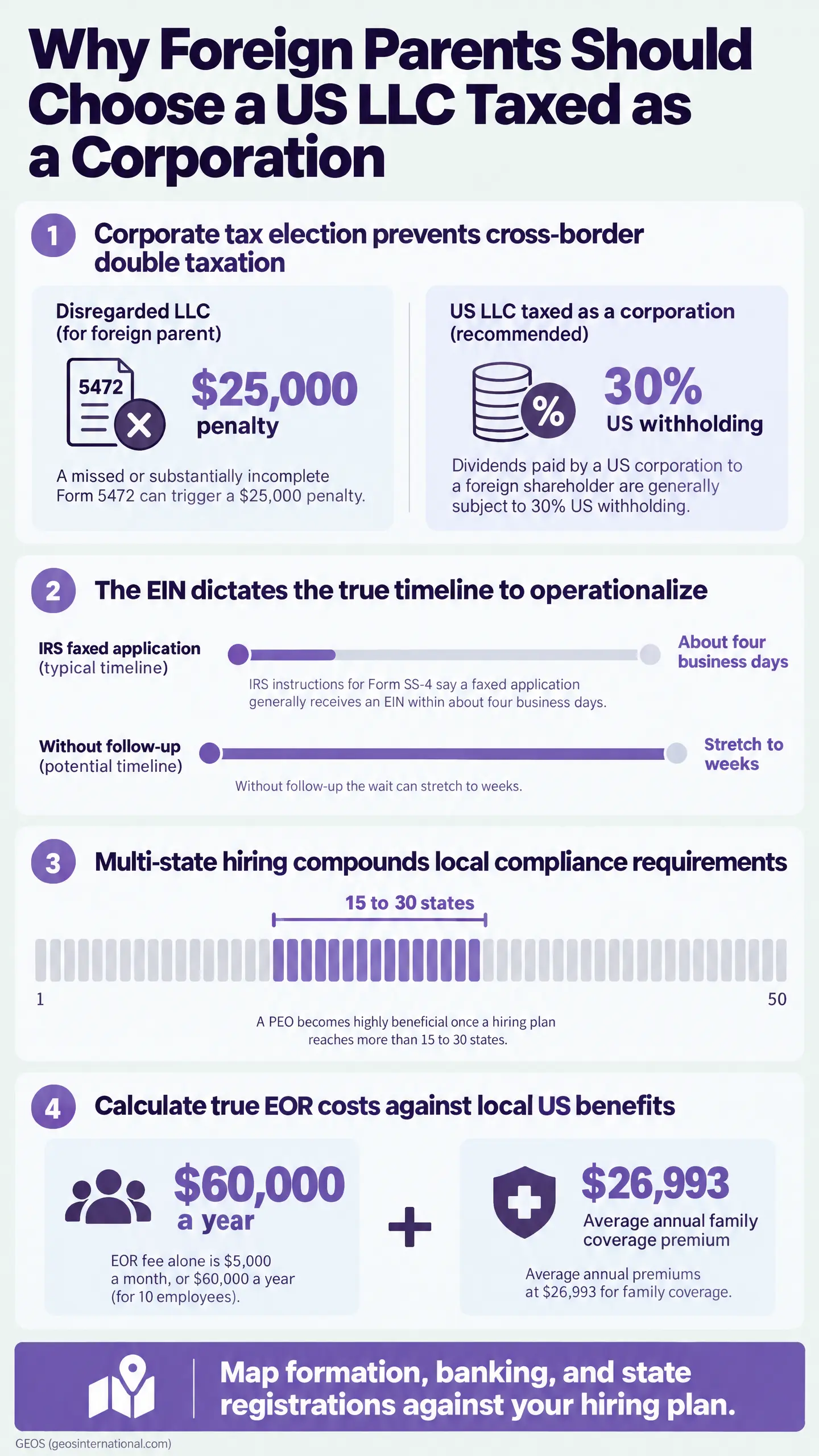
- Failing to file a complete IRS Form 5472 for a foreign-owned US LLC with reportable transactions can trigger an automatic $25,000 federal tax penalty.
- Using automated registered agent services to generate operating agreements for foreign-owned US LLCs frequently creates governance mismatches that block the issuance of an Employer Identification Number.
- Foreign founders without a Social Security Number should bypass the slow Individual Taxpayer Identification Number process and directly fax IRS Form SS-4 to obtain an Employer Identification Number.
- US fintech platforms like Mercury and Airwallex streamline banking for foreign-owned subsidiaries because they support remote know-your-customer compliance, bypassing the in-person requirements of traditional banks like Wells Fargo.
- Companies migrating US employees from an Employer of Record to a proprietary LLC often face benefit cost shocks because small headcounts lose access to large-group healthcare insurance rates.
- European companies expanding into the US frequently underestimate employee benefit expenses in a privatized healthcare system, where average annual family premiums reach $26,993 according to the KFF 2025 survey.
What Is the Difference Between Legal Form and Tax Classification for a US Subsidiary?
There are two decisions inside this choice, and they are easy to blur. The legal form is whether the subsidiary is an LLC or a corporation under state law. That sets its governing documents and how much corporate secretarial work it carries. The tax classification is how the IRS treats its income.
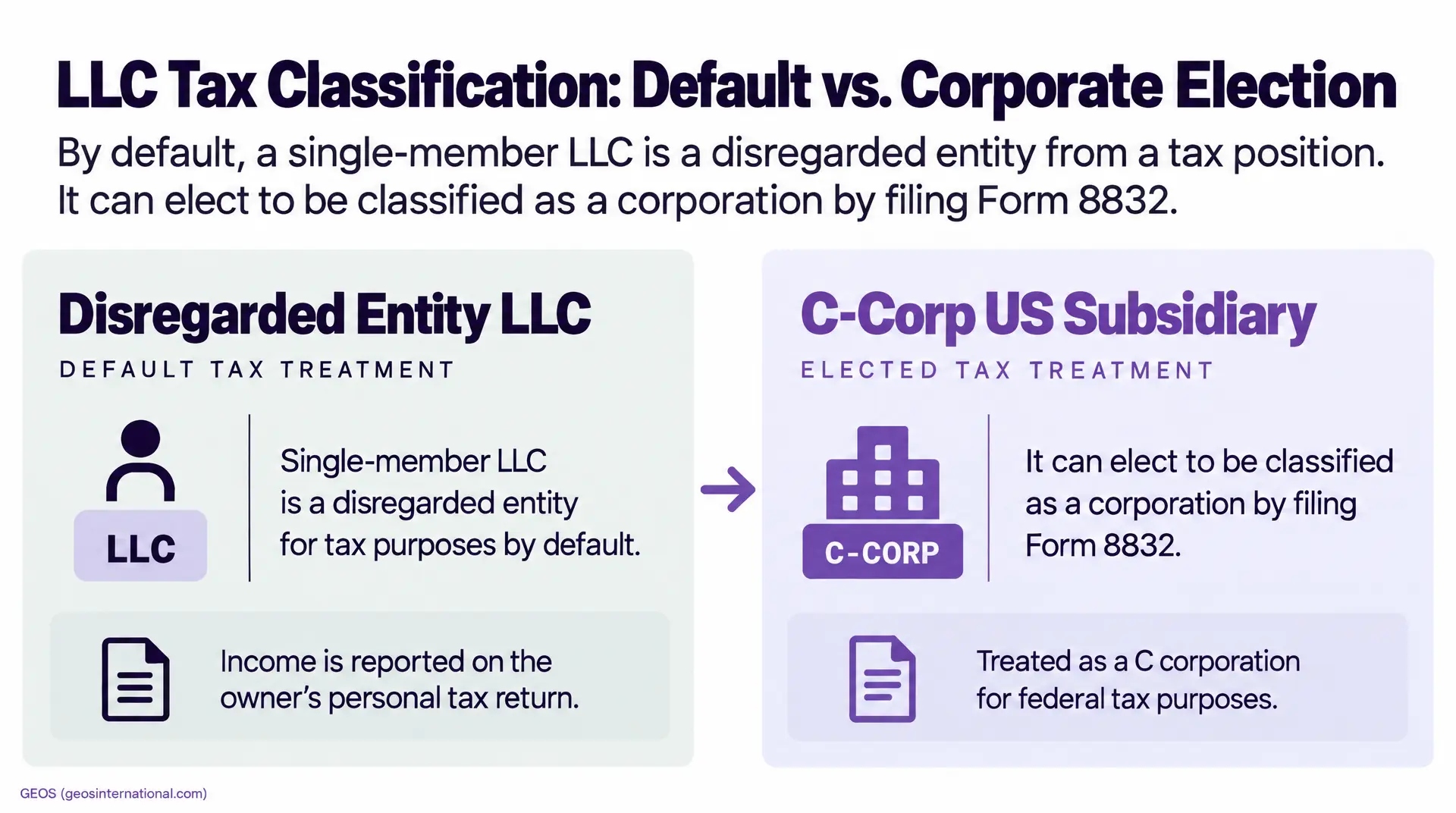
By default, a single-member LLC is a disregarded entity from a tax position. It can elect to be classified as a corporation by filing Form 8832. The election changes its federal tax treatment, and the LLC keeps its legal form.
What Are the Tax Risks of a Disregarded Entity US LLC for Foreign Parents?

A disregarded LLC is a pass-through, so the tax liability goes through the LLC to whoever owns it. When that owner is a foreign company, cross-border tax treaties and regulations become very complicated. I would describe that position as ripe for double taxation.
How much US tax exposure that creates for your parent depends on the facts. The main question is whether your parent is engaged in a US trade or business and has effectively connected income, which is income the IRS treats as tied to that business. For a company selling inventory into the US, the US-source profit on those sales can be effectively connected income. A foreign corporation with US business income may have to file Form 1120-F, which is a US return for the parent itself.
The LLC also has a federal filing of its own. When it has reportable transactions, it generally files Form 5472 attached to a pro forma Form 1120. The contributions made in forming the entity count as reportable. A missed or substantially incomplete Form 5472 can trigger a $25,000 penalty, and further penalties are possible if the failure continues after the IRS notifies you.
A lot of the time, CFOs who manage subsidiaries know compliance and tax only in their home country, and everything else is a black box. In Canada, domestic accountants often miss the Investment Canada Act notification because they do not realize it is required for foreign-owned companies. Form 5472 is the same kind of filing on the US side. I would make sure that whoever prepares the LLC’s US returns knows from the start that its owner is foreign.
Why Should a Foreign Parent Choose a US LLC Taxed as a Corporation?

Most of our clients end up choosing an LLC, and electing to file it as a corporation is normally the best of both worlds. On the legal side, you keep the ease of an LLC: simpler legal documents, a self-governed operating agreement, and fewer of the corporate secretarial tasks that keep the lights on from a compliance perspective. On the tax side, the LLC is taxed in its own right, and its corporate taxes stay separate from your parent company’s.
That is what the e-commerce clients were after. They wanted an entity that was easier to set up and maintain, with a cleaner tax division that avoids the double taxation risks of a pass-through.
Electing corporate treatment still leaves one cross-border layer in place, which is the tax on profits sent back to the parent. Dividends paid by a US corporation to a foreign shareholder are generally subject to 30% US withholding, and an applicable treaty may reduce that rate. Which rate applies to your parent is a pretty complex tax analysis, and I would leave it to tax advisors who know both countries.
A Delaware C-Corp is still a fine option for a subsidiary. It is taxed as a corporation from the start, so the tax separation is the same, and choosing it would not be a massive amount of money wasted. What you take on is the heavier corporate secretarial load of a corporation, for an entity whose only shareholder is your parent.
Why Do Foreign-Owned US Subsidiaries Require Specialized Delaware Operating Agreements?

Delaware remains the most common state for incorporation because of its favorable business laws and its reputation for low corporate tax. Its corporate income tax is 8.7% on taxable income allocated and apportioned to the state. What a subsidiary pays there depends on how much of its income is attributed to Delaware. Setting up in Nevada and Wyoming is also becoming increasingly common.
The operating agreement can go wrong at both ends of the price range. Cheap, automated registered agent services provide operating agreements templated for a citizen-owned straightforward entity, and those do not fit the governance needs of a subsidiary owned by a foreign company. That mismatch often causes compliance issues and can hold up the EIN, the US tax ID. At the other end, hiring a lawyer to set up a straightforward LLC is usually expensive overkill that overcomplicates the process. It is worth it when you strictly need a complex internal operating agreement. For a standard foreign-owned subsidiary, GEOS International provides operating agreement templates written specifically for foreign-owned US LLCs.
What Are the Requirements to Make a Foreign-Owned US Subsidiary Operational After Incorporation?
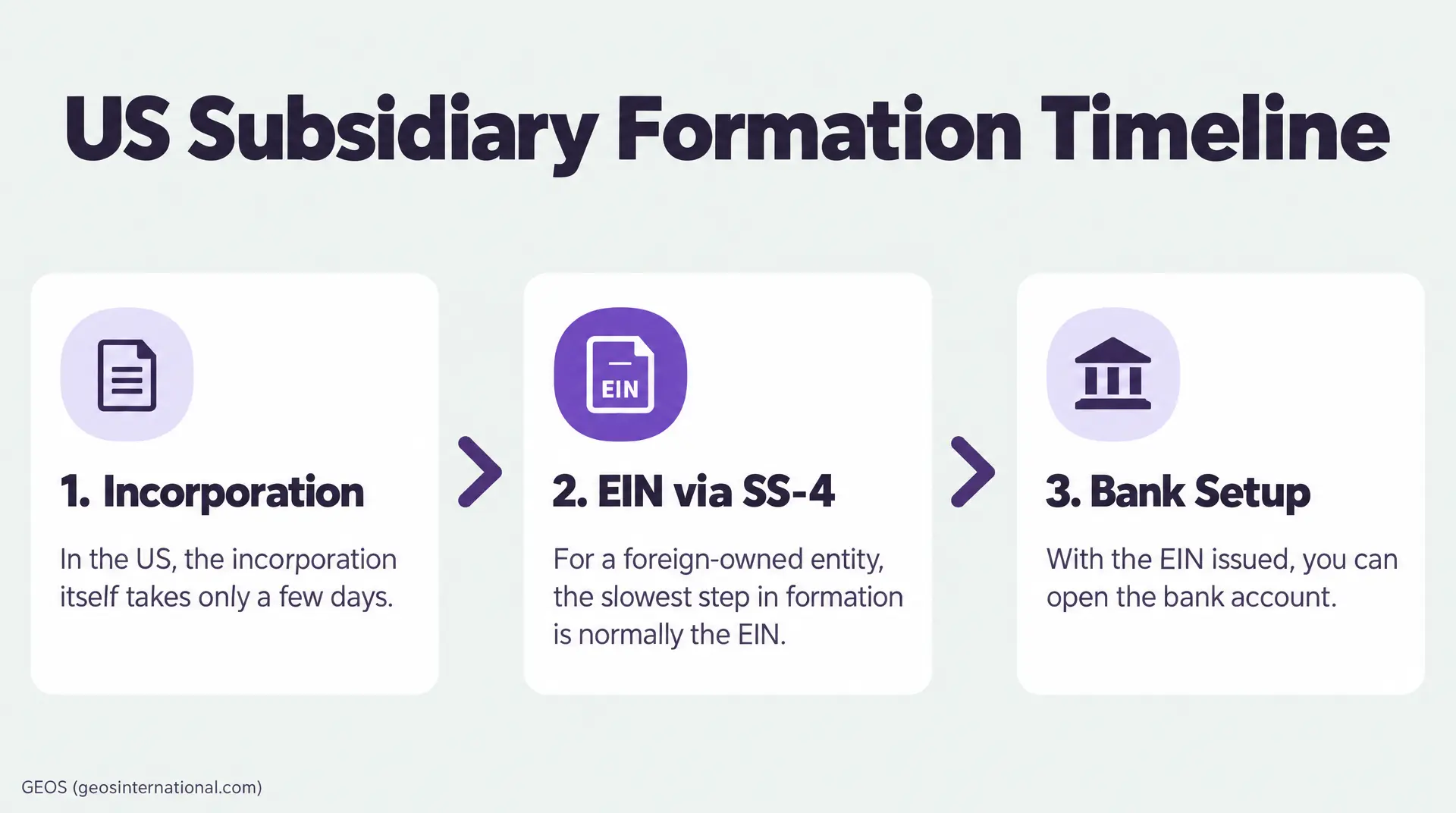
There is a difference between an entity being incorporated and an entity being operational. In the US, the incorporation itself takes only a few days and is standardized enough to automate. Even so, an LLC without a tax ID and a bank account cannot functionally do business.
The US also asks for significantly less documentation on ultimate beneficial owners than other countries. Elsewhere, collecting notarized, apostilled and translated parent documents is normally the best indicator of the overall timeline. Under FinCEN’s current guidance, US-created entities and their beneficial owners are exempt from federal beneficial ownership reporting. That exemption does not settle what your bank will ask for in its know-your-customer (KYC) checks.
For a foreign-owned entity, the slowest step in formation is normally the EIN, which you need to open a bank account and do anything functional. The IRS is a lot slower to issue one when none of the directors is a US citizen with a Social Security Number. The IRS instructions for Form SS-4 say a faxed application generally receives an EIN within about four business days. That is not a guarantee, and without follow-up the wait can stretch to weeks.
In every case, we fill out the SS-4 on the client’s behalf and fax it to the right department at the IRS. If around a week passes without a number, we call the line for a status update, and we often find that the call speeds up processing of that specific form. I also advise foreign founders against applying for an Individual Taxpayer Identification Number (ITIN) to facilitate the setup. The ITIN process is itself too slow, and faxing the SS-4 directly is much faster. During a US government shutdown, IRS processing delays meant we had to fax SS-4 forms repeatedly and keep calling the correct departments to push EINs through for foreign clients.
With the EIN issued, you can open the bank account. For foreign founders, I recommend US fintech platforms such as Mercury or Airwallex. They support remote KYC and know-your-business (KYB) checks and avoid the onboarding difficulties of traditional banks like Wells Fargo. One client was struggling with in-person travel and changing KYC requirements at traditional US banks, and we guided them to a fintech option that established their banking.
How Does Multi-State Hiring Impact Compliance and Payroll for a US Subsidiary?
The first platform dedicated to streamlining entity setup and management.
Establishing a US entity is cheap and fast, but the complexity compounds once you hire. Each state has its own employment laws, payroll rates and benefits implications. Every state an employee lives in brings its own registrations and payroll setup. Whether the LLC itself also has to register in that state as a foreign entity, with a registered agent there, depends on that state’s rules.
A Professional Employer Organization (PEO) can work with your existing Delaware LLC, or any LLC, and act as an extension of it, so that it becomes your employment infrastructure in all the other states. That is very helpful while you are hiring your first few employees across the country. As a rule of thumb, an employment provider like a PEO becomes highly beneficial once a hiring plan reaches more than 15 to 30 states. When you have the know-how, the internal functionality or the headcount to justify it, it can make more sense to bring HR operations in-house.
Moving employees between employment vehicles across several states can take longer than planned. I worked with a company moving employees across eight to ten US states from its own entity onto an employer of record (EOR). It repeatedly missed its transition deadlines because of complications and employee pushback over changes to their benefits packages.
Each registered agent you appoint also receives official mail for the LLC. I would advocate using a centralized compliance partner as your registered address, so physical government mail is collected, scanned onto a platform and acted on before a deadline is missed. At GEOS International, our registered address and mail scanning work as an early warning system. They let us catch corporate changes we were not told about before an annual filing is rejected.
How Do Employer of Record Costs Compare to Managing a Proprietary US LLC?
If your US employees are currently on an EOR, moving them onto your own LLC is a bespoke calculation. At 10 employees and an advertised fee of around $500 per employee per month, the EOR fee alone is $5,000 a month, or $60,000 a year. The advertised price is not telling the total story, because FX translation, money movement and mandatory statutory payroll payments often add 10 to 30% on top of base payroll.
Statutory payments follow your employees to your own entity. For that reason, I would set the full EOR cost against the ongoing cost of running your own: entity compliance, payroll, your own benefits package, tax compliance and your registered address. If your own ongoing cost is lower, the case for your own entity is clear.
For a US subsidiary, benefits can change the math at small headcounts. I recall a company migrating more than 10 employees from a US EOR to its own entity that hit a massive cost shock. Its low headcount disqualified it from the cheap, large-group insurance rates the EOR had leveraged, so matching its employees’ existing benefits became significantly more expensive.
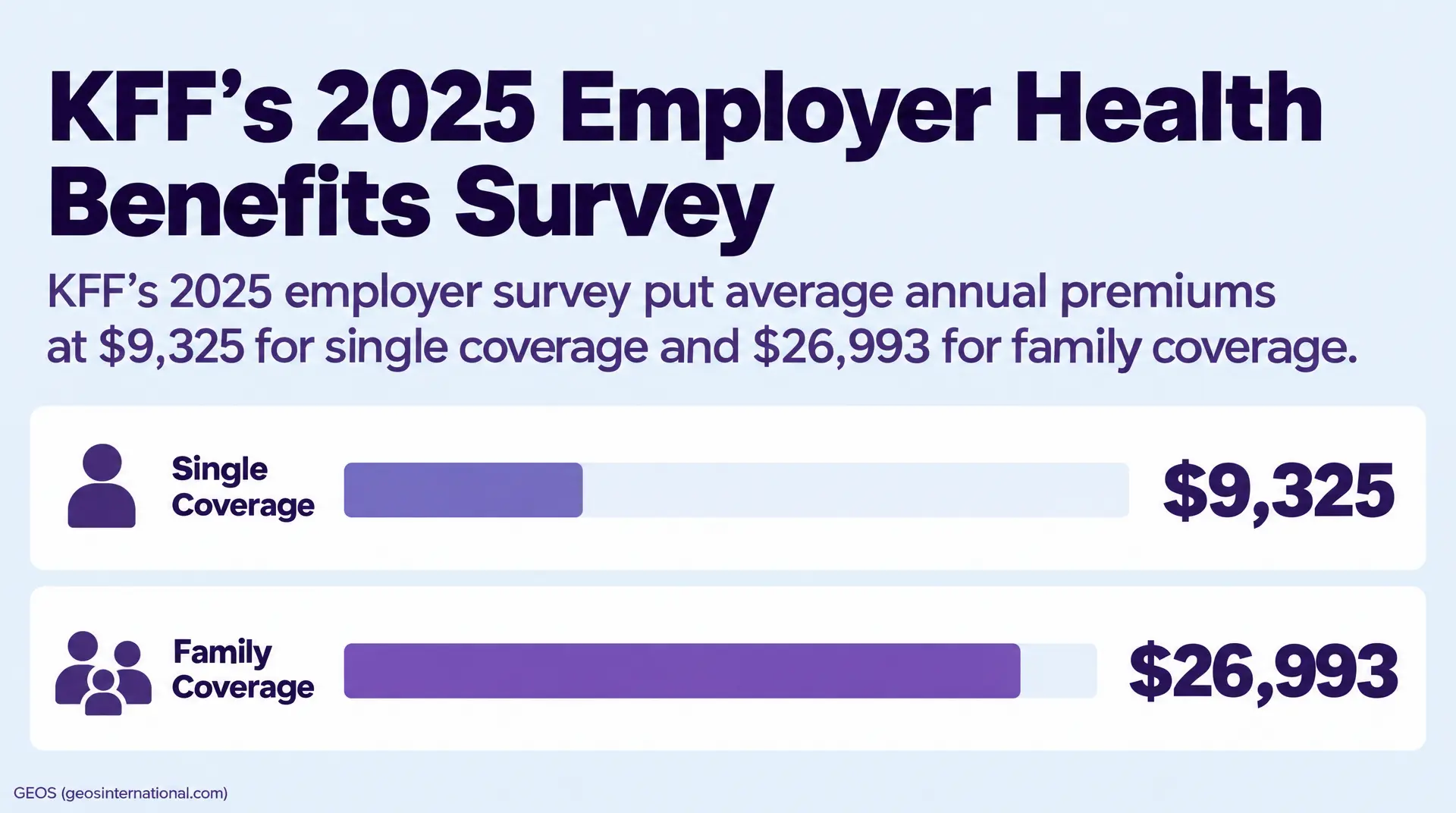
European companies expanding into the US are frequently caught off guard here. They underestimate the cost of competitive benefits in a privatized healthcare system compared with the universal healthcare they know at home. KFF’s 2025 employer survey put average annual premiums at $9,325 for single coverage and $26,993 for family coverage. It also found that family premiums at firms with 10 to 199 workers averaged $26,054, against $27,280 at larger firms, so a small group does not automatically pay more. Your own comparison depends on how a quote at your headcount compares with the group rates your EOR has access to. I would get that quote before you count the EOR fee as savings.
Staying on the EOR is less protective than it can look. EOR contracts typically pass off liability and indemnity to the parent company in disputes such as wrongful termination, because the parent is the one that controls and works closely with the employee. Your own entity also gives you control over benefits programs and HR policies. It also gives you much more freedom to provide equity. Through an EOR, equity needs a separate contractor agreement or vehicle that is administratively burdensome and legally shaky.
If your reason for the subsidiary goes beyond employing one or two people, such as recognizing US revenue or signing enterprise contracts, I would skip the EOR route and explore setting up the entity right away. A foreign company in the defense space needs a locally owned entity to legally contract with the US government. When you do convert, I would argue the biggest mistake founders make is failing to communicate the change of legal vehicle in advance, because employees who are suddenly asked to resign can panic.
For a foreign parent, the structure is normally the more settled part of the decision. What a US LLC costs to keep compliant depends on whether it is dormant, hiring or recognizing revenue. Accounting firms frequently bill a dormant entity at the full annual compliance rate of an operating one, so I would check what yours is being billed for. Once the LLC hires, its cost depends on how many states your employees live in and what matching their benefits costs at your headcount. If you’re working through that for your own US subsidiary, we’re happy to map the formation, EIN, banking and state registrations against your hiring plan and show you where the time and cost will sit.
Frequently Asked Questions
Can our foreign parent company minimize US taxes by forming an S-Corporation?
No. IRS eligibility rules strictly exclude corporations and nonresident aliens from acting as shareholders, meaning a foreign-parent subsidiary cannot use S-corporation status. You must choose between a C-Corp and an LLC, weighing the standard 21% federal corporate tax rate against complicated pass-through risks.
What is the exact financial exposure if our foreign-owned LLC misses a US tax filing?
The financial exposure is severe. Failing to file, or submitting a substantially incomplete return, triggers an automatic $25,000 IRS penalty on Form 5472. Additional fines compound if the failure continues, making centralized oversight of local vendors critical to prevent blind spots.
Does incorporating our US subsidiary in Delaware completely eliminate state-level corporate taxes?
No, Delaware is not a universal tax haven. Delaware levies an 8.7% corporate income tax on taxable income allocated and apportioned to the state, alongside a $300 annual LLC tax. CFOs must accurately model these state-specific liabilities in their OPEX forecasts rather than assuming a zero-tax footprint.
If we elect corporate taxation for our LLC, does that eliminate double taxation completely?
Not entirely. While the corporate election safely isolates your federal income tax at a 21% rate, repatriating those profits creates another hurdle. Dividends paid to a foreign parent are generally subject to a 30% US withholding tax, though applicable international tax treaties might reduce this burden.
Will we need to legally register our new LLC in every state where we hire remote employees?
Often, yes. SBA guidance cautions that operating across multiple states may trigger foreign qualification requirements. Beyond federal filings, a geographically fragmented workforce creates localized registration and fee obligations. Utilizing a unified vendor platform keeps this administrative sprawl visible and predictable for your finance team.