
A client came to us partway through setting up a subsidiary in Mexico. They had conferred with AI along the way, and it told them that if they structured the setup a certain way, they would not need to appoint a local director. The process then stalled at the RFC registration, which is Mexico’s tax registration. The tax administration, the SAT, requires the company’s legal representative to have an RFC of their own, along with valid ID and proof of address. The client had not nominated a local director to fill that role. We had to work with them to undo what had been done and start from the beginning, which cost them time and money.
For an operations leader, that story raises a decision: which parts of global compliance to hand to software, and which still need a person who knows the country. I would argue that most companies automate far less than they could. I would also argue that using AI where local expertise is needed creates delays of its own. Compliance automation handles coordination well. That means steps and deadlines mapped in advance, documents in one place, tasks assigned to the right vendor, and alerts when something is due or missed. The work with notaries, banks and tax authorities, and anything that counts as legal or tax advice, will stay AI resistant for a while.
Key Takeaways
- Relying on AI for Mexican subsidiary setup can cause severe delays because Mexico’s tax administration strictly requires a local legal representative with their own RFC tax registration.
- Foreign directors cannot automate Canadian corporate incorporation because the Canada Revenue Agency portal is inaccessible to non-residents without an authorized representative holding a Social Insurance Number.
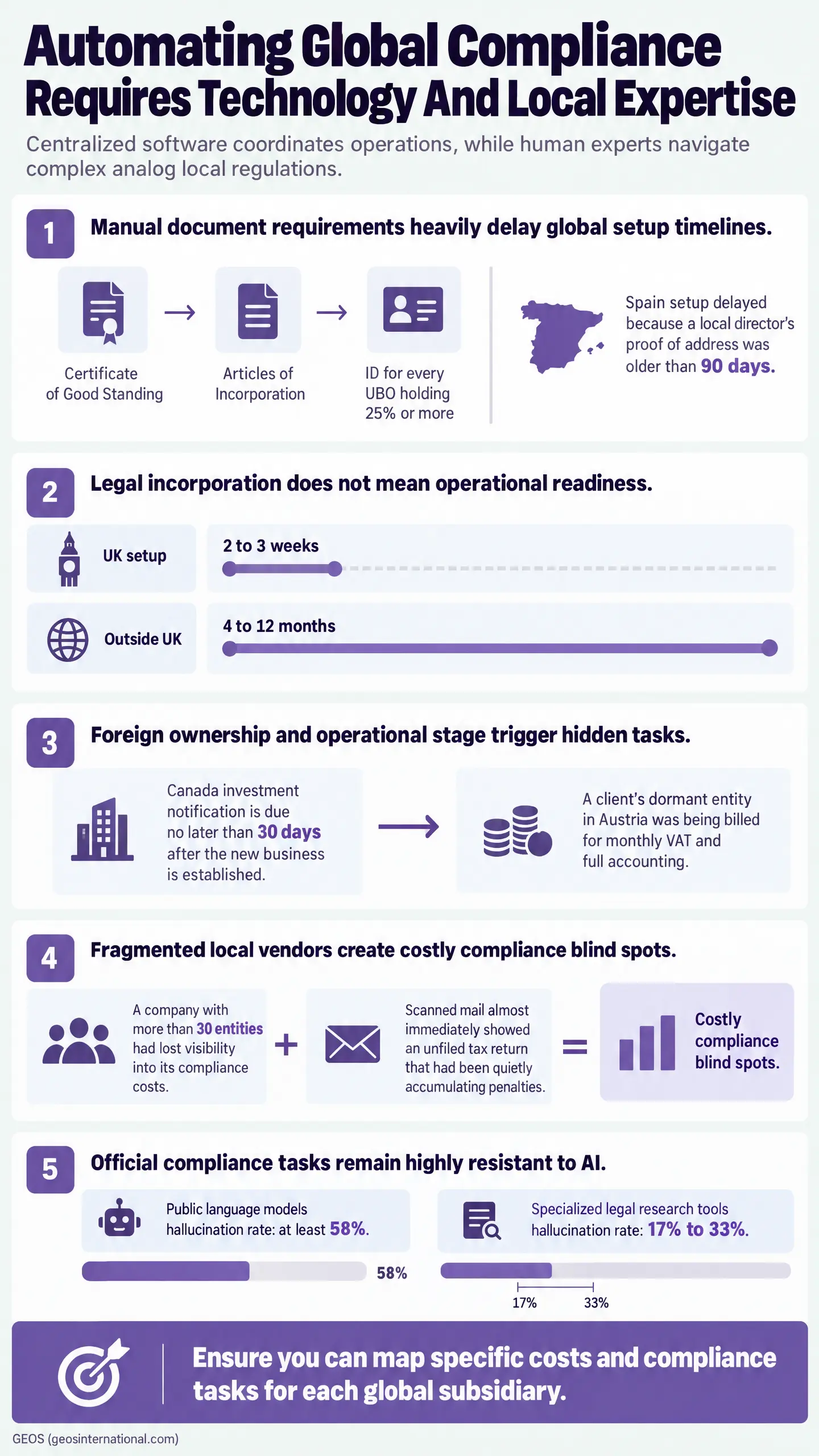
- Global entity incorporation requires collecting a Certificate of Good Standing, Articles of Incorporation, and valid identification for every ultimate beneficial owner holding 25% or more of the parent company.
- While UK legal incorporation takes only a few days, operational readiness requires an HMRC PAYE payroll registration, which cannot be submitted more than two months before paying staff.
- Domestic Canadian accountants frequently miss the Investment Canada Act notification, which foreign companies must file no later than 30 days after establishing a new Canadian business.
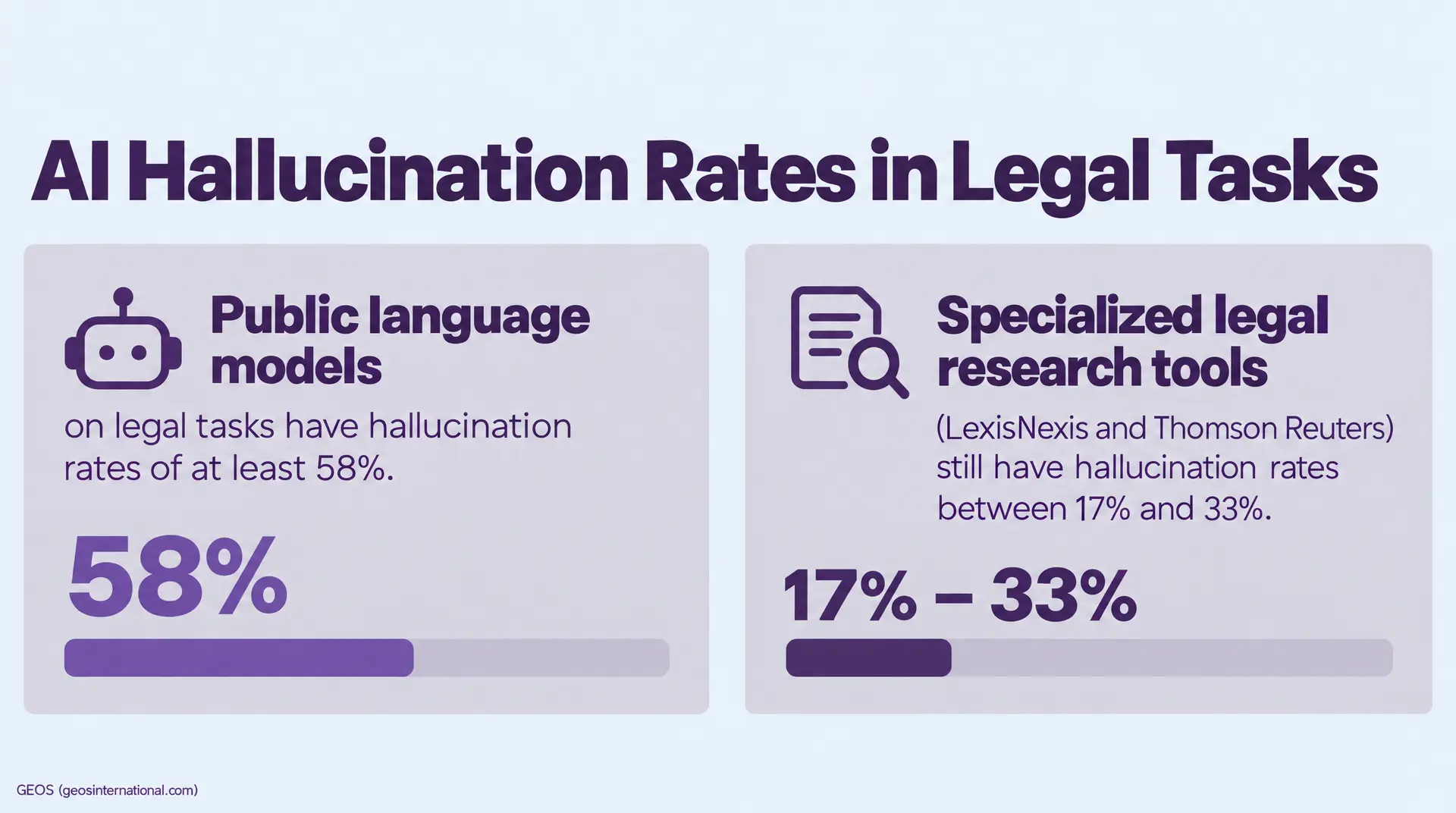
- Specialized legal research tools from LexisNexis and Thomson Reuters exhibit hallucination rates between 17 and 33%, making human domain expertise essential for global corporate compliance planning.
- The proposed EU-Inc corporate framework targets a 48-hour registration process, but foreign companies will still face analog delays from bank KYB checks, notary appointments, apostilles, and sworn translations.
Why Is Manual Research Required to Map Global Entity Incorporation and Compliance?

Global compliance usually sits in spreadsheets or with each local partner, or it isn’t tracked at all. The company ends up blindly paying invoices and hoping the work gets done. When we built the GEOS International platform, we found there were no shortcuts. Our team spent hundreds of hours documenting what it takes to set up and maintain an entity in each of the 80+ countries we cover. I also held hundreds of meetings with local tax and legal experts. That research was the only way to put technology on top of this work in a meaningful way.
It helps to separate AI from technology. AI can’t lodge an incorporation application or file a return, and many government portals are closed to automation. Some are closed to foreigners as well. Incorporating in Canada as a foreigner is fast, but the Canada Revenue Agency’s online portal is inaccessible to non-residents. Foreign directors deal with phone trees and long lag times unless an authorized Canadian representative with a Social Insurance Number handles their registrations, and we arrange that for clients. What software can do is hold the compounding variance. That means how steps, documents and filings change between countries, and between an entity that is incorporated and one that is operational.
From entity setup through ongoing filings, compliance automation handles the coordination tasks for a foreign subsidiary, while notaries, banks, tax authorities and legal advice still need a person.
|
Compliance task |
Can compliance automation handle it? |
What still needs a person |
Country example |
|---|---|---|---|
|
Compliance calendar and filing deadlines |
Yes |
Local accountant files, finance team tracks VAT thresholds |
Canada: Investment Canada Act notification due within 30 days of establishing a new business, subject to exemptions |
|
Parent company and UBO document collection and expiry tracking |
Yes |
UBOs holding 25% or more supply personal ID |
Spain: setup delayed because a local director’s proof of address was older than 90 days |
|
Vendor task assignment and proof of completion |
Yes |
Local accountant, lawyer or payroll provider does the work |
Austria: dormant entity billed for monthly VAT and full accounting when only nil filings were required |
|
Tax ID and payroll registrations |
Partly |
Local tax representative, plus codes sent by mail |
UK: PAYE registration accepted no more than 2 months before first payday, and the reference letter can take up to 30 working days |
|
Notarization, apostille and sworn translation |
No |
Notary, apostille authority and sworn translator |
Spain: sworn translations by translators appointed by the Ministry of Foreign Affairs are official |
|
Business bank account opening (KYB and KYC checks) |
No |
Bank KYB and KYC review, directors on a live video call |
UK: a traditional bank account for a foreign-owned subsidiary can take a few months |
|
Legal and tax advice (e.g. whether a local director is required) |
No |
Licensed local lawyer or tax adviser |
US: public AI models hallucinated at least 58% of the time on federal case questions, legal research AI tools 17% to 33% |
The first platform dedicated to streamlining entity setup and management.
What Are the Three Phases of End-to-End Global Corporate Entity Setup?
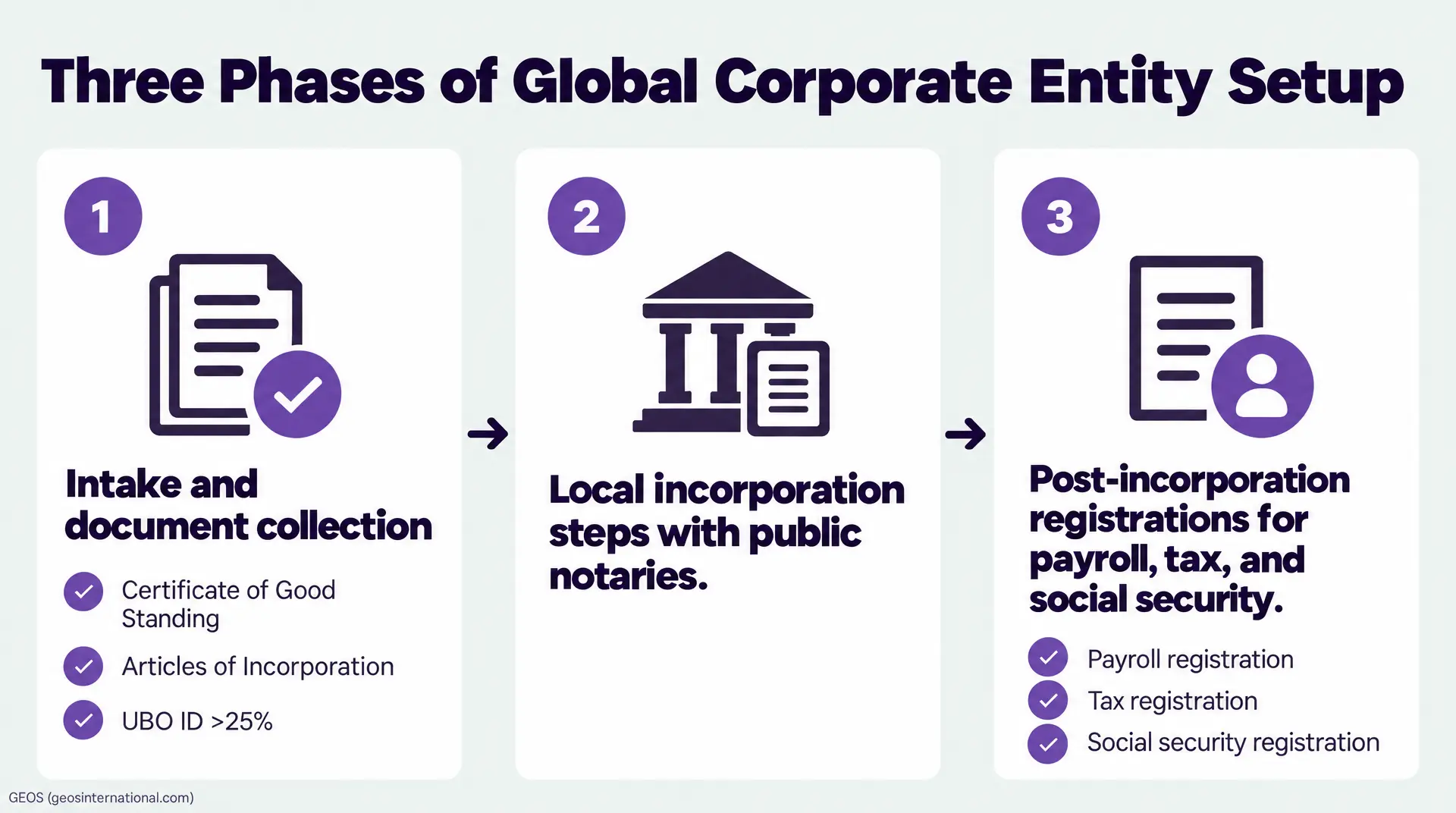
I break entity setup into three phases. The first is intake and document collection. The second is the local incorporation steps with public notaries. The third is the post-incorporation registrations for payroll, tax and social security. Quoted timelines often cover only the middle phase, and sometimes only the government’s processing time. When I see a couple of weeks quoted for a country I know is complicated, I know the client has been hooked into a false promise. Dates will be missed and costs added.
Intake is the best predictor of the overall timeline. At our intake, foreign incorporation typically needs three things from the parent company: its Certificate of Good Standing, its Articles of Incorporation, and ID for every ultimate beneficial owner (UBO) holding 25% or more. Each jurisdiction then applies its own ownership test. Founding documents are often hard to find because an outside lawyer drafted them years ago. Some of the most severe delays come from UBOs, usually silent investors, who resist sending personal ID. We give the client’s executive team messaging that explains these anti-money laundering checks are mandated by local governments and are non-negotiable.
Documents also expire. Authorities often enforce 60- to 90-day validity windows, and UBO IDs and proofs of address lapse most often. A client’s setup in Spain was delayed because a local director’s proof of address was older than 90 days. The documents then have to be notarized, apostilled, couriered and translated in country through a sworn translation. The order of those steps changes with the parent company’s origin and the target country.
Our platform keeps the parent company and UBO documents from the first intake, so the next subsidiary doesn’t start from zero, although some jurisdictions want fresh copies. The repository helps after setup too. A client recently needed to register for VAT in the Netherlands and at first couldn’t find their KVK register, which their registration required. It was readily available on the platform.
Local providers normally send each next step piecemeal by email once the previous one is done. With the full path mapped, steps can run concurrently. Our platform also flags in advance when a step needs a wet signature, a specific letterhead or a live know-your-customer (KYC) video call. Major delays often come from busy executives who set up several entities at once and get overwhelmed as these requirements compound.
The incorporation phase itself stays manual, and I expect it to stay that way for a long time. In Spain, a notary demanded a traditional corporate certificate that a US client’s LLC could not produce. We had to reason with the notary to accept alternative documentation. Spain’s mercantile registry also frequently pauses applications to ask for more. Communication with local partners there often drops off completely in August and December. If you know that in advance, you can build a cushion into the timeline.
Why Does a Time Gap Exist Between Subsidiary Incorporation and Operational Status?
The third phase decides when an entity can functionally do business. An entity can be incorporated with no bank account, no tax ID and no payroll registration, and in that state it can’t actually do anything.
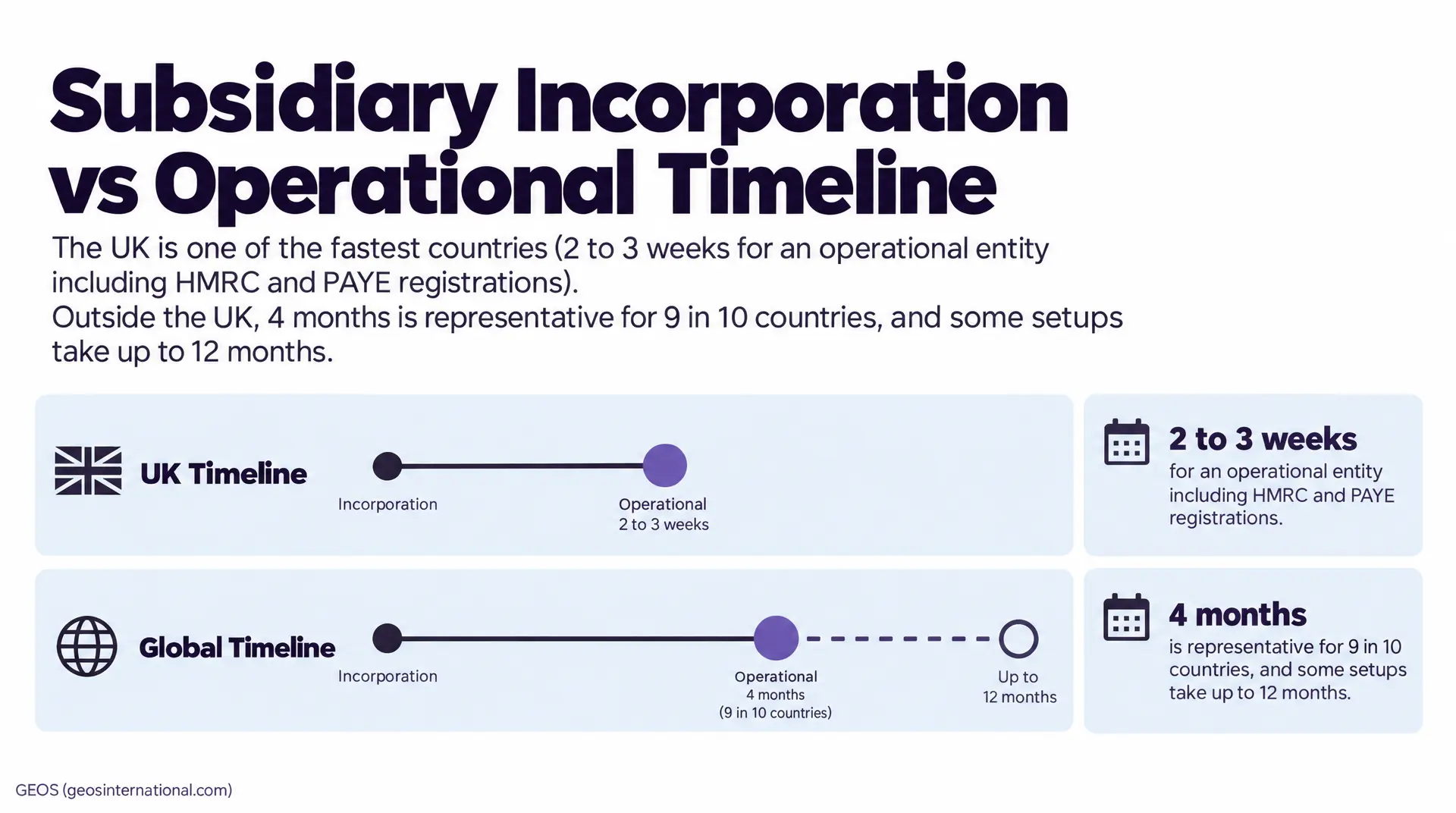
The UK is one of the fastest countries, and it still shows the gap. There are no wet signatures, notarizations or apostilles, and legal incorporation takes a few days. I tell clients to budget one to two weeks for intake, incorporation and the director verification on Gov.uk. I add another week for the HMRC and PAYE payroll registrations. These first need a decision on who your local accounting and tax representation will be. HMRC won’t accept a PAYE registration more than two months before you pay staff, and it sends the PAYE reference by letter. That means this step has to be planned against the hiring date. It puts an operational UK entity at two to three weeks.
A traditional UK bank account can still take a few months for foreign owners because of know-your-business (KYB) and KYC checks. Revolut can often handle a UK subsidiary’s finances end to end. Outside the UK, four months is the more representative timeline for probably nine in 10 countries, and some setups take as long as 12. In one Indian setup, a local bank that had been responsive went completely silent. We had to restart the application with a new bank before the client could make the share capital deposit and run payroll. Global payroll providers also often run their own checklist right before payday. If the local tax and pension registrations aren’t in place, they stop.
If the entity won’t be ready by a hiring date, an employer of record (EOR) can bridge the gap. A client’s Indian setup stalled on their director’s signatures and proof of address. We brought in an EOR partner to hire the team temporarily, so the employees kept the start dates they had been given verbally. The move to the entity afterward was a complex transition. I would keep any period of paying both the EOR and the entity as short as possible.
What Factors Trigger Ongoing Global Subsidiary Compliance and Tax Registration Tasks?

Once an entity is live, most of the automation sits in the compliance calendar. We keep a master list of all the compliance tasks we know exist in each country we service, and it gives every entity its baseline. The registrations an entity holds then add to it. A Dutch subsidiary has its standard tasks. A VAT registration adds VAT filings, and a payroll registration adds payroll-specific items. When we onboard an existing entity, roughly the last five to 10% of tasks are specific to that client, such as filings that began when they crossed a VAT threshold. I would have the finance team own week-to-week tracking of those thresholds from the expansion planning stage, well before the entity exists.
The entity’s stage changes the list as much as its country does. In Mexico, annual compliance varies drastically depending on whether the entity is fully dormant, hiring and paying employees, or recognizing revenue. Accounting firms frequently bill a flat rate that assumes full operations. A client’s dormant entity in Austria was being billed for monthly VAT and full accounting, when the only requirement was the basic nil filings. We moved them to a much lower fee.
Domestic vendors also miss tasks that exist only because the owner is foreign. Canadian accountants often miss the Investment Canada Act notification. They don’t realize it applies when a foreign company establishes a Canadian business. Subject to exemptions, it is due no later than 30 days after the new business is established.
How Does a Centralized Platform Improve Global Subsidiary Compliance Vendor Management?
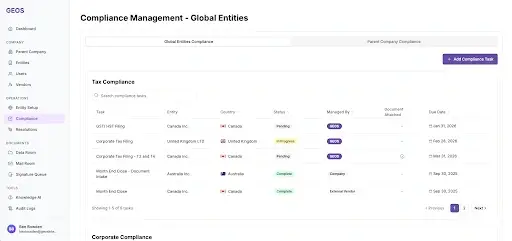
It is virtually impossible to find one provider who can handle tax, legal and payroll across dozens of countries. A growing footprint therefore means several local vendors. Managing them separately can take two or three full-time jobs just to handle the invoices and actions coming in. It is like playing basketball with a blindfold, moving only on what your four teammates call out.
Our platform is vendor-agnostic for that reason. Clients bring their existing vendors onto it, whether that is a single-market accountant or a Big Four firm. Each vendor is assigned the tasks they own. The workflow prompts them and asks for a receipt when a task is done. We also compare each vendor’s work against our own mapping of what compliance should look like in that country. That adds a layer of oversight that wasn’t there before.
A company with more than 30 entities had lost visibility into its compliance costs because local firms were invoicing the subsidiaries directly. Untangling years of backdated auditing and unverified invoices took a newly hired global compliance manager working full-time alongside our team. In cases like that, we audit the local vendors, keep the ones that perform and replace the rest.
Government mail belongs in the same system, since some registrations still arrive by letter. A client had lost track of the provider that set up their two UK entities. They moved the registered addresses to our mail-scanning service. The scanned mail almost immediately showed an unfiled tax return that had been quietly accumulating penalties, and they resolved it before more were added.
What Are the Limitations of Artificial Intelligence in Global Corporate Subsidiary Compliance?
The AI answer in the Mexico case was wrong for reasons that apply across this work. The rules are complex, context dependent and always changing. Much of the accurate information isn’t published online, especially in countries without government portals that lay out the process. Hallucinations are very common as a result. One study of public language models on legal tasks reported hallucination rates of at least 58%. An evaluation of specialized legal research tools from LexisNexis and Thomson Reuters still found rates between 17% and 33%. Those figures are specific to the tools and questions tested. Even so, I would have someone with domain expertise check any AI answer about a director or registration requirement before it goes into a launch plan. Official legal or tax advice should never be outsourced to AI. It carries serious liability and needs a licensed professional.
In our platform, the AI assistant, Geovanna, answers questions about a client’s own footprint, such as which registrations they hold in Mexico. It doesn’t carry out tasks, and it hands off to the account team when a question needs a person. Automating general incorporation may already be viable in the US, UK and Canada, though it falters at the tax authority. Even in the UK, full automation risks misconfigured tax and payroll registrations while some steps still depend on codes sent by physical mail.
The same analog hurdles will test EU-Inc, the proposed EU-wide corporate framework. The Commission proposed it in March 2026, and the Council adopted its negotiating position in October. It is not law yet, and the 48-hour registration it proposes is still a target. I see it as a positive step for foreign companies. I expect VAT, payroll and social contributions to stay country-specific. I also expect bank KYB, notary appointments, apostilles and translations to be the most stubborn analog parts. I wouldn’t pause a European expansion to wait for it, given the opportunity cost in lost market share.
How Does Corporate Footprint Determine the Right Global Subsidiary Compliance Model?

For some companies, the right answer isn’t a platform like ours. A publicly traded company with a large in-house legal team that has country-specific expertise is the rare case where I’d keep corporate secretarial and compliance work in-house. A Big Four firm can suit Fortune 100 and publicly traded companies. For a single-country setup, a local accountant or lawyer can be knowledgeable and good to work with.
For a privately held scale-up past a handful of entities, I would argue the picture changes. Local accountants and spreadsheets become practically untenable without a full-time internal team. When local vendors become a black box, in my experience it comes from a lack of resources, technology and experience with foreign-owned companies. The large firms keep their teams fragmented by region. You re-share parent company documents with each country team and still project manage it yourself. The invoices often show only one or two generic line items, such as “corporate compliance.” A premium does buy more safety, although much of it pays for the overhead of a very large machine, and the work still needs checking. We audited one client previously managed by a global firm. They were being overbilled, and their Costa Rican entity was non-compliant and needed a shareholder transfer to restore its good standing.
The condition I would use to decide is whether you can say, for each subsidiary, what you pay and which tasks that payment covers. If an operations leader can’t answer that clearly, it is the most obvious sign the global compliance setup is broken. If you’re planning new entities, or want that clarity on the ones you already have, I’m happy to walk through how the steps and compliance tasks map out in your countries.
Frequently Asked Questions
How much internal headcount does compliance automation save during global expansion?
It drastically reduces manual coordination. An EIB survey notes 22% of SMEs devote over 10% of their workforce to regulatory tasks. Automation centralizes tracking, letting your operations team manage global footprints without scaling headcount linearly.
Why do automated workflows still stall during cross-border entity activation?
Automation handles coordination, but local bureaucracy remains analog. A Flash Eurobarometer report shows 33% of EU SMEs cite differing business environments as barriers. Software cannot force a foreign notary or bank to move faster. It only surfaces these bottlenecks early.
How does compliance automation accelerate the transition from an EOR to a local entity?
Transitioning off an Employer of Record requires precise timing to avoid payroll gaps. Automation maps the exact prerequisites for operational status – like bank accounts and tax IDs – against your target hiring dates. This ensures the legal plumbing is fully live before you migrate employees.
Can compliance automation completely replace our fragmented network of local vendors?
No, but it consolidates their management. You still need licensed local professionals for specific tax and legal filings. However, a centralized platform replaces unorganized email threads with unified workflows. It holds your local vendors accountable to standardized timelines, giving you a single operational view.
How does automation sequence post-incorporation tasks like UK PAYE to hit hiring deadlines?
Automation reverse-engineers timelines from your hard launch dates. For example, HMRC rules state UK PAYE registration cannot occur more than two months before paying staff. A centralized system flags this sequencing constraint instantly, ensuring you file at the exact right moment.