
An Australian company we worked with made a large sale of servers in the EU and incurred heavy VAT costs as part of that sale. They then tried to set up an entity after the fact to make a VAT claim retroactively. Because the process was retroactive, it was long and had a lot of hurdles. We connected them with local tax experts, who advised against rushing an incorporation solely to reclaim the VAT. Once the reclaim looked unlikely, we helped them set up an entity in the Netherlands for long-term operations instead.
For an operations leader, I would look first at the order of events. The VAT cost arose on the sale, and the entity came afterwards, as a way to recover it. I would argue that tracking foreign VAT thresholds belongs in each country’s expansion plan well before an entity exists. If tracking waits until a new entity is live and its local accountant picks it up, the decisions that created the exposure may already have been made.
Key Takeaways
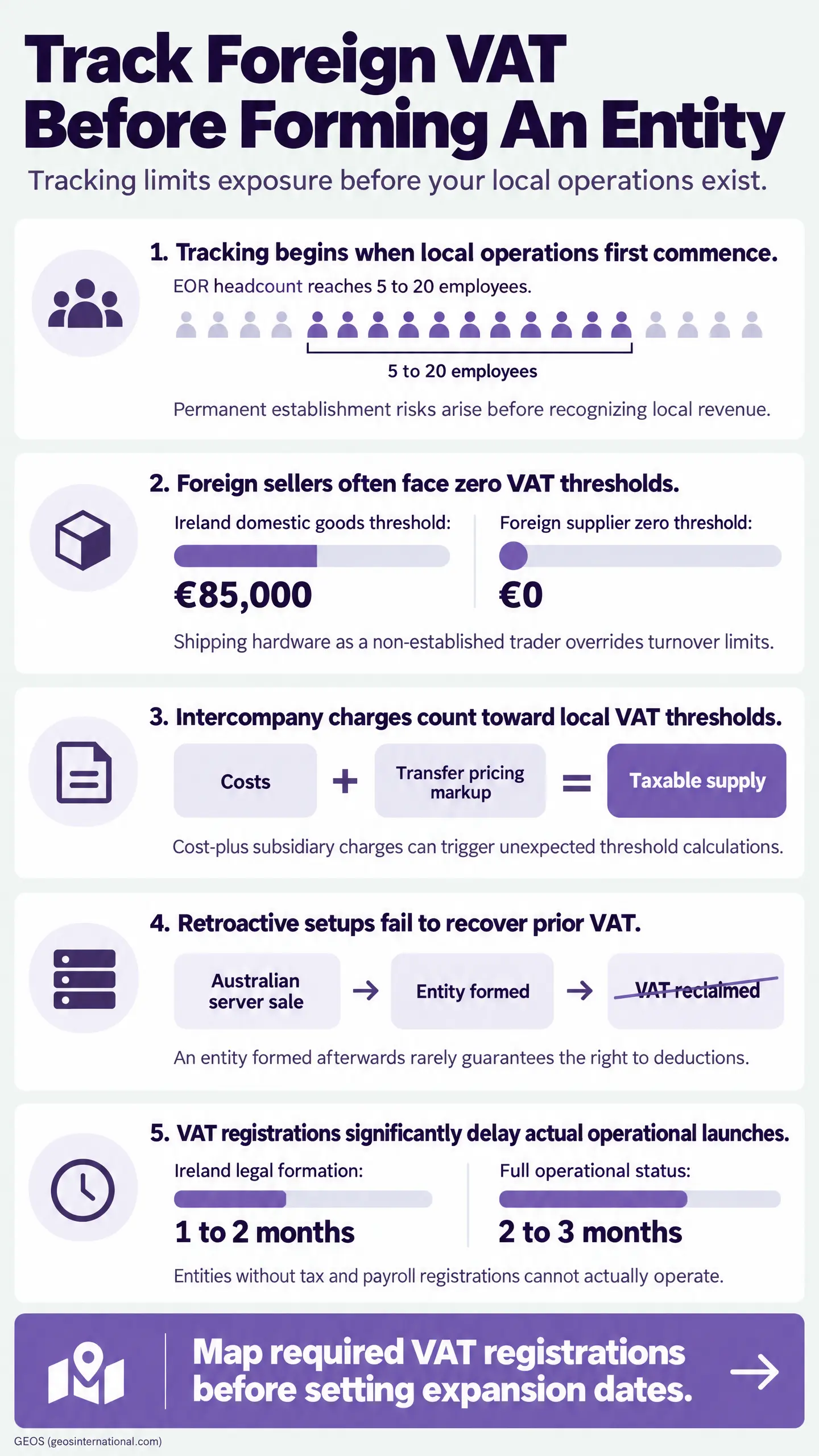
- Forming an entity after a large cross-border transaction does not automatically create a right to retroactively recover VAT costs under the EU VAT Directive.
- Permanent establishment risk typically triggers between five and twenty Employer of Record employees in a single country, requiring formal evaluations for both income tax and VAT fixed establishment status.
- Non-established foreign companies face a zero VAT registration threshold when importing goods into Ireland or making any taxable supply in the United Kingdom.
- Intercompany charges paid by a parent company to a cost-plus subsidiary can qualify as taxable supplies that count toward foreign VAT registration thresholds.
- Post-incorporation VAT and bank account registrations extend Ireland’s standard one-to-two-month legal formation timeline to two to three months for full operational status.
- Foreign corporate entities operating in Ireland must maintain a physical registered address for government correspondence because virtual post office boxes are legally prohibited.
When Should Companies Begin Tracking Foreign VAT Thresholds and Permanent Establishment Risk?
The first platform dedicated to streamlining entity setup and management.
Normally, VAT tracking should begin as soon as the company is operating in a country, and operating covers more than owning an entity there. If you are recognizing revenue in a country, the tracking should already be running. The same applies if the parent company is making sales into that country. It also applies if you are carrying out activities there that could be interpreted as a permanent establishment.
That last condition can arise without any sales at all, for example through a team hired on an Employer of Record (EOR). I would put the point where permanent establishment risk starts at somewhere between five and twenty EOR employees in one country, depending on that country’s local stance. From that point, I would have the question checked.
Permanent establishment is an income-tax question. It is decided under the applicable tax treaty and local law, using criteria such as a fixed place of business or a dependent agent who habitually concludes contracts for the company. From a VAT perspective, the separate test is the fixed establishment. EU rules describe it in terms of sufficient permanence and suitable human and technical resources. I would have the local tax partner look at both.
How Do Foreign VAT and US Sales Tax Thresholds Vary by Jurisdiction and Product?
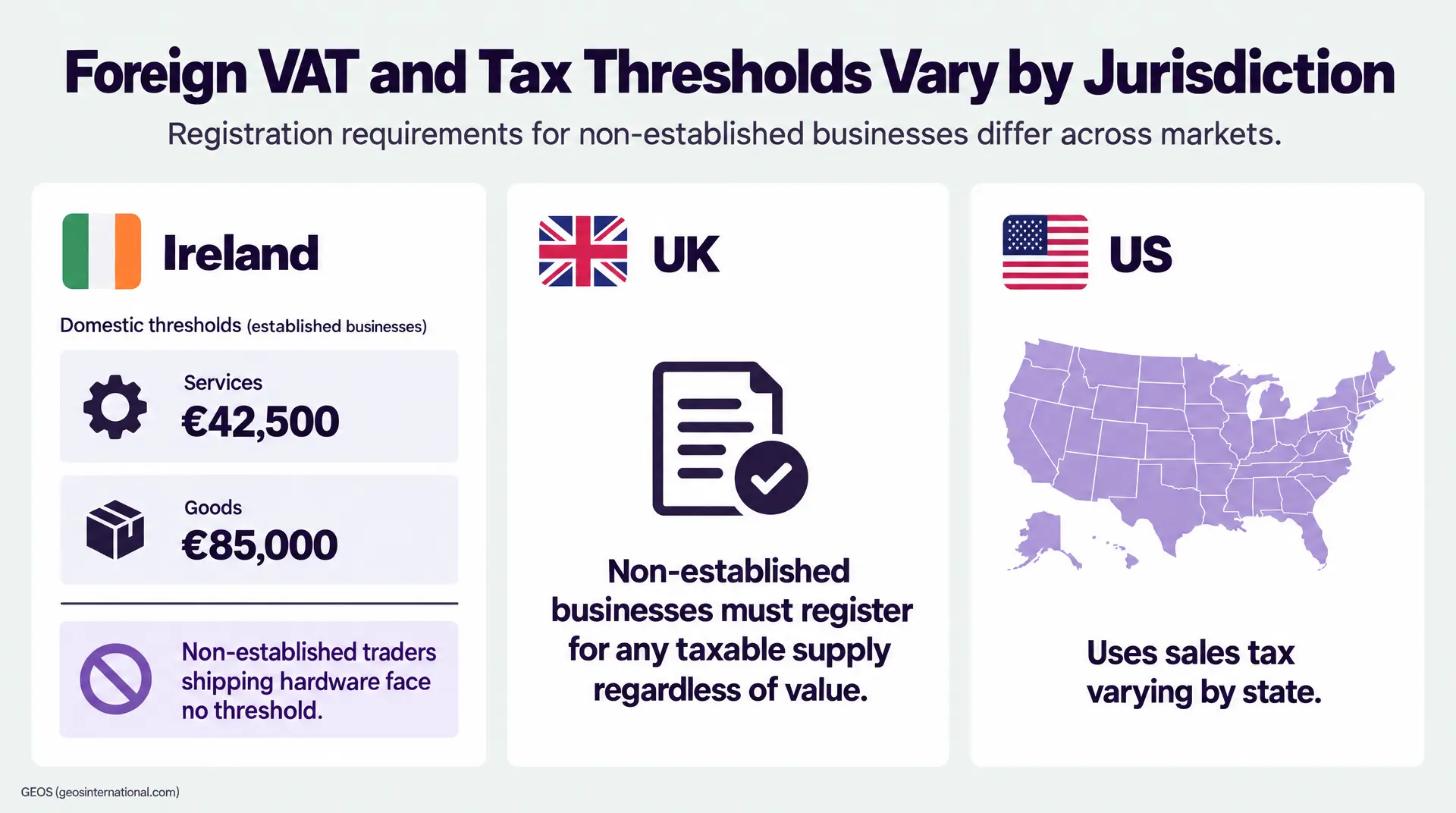
Ireland’s Revenue lists domestic thresholds of €42,500 for services and €85,000 for goods. A non-established trader, however, must register irrespective of turnover for specified activities, including importing goods into Ireland or supplying goods there. That means a foreign company shipping hardware into Ireland can face no threshold at all. Many B2B services fall under separate reverse-charge rules there. For a team at the parent company, this is a case of not knowing what you don’t know in every jurisdiction. So I would have the rules confirmed for the exact product, sale and seller.
Across six common expansion markets in 2026, VAT and GST registration thresholds for local businesses differ widely, and a foreign non-established seller often has no threshold at all.
|
Country |
VAT/GST threshold for local businesses |
VAT/GST threshold for foreign (non-established) sellers |
Standard VAT/GST rate |
|---|---|---|---|
|
Ireland |
€42,500 services / €85,000 goods (2026) |
None for importing or supplying goods, many B2B services reverse-charged | |
|
United Kingdom |
£90,000 taxable turnover in a rolling 12 months (since April 2024) |
None, register from the first taxable UK supply of any value | |
|
Germany |
Small-business exemption up to €25,000 prior year and €100,000 current year (since 2025) |
None where the supplier is liable, many B2B services reverse-charged | |
|
France |
Small-business exemption up to €85,000 goods / €37,500 services, prior year (since March 2025) |
Register once a sale requires French VAT returns, covered B2B sales reverse-charged | |
|
Netherlands |
No threshold, optional small-business scheme up to €20,000 (since 2020) |
Register for B2C goods sales, B2B goods and services often reverse-charged | |
|
Singapore (GST) |
S$1 million taxable turnover, calendar year or next 12 months (since 1994) |
S$1 million global turnover and S$100,000 B2C remote services or low-value goods (since 2023) |
The US uses sales tax rather than VAT, but it shows the same variance. Each state sets its own threshold for when a remote seller takes on sales tax obligations. Whether a given product is taxable is a separate question, and that also varies by state. It’s common for e-commerce companies to sell into the US through a TikTok Shop or a Shopify store without being savvy about sales tax, and to make those sales without the right filings. That can cause major issues in the long run if it goes unnoticed. GEOS International partners with Ionda Tax for this kind of state-by-state tracking.
How Do Transfer Pricing and Intercompany Charges Impact VAT Thresholds for Cost-Plus Subsidiaries?
The costs flowing through a subsidiary need watching as well. A cost-plus entity, such as a local team that provides services to the group, is paid by the parent for its costs plus a markup set by the transfer pricing policy. It may not make any local sales, so it can look as though there is nothing to track. I would still put the transfer pricing policy into the VAT calculation from the day the entity is planned.
EU VAT rules generally measure a supply by the consideration paid for it. For a cost-plus subsidiary, the figure that may matter is the intercompany charge, if that charge is consideration for a taxable supply to the group. It covers the costs as well as the markup, so it is a larger number than the local profit. The question for the local tax partner is whether that charge is a taxable supply in that country and, if so, how it counts against the threshold.
Which Departments Are Responsible for Monitoring Foreign VAT Thresholds During International Expansion?

Normally, finance should be the main owner of the threshold number week to week. When registration timing goes wrong, the exposure mostly lands with finance and the company as a whole. It shows up as penalties, fines and issues that arise locally.
The operations leader’s part comes earlier. Monitoring has to be part of each country’s planning process, so that it is running before the expansion starts and continues as the expansion happens. If you own the expansion plan, it should name three things: the person in finance who watches the number, the inputs they track in that country, and the local tax partner who confirms the threshold and rules. I would choose a partner who works with foreign-owned companies, because standard local accountants can overlook tasks that apply only to them.
How Does Selling Below Foreign VAT Thresholds Impact Market Testing and Entity Formation?

There are often five to seven ways to accomplish an expansion goal. If the goal is only a local sales presence, it can often be reached without hitting VAT thresholds and without an entity. That makes selling below the threshold a sensible way to test a market. How much room it leaves depends on the country. In the UK, a business that is not established there generally must register for VAT if it makes any taxable UK supply, regardless of its value, so that seller has no room below a threshold at all. For that reason, I would confirm the threshold and rules for that type of product or sale when the first sale is made.
Importing or exporting goods changes the calculation. An owned entity supports VAT and tax optimization around imports and exports, which an EOR cannot. That can shift the mathematical equation toward an entity a lot earlier than headcount alone would. The same is true when the reason for entering a country includes recognizing local revenue or signing enterprise contracts there. In those cases, I would explore setting up an entity right off the bat. For plans that include large hardware sales, like the Australian company’s servers, that decision belongs before the sale goes through.
I would not count on a later entity to recover VAT from an earlier transaction. Under the EU VAT Directive, deduction generally concerns VAT on purchases used for the taxable person’s own taxed transactions. Forming an entity afterwards does not by itself create a right to recover the VAT. Whether anything can be recovered depends on the jurisdiction and the facts.
Reclamations that do go ahead can be heavy work as well. A client’s large VAT reclamation in the Netherlands met intense scrutiny and pushback from the local authorities. We managed the supplementary tax and accounting paperwork they demanded, and the reclamation was secured. It still took a significant amount of unexpected work.
How Does Foreign VAT Registration Impact Post-Incorporation Entity Activation Timelines?
Where VAT registration applies, it is also one of the registrations that make an incorporated entity operational. That matters when you have a launch date or a client contract start date to meet. An entity without its tax IDs and payroll registrations can’t actually do anything.
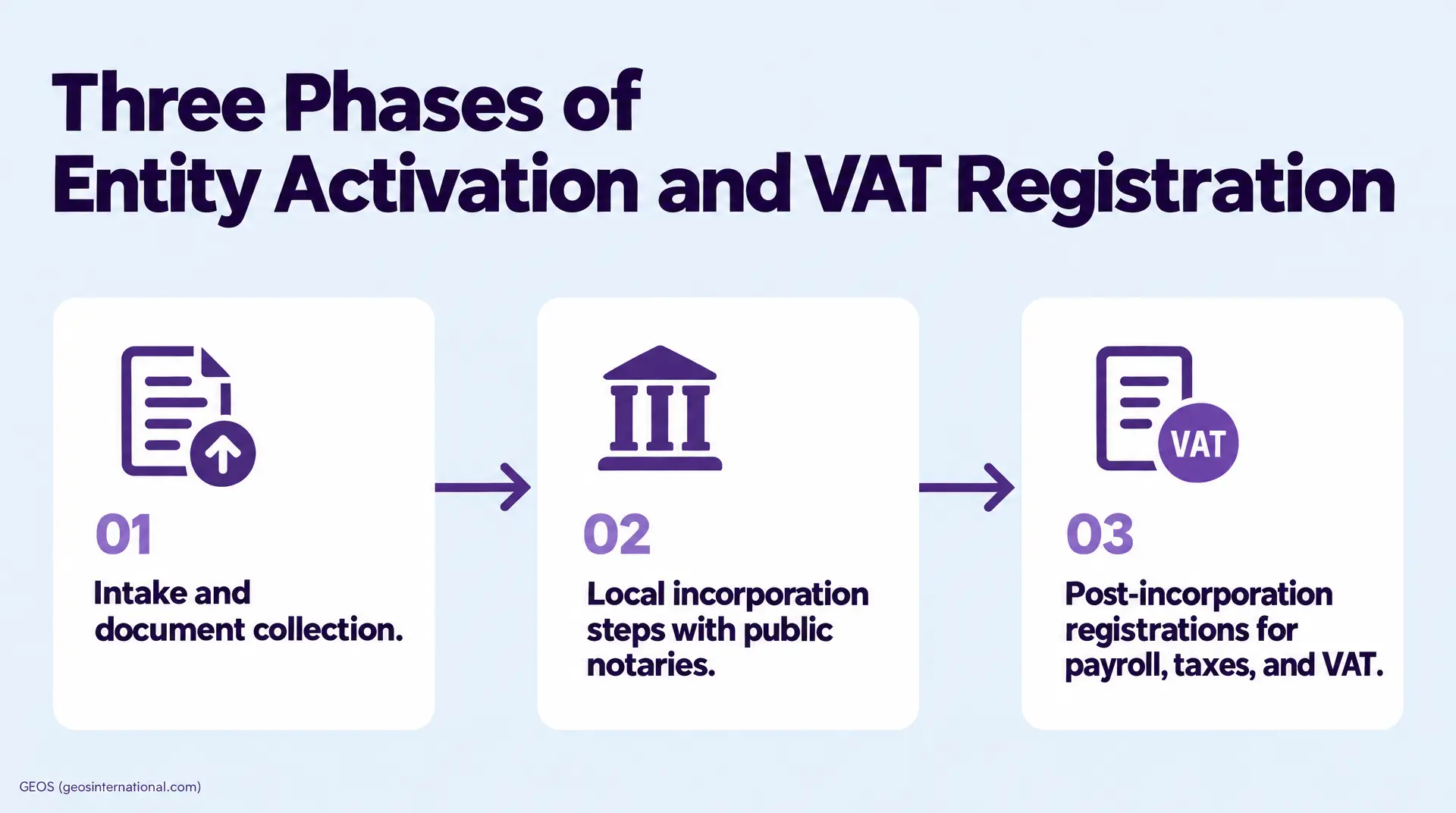
I break setup into three phases: intake and document collection, the local incorporation steps with public notaries, and the post-incorporation registrations for payroll, taxes and social security. VAT registration sits in the third phase, and quoted incorporation timelines generally leave that phase out. A launch plan built on such a quote is hooked into a false promise, and missed timelines and added costs follow.
In Ireland, an entity can be legally formed in one to two months. I would plan for two to three months to reach full operational status, which includes the necessary VAT registrations and the bank account. The UK is one of the fastest markets. There, I would budget one to two weeks for intake, incorporation and director verification, then an additional week for HMRC tax and PAYE registrations. Delays often come at that point, because those registrations first require a decision on who the local accounting and tax representation will be.
Mapping the post-incorporation steps upfront lets you hit steps concurrently rather than getting hit with the next immediate step. I would also build a cushion into any timeline tied to a contract start date, because government registration delays are unpredictable.
How Do Foreign VAT Filing Requirements Change Based on a Subsidiary’s Operational Stage?

A VAT registration brings its own filings, and those need an owner and a due date in the entity’s compliance calendar. When GEOS International onboards an existing entity, most of its compliance tasks are already pre-mapped for that country. Roughly the last five to 10% are specific to the client, and a VAT registration that followed from hitting a threshold is one example. We onboard the client’s local vendors to the platform and assign them the tasks they own. When they complete a task, we require a receipt.
The task list also has to change with the entity’s stage, and crossing a threshold is one of the events that changes it. In Mexico, for example, annual compliance varies drastically across three stages: an entity that is fully dormant, one that is hiring and paying local employees, and one that is actively recognizing revenue.
A client of ours in Austria had an entity that was fully dormant, so no transactions, nothing. It was being billed for monthly VAT and full accounting work, which meant paying for an operational load that didn’t exist. We mapped what was actually required and moved them to a significantly lower fee for the mandatory basic nil filings. When I review invoices like these, I check whether each billed tax filing is legally required yet. Some only apply after a VAT registration that hasn’t happened.
The most obvious warning sign that a global setup is broken is when an operations leader can’t clearly say what the company pays per subsidiary, or which tasks those fees cover. Without one view of entities, registrations and vendor tasks, managing subsidiaries is like playing basketball with a blindfold on, moving on instructions called out by four teammates. One company we worked with had over 30 entities and had completely lost visibility into its compliance costs, because local firms were invoicing the subsidiaries directly. Untangling years of backdated auditing and unverified vendor invoices took a dedicated full-time hire, their new global compliance manager, working alongside our team.
What Is the Operations Checklist for Tracking Foreign VAT Thresholds and Subsidiary Compliance?

For each country in the plan, these are the checks I would want answered, roughly in the order they come up.
1. Owner named at planning. Finance owns the number week to week, alongside a local tax partner who works with foreign-owned companies.
2. Rules confirmed at the first sale. The threshold and rules for the exact product, sale and seller are known. That includes whether a non-established seller has any threshold at all, which it may not, as in the UK for any taxable supply and in Ireland for importing or supplying goods.
3. US sales tax tracked by state. Thresholds and product taxability are tracked state by state, through a platform such as Ionda Tax.
4. Transfer pricing in the calculation. For a cost-plus subsidiary, the local tax partner confirms whether the intercompany charge is a taxable supply and how it counts.
5. EOR growth reviewed. Once an EOR team in one country reaches the five-to-20 range, depending on that country’s local stance, permanent establishment and fixed establishment are both checked.
6. Entity decision made before large cross-border sales. Imports, exports, local revenue and enterprise contracts are weighed early, and nothing in the plan depends on recovering VAT afterwards.
7. VAT registration in the activation timeline. It sits in the post-incorporation phase. Ireland is planned at two to three months to full operation, and any timeline tied to a contract date carries a cushion.
8. Government mail captured. A compliance partner holds the registered address and scans correspondence onto a platform. In Ireland, the address must be physical, because virtual PO boxes are not accepted.
9. Filings calendared by stage. Each VAT filing has an owner, a due date and a receipt, and the task list changes as the entity moves from dormant to hiring to recognizing revenue.
10. Invoices audited. Every billed VAT filing, including nil filings, traces back to a registration that exists.
For any given country, whether tracking should already be running comes down to whether the company is operating there yet. Operating means selling into the country, recognizing revenue there, or building up activity that could be read as an establishment. Where any of those is true, the tracking should be running now, whether the entity is live, in progress or not yet planned. If it would help to see the registrations, timelines and compliance tasks for your countries mapped against your launch dates, I’m happy to go through them with you.
Frequently Asked Questions
Can non-EU scale-ups utilize the new EU cross-border SME VAT scheme?
I would not build an expansion plan around it. Since 1 January 2025, the EU offers a €100,000 threshold exemption, but it is strictly unavailable to non-EU businesses. If your parent company is outside the EU, expect to manage local registrations from day one without relying on this scheme.
How do zero-threshold markets alter the standard entity activation timeline?
In markets like the UK, a non-established seller making any taxable supply faces no threshold at all. Operationally, this means tracking foreign VAT thresholds is replaced by immediate registration. I would budget at least three extra weeks for local tax IDs before allowing the first commercial transaction to proceed.
Do online marketplaces eliminate the need to track local VAT thresholds?
Not entirely. While EU rules often treat digital platforms as the deemed supplier, assuming the marketplace handles all VAT directly is a dangerous trap. I would have your local tax partner map the exact transaction structure to confirm your ongoing liabilities before finalizing your operational expansion plans.
Is it ever operationally viable to reclaim pre-incorporation VAT expenses?
While I advise against relying on it globally, specific markets do allow it. In the UK, you can reclaim VAT on goods acquired up to four years before registration, and services within six months. Because the documentation burden is severe, I would treat this strictly as a fallback.
Does delaying our commercial launch suspend our foreign VAT filing obligations?
No. Once your VAT registration goes live, the compliance clock starts ticking immediately. In the UK and similar jurisdictions, businesses must submit a return for each tax period even with zero transactions. I would ensure your consolidated vendor manages these mandatory nil filings to prevent swift local penalties.