
One company I recall moved more than 10 employees in the United States off an Employer of Record and onto its own entity, and it ran into a massive cost shock. The EOR had been leveraging cheap, large-group insurance rates for benefits. At that headcount, the company did not qualify for those rates on its own, so matching its employees’ existing benefits became significantly more expensive.
For an operations leader, a move off an EOR is tied to a business date: a local hiring wave, an enterprise contract start or a market launch. The financial reconciliation during an employer of record transition sits behind that date, starting well before the last EOR invoice and continuing after it. The saving only begins once the entity can actually pay people. Companies often underestimate the total cost and time it takes to set up an entity in certain countries, and the transition adds its own time on top.
Key Takeaways
- Moving 10 United States employees off an Employer of Record onto an owned entity triggered a massive cost shock because the company lost access to the provider’s large-group insurance rates.
- Advertised Employer of Record fees exclude the foreign exchange conversion margins that providers charge parent companies every time they fund local currency payrolls.
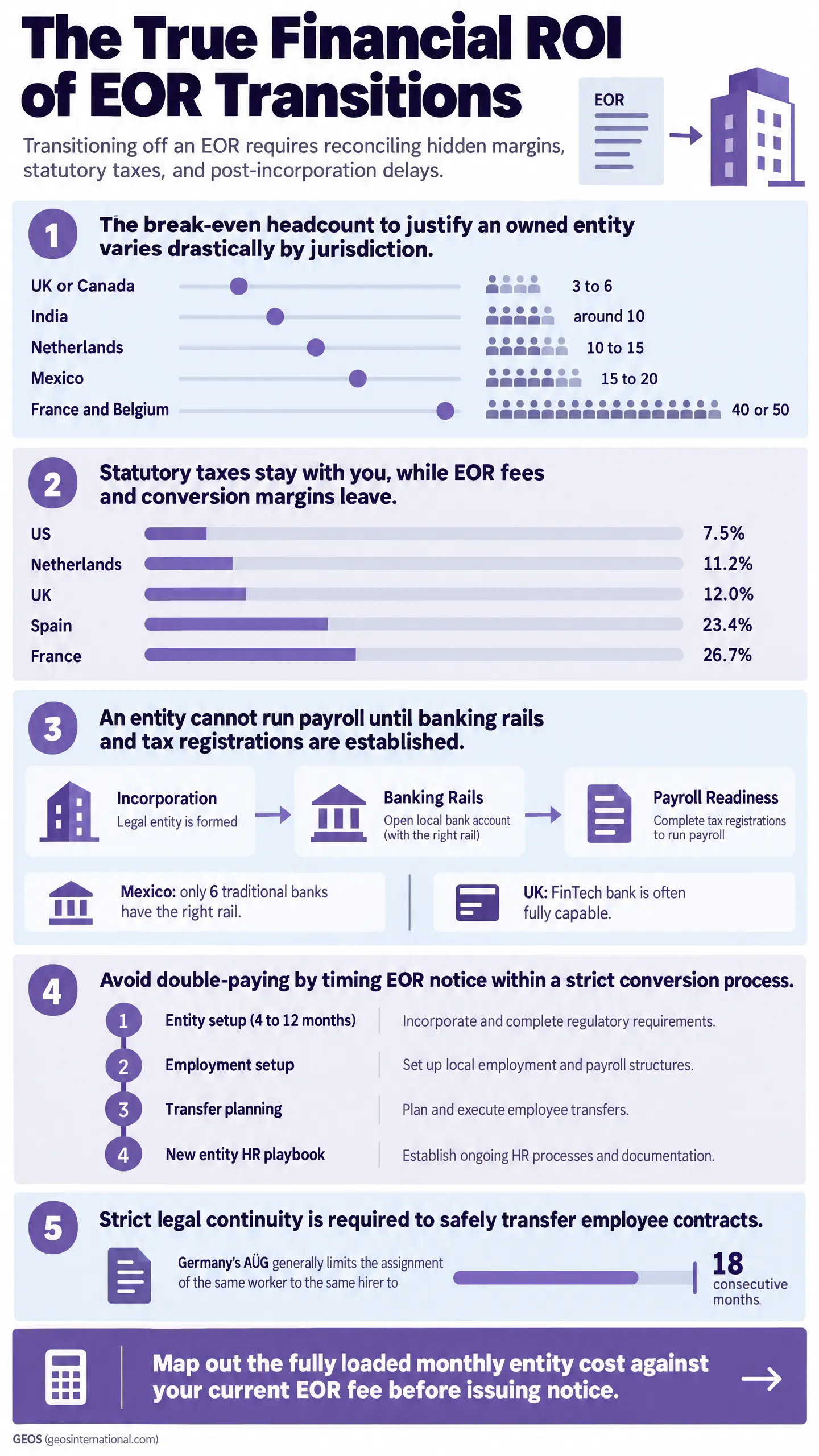
- Transitioning to an owned entity does not eliminate employer statutory costs, which reach 11.2% of labor costs in the Netherlands, 23.4% in Spain, and 26.7% in France.
- The break-even headcount for replacing an Employer of Record with an owned entity ranges from three to six employees in the United Kingdom to 40 or 50 employees in France.
- FinTech bank accounts often fail for foreign entity payroll setups because countries like Mexico require traditional banking rails to process mandatory social security payments.
- Companies utilizing an Employer of Record in Germany must transition workers to an owned entity before hitting the 18-month consecutive assignment limit set by the German AÜG regulations.
- Local tax officials heavily penalize companies that maintain workers on an Employer of Record while simultaneously operating a tax-paying entity in that same country.
How Do Foreign Exchange Margins and Statutory Taxes Impact Employer of Record Invoices?
The first money question I ask is how many EOR employees the company has in the country. That number sets the total monthly subscription cost, and from there we move backwards to understand the total ROI of switching to your own entity. At an EOR fee of, say, $500 per employee per month, 10 employees cost $5,000 a month, or $60,000 a year. That advertised price is not telling the total story.
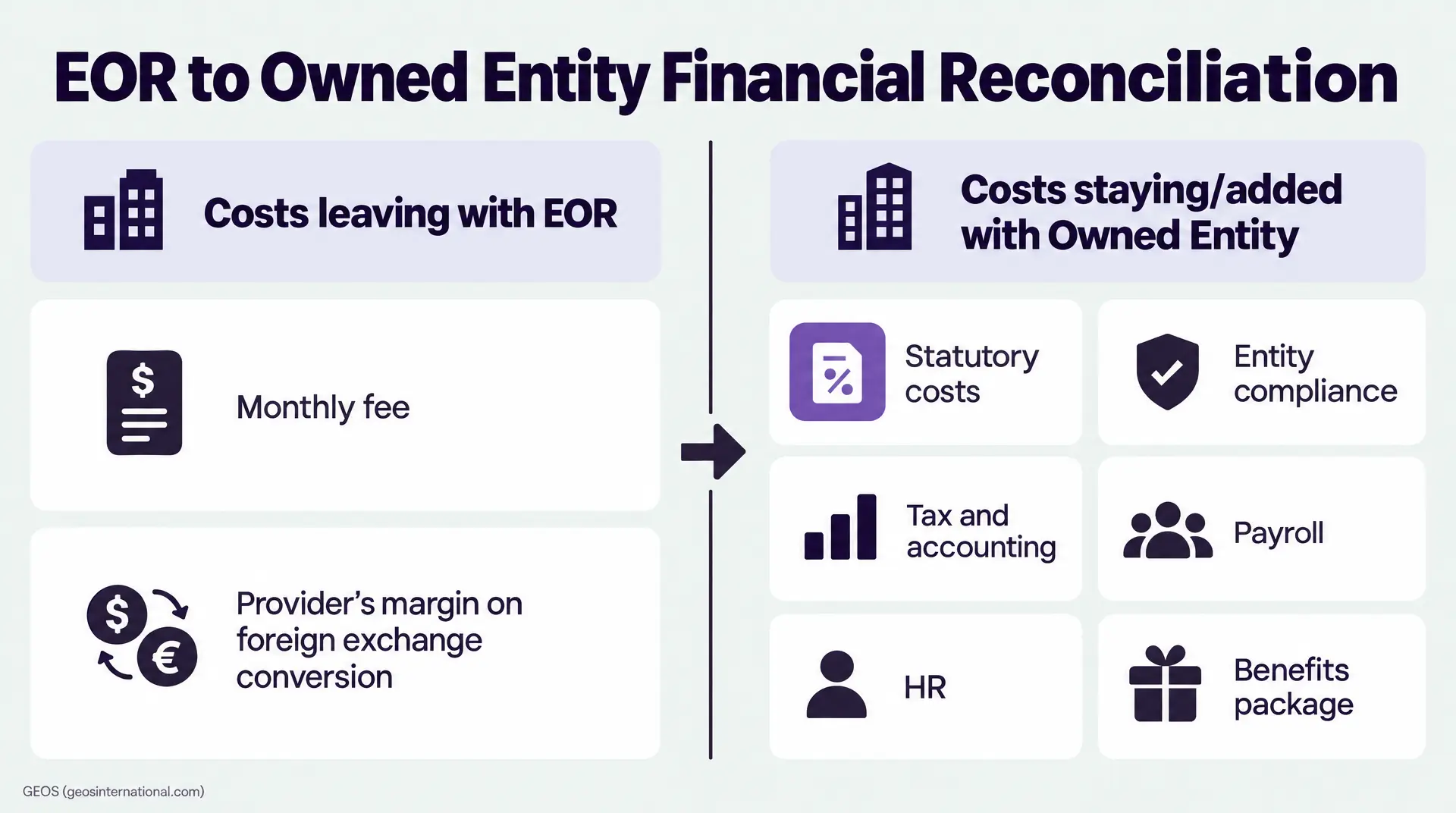
When you pull the invoices apart, the most common culprit is the amount of money spent on the FX. The parent company pays the EOR provider in its own currency, but the employees have to be paid in local currency. The provider converts the funds and charges back the cost of the conversion. Providers can also add a margin on top, and that margin applies every time you fund payroll.
Payroll taxes and statutory employment costs are the other surprise. They are owed whether you employ through an EOR or through your own entity, so the move does not save them. They still catch companies off guard because they can be much higher than what the team is used to at home. OECD figures for 2025 put employer social security contributions, including payroll taxes where they apply, at 7.5% of labor costs in the US. The same figures put them at 11.2% in the Netherlands, 12.0% in the UK, 23.4% in Spain and 26.7% in France. Those are estimates for a single worker on an average wage, so your own numbers still need to be priced locally.
For the reconciliation, I would sort every charge by whether it leaves with the EOR. The monthly fee and the provider’s margin on conversion leave with it. Statutory costs stay with you. So does some conversion cost, because your entity still needs local currency to run payroll. The saving is what leaves, net of what the entity costs to run. If you count the statutory costs as savings, you will overstate the return.
What Are the Fully Loaded Setup and Operational Costs of an Owned Foreign Entity?

It is easy to look at the entity setup cost. It is much harder to see the amalgamating additional costs that follow: entity compliance, tax and accounting, payroll, HR and employment, the initial employment setup and the bank account setup. These are often offered by different partners and vendors, which makes the total hard to see upfront.
For 10 employees in the UK, I would put the monthly EOR fee on one side. On the other side, I would put the projected ongoing cost of the entity: entity compliance, its own payroll, its own benefits package, tax compliance and the registered address. If the entity’s number is lower, the decision becomes straightforward. Benefits deserve their own quote before notice goes out. The US company that left its EOR lost the group insurance rates. Whether that happens to you depends on the plan the EOR uses and the group size it is priced on.
The entity’s compliance cost also changes with its stage. In Mexico, annual requirements differ drastically between a dormant entity, one that hires and pays local employees, and one that recognizes revenue. Until employees move across, your entity may have little or no activity, and its fees should reflect that. We helped a client whose entity in Austria was completely dormant but was being billed for monthly VAT and full accounting. We moved the client to a significantly lower fee for the mandatory basic nil filings.
What Headcount Break-Even Point Justifies Leaving an Employer of Record for an Owned Entity?
Finding the break-even is a pretty complicated calculus, because the effort and cost of setting up and maintaining an entity vary so much by country. In the UK or Canada, I would argue it is closer to three to six employees. In India it is around 10, and companies there often make the move intending to scale a large team for a global command center. The Netherlands sits around 10 to 15. Mexico is around 15 to 20 because of its complex ongoing tax, accounting and employment requirements. France and Belgium are closer to 40 or 50. If the goal in France is three employees, I would tell you to go with an EOR, and we refer companies in that position to EOR partners.
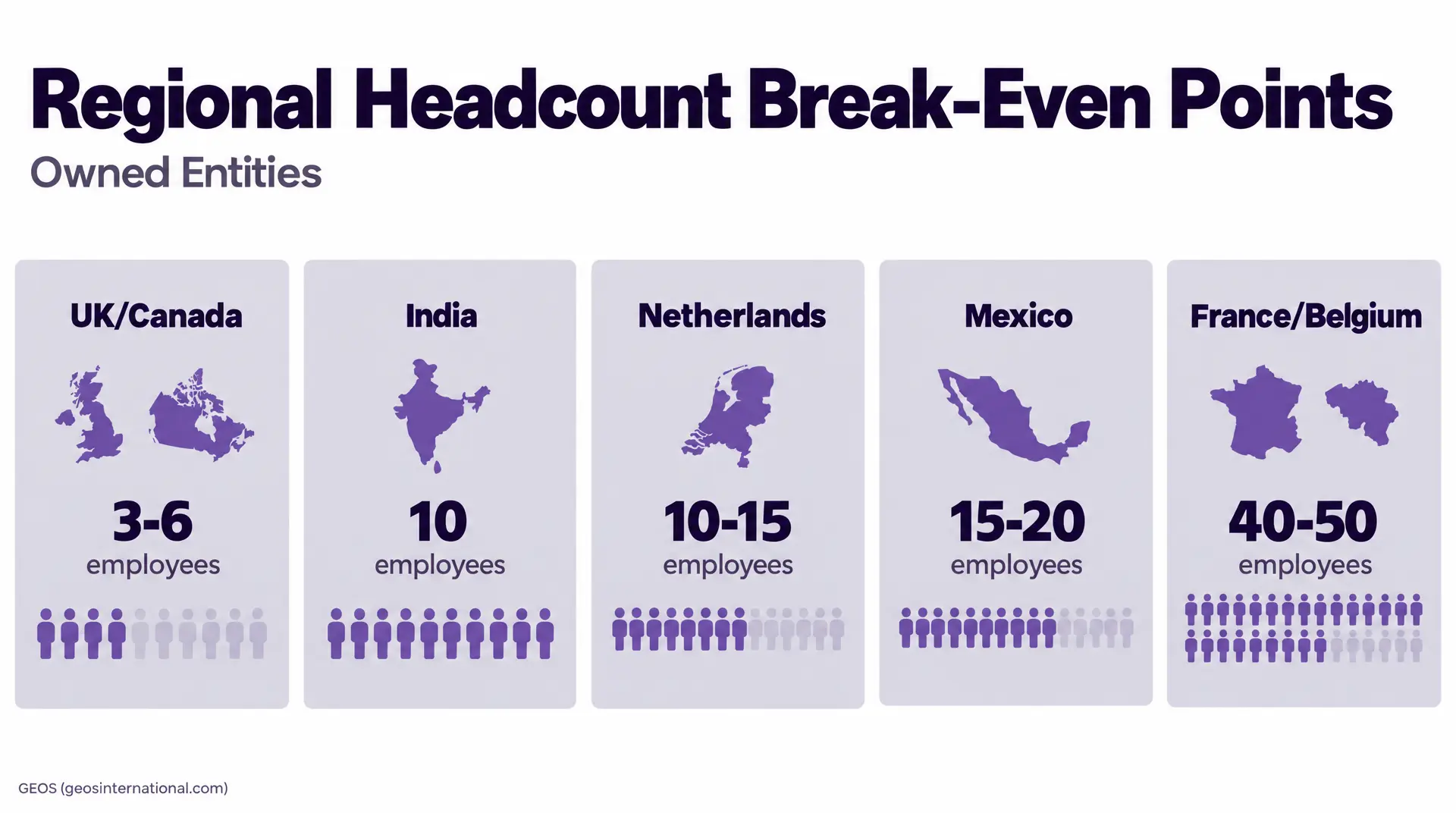
Break-even headcount for leaving an EOR runs from 3-6 employees in the UK and Canada to about 40-50 in France and Belgium, while employer social security costs stay either way.
|
Country |
Estimated break-even headcount, own entity vs EOR (employees) |
Employer social security contributions, 2025 (% of labor costs, single worker on average wage) |
Payroll registrations before first payroll |
|---|---|---|---|
|
United Kingdom |
About 3-6 |
12.0% | |
|
Canada |
About 3-6 |
CRA payroll program account (RP), plus Revenu Québec for Quebec payroll | |
|
India |
About 10 |
Statutory rates, 2026: EPF and EPS 12% of wages, ESI 3.25% where wages are up to INR 21,000/month |
TAN from the Income Tax Department, EPFO at 20+ employees, ESIC at 10+ persons |
|
Netherlands |
About 10-15 |
11.2% |
Belastingdienst employer registration (loonheffingennummer) |
|
Mexico |
About 15-20 |
9.8% |
SAT RFC, IMSS Registro Patronal, state payroll tax (ISN) |
|
France |
About 40-50 |
26.7% |
First DPAE to Urssaf, which opens the employer account |
|
Belgium |
About 40-50 |
21.4% |
ONSS/RSZ employer identification via WIDE, then Dimona |
Why Do Banking Rails and Payroll Registrations Delay Foreign Entity Readiness After Incorporation?

Quoted setup timelines often stop at incorporation, and an entity can’t do anything useful at that point. Without a tax ID and a payroll registration, a legally formed entity cannot run payroll. The savings in your model should be dated from the day it can.
Banking rails decide much of the gap between those two days, and they vary by country. In Mexico, only six traditional banks have the right rail to make social security payments for payroll, so a FinTech account typically fails. In India, payroll needs a traditional bank account on the Indian rails. Without one, Tax Deducted at Source remittances and provident fund payments are not legally recognized. The UK sits at the other end, where a FinTech bank such as Revolut is often fully capable of handling a subsidiary’s requirements end to end.
When the rails are not in place, a new entity cannot make its share capital deposit or process payroll and corporate taxes, and that often leads to compliance snags and fines. Bank onboarding can also stall partway. During one entity setup in India, a local bank that had been responsive just went silent. We had to restart the application with a new bank, which significantly delayed the client’s share capital deposit and its ability to run local payroll. Even in the UK, where incorporation can take a few days, there is a dependency. Before you can complete the HMRC tax and PAYE registrations, you have to decide who your local accounting and tax representation will be.
The first platform dedicated to streamlining entity setup and management.
How Can Companies Minimize the Double-Paying Payroll Window During an Employer of Record Transition?
The window where a company pays the EOR and runs its own payroll at the same time should be as short as possible. There is no reason to do it that way, full stop. From a compliance perspective, the overlap has a second cost. Local officials view keeping employees on an EOR in a country where you already operate a tax-paying entity as a much worse posture than using an EOR with no entity at all.
The overlap stays short when notice to the EOR is timed against a date you can rely on. That date exists only once the bank account, tax registrations and payroll registration are in place. In the four-phase conversion process we run at GEOS International, notice sits in the third phase:
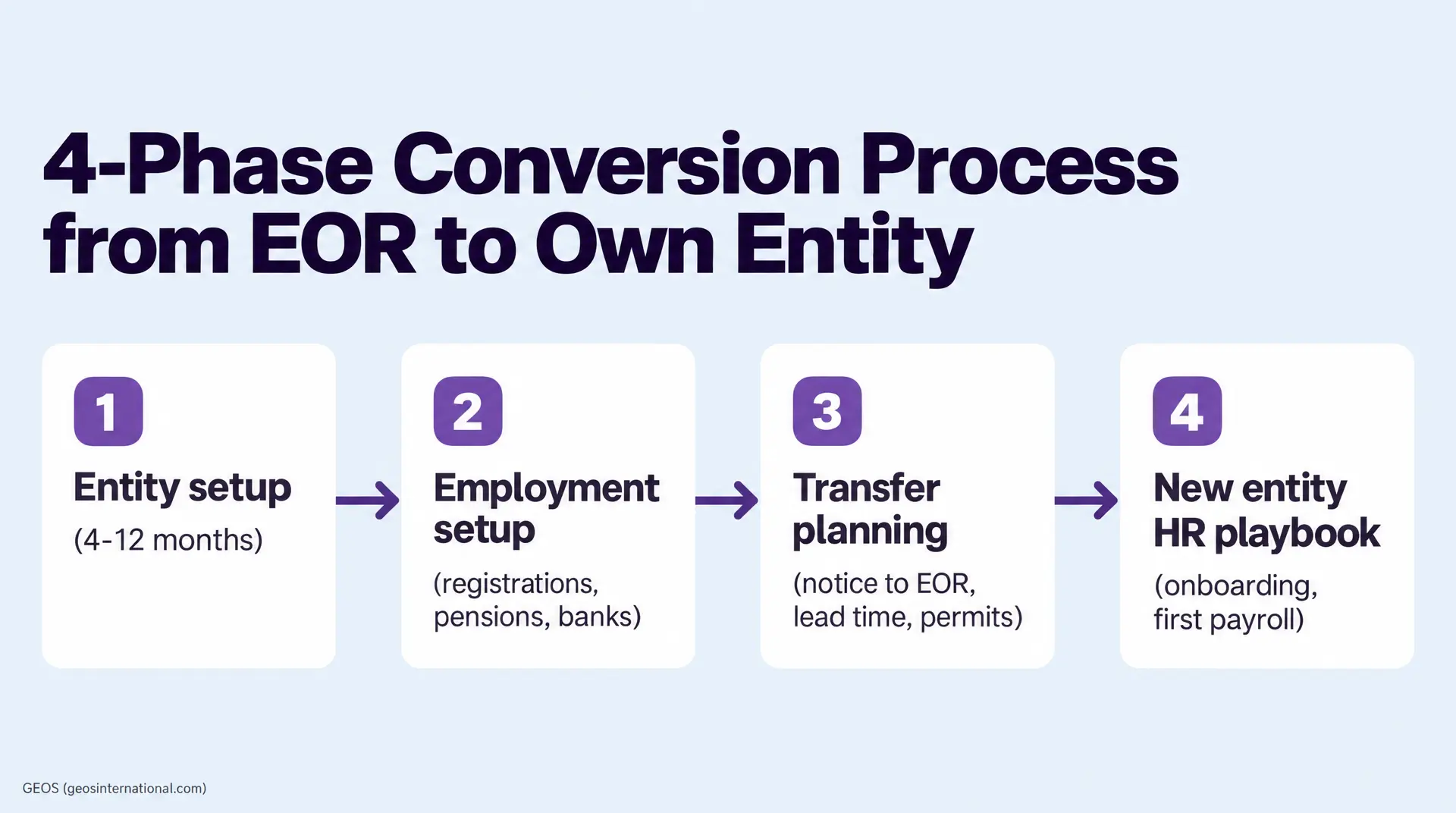
1. Entity setup. Planning and setup activities, typically four to twelve months of project management across vendors, with the UK as a rare exception.
2. Employment setup. Local tax registrations, private pension accounts, local bank accounts, insurance and benefits implementation, and drafting the employment contracts.
3. Transfer planning. Notice to the current EOR, covering payroll lead time, social insurance un-enrollment, deposit reconciliation and work permit transfers. This phase also includes the employee communication plan and an assessment of the legal transfer mechanism.
4. New entity HR playbook. Onboarding employees, running the first payroll and creating an HR playbook for ongoing local compliance.
Even a well-planned date depends on local officials, who are not always consistent. A client of ours was converting independent contractors in Spain into employees through a new entity. The public notary declined the initial incorporation application and asked for extensive additional documents. That pushed back the timeline the client had already given its employees. Because we knew the local bottlenecks upfront, we could help the client manage its budget and communicate the shift accurately.
Germany can set a deadline of its own. Germany’s AÜG generally limits the assignment of the same worker to the same hirer to 18 consecutive months. An earlier assignment still counts toward that limit if the gap was three months or less. Collective agreements can set different maximums. Before you plan the entity’s operational date around the limit, confirm whether your EOR arrangement qualifies as employee leasing and which agreement applies.
An EOR can also bridge a late entity. In India, director signature and proof-of-address delays stalled a client’s entity setup. We partnered with an EOR to hire the employees temporarily and keep their verbal start dates, then moved them to the entity once it was established.
How Are Employee Contracts and Statutory Benefits Transferred During an Employer of Record Transition?

In my view, the hardest part of the transition is the legal continuity. In effect, each employee resigns from the EOR’s contract and signs a new one with your entity, with continuity in between. That takes a lot of communication and coordination. The legal mechanism still depends on the country and the facts. In the UK, where TUPE applies, the new employer takes over the employment contracts, holiday entitlement and continuity of employment. The outgoing employer must also provide employee liability information at least four weeks before the transfer. Whether an EOR-to-entity move qualifies is fact-specific, so the transfer mechanism gets assessed during transfer planning.
Either way, the accrued vacation, the replacement benefits package and the local HR and banking setup all have a cost. The EOR cannot help your employees navigate the process. It also cannot decide for you how to honor seniority, benefits and vacation accruals, and it generally will not draft your employment contracts. Those decisions set what the entity owes from the first day, so they belong in the reconciliation. I would argue the biggest mistake is failing to communicate the change of legal vehicle in advance. Employees who are suddenly asked to resign can panic.
Statutory pensions can need their own reconciliation. A client in India had used a global payroll provider’s patchwork solution before moving onto its own subsidiary. As a result, its provident fund payments had been made in a roundabout way. We worked with a local tax partner to reconcile them and make the subsidiary’s pension accounts whole again.
If anyone is let go during the transition, the EOR can help with the exit as long as you follow the correct severance protocol in that country. If you do not, you are liable for the issues and losses and lawsuits that follow, because EOR contracts typically pass liability and indemnity back to the parent company. US-based companies are used to at-will employment, which doesn’t really fly in foreign countries. I recall a US company that unknowingly violated Japanese labor laws by firing an employee through an EOR. It triggered a massive lawsuit and exposed the parent company to full liability.
How Do Independent Vendor Invoices Impact Global Compliance After an Employer of Record Transition?
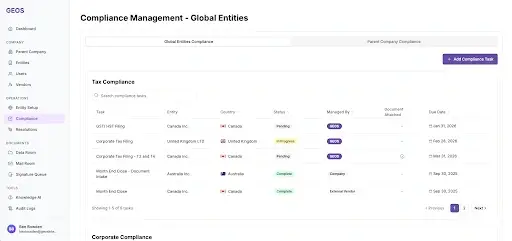
Once employees are on your entity, the costs the EOR bundled into one invoice arrive from several vendors. Some may not be final when the employees start. The Dutch Tax Administration says the sector details that set employee insurance contributions usually arrive within three weeks but can take up to eight. The differentiated premium percentage is sent within four.
Managing independent local vendors across several countries can add up to two or three full-time jobs just to handle the incoming invoices and the actions they require. We supported a company with more than 30 entities that had completely lost visibility into its compliance costs, because local firms were invoicing its subsidiaries directly. Untangling years of backdated auditing and unverified vendor invoices took a newly hired global compliance manager working full time alongside us.
In my view, the most obvious warning sign that a global compliance setup is broken is an operations leader who cannot clearly say what they pay per subsidiary, or what specific tasks those fees cover. Leaving an EOR calls for the same clarity before notice goes out. You should be able to put the entity’s fully loaded monthly cost next to what you pay the EOR today for the same headcount, FX included. You should also know the date the entity can pay employees on the right banking rails.
At GEOS International, we map out the setup steps, post-incorporation registrations and timelines for each country we work in. If you are planning a move off an EOR in one or more countries, I’m glad to walk through the numbers for your headcount with you.
Frequently Asked Questions
How do we reconcile Tax Deducted at Source (TDS) liabilities when switching from an EOR in India?
You must align your transition date with local tax timelines to avoid late-payment interest. India’s general TDS deposit deadline is the 7th of the following month, with March deductions due April 30. Your entity’s local bank account must be fully operational before this cutover.
Who holds the worker risk liability in Mexico during the exact EOR-to-entity cutover window?
The legal employer on the date of the incident holds the risk. You must report Mexico IMSS worker registrations within five business days. Crucially, if an accident occurs before that notice is filed, your new entity retains full liability. Factor this immediate risk into your operational handover.
When exactly must our new foreign entity register for payroll taxes to prevent a transition gap?
Registration windows are rigidly enforced. In the UK, you must register for PAYE before the first payday, but no more than two months prior. In the Netherlands, registration must happen no later than the employee’s start date. Missing these deadlines guarantees a delayed transition payroll.
How do we accurately forecast US healthcare premiums during our financial reconciliation?
Never assume your EOR’s rates reflect open-market pricing. If your entity has 1 to 50 employees, you will likely utilize SHOP small-business coverage. If you average 50 or more full-time equivalents, strict ACA rules require offering qualifying coverage to at least 95% of your staff.
How do sudden statutory wage ceiling updates impact our financial transition model in India?
Local statutory updates can instantly invalidate your break-even modeling. For example, India increased the mandatory EPF wage ceiling to ₹25,000 per month effective September 17, 2026, requiring 12% basic wage contributions. You must audit real-time local thresholds rather than relying on historical EOR invoices.