
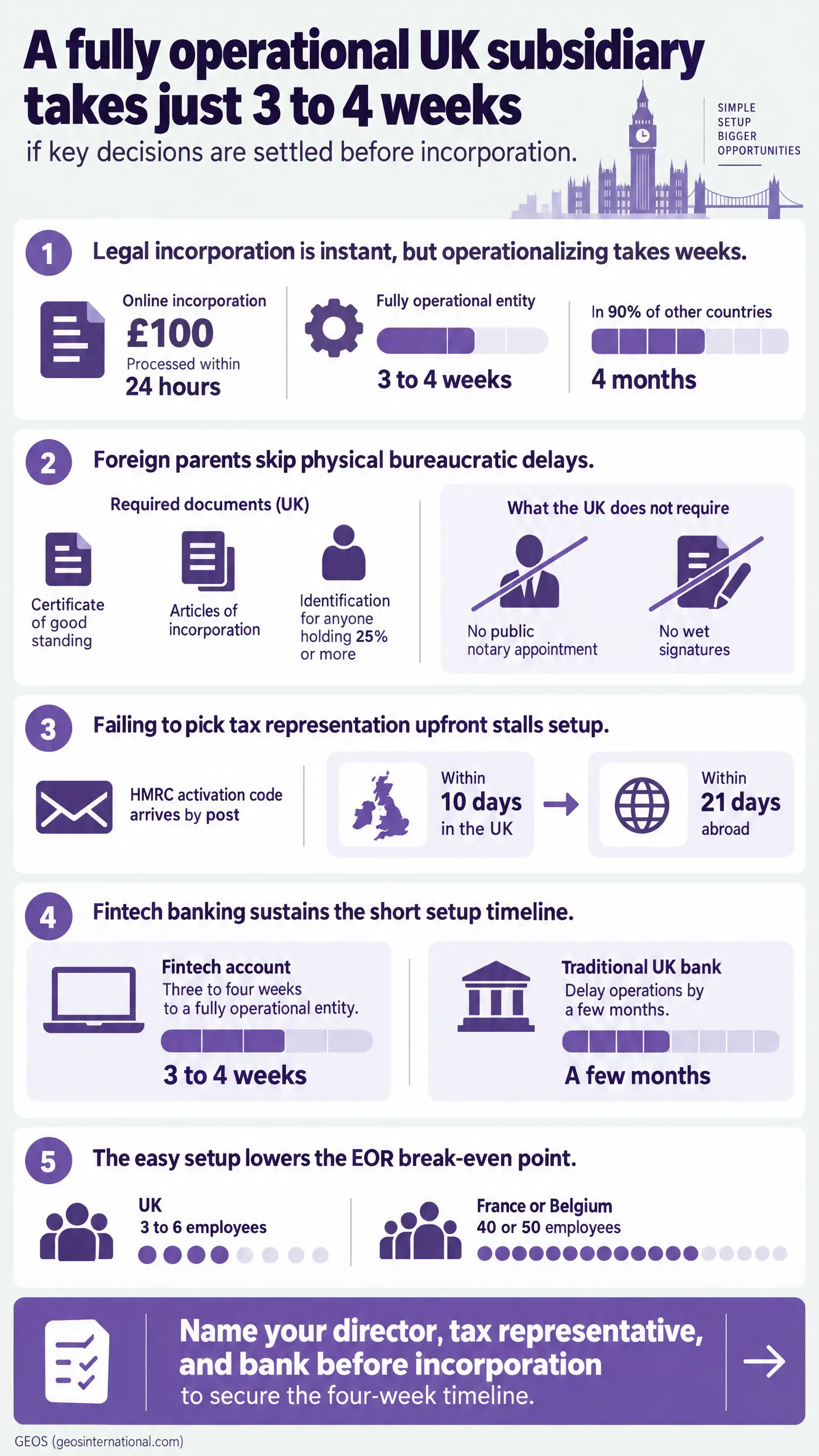
If you’re setting up a subsidiary company in the UK that has to be ready for a date that won’t move, such as an enterprise contract starting in London or a local hiring wave, the UK is one of the few countries where I would quote a short timeline and expect it to hold. According to Companies House, an online incorporation is usually processed within 24 hours. That figure covers the legal incorporation only. A fully operational foreign-owned entity takes longer. I plan on three to four weeks, which in my experience is accurate and doable. For probably 90% of other countries, I would say four months is more representative.
When UK plans slip, it is often in the gap between those two milestones, when the company tries to operationalize the entity. Incorporated means the company exists. Operational means it is registered with HMRC, the UK tax authority, including for PAYE so it can run payroll, and it has a bank account that can move money. Without the tax and payroll registrations, the entity can’t actually do anything.
Those steps are still relatively easy in the UK. They depend on a few decisions that sit with your team:
– who will own the entity – who the directors are – who will handle accounting and tax locally – what kind of bank account you open
The short timeline holds as long as those are settled during intake, before the company exists.
Key Takeaways
- Establishing a fully operational foreign-owned UK subsidiary requires three to four weeks, whereas a comparable entity setup averages four months in most other countries.
- A UK subsidiary becomes more cost-effective than an Employer of Record at three to six employees, compared to a threshold of 40 to 50 employees in France or Belgium.
- As of November 18, 2025, all new and existing UK company directors must complete mandatory identity verification with Companies House to receive a personal incorporation code.
- Unlike many jurisdictions, UK subsidiary incorporation requires no notarized, apostilled, or wet-signed parent company documents, relying solely on basic certificates of good standing and articles of incorporation.
- Using fintech platforms like Revolut for a UK subsidiary prevents the multi-month setup delays associated with traditional bank know-your-business checks and temporary nominee director requirements.
- HMRC requires UK corporate entities to register for Pay As You Earn taxation no more than two months before the company’s first scheduled payday.
- Transitioning staff from an Employer of Record to a UK subsidiary may trigger TUPE regulations, which legally transfer existing employment contracts and holiday entitlements to the new entity.
Why Is UK Subsidiary Incorporation Faster for Foreign Parent Companies?
The first platform dedicated to streamlining entity setup and management.
Normally, the parent company’s documents set the pace of an incorporation. They have to be notarized, apostilled, couriered, and translated in country in a sworn translation process. The order of those steps changes with the parent company’s home country and the target jurisdiction. Many countries then add a public notary appointment and wet signatures. The UK asks for none of these, and the application can be filed fully online.
We run KYC and KYB (know-your-customer and know-your-business) checks on every client under our anti-money laundering policy. For the UK, they need only basic parent company documentation. That normally means the certificate of good standing, the articles of incorporation, and identification for anyone holding 25% or more, which is the threshold our policy uses. It is not a step that slows UK projects down much.
Ownership has to be settled at this point, meaning whether the parent company or an individual will hold the UK company. The documents drafted for the new entity follow from that choice. The directors need to be named too. A UK company needs at least one director, and directors do not have to live in the UK, so the role can sit with an executive at the parent.
What Are the Operational Steps and Timelines for UK Subsidiary Setup?
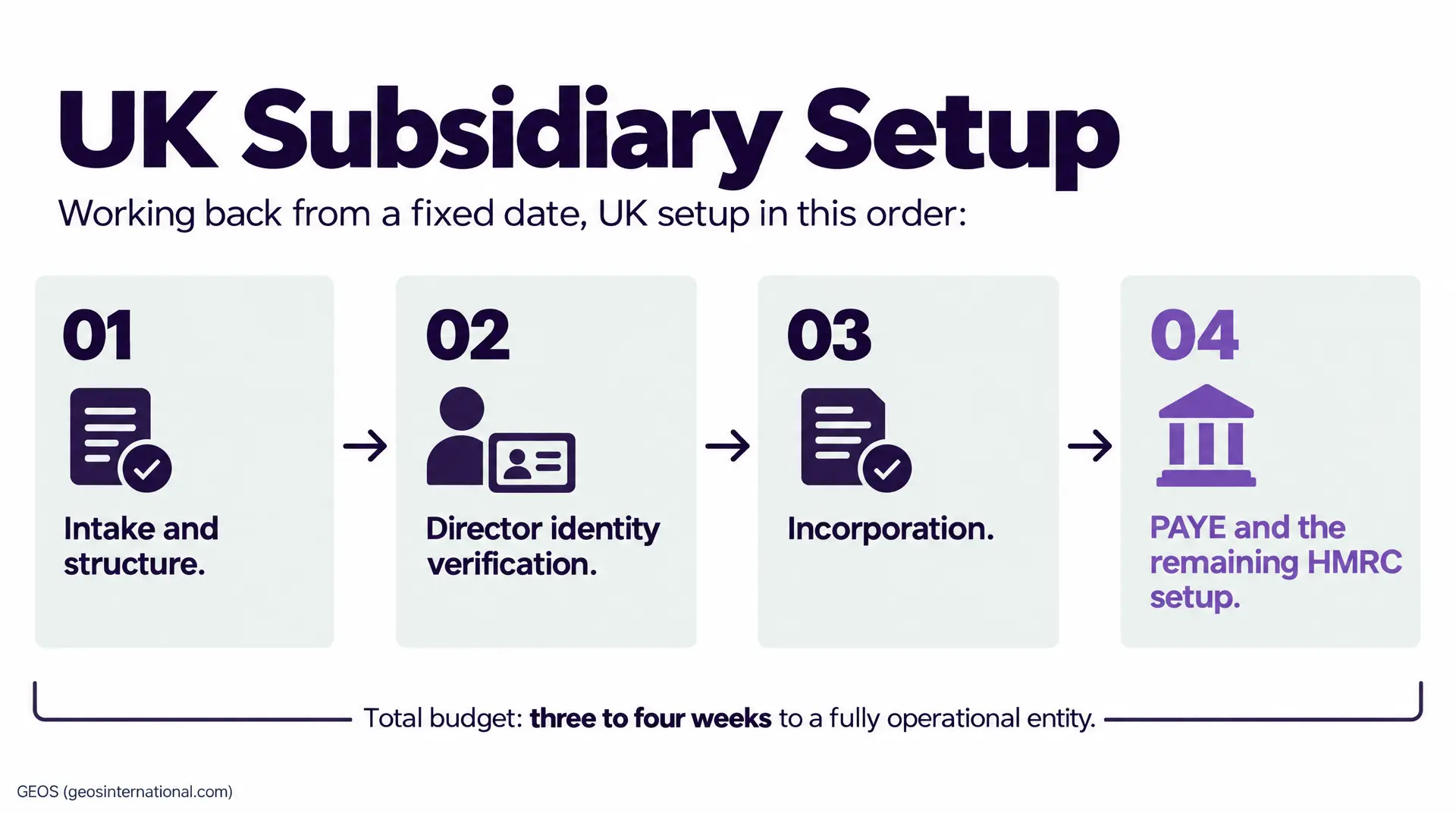
Working back from a fixed date, I would lay out a UK setup in this order:
1. Intake and structure. Ownership is decided, the directors are named, the documents for the new entity are drafted, and our KYC and KYB checks are completed. 2. Director identity verification. Each new director verifies their identity with Companies House and receives a personal code, which goes into the incorporation application. The process is easy, but each director has to complete it themselves. 3. Incorporation. The application is filed online. The service usually sets the company up for Corporation Tax at the same time, unless it is dormant. 4. PAYE and the remaining HMRC setup. These steps are relatively easy and can be done online. HMRC requires an employer to register for PAYE before its first payday, and no more than two months before it starts paying people.
I budget one to two weeks for the first three steps together and another week for the HMRC registrations, which comes to two to three weeks. With a fintech bank account, three to four weeks to a fully operational entity is a realistic plan.
The PAYE window matters if the entity is set up well ahead of a hiring wave. In that case the registration cannot be pulled forward into the setup sprint. It becomes its own dated task inside the two months before the first payday.
Each step from incorporation to fully operational for a foreign-owned UK subsidiary in 2026 has its own rule and timing, and the bank account type can stretch weeks into months.
|
UK subsidiary setup step |
Rule or deadline (2026) |
How long it takes |
Government fee (£) |
|---|---|---|---|
|
Director identity verification (Companies House) |
Mandatory since 18 November 2025, personal code goes on the application |
Average 2.4 minutes in the ID checking app (18 March-30 June 2025) |
£0 (free) via GOV.UK One Login |
|
Online company incorporation (Companies House) |
UK registered office and at least one director, who can live abroad |
Usually within 24 hours |
£100 online (from 1 February 2026) |
|
Corporation Tax registration and activation code (HMRC) |
Usually set up at incorporation, tell HMRC within 3 months of starting to trade |
UTR about 15 days, activation code within 10 days (21 abroad) |
£0 (free) |
|
PAYE employer registration (HMRC) |
Before first payday, no more than 2 months ahead |
Up to 30 working days for the PAYE reference, often quicker |
£0 (free) |
|
VAT registration (HMRC) |
Within 30 days of month-end once 12-month taxable turnover passes £90,000 |
Contact HMRC if no reply after 40 working days |
£0 (free) |
|
Business bank account: fintech platform |
Official guidance calls it a possible short-term arrangement |
24-48 hours to verify most applicants (one provider’s claim) |
£0 government fee, bank account fees apply |
|
Business bank account: traditional UK bank |
May need an in-person UK meeting or a UK-resident director |
4 weeks to 3 months (Business.gov.uk estimate) |
£0 government fee, bank account fees apply |
Why Must You Select UK Tax Representation Before Subsidiary Incorporation?
In practice, the PAYE registration and the rest of the HMRC setup wait on a decision about who will be your local accounting and tax representation. UK projects often lose time at this point, because the company is incorporated before anyone has made that choice.
I would make that choice during intake. Normally, each next step from a local provider is received piecemeal by email once the last one is done. When the whole process is mapped out up front, you can hit steps concurrently rather than getting hit with the next immediate step. The accountant can then be engaged while the directors verify. It can be a firm you already use or one from a pre-vetted network like ours, as long as it is named before incorporation.
HMRC still relies on paper for some steps. When you add Corporation Tax services to the company’s online business tax account, HMRC’s guidance says an activation code is posted to the registered office. It arrives within 10 days in the UK, or 21 days abroad.
Steps like this are why I am cautious about fully automated UK setup. Automating the incorporation itself might already be viable. Relying entirely on automation for tax and payroll today, though, risks misconfigured registrations. For the same reason, I prefer the registered address to sit with the partner managing compliance. That way, government mail is scanned onto the same platform as the deadlines and acted on before one is missed.
How Do Fintech Platforms Compare to Traditional Banks for UK Subsidiary Accounts?

The bank account can stretch a UK timeline from weeks to months, depending mostly on which type you open. In my experience, a fintech platform like Revolut is often fully capable of handling a foreign-owned UK entity’s financial requirements from end to end. The UK is one of the few markets where I would say that.
The UK government’s investment guidance is more cautious. It treats fintech accounts as a possible short-term arrangement while a company applies for a full account. It also says an overseas business may need a representative to meet the bank in the UK.
KYC and KYB at a traditional UK bank are often more complicated than the incorporation itself. They can require a local resident to be appointed, and they can delay operations by a few months. If your finance team needs a traditional account, I would plan it as its own workstream with its own date, outside the three-to-four-week plan.
One way through that onboarding is a temporary nominee director. At GEOS International, we can appoint a UK-resident director for three to six months and limit their control with legal documents such as a power of attorney. Once the account is established, we lodge the resolutions that remove them. Those documents limit what the nominee can do. Companies House guidance is still clear that directors remain legally responsible and must exercise independent judgment, even when someone else tells them what to do. The nominee takes on personal liability in the role, and I would have UK counsel review the arrangement.
Wherever a local director is needed, I would use a professional third-party director rather than an employee, because it is cheaper and faster from the start. One client had appointed a local employee as a resident director simply to check a compliance box. When that employee left and wanted to shed the liability, removing them became a bit of a sticky legal situation. We removed them and appointed one of our own vetted local directors to keep the entity compliant.
What Are the 2026 Companies House Identity Verification Requirements for UK Directors?

Companies House identity verification became mandatory on 18 November 2025. New directors provide their personal code as part of incorporation or appointment. Existing directors provide theirs with the company’s next confirmation statement during the transition period. The confirmation statement is the regular filing that confirms the company’s details.
When the requirement was first announced, it became a nuisance for established entities, because it reached companies set up before it was part of the protocol. Directors who were not aware of it, or not comfortable with the technology, found it difficult to complete retroactively. We guide foreign directors through it for new and existing entities alike.
If you already run a UK entity, ask whoever manages it two things: whether every current director has verified, and when the next confirmation statement is due. Companies House requires every company, including a dormant one, to file a confirmation statement at least every 12 months. It says failing to file can lead to a penalty of up to £5,000, and the company may be struck off.
When Should Foreign Companies Transition from an Employer of Record to a UK Subsidiary?
An Employer of Record (EOR) is the right tool for a first hire or a first handful of hires in most countries. The UK changes the arithmetic because its entity is so easy to set up and maintain. I would argue the break-even point there is closer to three to six employees, compared with 40 or 50 in France or Belgium.
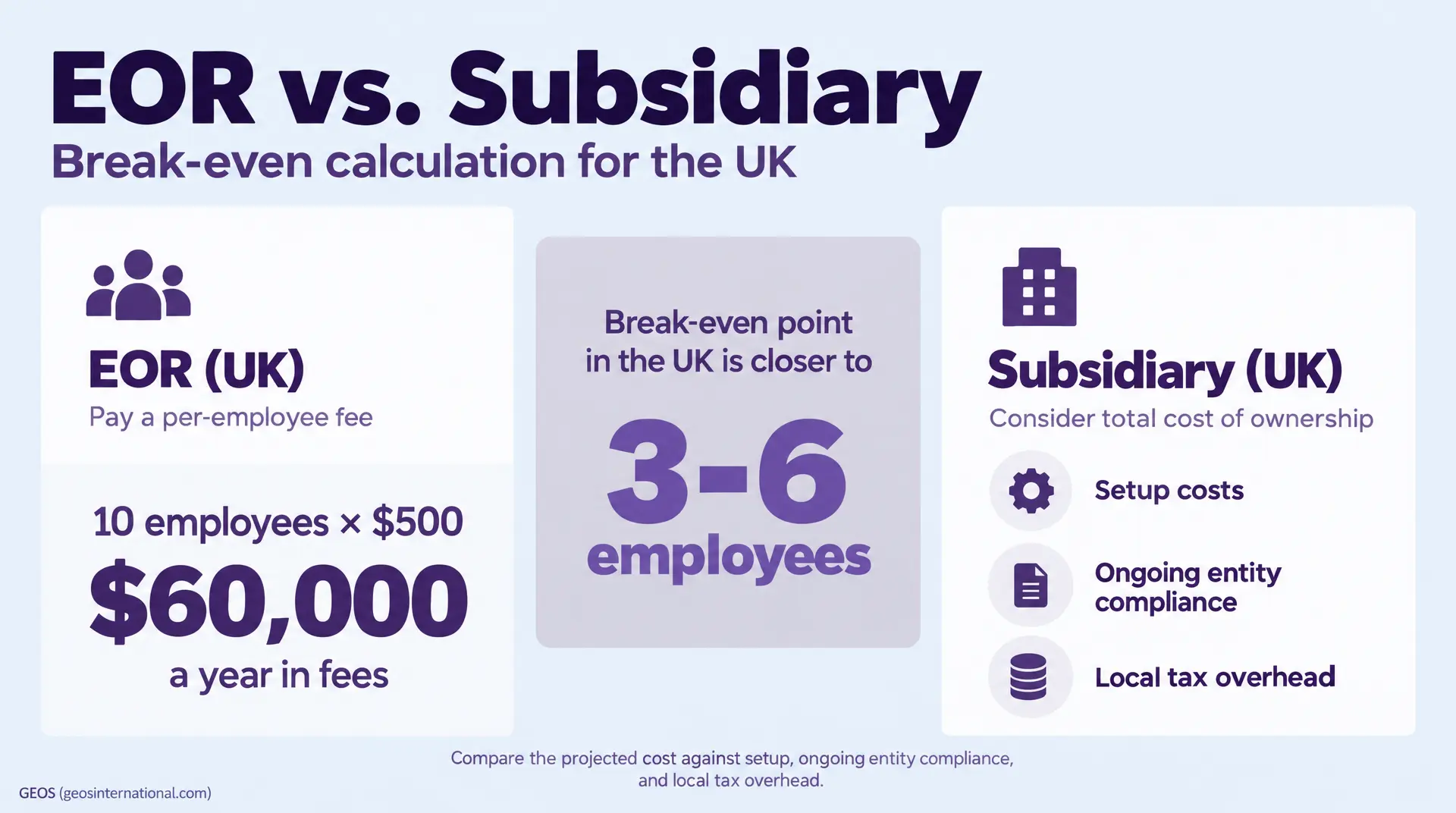
The calculation works backwards from headcount and the monthly fee per person, say $300 to $500. At 10 people and $500 each, that is $5,000 a month and $60,000 a year in fees, before the EOR’s foreign exchange markup. Against that, put the projected cost of your own entity, which covers setup, ongoing entity compliance, payroll, benefits, tax compliance and the registered address. If that total is lower, the decision is straightforward.
An EOR also covers employment only. Contracting with enterprise or government clients as a local company, recognizing revenue in the UK and signing a commercial lease all need your own entity. If your reasons for the UK go beyond employing one or two people, I would explore the entity from the start.
Converting the team normally means each employee resigns from the EOR contract and signs a new one with your entity, with continuity in between. In the UK, check first whether TUPE, the Transfer of Undertakings (Protection of Employment) regulations, applies to the move. Where it does, contracts, terms, holiday entitlement and continuity of employment transfer to the new employer. Whether it applies depends on the circumstances, which makes it a question for employment counsel. Either way, the EOR’s benefits package has to be replaced with your own, and the EOR generally won’t help your employees through the change.
In my view, the biggest mistake is asking people to resign or sign before explaining the change of legal vehicle, which can cause them to panic. Keep the window where you pay both the EOR and your own payroll as short as possible. Once the UK entity is paying tax, don’t keep the EOR running alongside it. Local officials see that as a much worse posture to have than an EOR with no entity at all.
Why Do Multi-Country Subsidiary Incorporation Timelines Differ from the UK Setup Process?

If the UK is the first of several countries on your roadmap, its timeline does not transfer. Germany needs parent company documents notarized, apostilled and couriered into the country before a GmbH can be incorporated. Mexico requires a local legal representative to wet-sign employment contracts. A three-week quote elsewhere generally leaves out intake, post-incorporation registrations and bank KYB, and a plan built on it is hooked into a false promise.
Running those entities through separate local vendors without a single view is like playing basketball with a blindfold, moving only on what your teammates shout at you. In my view, the most obvious sign that a global setup is broken is an operations leader who cannot say what they pay per subsidiary or which tasks that fee covers. One client with more than 30 entities had lost visibility into its compliance costs because local firms were invoicing the subsidiaries directly. Untangling it required a dedicated full-time hire working alongside us.
For the UK itself, there are three questions I would put to your team. Who will serve as director and complete verification? Who will handle the PAYE and HMRC setup? Which bank account are you opening? If each has a name and a date before incorporation, the three-to-four-week plan holds. If you are working back from a fixed UK date and would like those steps mapped against it, I’m happy to walk through it with you.
Frequently Asked Questions
How deep does UK compliance look into our parent company’s capitalization table during setup?
They look for anyone holding more than 25% of shares or voting rights. Unlike some jurisdictions, the UK’s People with Significant Control (PSC) test is strict about identifying ultimate beneficial owners. If an individual holds control or can remove a majority of directors, they must be disclosed to avoid delays.
If we incorporate early to secure the name, when are we legally forced to activate UK tax registrations?
You must notify HMRC within exactly 3 months of starting your first tax accounting period, which is triggered the moment you begin trading. If you incorporate early simply to secure the entity name but remain dormant, you avoid immediate Corporation Tax setups but must still manage strict annual compliance filings.
Can our new UK subsidiary issue parent-company equity to local hires?
Yes, employee equity is well-supported. HMRC recognizes share awards and options, including the tax-efficient Enterprise Management Incentive (EMI) scheme. However, your global business must meet specific eligibility thresholds, including having gross assets of £120 million or less and fewer than 500 full-time employees to qualify. Always confirm eligibility early.
What compliance overhead exists if we incorporate the UK entity but delay our market launch?
Even non-trading entities carry strict reporting obligations. You must file a confirmation statement at least every 12 months. Failing to file this compliance update can result in a penalty of up to £5,000, and authorities may aggressively move to strike off the company entirely, destroying your setup timeline.
Is a standard virtual office address sufficient for our UK subsidiary’s registered office?
No, a generic PO box won’t suffice. The UK requires an ‘appropriate’ physical address where company mail can be delivered and acknowledged. Because critical HMRC activation codes arrive by post – taking up to 10 days locally or 21 days abroad – you need a managed address integrated with your operational platform.