
Every board commits to the country first, and that is the last decision that should be made. Purpose decides the jurisdiction, the cost, and whether you need an entity at all, still almost no one can name it before the date is set.
An Australian firm pushed us to incorporate quickly, certain that EU law’s refund routes for non-established businesses would recover a large VAT bill before a deadline. The reclaim turned out to be unlikely before a single document was drafted.
An entity built for a job it cannot do does not fail loudly. It sits on your books as a dormant company you pay every year to keep alive.
Key Takeaways
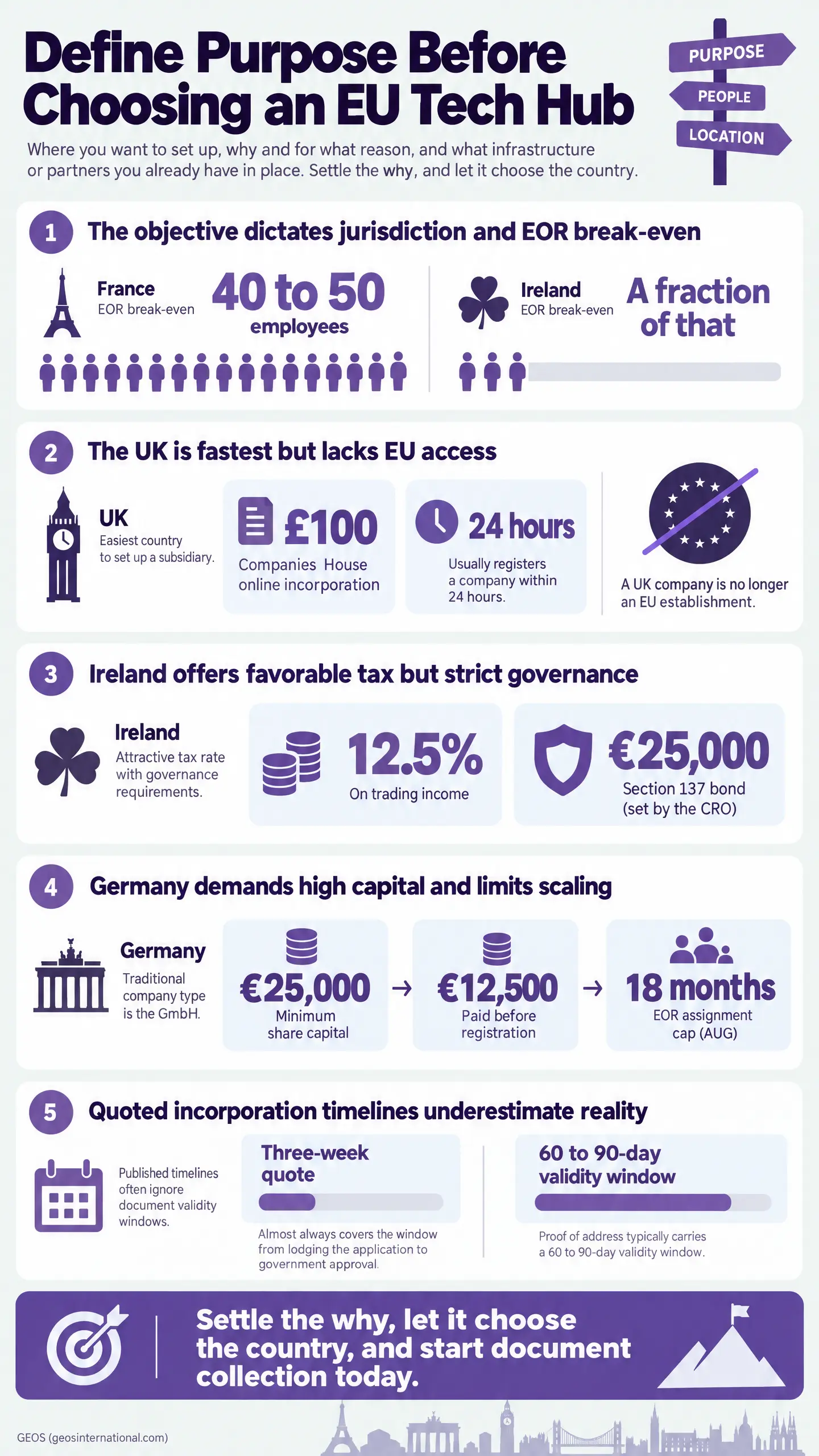
- Forming and maintaining a French entity is complex enough that the Employer of Record break-even point sits around 40 to 50 employees.
- The United Kingdom’s Companies House charges £100 for online incorporation and registers subsidiaries within 24 hours without requiring wet signatures, notarization, or apostilles.
- Foreign businesses expanding into Ireland without an EEA-resident executive can satisfy director requirements by purchasing a €25,000 Section 137 bond instead of assuming liability with local hires.
- Registering a standard German GmbH requires €25,000 in minimum share capital, with at least €12,500 paid in to secure the mandatory bank deposit certificate for the civil-law notary.
- Under the German AUG law, companies scaling through an Employer of Record face a strict 18-month limit on assigning the same worker to the same company.
- Ultimate beneficial owner proof of address documents typically carry a 60-to-90-day validity window, making executive document gathering the single best predictor of total European incorporation timelines.
- The proposed EU Inc. legislation aims for 48-hour digital corporate registration for €100, but it explicitly leaves national employment, payroll, and VAT registrations at the individual country level.
The first platform dedicated to streamlining entity setup and management.
Why Must You Define an Entity’s Purpose Before Choosing a Tech Hub Location?
Before any country comes up, I ask three things: where you want to set up, why and for what reason, and what infrastructure or partners you already have in place to support it. The second answer sorts the map.
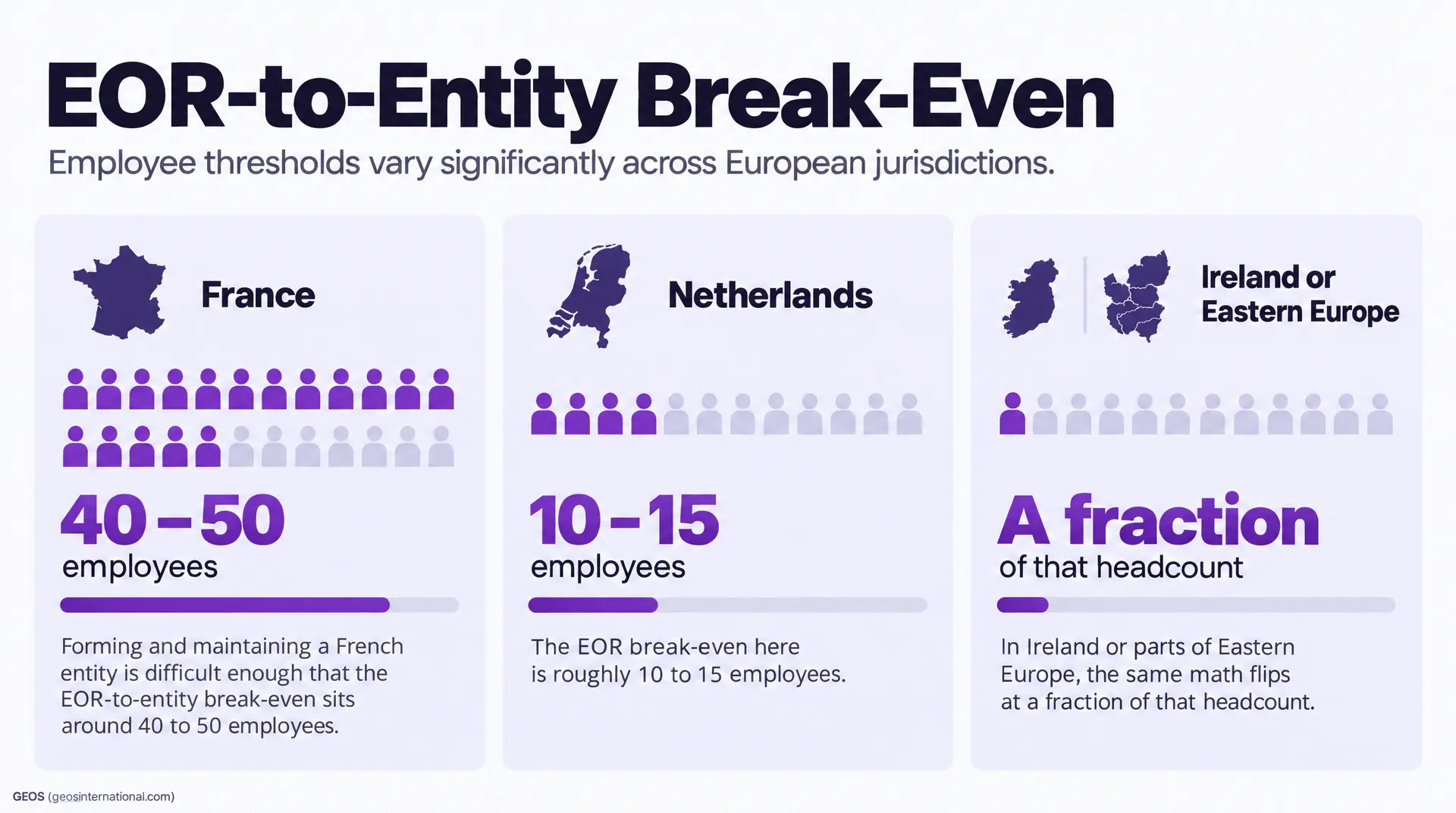
If the entity exists to hire, the deciding factor is how hard it is to form a company and build employment infrastructure in that country. Forming and maintaining a French entity is difficult enough that the EOR-to-entity break-even sits around 40 to 50 employees. In Ireland or parts of Eastern Europe, the same math flips at a fraction of that headcount. If the entity exists to recognize revenue or optimize tax, the decision turns on corporate rates, personal rates, and cross-border treaties. That is a pretty complex tax analysis, and it belongs with local tax experts before you commit.
Confirm you need an entity at all. A pure local sales presence can often operate below VAT thresholds with nothing incorporated. If your reason includes anything beyond employing one or two people, such as signing enterprise contracts locally or holding a commercial lease, skip the EOR phase entirely. Our Global Subsidiary Index scores 50 countries across 40-plus criteria, and it only becomes useful once you know which of those criteria your objective weights.
What Are the VAT Recovery Risks of Choosing an Incorrect Tech Hub Entity Purpose?

An Australia-based company came to us needing an EU entity quickly. They had paid a large amount of VAT on an infrastructure purchase in Europe and believed a local subsidiary would let them reclaim it before a deadline. EU VAT law does provide refund routes for non-established businesses. For non-EU companies, though, the outcome depends on the type of expense, local deduction rules, and whether the country requires reciprocity. Reclaiming VAT after the fact, with no establishment in place when the purchase was made, is a pretty complicated calculus.
We connected them with local tax resources for official advice before anyone drafted a document, and the reclaim turned out to be unlikely. They set up in the Netherlands anyway, as a long-term operating base rather than a tax-recovery vehicle. With the purpose corrected, the timeline could breathe, and they ended up far more comfortable with their VAT position going forward. An entity rushed into existence for a purpose it cannot serve usually becomes a dormant company you pay to maintain.
Why Is the UK the Fastest European Tech Hub Jurisdiction for Subsidiary Formation?

The UK is the easiest country in all of Europe to set up a subsidiary. Companies House charges £100 for online incorporation and usually registers a company within 24 hours. We can have a client’s entity formed in a matter of days, because the UK skips every analog step that slows down the mainland: no wet signatures, no notarization, no apostilles. It remains one of our top three most popular countries worldwide.
Brexit changed what that entity is for. Trade with the bloc continues under the Trade and Cooperation Agreement, so business did not stop. A UK company, though, is no longer an EU establishment, and it no longer carries the hub benefits of sitting inside the Single Market. If the board mandate is EU market access, London is a second entity in your footprint rather than the hub.
Banking is the hard part of the UK for a foreign owner. For most subsidiaries, a FinTech option like Revolut can run the financial side end to end as the company’s “bank account,” air quotes intended. A traditional UK bank takes months of KYB and KYC for a foreign owner. Pursue one only if there’s a legal requirement, heavy payroll to push through it, or an enterprise relationship you want with that institution. One more item catches foreign owners: the UK government now runs a director verification process for UBOs on gov.uk, and missing it can cost the entity its good standing.
What Is the Most Commonly Mishandled Resident Director Rule for Tech Hubs in Ireland?

Ireland is a great option for a hub. It’s in the EU, though not Schengen, it’s English-speaking, and it’s relatively easy to set up in. The tax position is why so many companies path their European operations through Dublin, and it’s worth stating precisely. Irish Revenue applies 12.5% to trading income and 25% to non-trading income. Revenue’s Pillar Two rules only reach groups with at least €750 million in consolidated revenue, so the 15% minimum belongs on your tax counsel’s list rather than yours.
The rule that gets mishandled is the director requirement. An Irish company generally needs at least one director resident in the European Economic Area, and that is EEA-wide rather than Ireland-specific. If nobody on your executive team qualifies, do not recruit a local to sit on your board to tick the box. Purchase the Section 137 bond instead. The CRO sets it at €25,000 with a minimum two-year term, and it keeps an unrelated individual out of your governance entirely.
I’ve seen what the alternative costs. A client of ours once appointed a local employee as a resident director purely to satisfy a compliance requirement. When that employee left, they understandably wanted to shed the personal liability. Removing them became a complex legal ordeal that ended with us appointing a GEOS local director in their place. A bond or a professional third party from the start would have been cheaper and faster.
Plan on one to two months for legal formation and two to three months to be fully operational, including VAT registration and the bank account. Secure a physical registered office, because virtual PO boxes aren’t accepted. Before you sign with any provider, demand a compliance calendar covering accounting, tax, and corporate secretarial tasks. That calendar is where the hidden fees surface.
What Are the Civil-Law Notary and Tax Filing Requirements for Tech Hubs in the Netherlands?

I’d place the Netherlands at tier two out of three in terms of difficulty. There is no German-style capital hurdle, since the official minimum starting capital for a BV is a single cent. What gates you is the civil-law notary. A BV can only be incorporated through one, and for a foreign parent that review is where applications sit. We lean on established relationships with Dutch notaries for exactly this reason.
The ongoing corporate tax and accounting filings are the complex part, and a foreign-owned subsidiary needs a specialized local CPA to handle them. Banking usually ends up hybrid: a FinTech account for daily money movement, plus a traditional Dutch bank so corporate tax and social security payments clear reliably. One of our clients saw how exacting the authorities can be when a large VAT reclamation drew intense scrutiny and pushback. We completed the supplementary tax and accounting paperwork they demanded, and the reclaim was secured. The EOR break-even here is roughly 10 to 15 employees, though in my experience most companies flip to their own Dutch entity well before 10.
How Do Share Capital Requirements and Bank Approvals Bottleneck Tech Hub Formation in Germany?
The traditional German company type is the GmbH. Its minimum share capital is €25,000, and under the GmbH Act the registration can generally be filed once at least €12,500 has been paid in. The notary needs the bank’s deposit certificate to proceed, which makes opening the account the critical path. The deposit is money you keep, and it’s available to run the business once the entity exists. It still ties up cash at the moment you’d rather be spending it, and there is no route around it.
Founders who refuse to park that much should look at the UG. It can be formed with far less than €25,000, provided the full stated capital is paid before registration. From there it must allocate one quarter of its annual surplus to a statutory reserve until the GmbH threshold is reached. It’s easier on the bank and kinder to a scale-up’s cash position.
The bank itself is where German setups stall. Traditional banks often refuse foreign-owned entities outright or insist on EU citizen directors. A US-based client of ours hit that wall when their first German bank rejected the application for lack of EU citizens on the board. We sourced an alternative banking partner that works with foreign founders, and the deposit cleared. Expect parent company documents to be notarized, apostilled, and couriered into the country as well, because that physical step bottlenecks most GmbH formations.
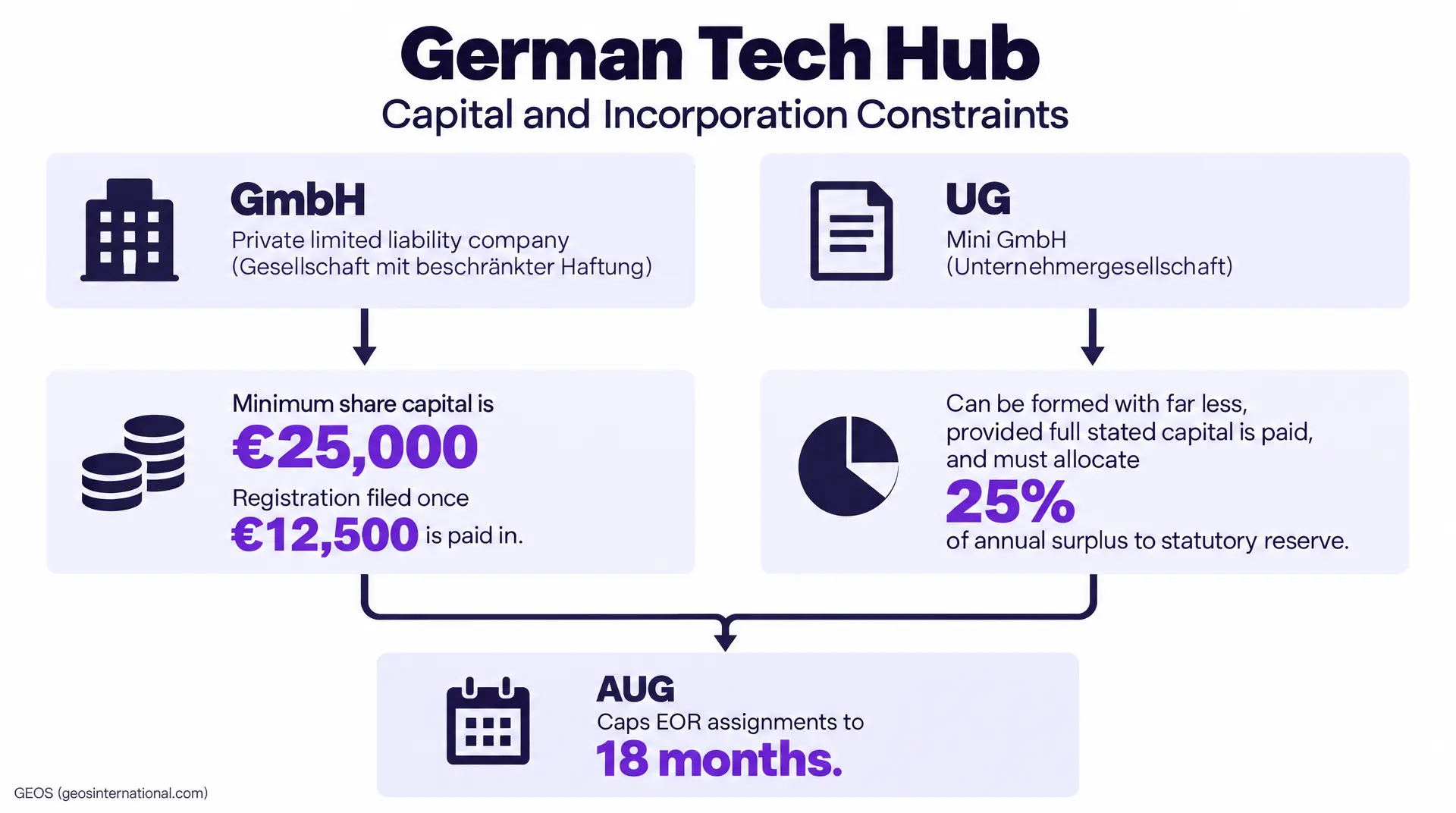
Germany also limits how long you can rent employment infrastructure. The AUG caps assignment of the same worker to the same company at 18 months, and assignments separated by three months or less are counted together. Not every arrangement marketed as EOR falls squarely under it, but Germany wants a real local employer, and a company scaling there on EOR is running toward a hard stop.
What Are the Operational and Incorporation Challenges for Tech Hubs in Other European Jurisdictions?
Eastern Europe is emerging as a credible alternative to Ireland for a hub with favorable corporate tax rates, and it deserves to be modeled against Dublin rather than dismissed. The operational quirks elsewhere are specific. Poland requires certified electronic signatures (QPS) after incorporation to execute local documents. Spain’s mercantile registry frequently pauses applications to request additional documentation, and communication with local partners predictably drops off in August and December. France and Belgium are among the hardest places in Europe to form and maintain an entity. For a first handful of hires there, use an EOR and revisit the math once you’ve reached critical mass.
Why Do Quoted European Tech Hub Incorporation Timelines Often Underestimate Actual Setup Durations?
Quoted incorporation timelines vary wildly because they measure different slices of the process. A three-week quote almost always covers the window from lodging the application to government approval. Before lodging, you need identification and proof of address from every ultimate beneficial owner, plus parent company documents certified, notarized, apostilled, couriered, and translated locally. After approval, the entity still cannot do anything until the tax ID, payroll, and social security registrations exist. An incorporated entity and an operational entity are two different milestones, and only the second one belongs on a board slide.
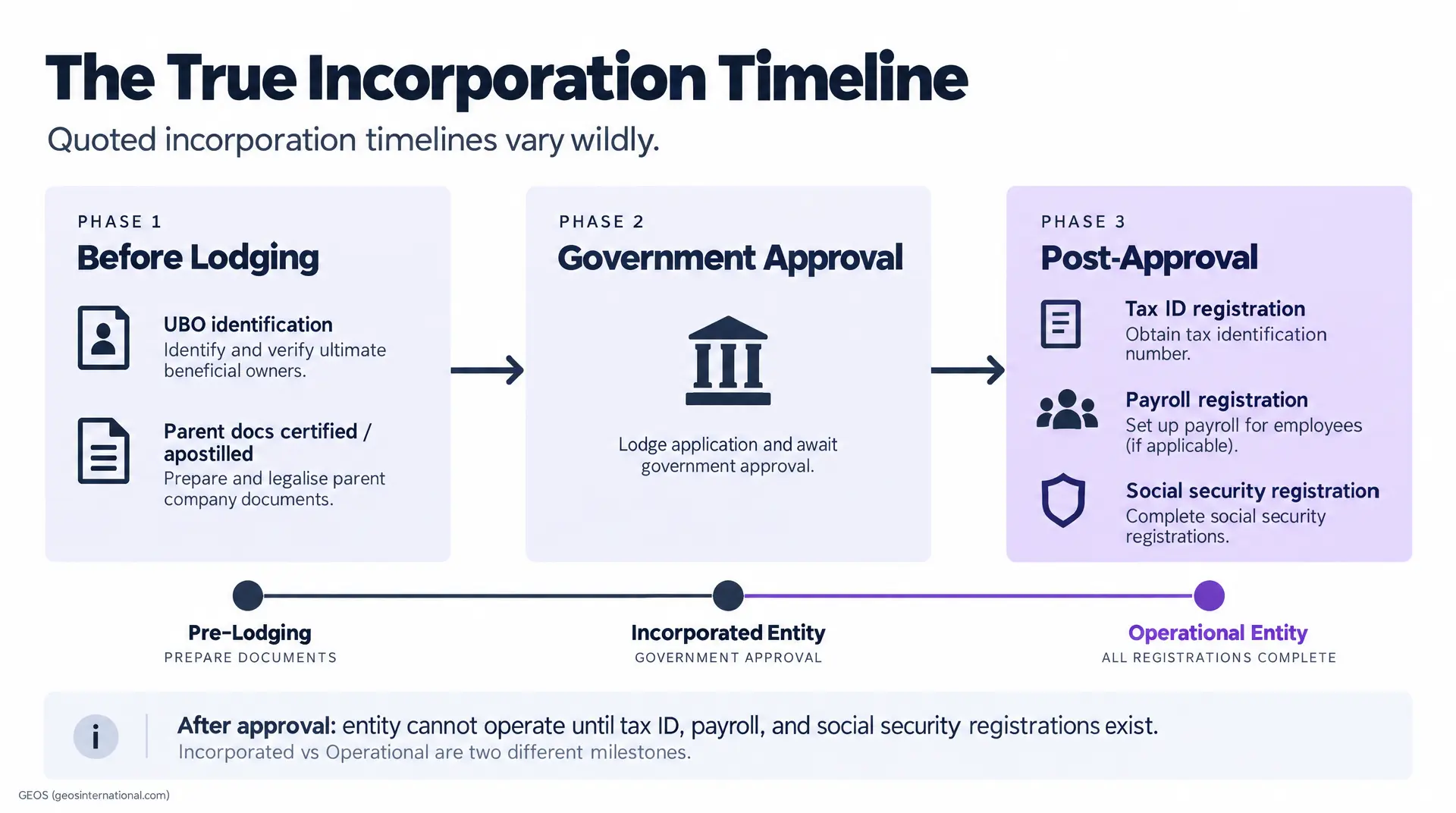
The document gathering phase is the single best predictor of total timeline. Proof of address typically carries a 60 to 90-day validity window, so one slow investor can expire a document and restart that part of the collection. Silent investors resist handing over personal ID, and they push back on you rather than on the notary. We arm the executive team with the messaging early: these are anti-money laundering requirements set by the local government, and no vendor can waive them. Notaries add their own unpredictability, requesting an extra certification or a differently formatted document with little consistency between reviewers.
The founders who move fastest in Europe run steps concurrently. We map the entire process for each country into the GEOS platform before a client starts. That map flags where a wet signature, specialized letterhead, or live KYC video call is required. The alternative is the drip-feed model most local lawyers run, where each step arrives by email after the previous one closes and every step is a surprise. Hourly billing offers little reward for handing over the full map in advance.
Why Should Companies Avoid Delaying 2026 Tech Hub Expansions for the EU Inc. Proposal?

In March 2026 the European Commission published a formal legislative proposal for EU Inc., envisioning fully digital registration within 48 hours for a maximum fee of €100. As of October, the Commission was still asking Parliament and Council to agree to it by year-end, so none of it is in force. Even once it passes, the Commission has been explicit that national employment and social laws remain unaffected. VAT, payroll, and social contribution registrations stay country-level, and I expect notary appointments, bank KYB, and apostilles to be the most stubborn holdouts.
I think it’s a genuinely positive step for Europe. Pausing a 2026 expansion to wait for it is a massive opportunity cost in lost market share. A B-plus plan executed today beats an A-plus plan executed after a legislative session you don’t control.
How Should Founders Sequence Subsidiary Setup and EOR Bridging for a 2026 Tech Hub?
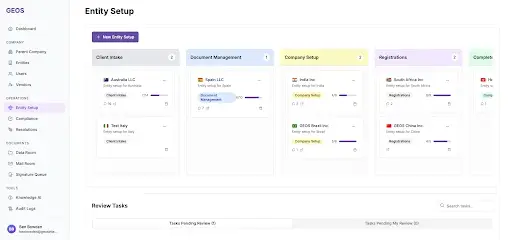
Settle the “why” in the next two weeks and let it choose the country. Start UBO and parent document collection the same day, because that clock runs independently of everything else. Decide on banking in parallel and lock the share capital plan if Germany is in play. If people need to start before the entity is live, an EOR partner can bridge them in. We did that for a client whose India setup stalled on director signatures and proof of address. The EOR preserved their start dates, and we converted the team once the entity was live. Never run an EOR alongside a tax-paying entity in the same country, though. Local officials view that split as a much worse posture than using an EOR with no entity at all.
Get those decisions right and the European entity becomes the easy part of your 2026. The variance between countries isn’t going away this year, and planning around it is the only form of speed that holds up.
Frequently Asked Questions
How does one EU tech hub location unlock the wider European market?
Setting up in one member state grants access to the Single Market’s 450 million consumers and 34 million businesses. A wholly owned subsidiary lets you passport services across the bloc without incorporating 26 more times. It is pure commercial leverage.
Can we use an Employer of Record to distribute company equity across our European team?
No. Relying on an EOR actively blocks your ability to distribute legitimate stock options. EORs are third-party employers. Granting equity through them triggers massive tax liabilities for talent. To offer localized equity that actually aligns incentives, you must establish a permanent subsidiary.
What are the true carrying costs of a Dutch BV once the incorporation phase is complete?
The real expense isn’t formation, it is maintenance. Beyond the €500 to €1,500 for the civil-law notary, official Dutch estimates peg basic bookkeeping at €600 to €1,800 annually. For a high-growth hub running localized payroll and corporate filings, expect those compliance costs to scale rapidly.
Should we register a branch office instead of a private limited subsidiary to save time?
Never. A branch exposes your parent company directly to local European liabilities. Enterprise clients and government contracts demand a fully localized, ring-fenced private limited company. Branches scream temporary, while a subsidiary signals permanent commercial establishment. Do it right and protect your cap table.
How do varying EU company laws impact our timeline for dominating multiple regional markets?
You are navigating 27 distinct national company-law systems and over 60 company forms. A 60-day mandate to open multiple markets requires executing parallel playbooks, not sequential ones. If you rely on fragmented local lawyers, your international revenue targets will die in administrative gridlock.