
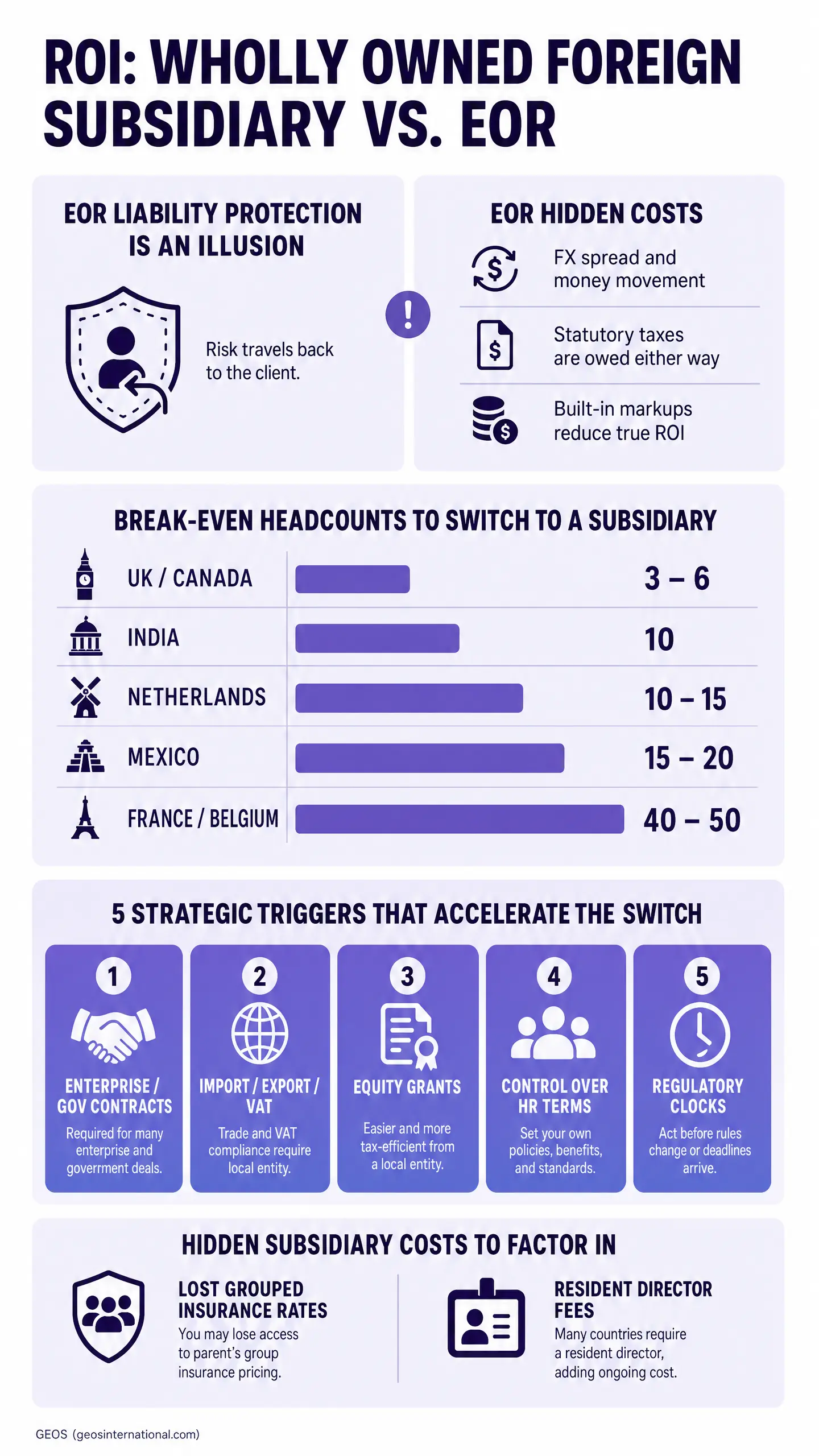
CEOs sign with an EOR believing the legal risk of a foreign hire now sits on someone else’s books. That single reassurance is what quietly justifies the premium.
I’ve read enough of these agreements to know the provider walks away indemnified almost every time a dispute actually lands, and when you directed the worker who sued, the liability travels straight back to you. You are renting protection that expires the moment you reach for it.
Headcount is the wrong number to wait for. You may already be paying full price for a shield that lives mostly in concept, long before any spreadsheet says it’s time to leave.
Key Takeaways
- Master Service Agreements for Employer of Record providers explicitly indemnify the vendor and return legal liability to the client if the client directly managed the worker.
- The headcount required to financially justify leaving an Employer of Record ranges from three employees in the United Kingdom to fifty employees in complex jurisdictions like France.
- Using an Employer of Record prevents United States companies from issuing qualified incentive stock options because the tax code requires recipients to be direct employees of the granting corporation.
- Companies must transition German workers off an Employer of Record within 18 months to avoid violating the Temporary Agency Work Act and facing fines of up to €30,000.
- Moving small teams off an Employer of Record eliminates access to pooled large-group health insurance rates, exposing companies to average individual United States premiums of $9,325.
- Establishing a direct operational subsidiary in India requires appointing a resident director who lives in the country for at least 182 days a year before any other incorporation steps proceed.
- Securing United States defense contracts under ITAR regulations requires establishing a direct local subsidiary because foreign entities utilizing an Employer of Record do not qualify as United States persons.
What Are the Hidden Costs Contained in an Employer of Record Invoice?

Deel lists EOR service starting at $599 per employee per month, and that figure is only the visible part of the bill. Add FX translation, money movement costs, and mandatory statutory contributions, and in my experience the real figure runs 10 to 30% above base payroll before the fee even appears.
Those statutory contributions are also where the modeling error hides. For a single average-wage worker, OECD’s Taxing Wages data puts employer social security and payroll taxes at 26.7% of labor costs in France, 21.4% in Belgium, 12.0% in the UK, and 8.8% in Canada. Founders routinely book that entire layer as savings when they go direct, but it is owed either way. France’s 26.7% is due whether an EOR’s name or your own sits on the employment contract.
What you actually recover by flipping to your own entity is the service fee, the FX spread, and the money movement markups. Build the comparison on that basis or the entity column will flatter itself.
What Determines the Break-Even Headcount for Switching From an EOR to a Subsidiary?
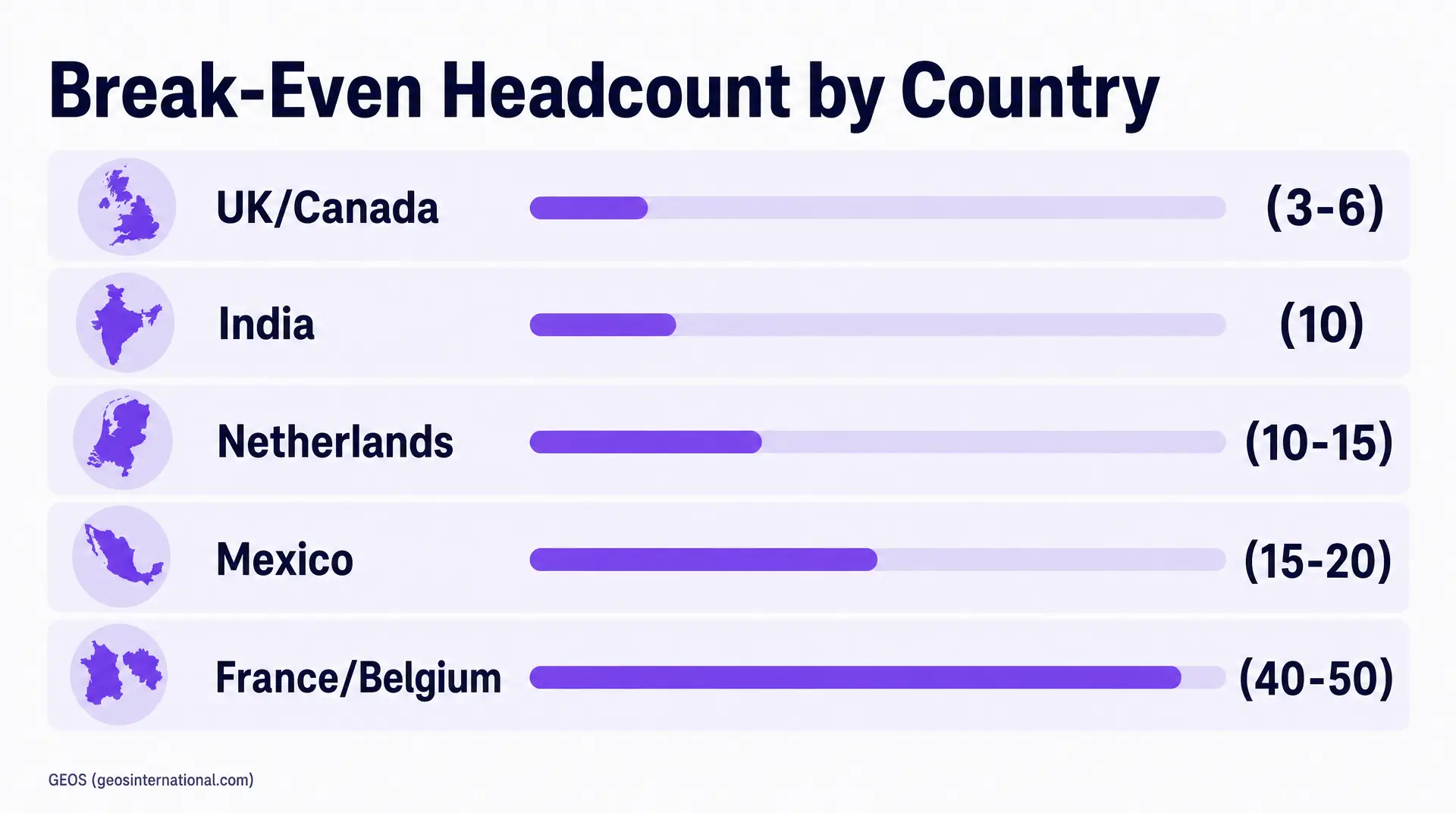
There’s no single number for leaving an EOR. In the UK and Canada I put it at three to six employees. India lands around 10, usually because the plan is to scale a global command center. The Netherlands, a tier-two country in our internal difficulty ranking, sits at ten to fifteen. Mexico needs fifteen to twenty. France and Belgium need forty to fifty.
The spread comes from the variance of effort and costs in standing up employment infrastructure once the entity exists. The UK is the easy case. Companies House usually turns an online registration around within 24 hours, nothing requires a wet signature, notarization or apostille, and Revolut can carry the entity’s finances end to end. If your board wants an entity live in 60 days, the UK is one of very few places where that is realistic.
Even there, incorporated and operational are different states. The Pensions Regulator starts your automatic enrolment duties the day your first hire begins work and expects a declaration of compliance within five months.
Mexico sits at the opposite end. IMSS only accepts employer social security payments through its list of authorized banks, currently seven traditional institutions, so a FinTech account will not process the mandatory contributions. A local legal representative must wet-sign employment contracts and face tax officials on the entity’s behalf. Payroll is calculated more like a day rate than an annual salary. Each hurdle is a fixed cost, spread across more heads before going direct beats the EOR fee.
India is where founders most often confuse incorporation with an operational entity. The Companies Act requires at least one director resident in India for 182 days a year, so a resident director comes before anything else. After incorporation you need a traditional bank account on Indian rails so provident fund payments and TDS remittances are recognized by local officials. One US client of ours ran a patchwork payroll when their bank application stalled, and the provident fund problems it created lingered long after the account finally opened.
What Hidden Entity Costs Arise After Switching From an EOR to a Direct Subsidiary?
The first platform dedicated to streamlining entity setup and management.
Even a careful entity budget has soft spots, and benefits are the largest, especially in the United States. I’ve seen a company move just over 10 employees off a US EOR and take a cost shock, because at that headcount they lost the large-group insurance rates the EOR had pooled. KFF’s 2025 survey puts the average employer-sponsored premium at $9,325 for single coverage and $26,993 for family coverage. European founders are especially exposed, since universal healthcare at home gives them no feel for privatized benefit costs.
Resident director fees are the second soft spot. In Mexico, India, Singapore, Australia, New Zealand, and the UAE the appointment is mandatory, and because that individual carries personal liability, it comes with an annual fee.
The third is keeping the lights on from a compliance perspective. Dutch incorporation and payroll setup are relatively clean, but the corporate tax and accounting filings that follow demand a specialized local CPA. We helped one client push a large VAT reclamation through in the Netherlands after local authorities pushed back hard, and the supplementary paperwork was substantial and unbudgeted.
What Strategic Triggers Accelerate the Transition From an EOR to a Foreign Subsidiary?
Most founders treat the switch purely as a financial equation of saving money. A second layer of ROI matters more at your stage, and any one of these five triggers can move the math to the entity side long before headcount does.
Enterprise and government contracts come first. We’ve had a few clients doing defense work with the US or Canadian governments, and each required a local entity even though the parent was foreign. On the US side, SAM.gov will register a foreign company with an NCAGE code, so the friction sits in export control rather than procurement. ITAR treats an entity incorporated to do business in the United States as a US person and excludes foreign corporations that are not, so the counterparty needs your subsidiary on the paper.
Import and export is second. A local entity unlocks customs capabilities plus VAT and tax optimization an EOR cannot support, and e-commerce companies building an EU hub to reclaim VAT are a regular case for us.
Equity is third, and it catches senior hires. Under an EOR the provider is the legal employer, so granting equity means building a separate contractor agreement or vehicle outside the employment relationship. That is more administration and a lot shakier in terms of making it defensible.
For a US parent there is also a tax-code problem. Incentive stock options require the holder to be an employee of the granting corporation, its parent, or a subsidiary from grant until three months before exercise. Your EOR is none of those, so the grant cannot sit inside a qualified plan.
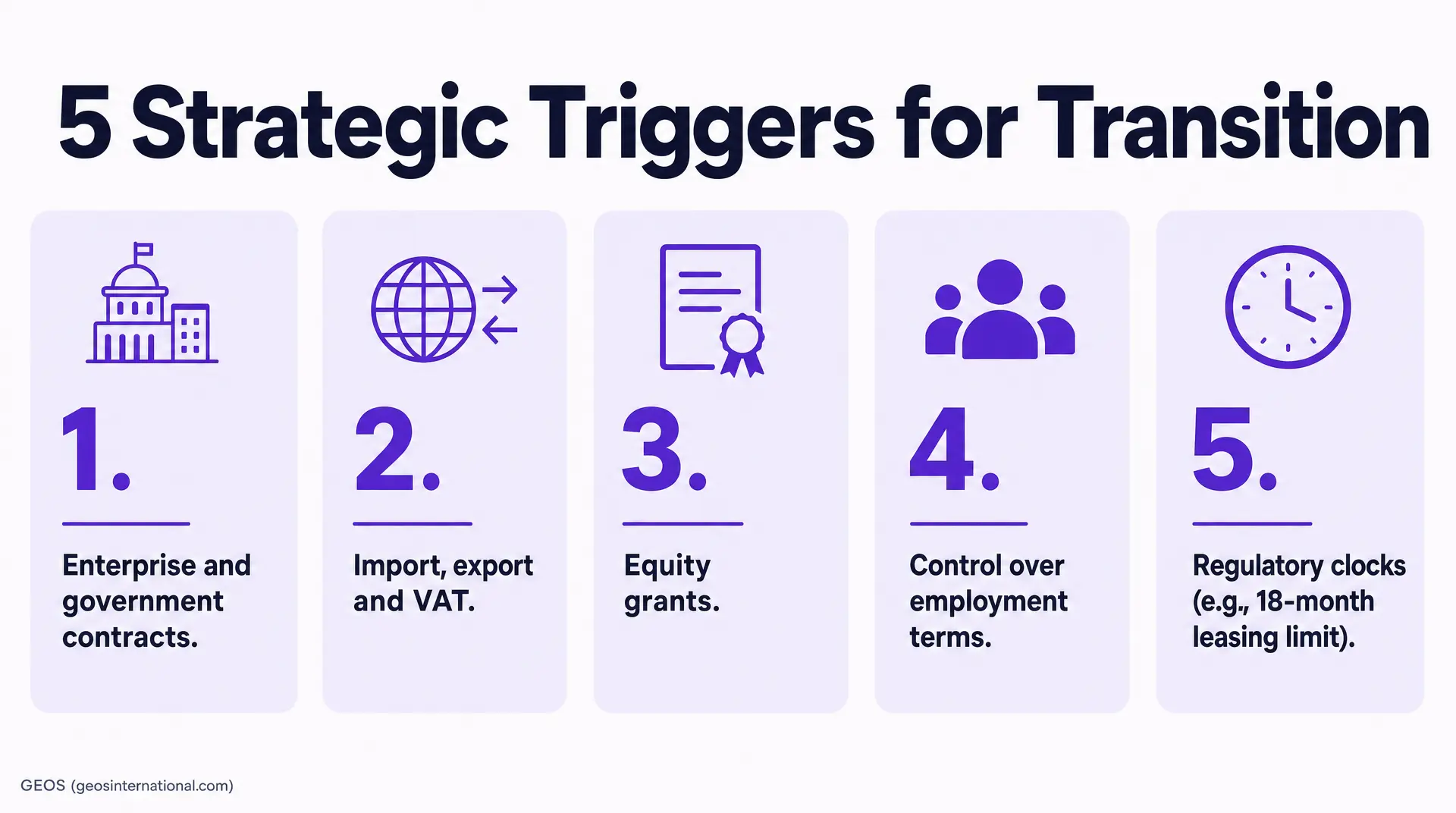
Control over employment terms is fourth. Your own entity lets you set HR policy and offer benefits above and beyond what is statutory, rather than renting the EOR’s standard package.
The fifth trigger is regulatory and comes with a clock. Germany’s Temporary Agency Work Act bars assigning the same worker to the same company for more than 18 consecutive months, and earlier stints count toward the limit unless the gap between them exceeds three months. Unlicensed leasing alone draws fines of up to €30,000.
Permanent establishment risk is less about headcount than founders assume. The OECD Model Tax Convention frames it around activity, whether a local person habitually concludes contracts or plays the principal role in getting them signed. The first people most CEOs put into a new market are sellers, which is exactly the profile a tax authority looks for.
How Do Employer of Record Contracts Limit Legal Liability Protection for Clients?

CEOs love EOR because it appears to offload legal risk. From my time in the EOR space, I know the MSA and SOW read differently. When a dispute arises, whether a wrongful termination or a fight over severance, the contract contains very specific language. If the client was the source of the issue, and the client is the one who directed and worked closely with that person, liability passes back to the client. The EOR is indemnified almost every time.
I’ve seen a US company terminate an employee in Japan in a way that violated local labor law. The resulting lawsuit was massive and exposed both the parent and the EOR provider. One rule I hold firmly: never keep an EOR agreement running in a country where you already operate a tax-paying entity. Local officials view that split as a much worse posture than using an EOR with no entity at all.
What Are the Conversion Phases for Transitioning From an EOR to a Foreign Subsidiary?
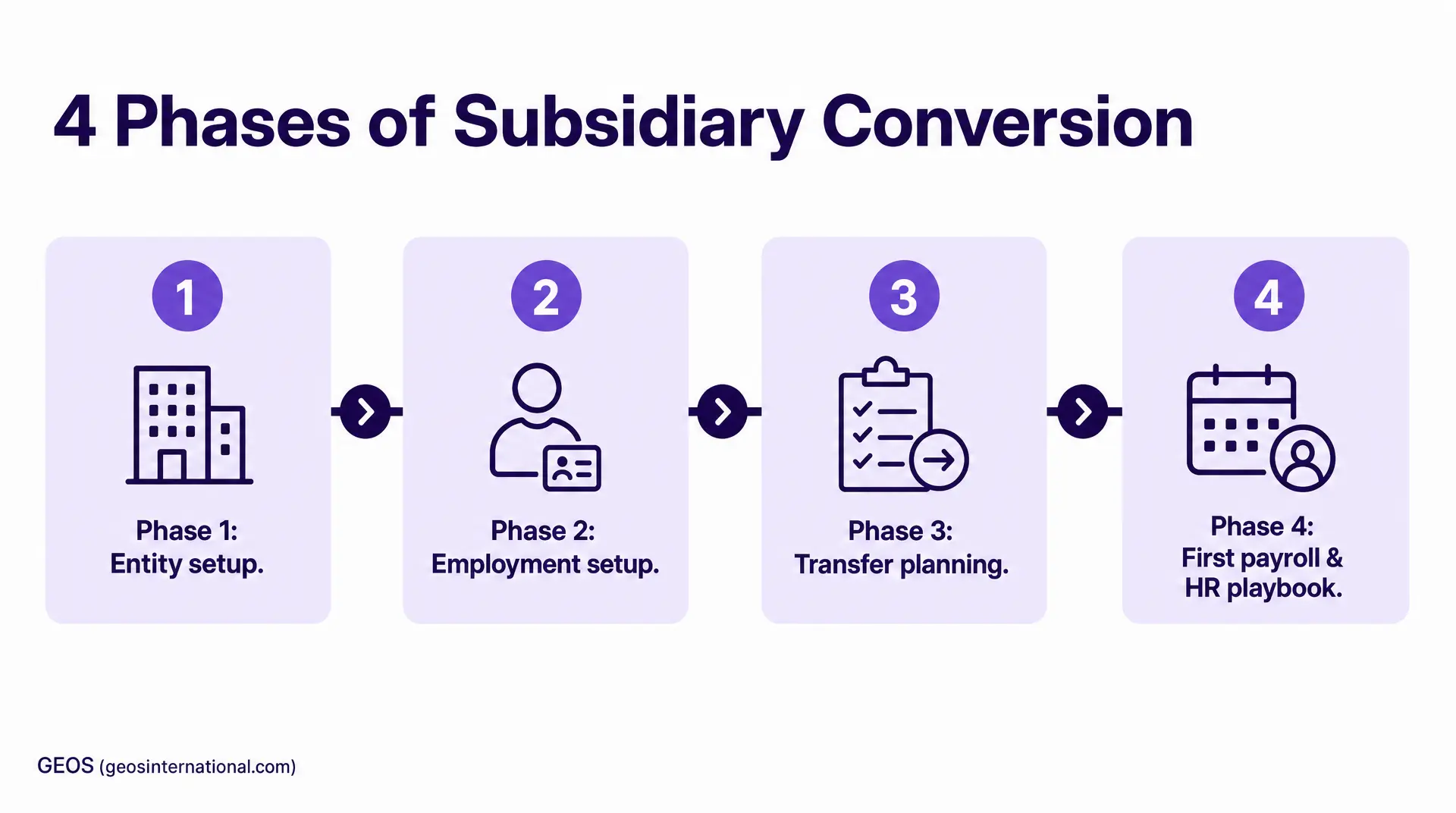
The transition carries a cost of its own and belongs in the ROI. We run it in four phases. Entity setup comes first and, depending on the country, takes four to twelve months of project management across vendors. Employment setup follows: local tax registrations, private pension accounts, a local bank account, benefits implementation, and drafting employment contracts.
Transfer planning is third, covering notice to the EOR, social insurance un-enrollment, deposit reconciliation, work permit transfers, and the legal transfer mechanism. The fourth phase is the first payroll on the new entity and the HR playbook that keeps it compliant.
The hardest part has little to do with filings. You’re asking employees to resign from one contract and sign another, with continuity in between. The failure I see most is a lack of communication and level setting. Asking a committed employee to resign without context reads as a red flag to them. Explain the vehicle they’re currently employed through, why you’re changing it for their benefit, how their seniority and vacation accruals will be honored, and what the new benefits look like. Do that ahead of the process and the panic never starts.
When Should Companies Retain an Employer of Record Instead of Setting Up a Subsidiary?
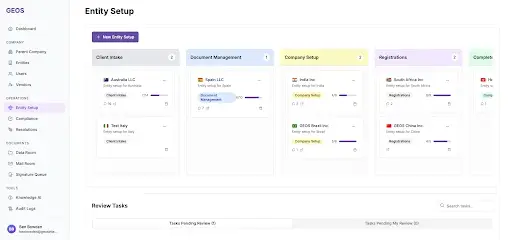
If a founder tells me they need a French entity to hire three people, my answer is to go the EOR route, and we refer them to a partner even though it does nothing for GEOS. The same applies to one or two hires in Belgium, Brazil, or Japan. A subsidiary is a permanent decision, and the operational lift in those countries is not justified by a couple of heads.
EOR also works as a bridge. We had a client whose Indian entity setup stalled on director signatures and proof of address documents. We partnered with an EOR to hire their team temporarily, preserved the start dates they had promised verbally, and converted everyone once the entity was live. The largest EOR firms understand this arc, which is why so many have built global payroll products for the clients who graduate.
How Should Companies Calculate the ROI of a Foreign Subsidiary Versus an EOR?
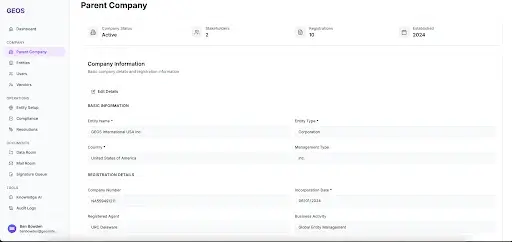
Start with three questions: where you want to set up, why, and what infrastructure and partners you already have to support it. Build both columns honestly. On the EOR side, isolate the fee, the FX spread, and the money movement costs sitting above the statutory layer. On the entity side, include setup, ongoing compliance, benefits at your actual headcount, resident director fees, and the conversion project. Then lay the five triggers over the top. If even one applies, you are likely looking at an entity well before headcount alone would say so, and you walk into the board meeting with a number you can defend.
Frequently Asked Questions
Can we accelerate foreign subsidiary ROI by paying premiums for faster incorporation?
You cannot buy your way past bureaucracies. While UK entities register in 24 hours, India mandates a resident director living there 182 days annually. Throwing capital at local lawyers won’t bypass mandatory apostilles or banking compliance. True ROI demands precise timeline execution, not blind spending.
How should we model enterprise revenue upside into our foreign subsidiary ROI?
Subsidiary ROI isn’t just about escaping EOR fees. It’s about unlocking regional sales. Defense and export-controlled contracts demand a local entity. Capturing one major government logo that ITAR or procurement rules would otherwise block ensures your net new revenue completely eclipses the entity’s setup costs.
How do we forecast the ROI of a US subsidiary without destroying our benefit margins?
You must aggressively model the loss of EOR pooled-benefit economics. Moving to a US subsidiary exposes you to healthcare shocks. Expect average annual employer-sponsored premiums to hit $9,325 for single and $26,993 for family coverage. Ignoring these privatized costs will instantly collapse your ROI.
How do harsh labor leasing fines alter the EOR versus subsidiary ROI math?
Staying on an EOR too long destroys ROI through massive compliance penalties. In Germany, breaching the strict 18-month temporary agency limit triggers administrative fines up to €500,000. When calculating subsidiary break-even, you must factor in these ticking regulatory time bombs alongside standard operational expenses.
Does building our own global payroll infrastructure improve the subsidiary ROI?
Yes, owning your infrastructure scales ROI, but demands heavy operational lifting. In Mexico, FinTechs fail. You must integrate directly with one of seven authorized banks for mandatory IMSS payments. Mastering these analog local rails turns your subsidiary into a proprietary growth engine, eliminating third-party reliance.