
The people you pay to eliminate your foreign compliance risk earn more the longer that risk stays invisible to you. A vendor billing by the hour to interpret a system only they can see is rewarded for your dependence, never your competence.
The bill arrives as a single line reading ‘corporate compliance,’ priced at a serious premium, with no account of the work behind it.
The obscurity is the product, which is why this industry has profited from it for 30 years – and why nobody who sells it will ever volunteer to lift the blindfold.
Key Takeaways
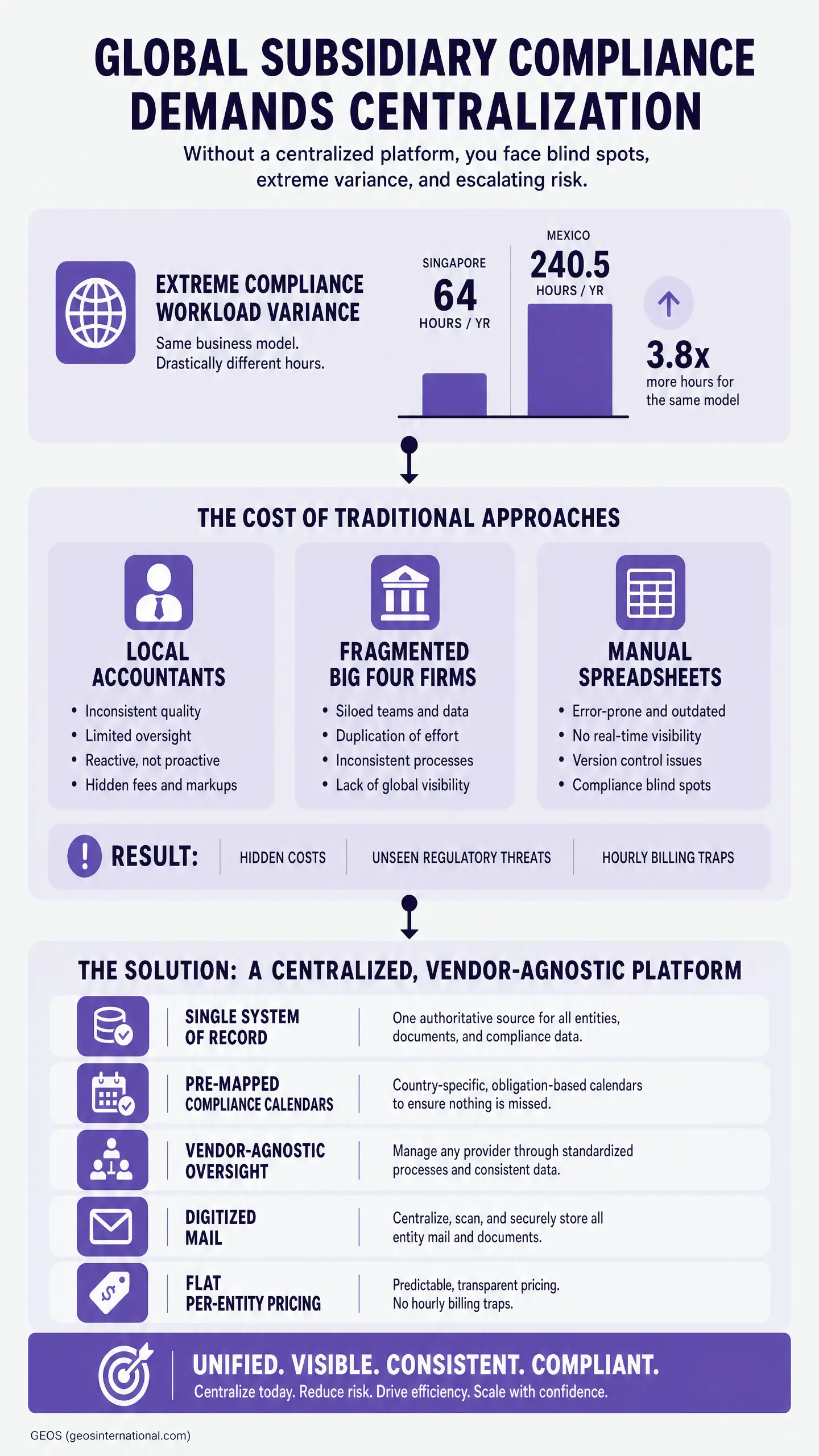
- For an identical business profile, annual tax compliance workloads vary significantly by jurisdiction, demanding 64 hours in Singapore, 147.5 hours in Spain, and 240.5 hours in Mexico based on World Bank data.
- Nearly two-thirds of the 52 jurisdictions tracked by the OECD amended their company or securities laws between 2023 and 2024, causing static compliance strategies to quickly become obsolete.
- Hidden local regulations pose severe operational threats, such as Peruvian corporate law automatically dissolving any subsidiary that fails to maintain at least two registered shareholders for a six-month period.
- The United Kingdom mandates identity verification for an estimated 6 to 7 million company directors starting November 18, 2025, penalizing unverified operators with financial fines or total disqualification.
- Crossing the European Union’s €10,000 distance-selling threshold automatically triggers localized VAT obligations, requiring customized compliance calendars even for entities operating within the exact same jurisdiction.
- Transitioning from an Employer of Record to an owned subsidiary breaks even financially at 3 to 6 employees in the UK and Canada, compared to 15 to 20 employees in Mexico.
- Global businesses should never employ staff through an Employer of Record in a country where they already operate a tax-paying entity, as local regulatory officials severely penalize this mixed operational posture.
The first platform dedicated to streamlining entity setup and management.
Why Is Global Subsidiary Compliance Difficult to Manage Across International Borders?
I compare managing global subsidiaries without a centralized platform to playing basketball blindfolded. You’re relying on four teammates shouting when to cut and where to pass. Everyone on the floor might be highly skilled. They still can’t see.
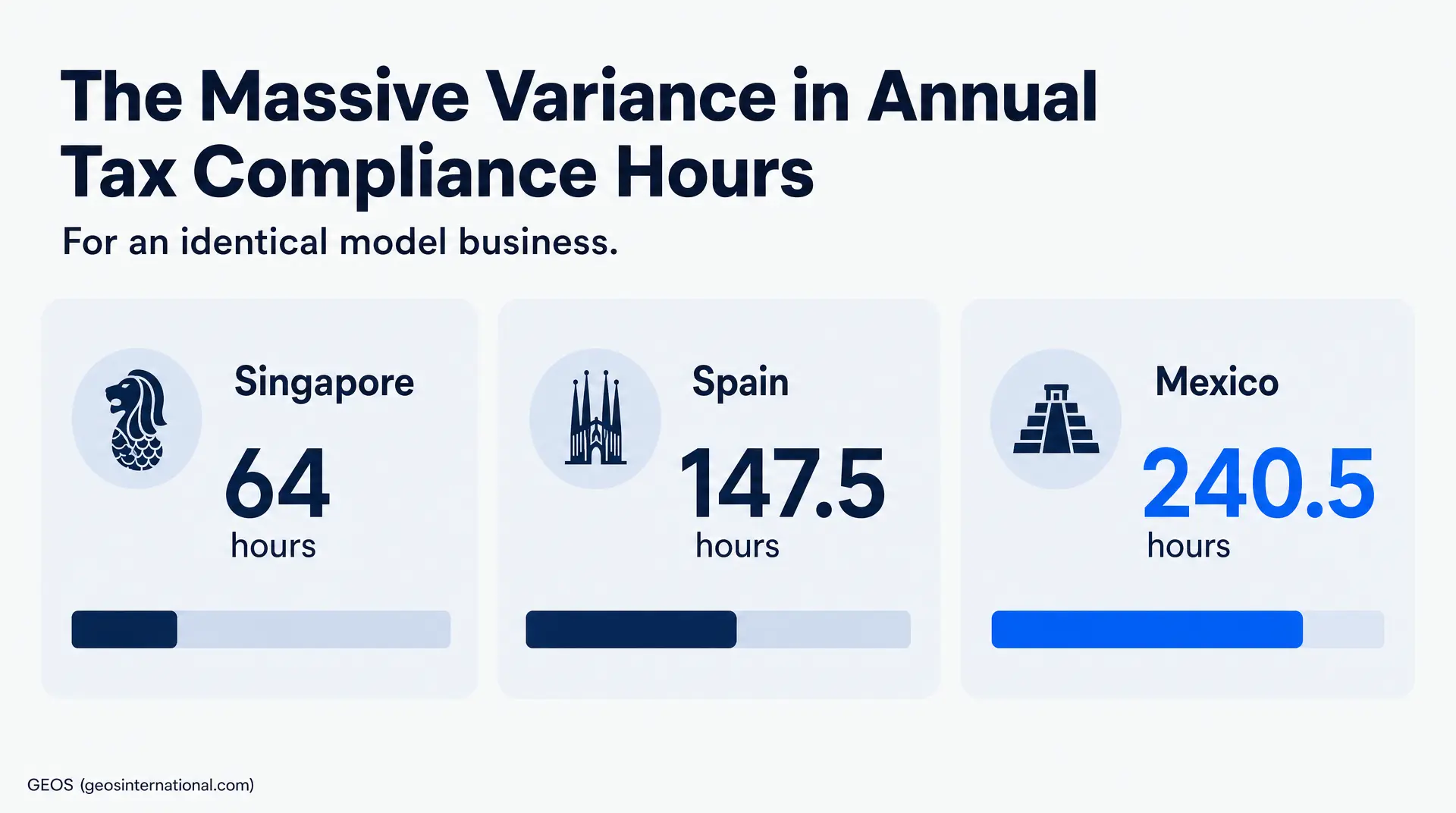
The blindness is structural, and the variance data proves it. In the World Bank’s standardized tax case study, the identical model business spent 64 hours a year on tax compliance in Singapore, 147.5 hours in Spain, and 240.5 hours in Mexico – where the same profile waited an estimated 42 weeks for a VAT refund. Identical business, three completely different workloads.
The target also moves. Nearly two-thirds of the 52 jurisdictions tracked by the OECD amended their company or securities laws in 2023 and 2024 alone. Whatever your team learned about a country at incorporation is already going stale.
This variability is also the legacy industry’s business model. Because it’s so difficult for one team to be savvy on the rules in every jurisdiction, large firms can charge a huge premium simply to navigate that disconnect and that mystery on your behalf. That’s where companies fall into a trap.
How Do Unseen Local Compliance Regulations Threaten Foreign Subsidiary Operations?

Failure in this space looks smaller than most CFOs expect. We took over a client’s Peruvian subsidiary and discovered a departed shareholder had left the entity with a single shareholder on record. Peruvian corporate law requires two, and a company that fails to restore that plurality within six months is dissolved by operation of law. No alarm rang. No vendor flagged it. The entity simply sat exposed until we drafted the documentation to appoint a second shareholder and restored its good standing with local officials.
That pattern repeats everywhere, in different costumes. In the UK, director identity verification became a legal requirement on November 18, 2025. Acting as an unverified director is now unlawful, with enforcement running from financial penalties up to disqualification. Companies House expects 6 to 7 million people to complete verification, and we walk every foreign UBO through it because missing the check can cost an entity its standing. Spain’s mercantile registry routinely pauses applications to demand extra documentation. Poland requires specialized certified electronic signatures after incorporation. None of this is exotic. It’s simply invisible from a head office in Austin or Toronto.
There’s one more layer CFOs consistently miss: obligations track business activity, not just geography. Cross the EU’s €10,000 distance-selling threshold and VAT becomes due in your customer’s country, which triggers registrations, which trigger filings. Two companies with entities in the same jurisdiction can carry meaningfully different compliance calendars.
What Are the Common Methods for Managing Global Entity Compliance and Their Flaws?
What Are the Risks of Using Local Accountants for Global Entity Compliance?
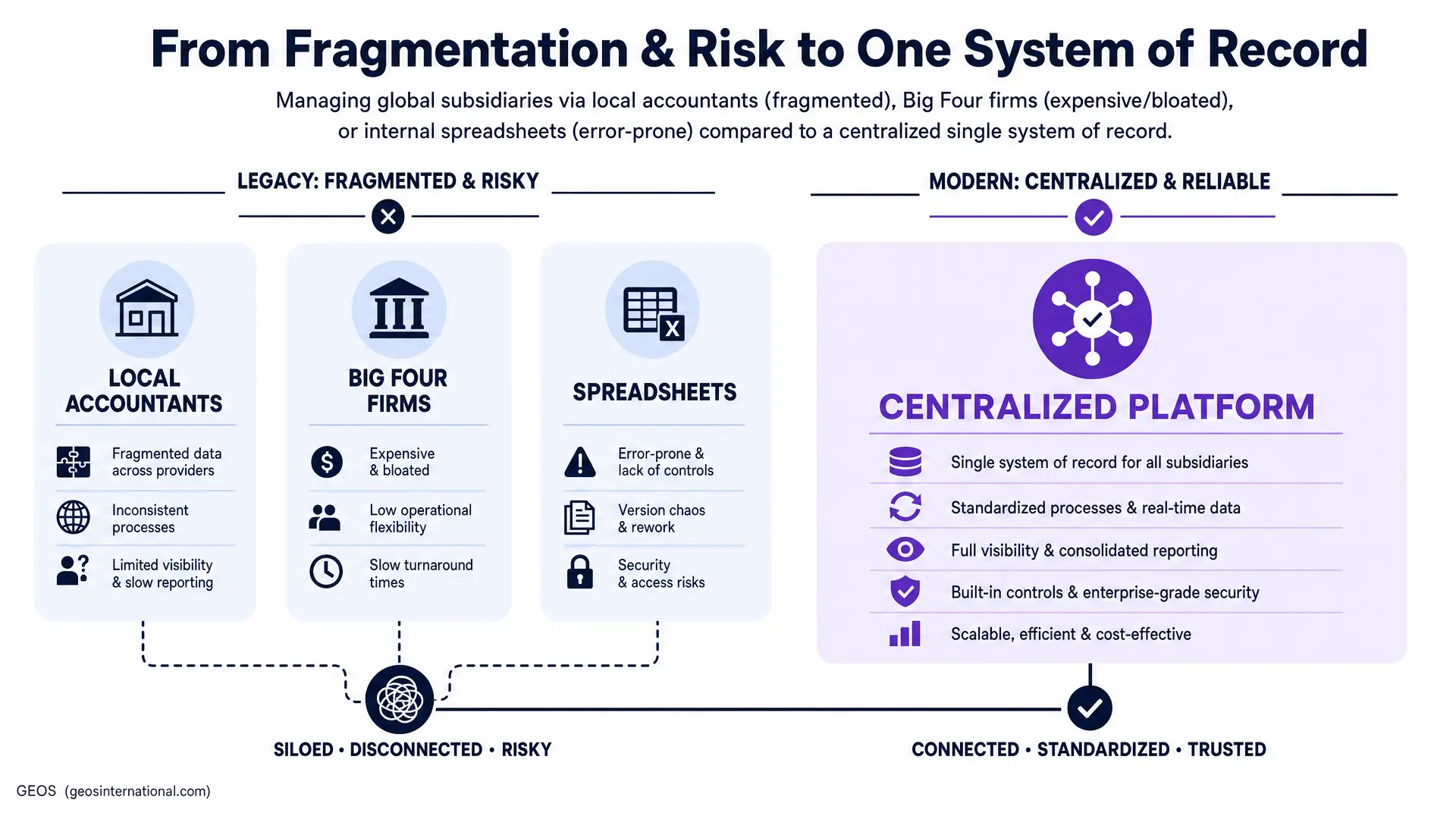
Hiring a local accountant in-country is usually the cheapest path, and I’ll be fair to these vendors: they don’t intentionally keep foreign clients in the dark. Most simply lack the resources and technological know-how to provide real visibility. Many have only ever serviced domestic companies, so they genuinely don’t know that a foreign-owned entity carries a different task list than a local one.
The deeper problem is multiplication. Every country adds a partner with its own process, its own bills, and its own way of communicating. Work with a partner in Spain and you’ll find communication culturally falls off in August and December. That matters when Spanish annual accounts run on strict preparation and deposit deadlines, with fines from €1,200 to €60,000 plus registry closure for lapses. Managing all of those endpoints across five or 10 countries becomes its own job. In my experience it consumes the equivalent of two or three full-time roles, just processing invoices and interpreting notices.
Hourly billing compounds it. A vendor paid by the hour to interpret a system only they can see is structurally incentivized toward dependency, not efficiency.
Why Is Using Big Four Firms for Global Subsidiary Compliance Often Inefficient?

I’ve been the client in this model, not just the competitor. When my last company needed entities around the world to legally deliver EOR services, we ran the project through a Big Four firm. The expertise was real. But the teams were fragmented by region, so every new country meant onboarding with a new team and re-sharing parent company context from scratch. We ended up project-managing our own engagement.
Then the invoices arrived: one or two generic line items reading “corporate compliance,” at a serious premium, with no breakdown of the work actually completed. For a Fortune 100 or publicly traded company, that trade can make sense. For a privately held scale-up, you’re paying for that glut – subsidizing bloated overhead in exchange for a feeling of safety, and carrying a major risk of overpayment just for insurance.
Why Do Internal Spreadsheet Methods Fail for Managing Global Subsidiary Compliance?

The third approach is internal: a spreadsheet, a shared drive, a very stressed controller. Past a handful of entities, I’d call this untenable without dedicated headcount. Notices arrive piecemeal by email or by physical mail to a registered address nobody checks weekly. The penalties start small – late UK accounts draw £150 to £1,500, but the figure doubles if you file late two years running. Regulators track patterns. By the time we get the call, fixing the situation means years of backdating, auditing, and untangling.
How Does Mapping Global Compliance Tasks Eliminate Hidden Subsidiary Management Costs?

A US-based company came to us managing three foreign entities, two in Latin America and one in APAC. The entities weren’t doing much activity at all. Even so, substantial bills landed every month just to keep the lights on from a compliance perspective. When the client asked their partner what was actually being done for that money, they received no clear answer. Sometimes no answer at all.
We mapped every compliance task in each of their three countries so their obligations were instantly visible, then ran a quick audit for tasks specific to their business activity. They switched immediately. They’re saving money, and for the first time they can be proactive about global compliance instead of reacting to whatever surfaces. Blindly paying for tasks that are arbitrarily maybe being done, or maybe not, was never a strategy. It was just the absence of one.
What Are the Core Requirements for Mitigating Foreign Subsidiary Compliance Risks?
Whatever partner you choose, hold the model to this standard.
Start with a single system of record. Every entity, its attributes, registrations, documents, and deadlines in one place. If your global footprint lives across email threads and one controller’s memory, you can’t answer a basic auditor question on demand – and neither can anyone else.
Then demand a pre-mapped compliance calendar before anyone bills an hour. For any given country, the large majority of obligations are knowable in advance. We spent hundreds of hours documenting exactly what it takes to set up and maintain an entity in 80-plus countries, so those tasks load onto our platform automatically. The last five to 10% is specific to your situation – a VAT registration you’ve triggered, a filing tied to your business activity – and it has to be identified deliberately, working with you and your vendors until the list is 100% accurate.
Insist, too, on vendor-agnostic oversight. You should not have to fire good local partners to gain visibility. We onboard a client’s existing vendors onto the platform, assign them their specific tasks, and let automated workflows prompt them for completion, including mandatory receipts as proof when a task closes. Because we know what compliance should look like in each country, we can compare a vendor’s actual output against that preset mapping. That layer of scrutiny simply didn’t exist in this industry before.
Digitize the mail as well. Foreign authorities still communicate on paper, and a registered address with digital mail management means a tax notice gets scanned onto the platform the day it arrives and pushed to your team, straight into Slack. Any CFO who has eaten a penalty triggered by an unopened envelope nine time zones away knows exactly what that’s worth.
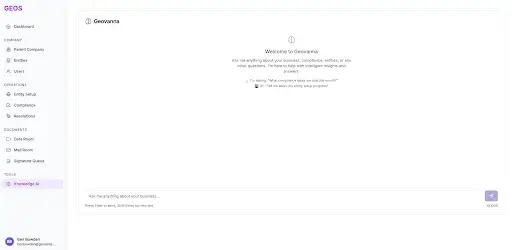
And keep humans in the loop. Technology should be an enabler, not a replacement for local expertise. Our platform is the organizational layer. Behind it sit our regional teams and a pre-vetted network of local tax, legal, and accounting experts built over a decade-plus in this space. Even our AI assistant, Geovanna, is deliberately scoped – it answers questions about your specific entity footprint instantly, but it doesn’t file anything with a local authority. Nothing should, without a human checking it.
How Should CFOs Calculate the True Cost of Global Subsidiary Compliance?
Compliance spend abroad usually fails the most basic finance test: you can’t tie cost to work performed. So rebuild the comparison from scratch.
Price predictability comes first. GEOS pricing is per entity, in tiers. Access runs $49 per month per entity for the system of record. Core, quoted flat per country, adds full corporate secretarial delivery: annual filings, resolution automation, compliance tracking, and an account team. A client with 10 entities can mix tiers entity by entity, deploying us only where needed. Legacy conglomerates charge five to ten times more than we do on average, and hourly local billing inflates in the opposite direction of your visibility.
Then count internal overhead honestly. If your team burns two or three roles’ worth of hours chasing foreign invoices and interpreting notices, that cost belongs in the model.
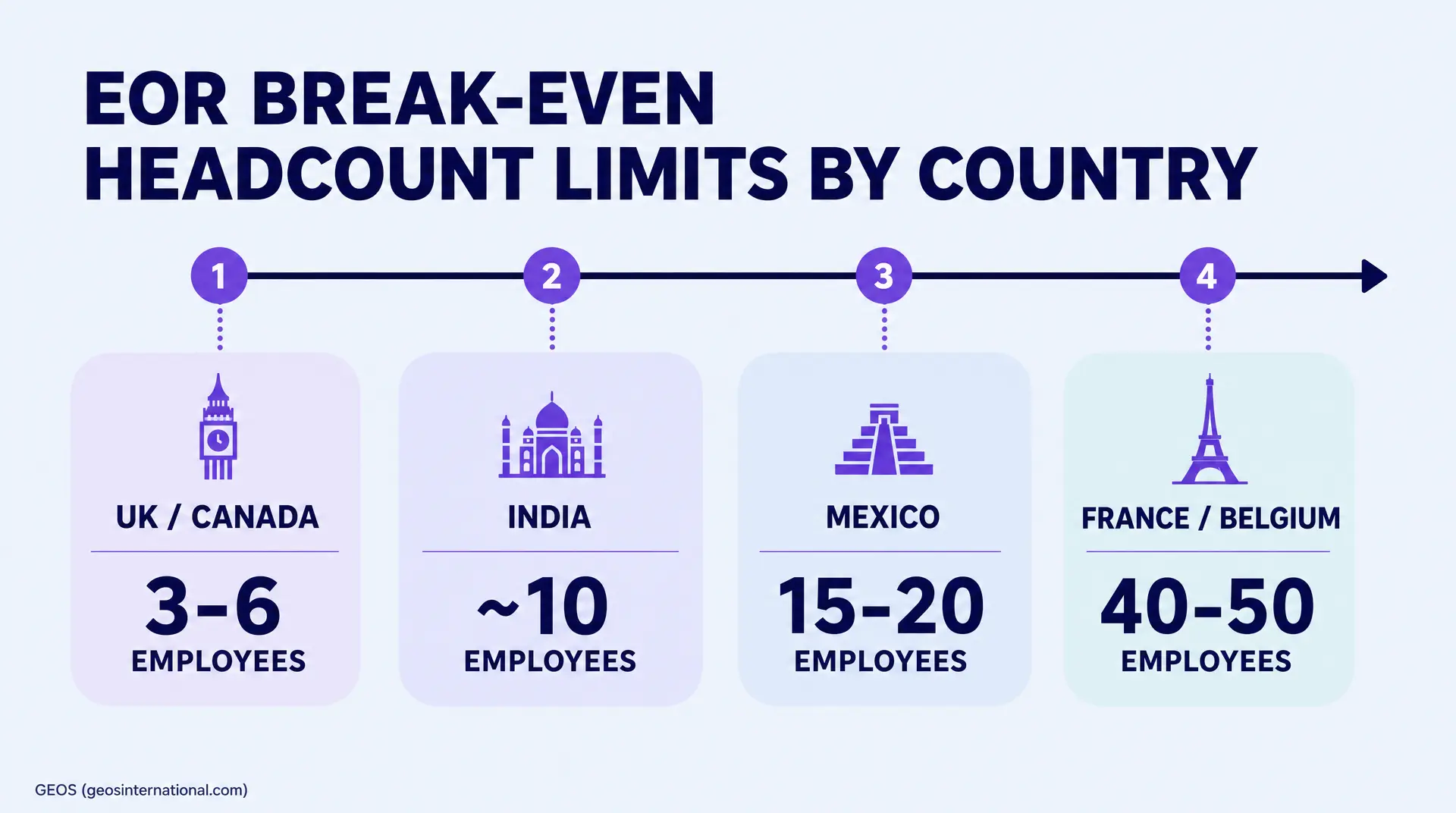
Finally, run your EOR exposure. EOR is a genuinely useful tool at the beginning of a global expansion journey – I sold it for years and still refer clients to EOR partners when it fits. But once you’ve reached critical mass in a country, the per-employee fees flip against you. The break-even lands around three to six employees in the UK or Canada, roughly 10 in India, fifteen to twenty in Mexico, and forty to fifty in France or Belgium. Mexico’s higher threshold is instructive: owning an entity there means administering a 15-day Christmas bonus paid before December 20, a 25% vacation premium, and distributing 10% of net profits to employees. That operational lift is real, so the headcount has to justify it.
One blunt warning while you run the numbers: never keep employees on an EOR in a country where you already operate a tax-paying entity. Local officials view that mixed posture as worse than using an EOR with no entity at all.
Since analytical CFOs appreciate receipts, here are mine. GEOS is bootstrapped, we’ve set up hundreds of entities, and we’ve had zero client churn to date. When the product is visibility, nobody volunteers to put the blindfold back on.
How Can Companies Efficiently Migrate Existing Foreign Subsidiaries to Centralized Compliance Platforms?
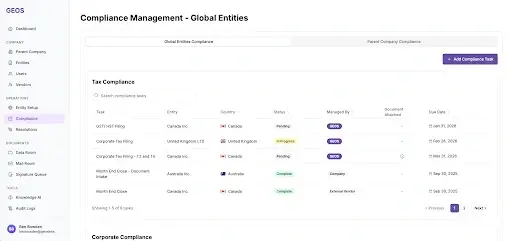
Migrating existing entities onto a managed system is a defined process, not a leap of faith. When we onboard an already-formed entity, we run a structured intake: high-level detail on the entity and its purpose, plus every document on file. Our team organizes those documents, builds the entity page with all major attributes, and loads the pre-mapped compliance tasks for that country. Your existing vendors get onboarded and assigned their tasks – tax work to the tax partner, payroll to the payroll provider. From there we close out the client-specific items together until the calendar is complete, then assess each incumbent partner on performance and price. The strong ones stay. The rest get replaced from our pre-vetted network, or we take the work on directly.
You don’t need a global overhaul to begin. I’ll take a B-plus plan executed today over an A-plus plan executed next week, and in compliance, waiting is the expensive option. This industry has profited from mystery for 30 years because CFOs had two bad choices: pay a bloated global firm for the feeling of safety, or put blind trust into local vendors and hope. There’s a middle path now. Map every obligation, centralize every document, demand receipts from every vendor, and get every notice pushed to you the day it lands. Take off the blindfold.
Frequently Asked Questions
What is my personal risk as a foreign director in global subsidiary management?
It is severe. Distance won’t shield you. Companies House warns that acting as an unverified director is unlawful, triggering prosecution or direct fines. Centralized, tech-forward subsidiary management is your only real defense against personal legal liability when governing foreign jurisdictions.
Can we standardize subsidiary management workloads across all our international entities?
Never. Assuming uniform workflows is a dangerous financial blind spot. The World Bank found tax compliance takes 64 hours annually in Singapore, but 240 hours in Mexico. Proper subsidiary management requires strict, localized task mapping, not just hoping a generalized global checklist will work.
How do foreign subsidiary compliance delays impact working capital?
Opaque compliance actively destroys cash flow predictability. When local vendors miss filings, capital is trapped. In Mexico, the World Bank estimated a staggering 42-week wait for standard VAT refunds. CFOs must centralize subsidiary management to monitor deadlines and protect global liquidity.
Does opening a foreign subsidiary trigger hidden local payroll liabilities?
Yes. Establishing entities often triggers unique labor costs. Mexico’s profit-sharing regime forces employers to distribute 10% of net profits to local workers. CFOs must rigorously factor these statutory compliance burdens into their baseline math before blindly transitioning away from an EOR.
When is the exact financial trigger to transition from an EOR to a managed subsidiary?
Transition the exact moment EOR premiums eclipse the ongoing cost of local entity maintenance. Don’t wait for massive scale. If you have five employees in Canada, EOR fees are draining capital. Calculate your break-even headcount, incorporate the entity, and deploy centralized subsidiary management.