
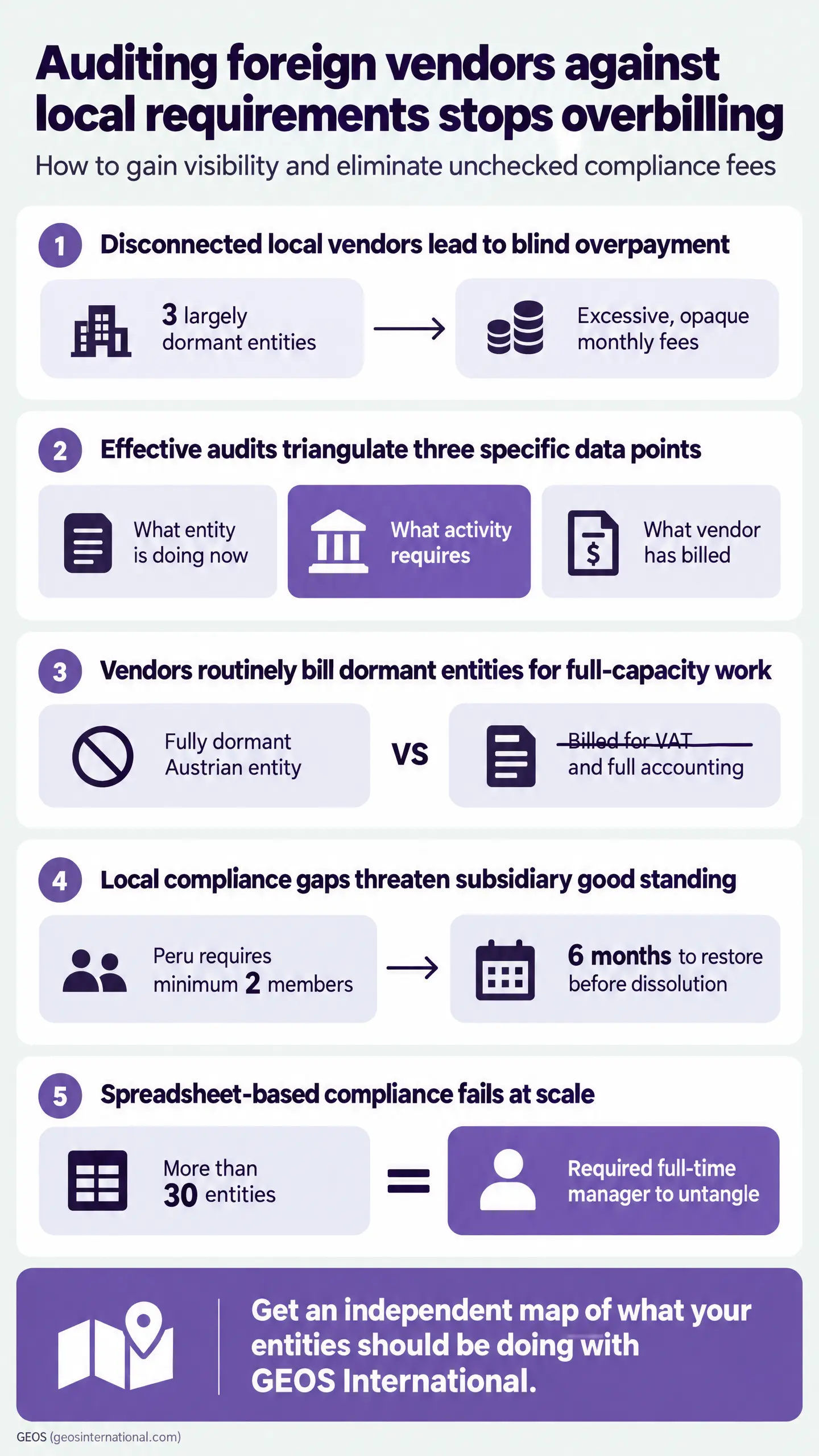
We worked with a US-based company that had three largely dormant foreign entities, two in Latin America and one in APAC. Their previous partner was charging excessive, opaque monthly fees to maintain them, and the client couldn’t get clear answers on what compliance work was being performed. We mapped out the compliance tasks for each entity and ran local audits. The client switched to us immediately, to save money and to gain visibility into their global operations.
I would say the most obvious warning sign that a global compliance setup is broken is when an operations leader can’t clearly say what the company pays per subsidiary, or which tasks those fees cover. Managers who juggle disconnected local vendors without one view of the work often lose so much visibility that they end up blindly paying the bills. Over time, that leads to unchecked overbilling and long-term compliance issues.
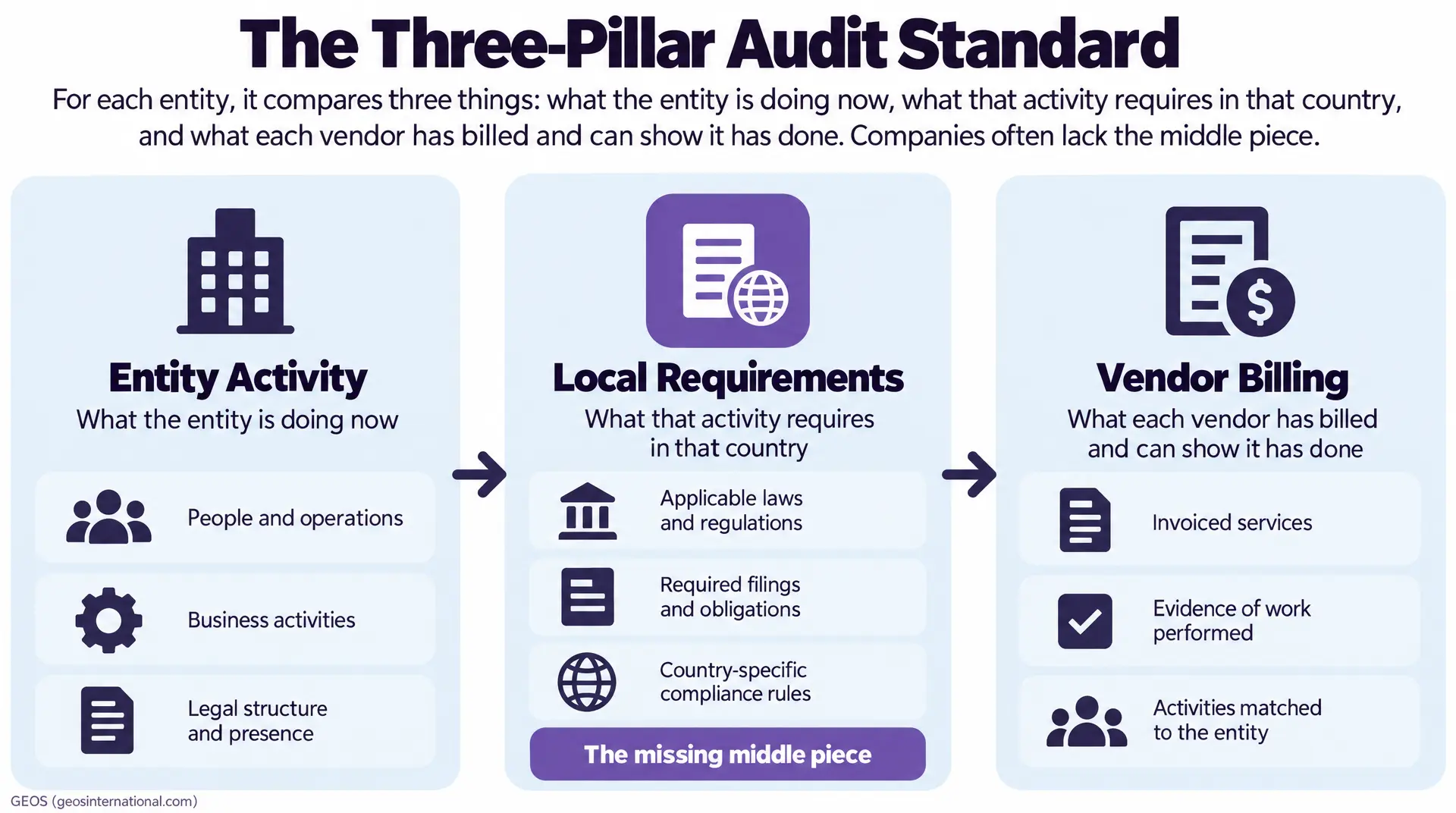
Auditing foreign corporate secretarial vendors answers both questions and shows you which ones to keep. For each entity, it compares three things: what the entity is doing now, what that activity requires in that country, and what each vendor has billed and can show it has done. Companies often lack the middle piece. Without it, there is no independent standard to hold a vendor against.
Key Takeaways
- Auditing foreign corporate secretarial vendors requires comparing an entity’s current operational activity against local country regulations and the specific tasks actually invoiced by the vendor.
- Under UK HMRC guidance, dormant entities that are VAT-registered and plan to restart must submit nil VAT returns, while those permanently ceasing trade must deregister within 30 days.
- Peru’s General Companies Law requires entities to maintain at least two members, providing a strict six-month window to replace a departing shareholder before facing automatic legal dissolution.
- Local Canadian accountants frequently miss the Investment Canada Act notification because they fail to realize that foreign ownership triggers a mandatory filing within 30 days of implementation.
- The UK mandated identity verification for Companies House directors on November 18, 2025, requiring existing directors to submit a personal code during a 12-month transitional period.
- Assigning a single explicit owner to every global compliance task prevents parent companies from double-paying for overlaps between local corporate secretarial vendors and internal finance teams.
What Compliance Tasks Should a Foreign Corporate Secretarial Vendor Audit Include?
From a compliance perspective, a corporate secretary is the individual or firm keeping the lights on for an entity. That covers the annual corporate filings. It also covers changes as simple as a new address or a departing director, or as complicated as amended bylaws or a redistribution of shares. Sometimes the role has to be a named natural person, but in most countries it is more of a spiritual role, and the work is divvied up among several parties. So I would audit employment and tax filings in the same pass as the corporate secretarial tasks.
What Is the 7-Step Checklist for Auditing Foreign Corporate Secretarial Vendors?
The first thing I would have an operations leader pull up is a list of every compliance, employment, tax and corporate secretarial task across all subsidiaries, marked as due, overdue or completed. If no list exists, the next best source is every invoice from every vendor for this work.
Often there is nothing to pull up. Running subsidiaries that way is like playing basketball with a blindfold, moving only on what your four teammates shout at you. It becomes hard to tell what needs to be done, what hasn’t been done, and how either reconciles with the cost being paid.
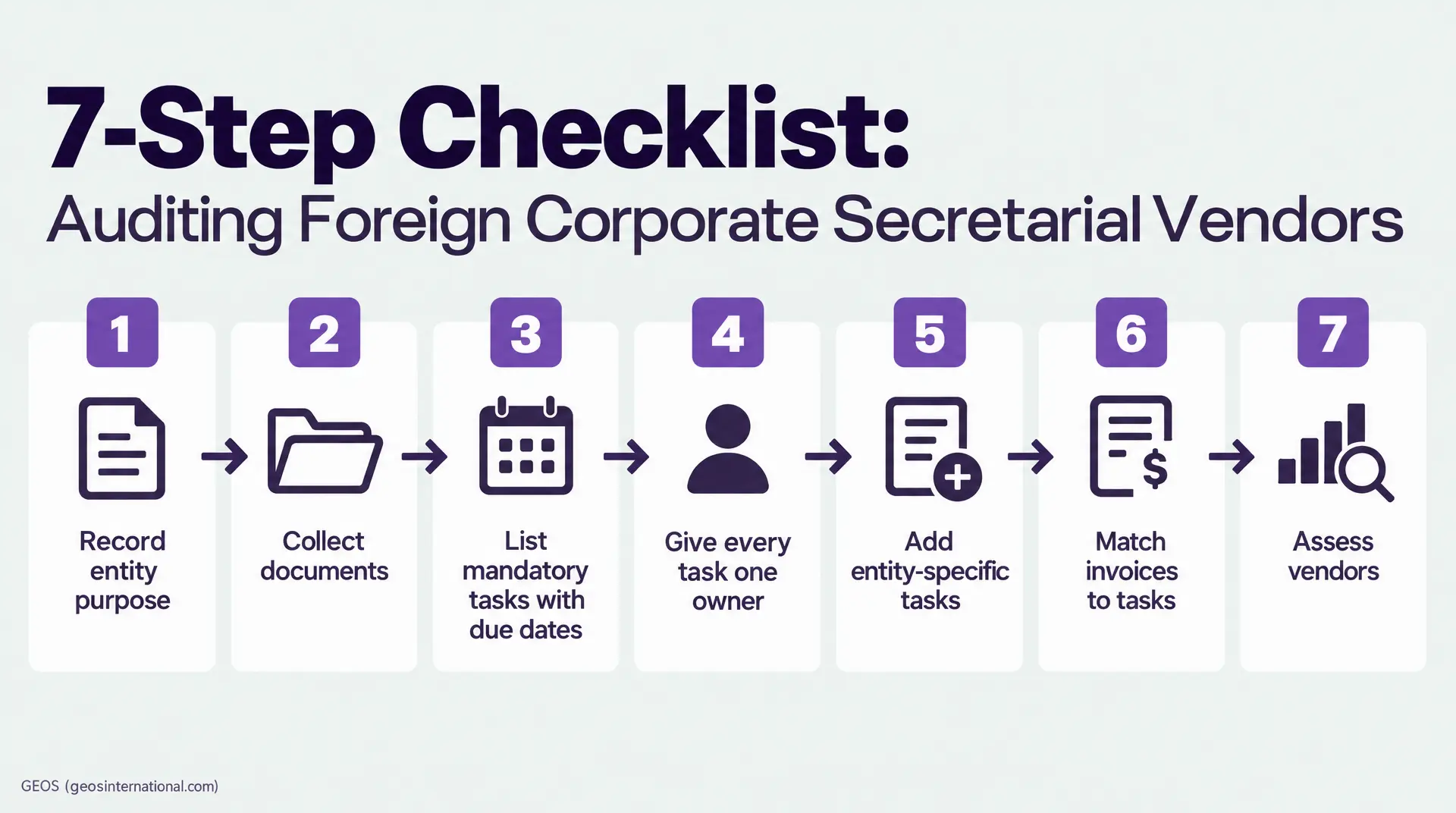
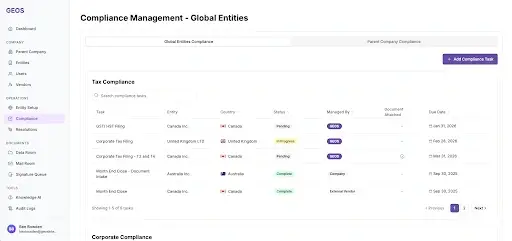
You can rebuild the list in a spreadsheet or on a platform like ours. Either way, I would follow the order we use at GEOS International when we onboard an existing footprint:
The first platform dedicated to streamlining entity setup and management.
1. Record what each entity is for today: dormant, hiring and paying people, or recognizing revenue.
2. Collect every document on file for each entity, and record its main attributes, including who is named as director and shareholder.
3. List the compliance tasks any entity in that country must complete, with due dates, from a reference the vendor you’re auditing didn’t write.
4. Give every task one owner. That might be the tax partner, the payroll partner, the corporate secretary or your own team. Ask for the filing receipt on anything marked completed. A task owned by both a vendor and your finance team may be paid for twice.
5. Add the tasks specific to your entity, and confirm them with your team and your vendors. This is normally the last 5 to 10% of the list, such as the VAT filings that follow once an entity crosses a VAT threshold and registers.
6. Match every invoice to a task on the list. Where local firms invoice subsidiaries directly, collect those invoices too, since the parent company may never see them.
7. Assess each vendor on whether they’re working well, whether they’re efficient and whether the price is right.
The country reference in step 3 takes time to build. Ours took hundreds of hours across more than 80 countries, and there were no shortcuts. In Ireland, I would also ask the vendor for one compliance calendar covering every accounting, tax and corporate secretarial task, as a way to uncover hidden fees. I would still check that calendar against an independent reference, since it comes from the party you’re auditing.
How Does a Foreign Subsidiary’s Operational Status Impact Corporate Secretarial Compliance and Billing?
Many entities stay dormant while a company prepares for activity in a country, and remain dormant until they need to become operational. Vendors in certain countries still bill a flat monthly and annual rate that assumes the entity is running at full capacity.
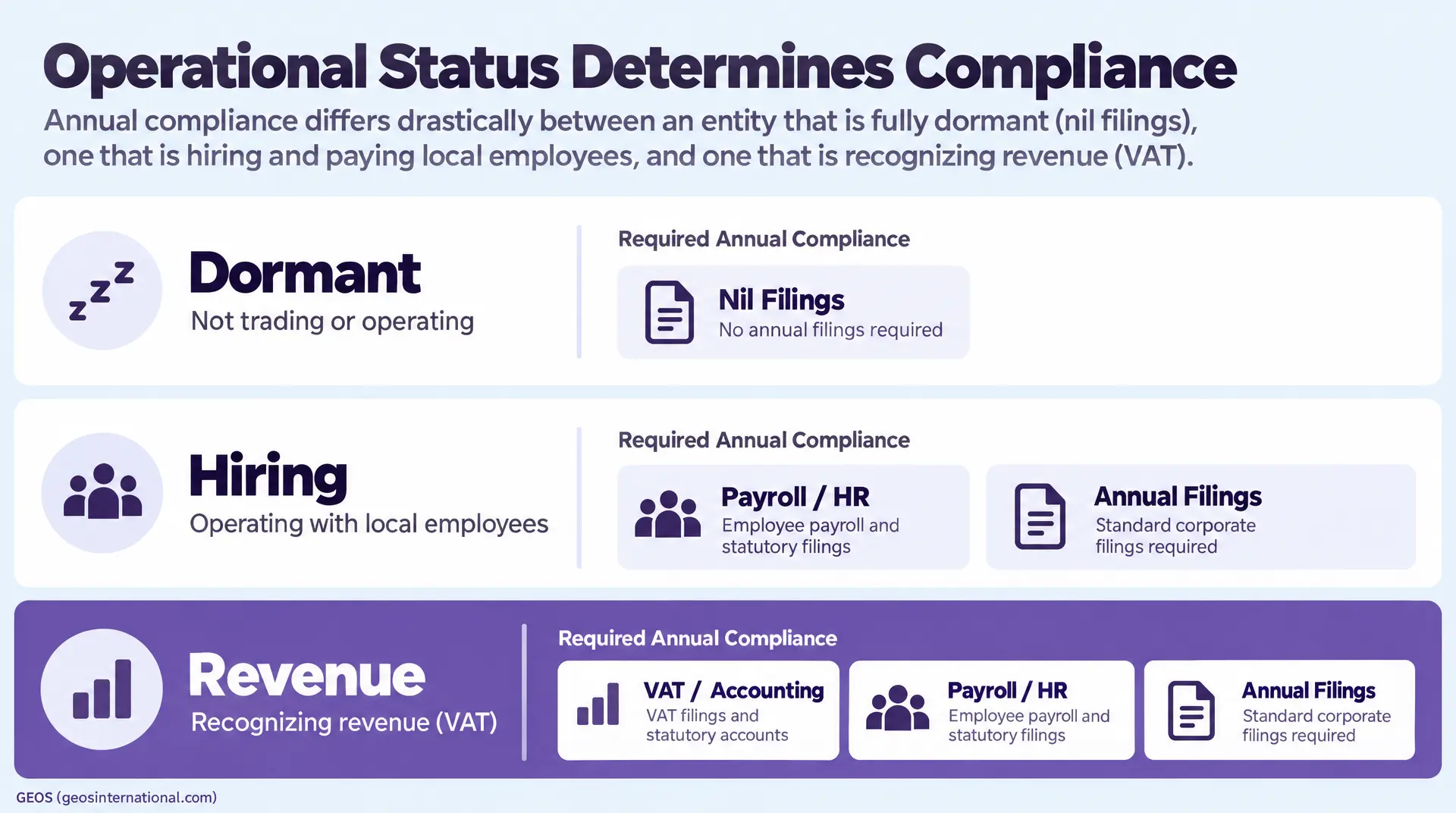
The tasks that keep an entity in good standing vary by country, and also by what the entity is doing there. In Mexico, annual compliance differs drastically between an entity that is fully dormant, one that is hiring and paying local employees, and one that is recognizing revenue.
As of 2026, these are the minimum filings a dormant foreign subsidiary owes in the UK, Ireland, Germany, Austria, Mexico and Singapore, the baseline for checking what a vendor bills.
|
Country (company type) |
Corporate secretarial filings when dormant |
Corporate tax return with no activity |
VAT/GST returns if still registered |
|---|---|---|---|
|
United Kingdom (private limited company) |
Annual accounts and confirmation statement to Companies House |
Not required once HMRC is told it is dormant, unless a notice to deliver is issued |
Nil VAT returns if restarting, deregister within 30 days if not trading again |
|
Ireland (private company limited by shares) |
Form B1 annual return to CRO within 56 days of annual return date, accounts attached |
Form CT1 still required, iXBRL accounts waivable if inactive |
Nil VAT3 every 2 months, due the 23rd of the next month, cancellable if not trading |
|
Germany (GmbH) |
Annual accounts to Unternehmensregister within 12 months of year end, balance sheet only for micro-companies |
Annual corporation-tax and trade-tax returns, filed electronically |
Advance returns can be waived if prior-year VAT was €2,000 or less |
|
Austria (GmbH) |
Annual financial statements to Firmenbuch court within 9 months, even if dormant |
Annual return required, €500 a year minimum tax in €125 quarterly instalments |
No advance returns at €35,000 or less prior-year turnover, unless the tax office asks |
|
Mexico (S.A. de C.V.) |
RNIE annual report only if assets, liabilities, income or costs exceed MXN 110 million |
Monthly and annual returns, unless SAT suspension of activities is filed (2 years, extendable 1) |
Monthly VAT return by the 17th plus DIOT, unless activities are suspended |
|
Singapore (Pte. Ltd.) |
ACRA annual return within 7 months of year end, accounts waived if qualifying dormant |
Return by 30 November each year unless IRAS grants a dormant waiver |
Nil GST returns 1 month after each period, cancel within 30 days if supplies stop for good |
This part of the audit sits closest to an operations leader’s work. You normally know early when an entity is about to change state, whether through a local hiring wave or a first enterprise contract in the market. A vendor that hasn’t been told can keep billing for activity the entity doesn’t have. It can also miss a registration, such as VAT, that the new activity triggers.
How Do You Audit Foreign Corporate Secretarial Vendor Invoices for Tax and Accounting Fees?

The two most common things to check are the ongoing accounting charge and the tax filing charges. Vendors will often bill a monthly accounting fee. If the entity has few or no transactions a month, it’s important to understand what that fee is actually for.
With tax filings, check two things. The first is whether the country requires a nil filing, meaning a return that reports no activity, from an entity in your position. The second is whether that filing is only triggered by a VAT registration that may not have happened. In the UK, even a dormant limited company must file annual accounts and a confirmation statement with Companies House, so some fees on a quiet UK entity are justified. VAT follows different rules. Under HMRC’s guidance, a dormant company that is VAT-registered and plans to restart must submit nil VAT returns. One that won’t trade again must deregister for VAT within 30 days of becoming dormant. If your entity never registered for VAT, ask what a recurring VAT charge covers.
We had a client whose Austrian entity was fully dormant, with no transactions at all, and it was being billed every month for VAT and full accounting work. We mapped out what the entity was actually required to file. The client then moved to a significantly lower fee that covered only the mandatory basic nil filings.
If an active entity is making sales, look at three things: what you’re charged for ongoing tax and accounting, how that work is done, and whether any of it is double billed because your team already handles it. If the entity is hiring and paying people, add up the total costs for payroll, benefits and HR support, and check which of those services it needs.
My business partner, others in our company and I have all been clients of PwC, so we’ve seen firsthand how a large global firm works. Having tax, legal, compliance and regional experts in one firm is convenient, and the premium does buy more safety. The teams are still split by geography, though. Each new country means restarting the process and giving context to another team.
With a global firm, I would check whether it knows how you actually operate in each country. It may be running cookie-cutter tasks that it knows exist there. Those tasks can miss a new registration, such as VAT, that a change in your operations has triggered. The firm can also bill for work a quiet entity doesn’t need. An invoice with one or two generic line items, such as “corporate compliance,” shows neither problem, and that leaves a major risk of overpayment just for insurance.
For a Fortune 100 or publicly traded company, that model can be the right fit. For a privately held scale-up, I would argue a more efficient, tech-forward setup serves you better.
Local providers often charge hourly and scale up their price as time goes on. In my view, that ends up incentivizing dependency. I prefer arrangements that reward a vendor for being proactive and efficient.
How Do You Audit Foreign Subsidiary Good Standing and Local Regulatory Compliance?

An entity has to stay compliant as well as operational, and an invoice tells you nothing about good standing. A client with multiple entities under a global firm told us they were being billed too much and didn’t know what was actually happening. Our audit confirmed the overbilling, and they switched to us. It also showed that their Costa Rican entity was non-compliant and needed a shareholder transfer to restore its good standing.
Check the names on each entity against who is still involved, since some countries set a legal minimum. Peru’s General Companies Law generally requires at least two members. A company that loses that minimum has six months to restore it before it is dissolved by operation of law, subject to statutory exceptions. One client’s Peruvian entity had fallen out of compliance because its second shareholder was a former employee who had left the company. We drafted the documentation to add a new shareholder and restore its good standing.
For local directors, I would argue that using a professional third-party director from the start is cheaper and faster. One client had appointed a local employee as resident director simply to check a compliance box. When that employee left and wanted to shed the liability, removing them became a complex ordeal. We replaced them with one of our vetted local directors.
We also audited a client with multiple entities in Latin America whose previous nominee directors were inactive. We restored those entities’ compliance and significantly reduced the client’s annual costs. Find out when each nominee or resident director last acted for the entity. Then confirm the appointment bars them from decision-making power or control over the company, which is how we structure ours.
When a single-market local accountant leaves a foreign client looking at a black box, it’s typically because the firm lacks the resources, technology and experience with foreign clients to provide visibility. Local accounting partners in APAC and Latin America are often used to serving domestic companies. They may not know the tasks that apply only to foreign-owned entities.
In Canada, domestic accountants often miss the Investment Canada Act notification because they don’t realize foreign ownership can trigger it. The filing is tied to events such as establishing a new Canadian business or acquiring control of one, subject to exemptions. A required notification is due no later than 30 days after implementation. For each vendor, ask which of their tasks exist because your company is foreign-owned.
In the UK, identity verification for Companies House became mandatory on November 18, 2025. New directors must verify before they’re appointed. Under the transitional regulations, existing directors provide their personal code with the company’s next confirmation statement during a 12-month transition. That has made things difficult for directors of established entities who weren’t aware of the change or aren’t comfortable with the online process. Your UK vendor should be able to tell you which directors have verified and when each entity’s next confirmation statement is due.
Check, too, who receives government mail at each registered address. We scan that mail onto our platform so it’s acted on before deadlines are missed. The same mail also brings up corporate changes that were never notified, before they cause an annual filing to be rejected. In Ireland, the registered office is where official documents and court papers are sent. It must be a physical location, and a PO box alone isn’t accepted.
How Should Operations Leaders Evaluate and Retain High-Performing Local Corporate Secretarial Vendors?
I would not use the audit as a reason to replace everyone. It’s virtually impossible to find a single provider that handles tax, legal and payroll across dozens of countries. Local accountants and lawyers can also be highly knowledgeable and good to work with in a single country. The difficulty comes when you depend on them across several countries at once. When you judge responsiveness, allow for local norms. In Spain, communication with local partners often drops off completely in August and December.
On large footprints, we keep the high-performing partners, bring them onto the platform as owners of their tasks, and replace only the ones that underperform. For vendors a client brings, we compare their work against our preset map of what compliance should look like in that country. The platform also prompts them to mark tasks complete and submit the receipt. Compliance takes several partners working together, and we aren’t ultimately responsible for every part of it. The comparison adds a level of oversight that wasn’t there before.
When Does Spreadsheet-Based Global Entity Compliance Management Become Untenable for Foreign Subsidiaries?

A client with more than 30 entities had local firms invoicing each subsidiary directly, and the parent company had completely lost visibility into its compliance costs. Untangling years of backdated auditing and unverified local invoices took a newly hired global compliance manager working full time alongside our team.
How you run this audit depends mostly on how many entities you have. With a handful, a well-kept task list with one owner per task can hold. Beyond a handful, I’d argue it becomes practically untenable without a full-time internal team. The invoices and the actions behind them can add up to two or three full-time jobs.
If you’d like an independent map of what each of your entities should be doing, set against what you’re paying for it, my team at GEOS International and I would be glad to walk through your footprint with you.
Frequently Asked Questions
How does appointing an inactive local employee as a Singapore director create risk?
It is a dangerous shortcut. ACRA explicitly states Singapore directors remain legally responsible whether active or not. When an employee leaves, removing them to shed liability becomes a complex ordeal. Additionally, you must still appoint a resident, natural-person company secretary within six months. Use vetted third-party professionals from day one.
Why do market launches stall immediately after a local vendor confirms incorporation?
Incorporation is only step one. Local vendors often hand over lodged paperwork, leaving a massive operational gap. You cannot actually operate until you secure bank accounts, tax IDs, and active payroll. Without a single partner coordinating these post-incorporation milestones, your planned enterprise contracts and hiring waves will silently miss deadlines.
How do shifting VAT rules expose overbilling on dormant European entities?
Vendors often charge flat recurring fees regardless of activity. In Austria, between 2025 and 2026, VAT advance-returns are only quarterly if prior-year turnover is under €100,000. For dormant entities, recurring monthly VAT charges are a major red flag. Map actual operational activity against statutory thresholds to uncover hidden overbilling.
How tight is the first compliance window for newly incorporated entities in Ireland?
The timeline is notoriously unforgiving. Your first annual return is made up to a date six months after incorporation, and must be filed with the Companies Registration Office within exactly 56 days. If fragmented local vendors drop the ball, you miss the deadline and immediately jeopardize your operational good standing.
Why can’t our Employer of Record (EOR) handle our broader local corporate secretarial duties?
An EOR only covers employment liability, hitting a ceiling when you need a true commercial presence. To contract directly with enterprise clients, secure local agreements, or hold a registered physical address, you need a legally recognized establishment. This requires dedicated corporate secretarial oversight, not just an outsourced HR layer.