
Germany lets a private bank decide the moment your company is legally allowed to exist. The commercial register won’t process your filing until €12,500 in share capital sits in a bank account, which hands the timing of your company’s birth to an institution the state doesn’t control.
That institution keeps its own rulebook, and it runs stricter than the law itself. German statute makes a director’s nationality and residence legally irrelevant, still the first bank we approached for a US client would not open an account unless every director held an EU passport.
You can satisfy every published requirement a country has and still be locked out of it, by someone who never has to explain why.
Key Takeaways
- In Germany, a GmbH incorporation filing cannot be processed by the commercial register until €12,500 in share capital is legally deposited into a corporate bank account.
- Although German corporate statute makes a director’s nationality legally irrelevant, some local banks strictly require all directors to hold an EU passport before opening a required corporate account.
- Mexican subsidiaries must use one of only seven authorized banks to process mandatory IMSS employer social security payments by the 17th of the month following payroll.
- Setting up an Indian subsidiary requires traditional local banking rails to meet strict 15-day deadlines for provident fund deposits and e-Pay Tax portal Challan Reference Numbers.
- Corporate bank account applications frequently fail because notarized Ultimate Beneficial Owner identification and proof-of-address documents carry strict 60-day validity windows that expire during the review process.
- Companies expanding into the UK can bypass strict bank pushback on foreign ownership by appointing a temporary nominee director constrained by a power of attorney for three to six months.
- Operations teams should mitigate compliance risks by implementing a hybrid banking stack that pairs a FinTech account for general operations with a traditional local account for statutory tax payments.
How Does Foreign Corporate Bank Account Dependency Impact Global Entity Incorporation Timelines?
Setting up an entity in another country and setting up a bank account there are related, but not intrinsically tied. The nature of that relationship changes per country, and it should change your entire project plan.
In share capital jurisdictions, incorporation is legally dependent on the account. Germany is the textbook case. The GmbH Act sets minimum share capital at €25,000, and the commercial register application can only be filed once at least half of that – €12,500 – has been paid in. No account, no deposit certificate, no entity. For startups that don’t want to park that much cash upfront, the UG structure exists for precisely this reason: it operates below the GmbH threshold and routes a quarter of annual net profit into a statutory reserve until the capital level is reached over time.
In countries without a capital deposit requirement, incorporation and banking run as two almost completely separate tracks. The UK is the cleanest example – the jurisdiction skips wet signatures, notarization, and apostilles entirely, which is why banking is often the only real bottleneck left there. Both tracks are still required to operate. But they can and should be parallelized from day one.
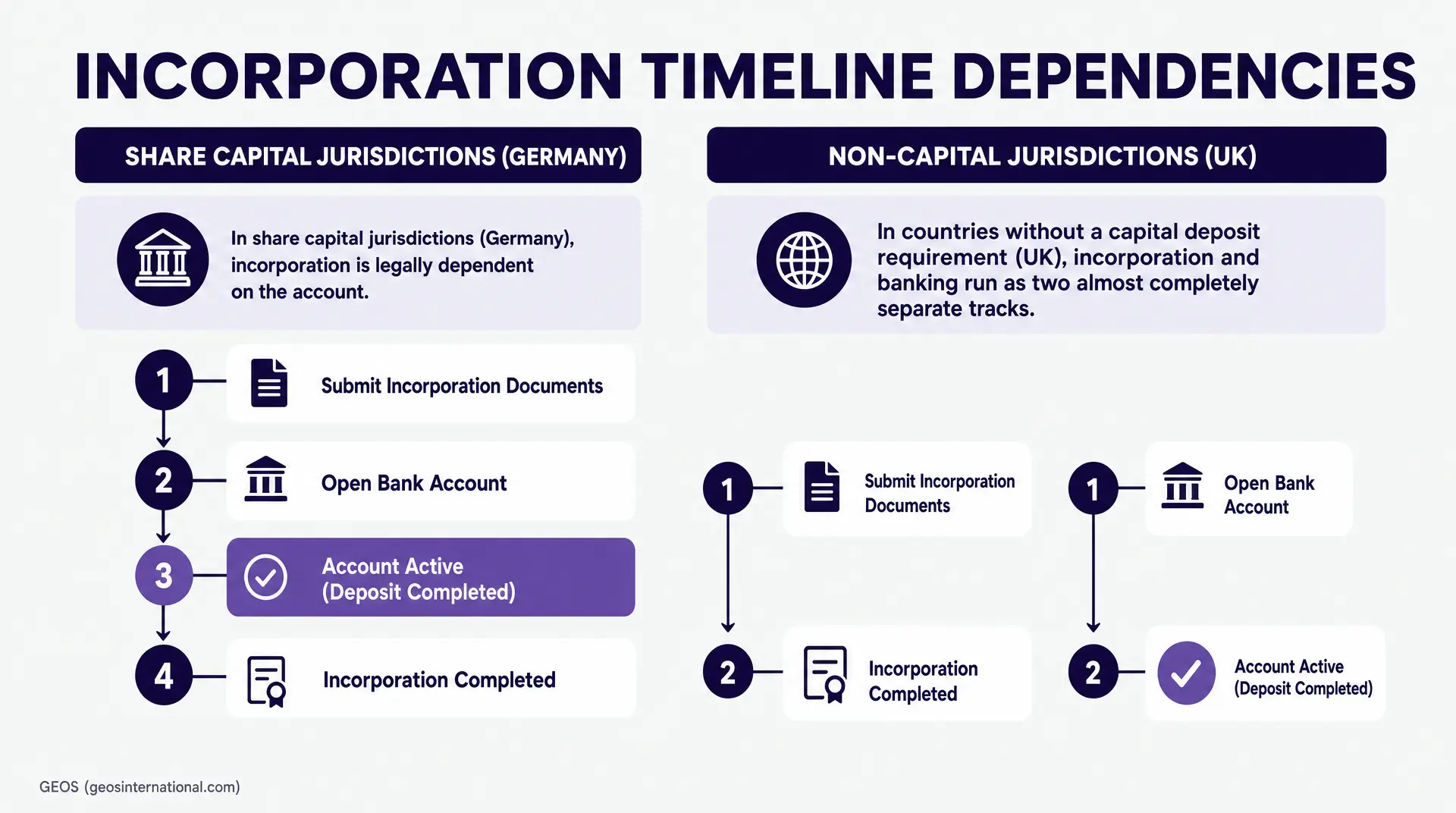
The first item on the checklist is settling whether incorporation legally depends on the account, or whether the operation practically depends on it. The answer decides if banking sits inside your incorporation timeline or directly alongside it. Either way, it’s on the critical path.
How Do Country-Specific Banking Rails Affect Foreign Subsidiary Payroll and Tax Compliance?
The most common mistake I see from operations teams is assuming a modern digital bank can carry the whole country. Sometimes it genuinely can. In the UK, Revolut often works end to end – it’s one of the few markets where a FinTech platform can handle a subsidiary’s complete financial requirements. Then there are countries where the rails are controlled by the state, and no app-based account will change that.
Mexico is the open-and-shut case I give every client. IMSS’s own documentation lists just seven banks holding agreements to process employer social security payments, and Article 39 of the Social Security Law makes those contributions due by the 17th of the month following payroll. If your account isn’t at one of those institutions, you will miss that date every single month. There’s a second trap layered underneath: foreign companies routinely get deep into the Mexican incorporation before realizing they can’t establish those social security rails – or wet-sign employment contracts – without a local legal representative appointed. We maintain vetted representatives and local banking relationships in Mexico for exactly this reason.
The first platform dedicated to streamlining entity setup and management.
India is equally rails-dependent for different reasons. Running payroll properly means a traditional local account on Indian rails, so that Tax Deducted at Source remittances and provident fund payments are actually recognized by local officials. India’s provident fund deadlines are hard: contributions must be deposited within 15 days of the close of every month, and the former five-day grace period was withdrawn back in 2016. Even the tax mechanics carry timing risk. The e-Pay Tax portal lists 33 authorized banks for net-banking payments, and a Challan Reference Number generated for a remittance is only valid for 15 days – a transfer that misses the window simply gets returned.
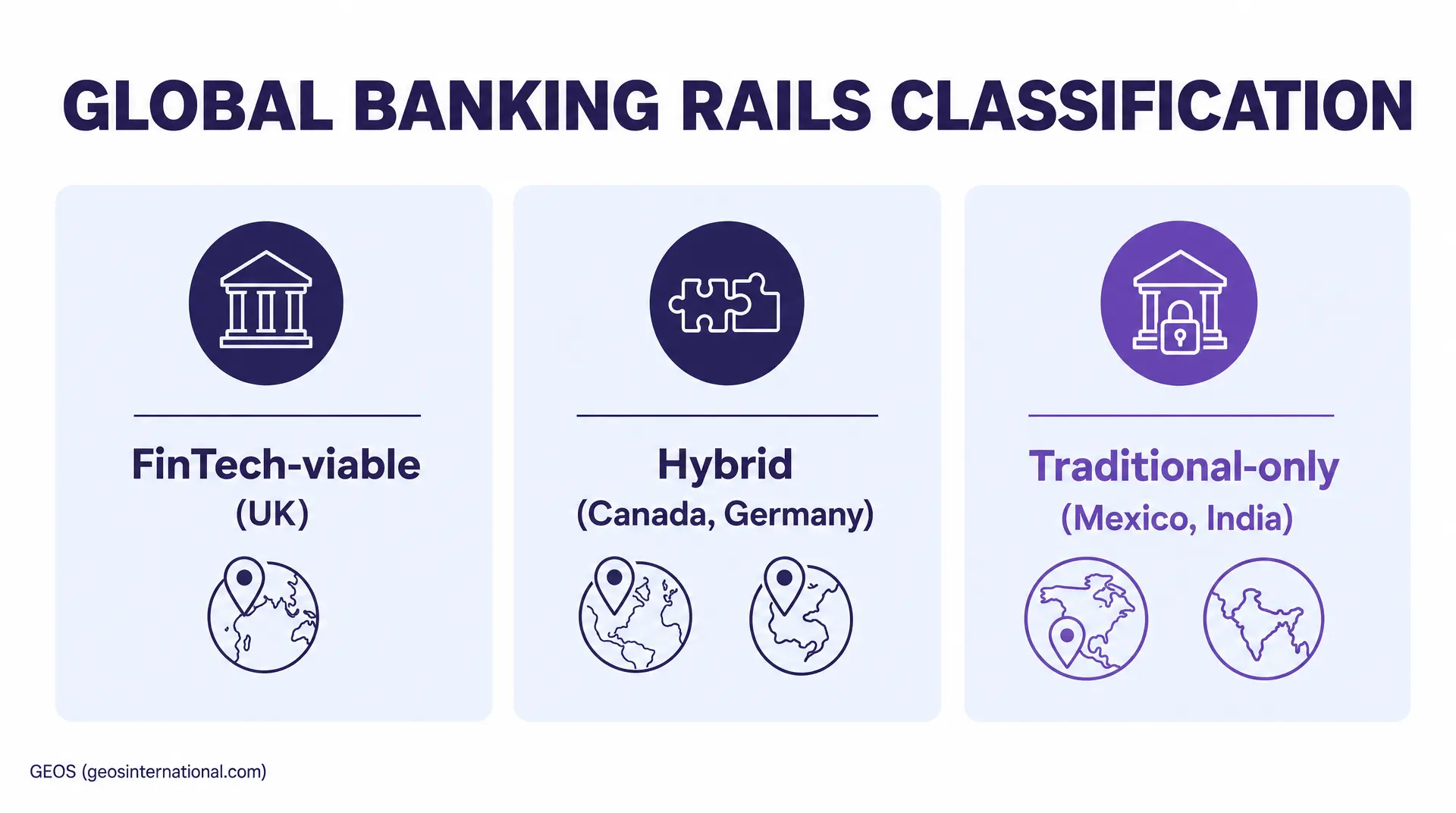
Each country has its own landscape of what banking you can actually use. Before you commit a date to your CEO, bucket the target market honestly: FinTech-viable, hybrid, or traditional-only. Getting that classification wrong is how a payroll go-live slips a full quarter.
Why Are Corporate Bank KYB Policies Stricter Than National Incorporation Statutes for Foreign Entities?

German law does not require a GmbH to have local or European directors. Germany Trade & Invest states plainly that the nationality and residence of directors are legally irrelevant. The first bank we approached for a US-based client expanding into Germany did not care what the statute said. It would only function if the directors were EU citizens – a requirement this client simply couldn’t meet – and we had to source a different, more FinTech-forward German institution to get them operational.
That gap between statute and bank policy is the most disorienting part of this process for operations leaders. The government’s requirements are published. The bank’s risk appetite is not. Every institution runs its own KYB rulebook, and navigating the variance between them is genuinely hard even when you do it every week.
How Do Ultimate Beneficial Owner Document Expirations Impact Foreign Corporate Bank Account Setup?

Banks interrogate ownership in a way corporate registries never do. In Canada, FINTRAC’s rules require banks to collect the names of all directors plus every individual who directly or indirectly owns or controls 25% or more of the corporation. The bank is approaching your company as a 100% foreigner entering the country, and it will keep asking until the ownership chart is airtight.
Refusals are actually rare. Expired documents are what derail applications. Notarized IDs and proof-of-address documents often carry strict validity windows – 60 days is common – and I’ve watched a single Ultimate Beneficial Owner who felt disconnected from the business sit on a utility bill long enough to expire the entire application package. When that happens, the collection process restarts from zero, and your launch date moves with it.
The UK has now formalized this scrutiny at the registry level as well. Companies House confirmed that director identity verification became a legal requirement from 18 November 2025, with an estimated six to seven million individuals needing to verify during the transition. Miss it and your entity’s good standing is compromised before the bank even weighs in. Where UK banks push back hard on foreign ownership, there’s a well-worn bridge we use: appoint a temporary nominee director for three to six months, constrain them with a power of attorney so they hold no real control, and lodge the resolutions to formally remove them once the account is established.
What Is the Recommended Backup Protocol When a Foreign Corporate Bank Application Stalls?

The engagement that shaped our internal protocol was an entity setup in India. The first bank we engaged was responsive at the beginning – it seemed semi-promising that the account would open. Then that bank just went silent. No rejection, no explanation, nothing to escalate against. We started a brand-new application with a second bank and rebuilt the file from there.
The real damage was downstream. The account was required to make the share capital deposit and complete the registrations needed to run payroll, so every silent week was a week the client couldn’t compliantly pay their Indian team.
Our protocol now is simple and I’d recommend any ops leader adopt it. Identify the second-choice bank on day one, not after the first one stalls. Track application responsiveness weekly, the same way you’d track any vendor with your launch date in their hands. And set a silence threshold – two to three weeks of no movement triggers the backup application, not another polite follow-up email.
Why Is a Hybrid Banking Stack Recommended Over FinTech-Only Solutions for Foreign Subsidiaries?

Clients who insist on going FinTech-first for everything discover the failure late, when it’s most expensive. In my experience it surfaces as either a compliance snag – a share capital deposit that can’t be made – or the inability to process a payroll tax or corporate tax payment, which leads directly to fines against the newly formed entity.
The improvised workaround is usually worse than the wait. One US-based client expanding into India resorted to a patchwork solution to run payroll while their bank application stalled. That improvisation caused long-term compliance issues with their provident fund and pension scheme that took far longer to untangle than the original banking delay would have cost them.
What actually works in most hybrid markets is a two-account stack: a FinTech account for general money movement, paired with a traditional local account strictly for tax and social security payments. Even in FinTech-friendly markets, keep treasury risk in view. The FCA has flagged that funds held by payment and e-money firms sit outside FSCS deposit protection, and payment firms that failed between 2018 and mid-2023 left average shortfalls of 65% of customer funds – with tighter safeguarding rules only arriving in May 2026. Convenient rails and protected rails are two separate diligence questions, and your finance team should answer both.
Canada carries its own wrinkle. FinTech options work well for simple payroll and can be set up entirely remotely. But complex, high-revenue operations that need a traditional Canadian bank should expect stringent onboarding – potentially including foreign directors traveling in person for KYC. Book that flight into the plan rather than discovering it in month three.
How Should Operations Teams Reverse-Engineer Foreign Subsidiary Setup Timelines from Payroll Deadlines?
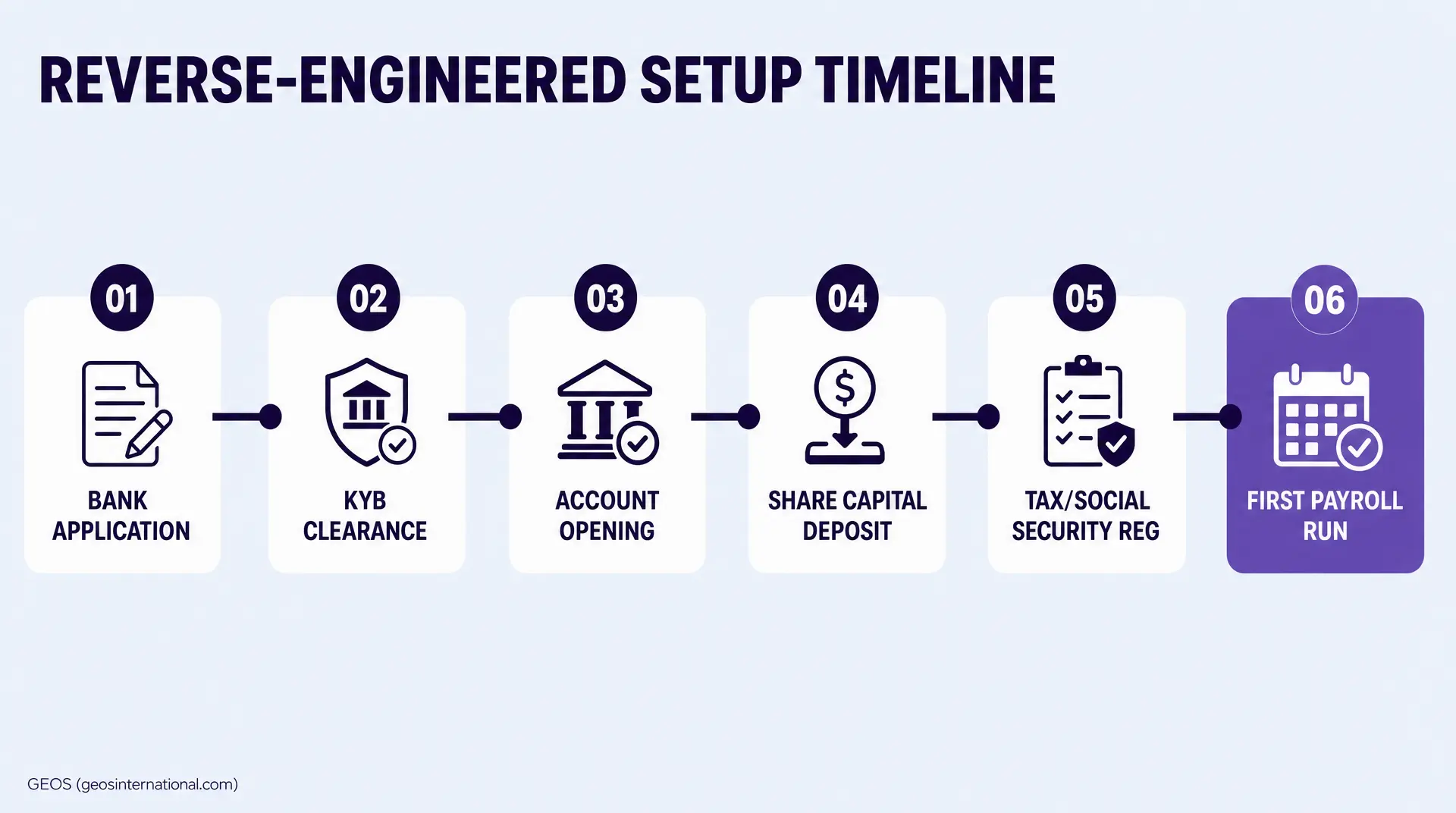
Most teams plan forward from incorporation. I’d push you to plan backward from the commercial deadline instead. If payroll must be live for a March 1 hiring wave, the chain runs: bank application, KYB clearance, account opening, share capital deposit, tax and social security registrations, first payroll run. Every link has lead time, and several involve humans with rubber stamps.
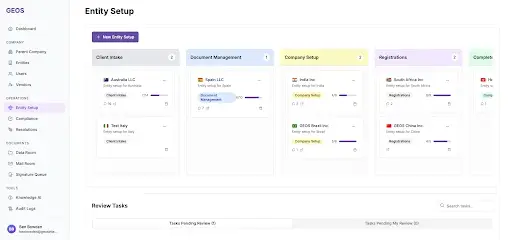
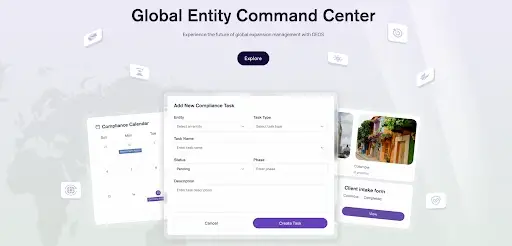
Heading into 2026, I expect corporate bank KYB, physical notary appointments, and country-specific apostille and translation requirements to remain the most stubborn analog steps in global expansion, no matter how digital the government portals become. Banks still schedule ad-hoc KYC video calls with named individuals. Some still require wet signatures. Some still mail physical codes to a registered address. We built the GEOS platform to map these steps upfront and flag exactly when client participation is mandatory – the live video call, the specific letterhead, the passport scan in the right format – because surprises are what kill launch dates, not complexity.
What Is the Complete 2026 Operations Checklist for Foreign Corporate Bank Account Setup?
If you take nothing else into your next expansion planning session, take this sequence:
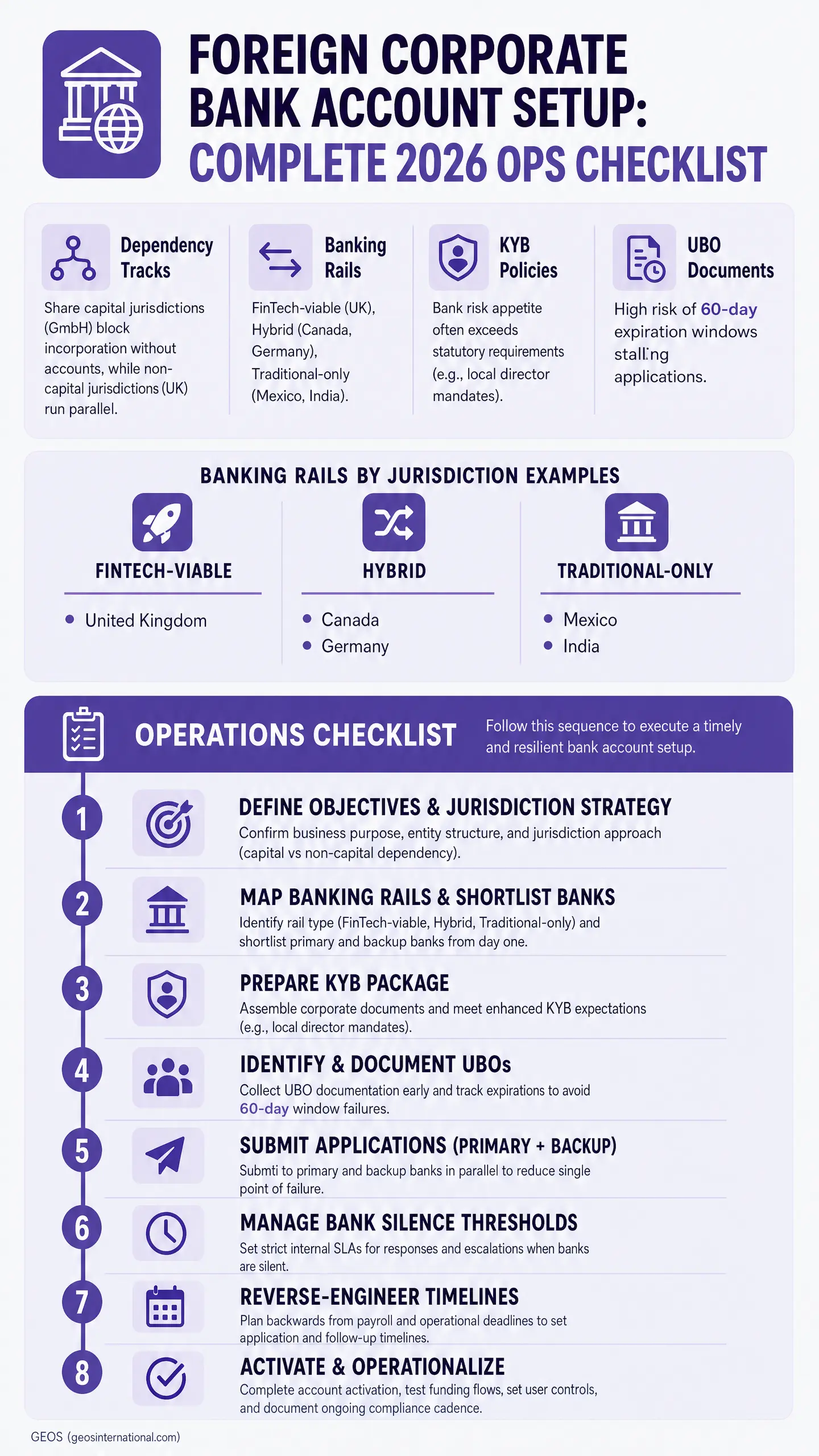
– Confirm whether the target country requires a share capital deposit – it decides whether banking blocks incorporation itself. – Bucket the rails honestly: FinTech-viable (UK), hybrid (Canada, Germany), traditional-only (Mexico, India). – Verify director eligibility against each specific bank’s policy, not the country’s statute. – Collect, notarize, and apostille UBO documents in week one. Log every expiry date and assume 60-day windows. – Name a backup bank before submitting to the first, and define the silence threshold that triggers it. – Match every statutory payment – IMSS by the 17th, EPF within 15 days – to an account that can legally make it, before the first payroll run rather than during it. – Calendar every human-dependent event: notary appointments, KYC video calls, wet signatures, mailed codes.
Why Is a Foreign Corporate Bank Account the Critical Milestone for Subsidiary Operational Readiness?
There is a meaningful difference between an entity that’s legally incorporated and one that’s operational, and banking is where that difference gets exposed – usually a few weeks before a date someone already promised the board. I’ll take a B-plus plan executed today over an A-plus plan next week, but foreign corporate banking is the one workstream where you don’t get to skip the plan entirely. The rails are country-specific, the requirements vary bank to bank, and the failure modes all surface late.
At GEOS, we’ve mapped this process across 80+ countries and hold the local relationships in the hard markets, so one accountable team owns the outcome instead of a patchwork of local vendors. However you choose to get there, treat the bank account like it is the launch. Operationally, it is.
Frequently Asked Questions
How strict are the UK Companies House verification deadlines for foreign beneficial owners?
Timing is tight. Under the new rules, a Person with Significant Control who is also a director must provide their personal code within 14 days starting the day after the confirmation-statement date. Miss this window, and your entity’s good standing collapses before banking even begins.
Can our Indian subsidiary use bank-counter tax payments if our corporate account application stalls?
No. The Income Tax Department explicitly dictates that the ‘Pay at Bank Counter’ option cannot be used by a company taxpayer. If traditional banking rails aren’t live, you cannot compliantly remit taxes. You must secure one of the 33 authorized net-banking accounts to operate legally.
What ownership threshold triggers mandatory KYB disclosure during a US corporate bank account setup?
Expect deep structural scrutiny. The FinCEN CDD Final Rule requires banks to verify anyone owning 25% or more of your entity, plus one controlling individual. They will interrogate your cap table until it is perfectly airtight.
Does Mexico’s Nuevo SIPARE system allow foreign subsidiaries to bypass traditional local banking rails?
Absolutely not. Even with the updated system, IMSS restricts payments to just seven institutions, including BBVA Bancomer, Citibanamex, and Santander. If your operations team attempts to rely on a global FinTech app, you will fail to make statutory employer contributions by the 17th of the month.
If we use a German UG to avoid the upfront €12,500 deposit, what is the long-term operational impact?
The trade-off directly hits your liquidity. While a UG bypasses the full €25,000 GmbH capital requirement, German statute dictates you must allocate one quarter of annual net profit to a statutory reserve until you reach that capital level. It speeds up incorporation but locks up future cash.