
You are already paying the full cost of an entity you refuse to build.
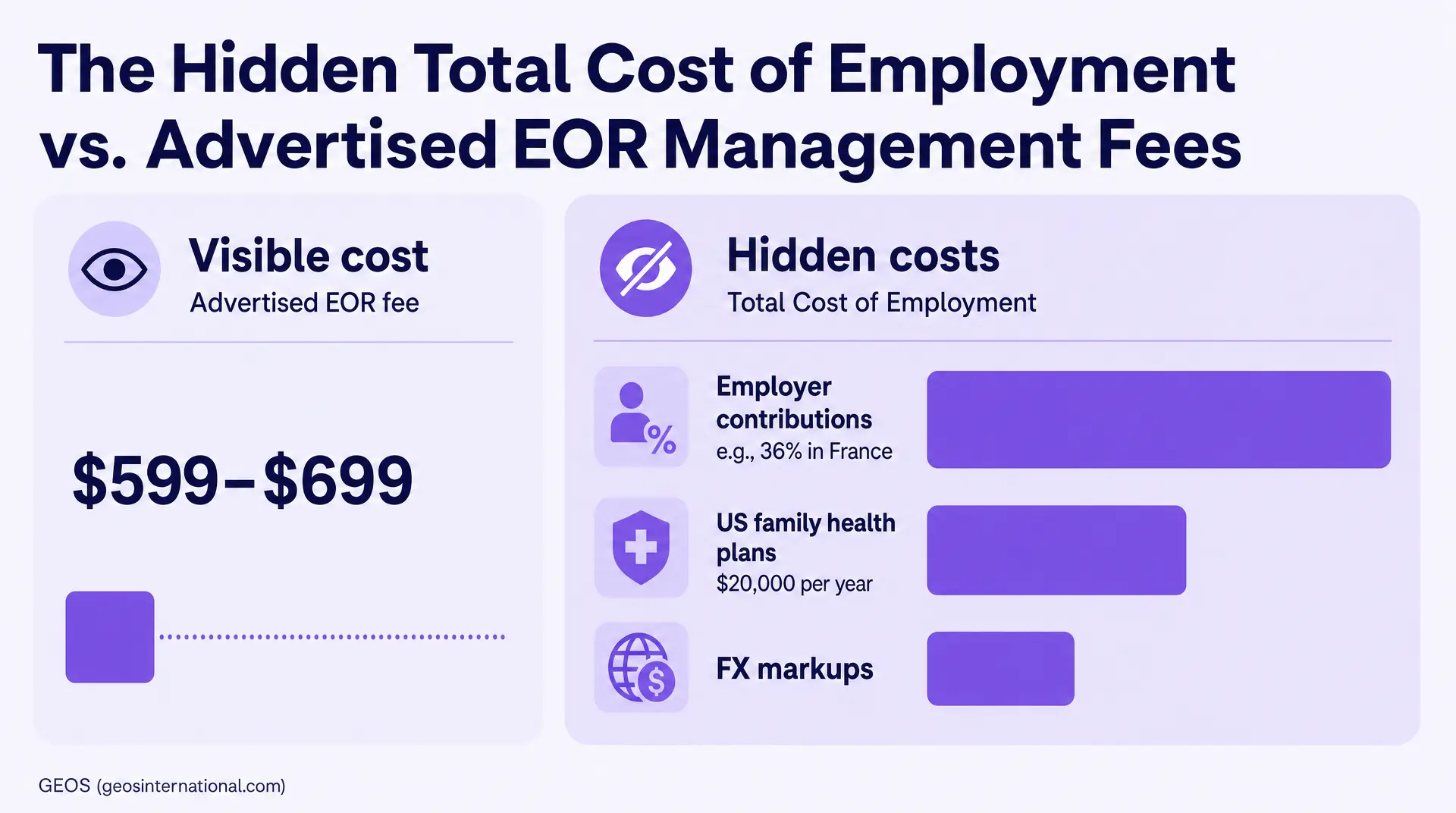
The management fee is the sliver you see. The real invoice is Total Cost of Employment – salary, employer contributions that reach 36% of wages in France, a family health plan running near $20,000 a year in the US, and a margin plus an FX markup on every dollar that crosses a border.
You are covering every cost of ownership and holding none of its rights – no lease in your name, no revenue booked locally, no standing with the enterprise or government buyer that wanted a local counterparty.
Key Takeaways
- The true cost of using an Employer of Record includes employer contributions reaching 36% of wages in France and United States family health plans costing roughly $20,000 annually.
- Companies using an Employer of Record cannot sign commercial leases, recognize local revenue, or contract directly with enterprise and government buyers under their own corporate name.
- Hiring sales teams through an Employer of Record creates permanent establishment tax exposure under OECD rules when those employees habitually conclude contracts on behalf of the parent company.
- The headcount breakeven point for replacing an Employer of Record with a local entity is three to six employees in the United Kingdom and 40 to 50 employees in France.
- Establishing a local corporate entity in Mexico requires an in-country legal representative for wet-signing contracts and a traditional bank account to process SIPARE social security payments.
- Germany mandates graduation from an Employer of Record through the AUG law, which caps employee leasing at 18 consecutive months and penalizes violations with €500,000 fines.
- Although UK Companies House registers private limited companies within 24 hours, HMRC restricts PAYE payroll registration to no more than two months before the first local payday.
Why Do Business Requirements Dictate When to Graduate From an Employer of Record?

The first question I ask a founder who says they need an entity in France or Mexico is why. The answer determines whether an entity is even the correct tool.
When the reason is “I need to hire three engineers in France,” I refer them to one of our EOR partners. A French entity for three people is a heavy lift from an operational perspective and it will not pay back. GEOS makes nothing on that referral. It is still the correct answer.
The moment the reason includes anything beyond employing a few individuals, the calculus flips. Signing a commercial lease. Recognizing revenue locally. Contracting directly with an enterprise or government buyer that wants a local counterparty. Granting equity and designing bespoke benefits. An EOR cannot deliver any of those, because the infrastructure you are renting does not carry your name.
Trying to fake a local commercial presence through EOR sales hires creates its own problem. The OECD’s model treaty language states that a person who habitually concludes contracts on your behalf can create a permanent establishment for the parent. Ten EOR account executives closing local deals is that exact fact pattern. You inherit the tax exposure of a local entity with none of its standing.
One more question comes before headcount: whether it has to be that country at all. A European team is far cheaper to build through Ireland than France, and our Global Subsidiary Index exists to make that comparison. A subsidiary is close to a permanent decision, so make it deliberately.
How Is the Employer of Record to Local Entity Break-Even Point Calculated per Country?
When the reason is purely employment, headcount becomes the primary variable. The crossover moves country by country because the effort to set up and maintain an entity varies drastically.
In the UK and Canada it sits at three to six employees. Nothing needs to be notarized or apostilled and ongoing filings are light. India converts at around 10, usually with a global command center in the plan, so headcount climbs fast after the flip. The Netherlands sits at ten to fifteen. Incorporation and payroll are straightforward there, but corporate tax and accounting filings are complex enough that we classify it as a tier two country.
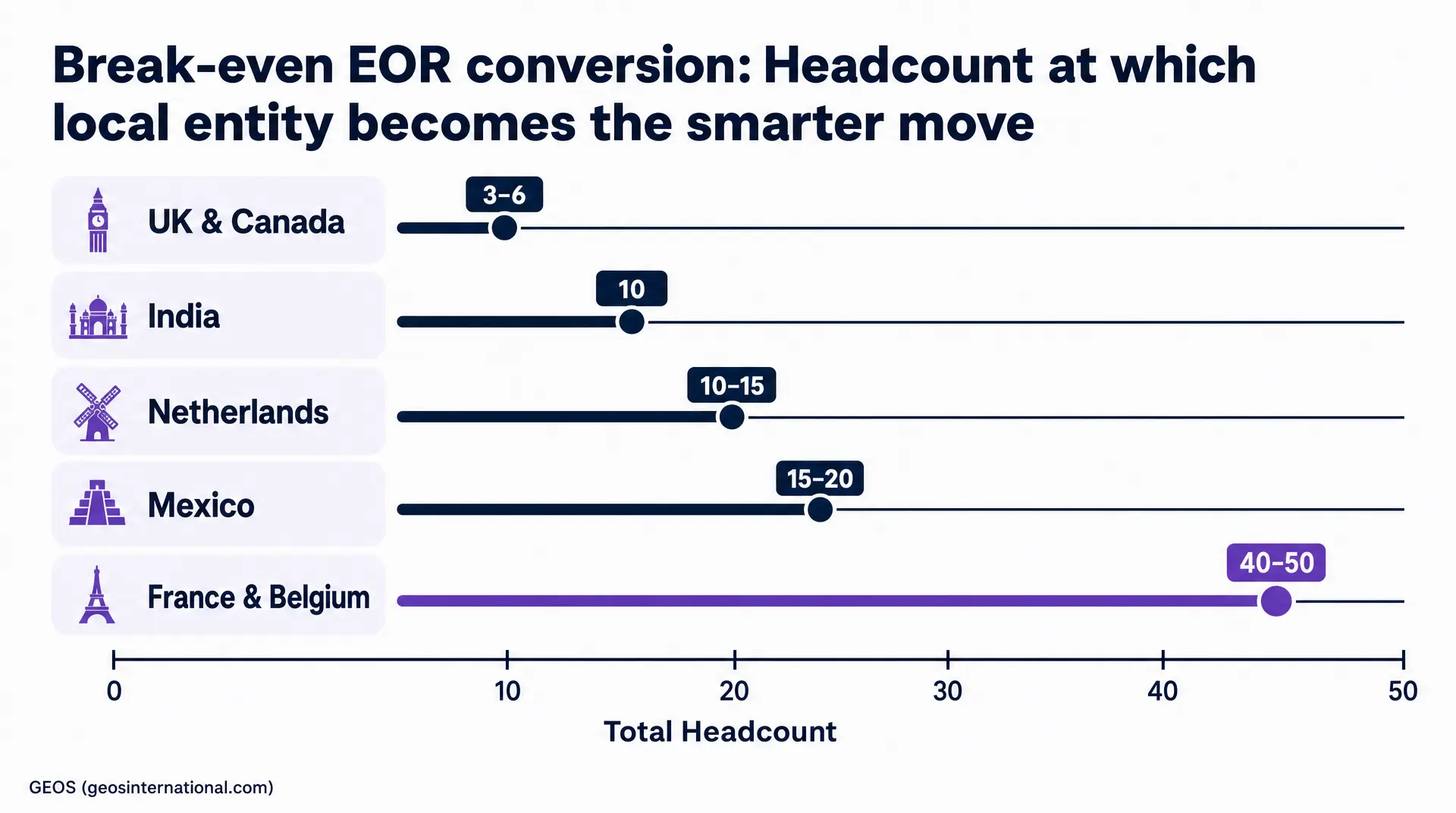
Mexico moves the line to fifteen to twenty. You need a local legal representative to wet sign employment contracts and face the tax authority. Salaries are calculated more like a day rate than an annual figure. Social security payments only clear through the seven traditional banks IMSS lists for SIPARE, so a FinTech account fails that test every time. France and Belgium push the crossover out to forty or 50, because every parent document must be notarized, apostilled, translated and couriered before a notary will look at your application.
The arithmetic itself is simple. Take your monthly EOR fee per employee and multiply by local headcount. Set that against the projected annual cost of the entity: compliance, your own payroll and benefits program, tax filings and a registered address. When the entity total comes in lower, the decision makes itself. Most companies we see expanding into the Netherlands flip while still under 10 employees because the trajectory is obvious.
What Hidden Costs Are Excluded From Advertised Employer of Record Management Fees?
Founders who run that comparison almost always understate the EOR column, because the management fee is the only visible part. Deel publishes a US rate of $599 per employee per month. Remote’s standard fee is $699.
Oyster’s own customer terms define the monthly bill as Total Cost of Employment: salary, employer contributions and the service fee. My rough rule for those contributions is 10 to 30% on top of gross payroll, depending on the country. France breaks through the top of that range. OECD data puts French employer contributions at roughly 36% of gross wages.
Benefits produce the sharpest surprises. European companies hiring in the US through an EOR consistently underestimate what a competitive plan costs in a privatized healthcare system. KFF’s 2025 survey puts the employer-paid share of family coverage near $20,000 per employee per year. Ten US hires with families commits roughly $200,000 annually that never appeared on the quote. Then add FX translation and money movement costs every time funds cross a border.
Statutory contributions and benefits will follow you into an owned entity. The management fee, the FX markup and the EOR’s margin will not, and control over how every remaining dollar is spent becomes yours.
What Are the Permanent Establishment and Compliance Risks of Using an Employer of Record?
The compliance exposure is quieter than the financial break-even and, in my experience, more dangerous for a company scaling quickly.
Permanent establishment risk builds without a headline. Somewhere between five and twenty EOR employees in a single country, depending on the local stance, a tax authority can start asking questions. The argument is that you are skirting a permanent establishment while doing business as if you had one. If the authority wins, you owe back taxes plus damages. Headline penalties are rare. This quieter reassessment is what actually lands.
Some governments have set your graduation date for you. Germany’s AUG law requires an employee-leasing permit, caps a worker’s assignment at 18 consecutive months and only resets that clock after a gap of more than three months. Fines for certain violations run to €500,000. Austria polices labor leasing without a license the same way, and France and Singapore are regulating in the same direction.
Then there is the liability you think you offloaded. EOR contracts pass indemnity back to you when the mistake is yours, so the protection exists in concept and thins out in practice. I have seen a US company terminate an employee in Japan without understanding how difficult that is under Japanese labor law. The resulting lawsuit exposed the EOR and the company alike.
A related point on posture. Never keep an EOR running in a country where you already operate a tax-paying entity. Local officials view that split as a worse posture than using an EOR with no entity at all.
How Do Companies Graduate From an Employer of Record to a Local Entity?
Most large EOR providers have built global payroll products. That is an admission that EOR is a phase, and a bid to keep your business after you leave it. They still stay away from entity setup, entity management, tax and accounting. That gap is where companies stall, and it is why GEOS partners with EORs rather than competing with them.
What Does the Entity Setup Phase Involve When Graduating From an Employer of Record?
The first platform dedicated to streamlining entity setup and management.
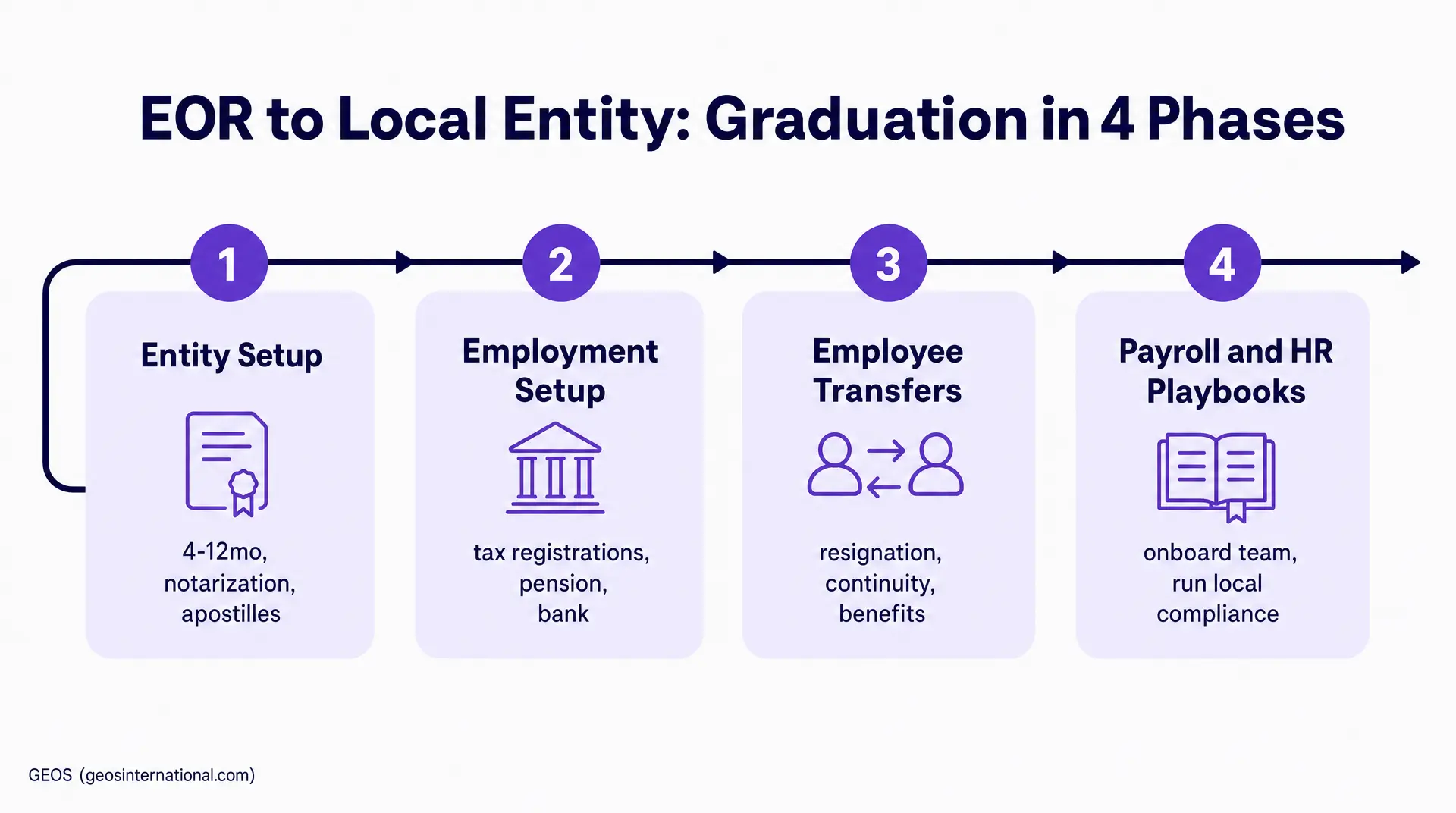
Budget four to twelve months in most countries. The UK is the genuine exception. Companies House usually registers a private limited company within 24 hours. HMRC, on the other hand, will not let you register for PAYE more than two months before your first payday, so even the fastest jurisdiction separates incorporation from operation. Everywhere else, the three-week quote from a local lawyer covers government processing time only. It ignores UBO document collection, notarization, apostilles, translation and couriers, plus the tax and payroll registrations that turn a dormant entity into an operational one. A UBO’s proof of address usually carries a 60 to 90 day validity window and is the most common document to expire and restart the application.
How Is Employment Setup Handled When Transitioning From an Employer of Record to a Local Entity?
Local tax registrations, private pension accounts and a bank account on the right rails. In India that means a traditional bank on Indian rails so provident fund and TDS remittances are legally recognized. A US client of ours ran a patchwork payroll solution while waiting for their share capital deposit to clear, and it left them with long-term provident fund and pension compliance problems.
How Are Employee Transfers Managed When Graduating From an Employer of Record to a Local Entity?

This is the hardest part of the journey. You are asking every employee to resign from one contract and sign another with continuity between them. Seniority, vacation accruals, benefits carryover, work permit transfers and social insurance un-enrollment all have to be decided and communicated. The EOR will not make those decisions, draft your local contracts or walk your people through the change.
How Are Initial Payroll and HR Playbooks Handled After Exiting an Employer of Record?
Onboard the team, run the first payroll and document an HR playbook for ongoing local compliance.
Sequencing is what breaks this. We had a client setting up in India while already working with a global EOR partner of ours. Delays getting a director’s signatures and proof of address pushed the entity past the verbal start dates promised to new hires. We worked with the EOR partner to hire those people temporarily, finished the entity, then converted them. It saved the start dates, and it added a full transition cycle that would not have existed if the entity clock had started earlier.
How Do Companies Manage Global Compliance When Scaling Multiple Local Entities?
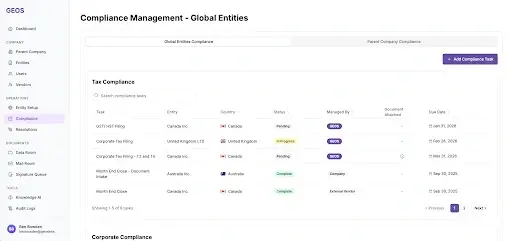
Once you go direct, you own everything the EOR used to absorb. Keeping the lights on from a compliance perspective means annual filings, resolutions for every director or address change, and a corporate secretary function in each country. Depending on the jurisdiction, that is a named individual or more of a spiritual role.
Do not fill mandatory roles with whoever is convenient. I have watched a client appoint a local employee as resident director to check a compliance box. When that employee left and wanted to shed the personal liability, removing them became a sticky legal situation. A professional third-party director from day one would have been cheaper and faster.
The larger problem arrives at entity three or four. Managing local accountants across several countries by email and spreadsheet is playing basketball with a blindfold on, moving on the shouts of teammates you cannot see. We onboarded a company with more than 30 entities whose local firms were invoicing each subsidiary directly. The parent had lost all visibility into what compliance cost, and untangling years of backdated work and unverified invoices took a dedicated full-time hire working alongside our team.
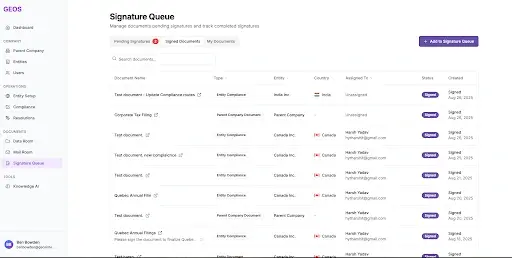
That is the problem GEOS was built to solve. We have mapped setup and ongoing compliance in more than 80 countries. The platform gives you one view of every entity, deadline and vendor, and it requires a receipt when a task is marked complete. It is vendor-agnostic on purpose: keep the partners who perform, replace the ones who do not, and hold all of it under one umbrella.
Why Should Companies Transition to Local Entities Before Reaching Employer of Record Compliance Limits?

EOR is the right tool for the beginning of your expansion journey. Your own entity is the right tool once you have reached critical mass, or once your reason for being in a country involves more than employing a few people.
The mistake is waiting for a trigger. By the time a permanent establishment inquiry lands, an AUG deadline passes or a government contract requires a counterparty you do not have, you are 12 months behind. Start the entity conversation when you can see the headcount trajectory. A B-plus plan executed today beats an A-plus plan executed next year.
Frequently Asked Questions
How does an EOR restrict issuing equity to foreign key hires?
An EOR heavily complicates equity distribution. Because the executive is legally employed by a third-party vendor, standard stock option grants often trigger immediate, punitive tax liabilities. You cannot seamlessly distribute parent-company equity without your own local entity, making it virtually impossible to incentivize elite global talent.
Does relying on an EOR impact valuation during an M&A due diligence?
Yes. Acquirers view heavy EOR footprints as unresolved operational liabilities. It signals core IP is entangled with vendors and flags hidden permanent establishment tax exposures. Serious buyers will discount your valuation to account for the heavy lifting required to untangle those indirect employment contracts.
Can we claim local R&D tax credits for a remote engineering team on an EOR?
No. Government innovation incentives require you to have local corporate substance. Because the EOR vendor is the legal employer incurring the payroll costs, you cannot claim lucrative R&D tax credits in most jurisdictions. You are leaving free capital on the table by refusing to incorporate.
Why can’t I just buy a dormant shelf company to bypass the local incorporation timeline?
Buying a shelf company rarely saves time. Changing the ultimate beneficial owner (UBO) and directors triggers the exact same KYC, notarization, and apostille requirements as a fresh incorporation. You will still wait months to open a corporate bank account, but now with added historical compliance liabilities.
Does an EOR prevent me from immediately firing an underperforming country manager?
Absolutely. You do not hold the employment contract – the EOR does. Even if you demand a swift exit, the EOR will block the termination until local labor laws are strictly met, often forcing you through months of performance improvement plans to shield themselves from wrongful dismissal lawsuits.