
The most dangerous number in a foreign expansion is the one your local lawyer quotes, precisely because it is true.
Three weeks in France describes government registry processing, the one phase he can see from his own desk. The documents that must clear before it and the bank account that must open after it – the parts that decide whether the entity can ever hire, invoice, or pay a tax authority – never appear on his invoice.
Brazil registers a company in 23 hours and remains among the hardest countries on earth to enter. Accept that registry number as your finish line and you have bought a certificate that cannot pay a soul, with the bill arriving later as missed start dates and surprise fees.
Key Takeaways
- Brazil’s government dashboard reports a 23-hour company registry time, but this figure excludes the municipal, state, and operating licenses required to hire employees or pay local taxes.
- The EU online company formation directive mandates a five- to ten-day incorporation processing time, but this timeline only begins after founders complete all prerequisite notarization and document formalities.
- Opening a corporate bank account in Spain or Mexico requires identification and valid proof of address for any beneficial owner holding 25% or more of the parent company.
- While the UK registers private limited companies within 24 hours, Companies House requires mandatory identity verification for all directors and people with significant control starting November 18, 2025.
- Companies operating in Mexico cannot use FinTech accounts for social security because the IMSS authority restricts SIPARE system payments to seven approved traditional banks.
- Registering a standard GmbH in Germany requires foreign founders to deposit at least half of the €25,000 minimum share capital before submitting the registry application.
- Foreign companies incorporating in Ireland without a resident director in the European Economic Area must secure a Section 137 bond that remains effective for at least two years.
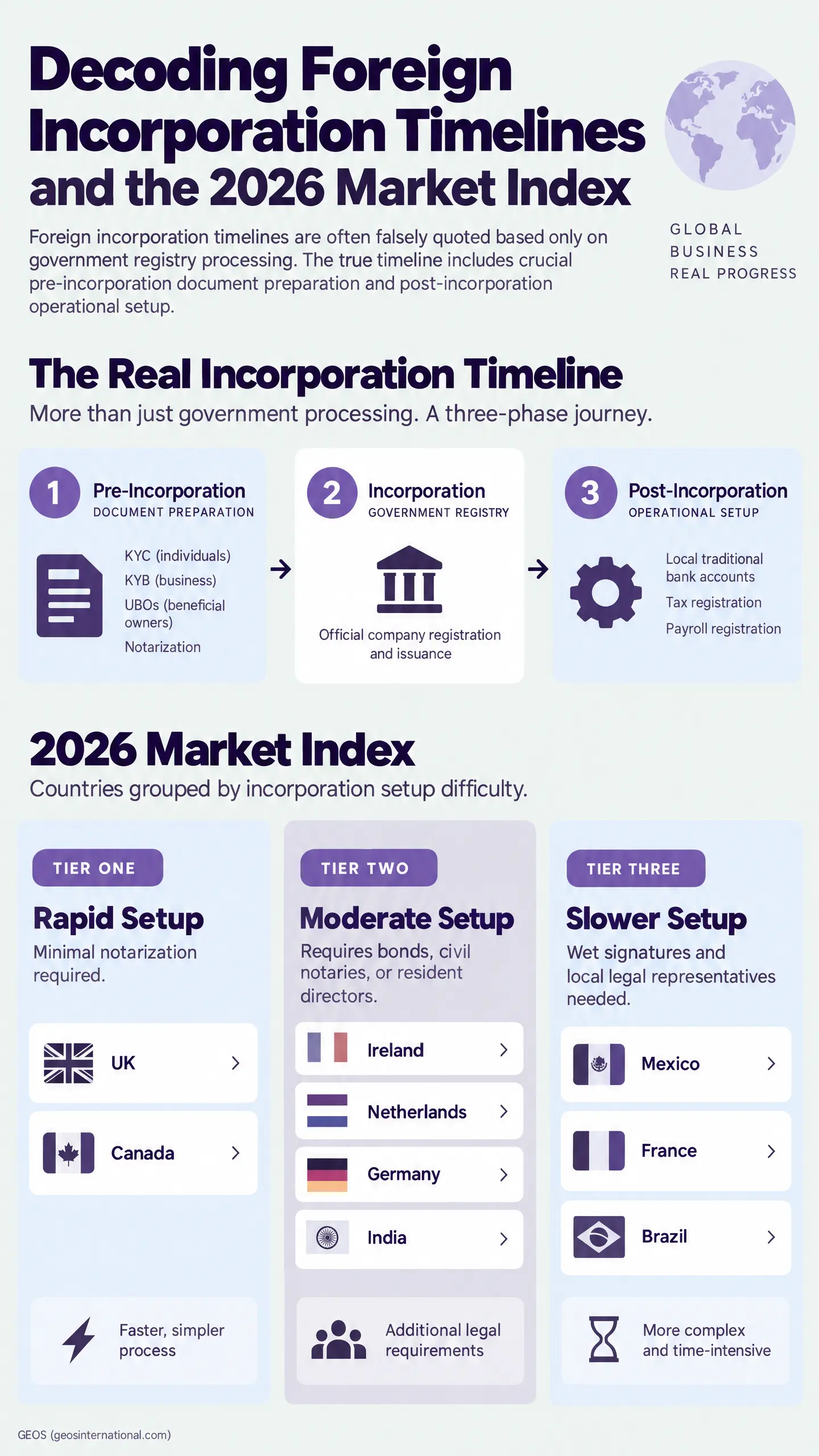
Why Do Foreign Company Incorporation Timeline Quotes Exclude Document Preparation and Operational Setup?

Timelines are wrongfully quoted almost every time, and dishonesty is rarely the reason. A local provider quoting three weeks in France is describing government processing, from the day the application is lodged to the day the registry approves it. Most single-market lawyers and accountants have never onboarded a foreign parent company. They simply do not see the work sitting on either side of their desk.
The EU wrote this blind spot into law. Its own online company formation directive requires member states to complete a qualifying online incorporation within five working days for template filings and ten in other cases. That clock only starts once every document, formality, and payment is already complete. Registry time is the fast part.
Brazil shows the same gap in reverse. The government’s own dashboard reports an average company-opening time of 23 hours, and I still place Brazil among the hardest countries to enter. The figure excludes municipal and state registrations and operating licenses. Those exclusions are the operational layer, and the operational layer is what you are actually buying.
An entity can hold a certificate of incorporation and still do nothing. Without a tax ID, a payroll registration, a social security enrollment, and a bank account that clears local payments, it remains dormant. Founders who accept the registry number get hooked into a false promise, and the bill arrives later as missed start dates and surprise fees.
The first platform dedicated to streamlining entity setup and management.
How Does the Initial Document Phase Determine Foreign Company Incorporation Timelines?
In our experience at GEOS, the initial part of an incorporation is by far the biggest indication of how quickly the whole project will go. Every country asks for a different set of corporate, director, and ultimate beneficial owner (UBO) documents. Each runs its own mix of KYC and KYB checks, meaning know-your-customer and know-your-business. Each also demands a different combination of those documents be notarized, apostilled, couriered, and translated locally. An apostille is the certification that makes a notarized document valid abroad.
Get this phase right and the incorporation date is usually hit, barring government delays. Plainly speaking, you cannot skip it, because in most countries the application cannot be lodged until the package is complete. Navigating this is where the biggest variance of how long it takes lives.
Two failure modes account for most of the slippage I see. The first is being laissez-faire about notarization. In strict jurisdictions a public notary will review the package and reject it on the spot, or quietly elongate the process. The second is the UBO problem. EU anti-money laundering rules define a beneficial owner as any natural person holding 25% or more of the parent, and opening a share capital account in Spain or a bank account in Mexico requires identification from each of them. Silent investors with no operational role find it jarring to be asked for a passport and a home utility bill, and they stall.
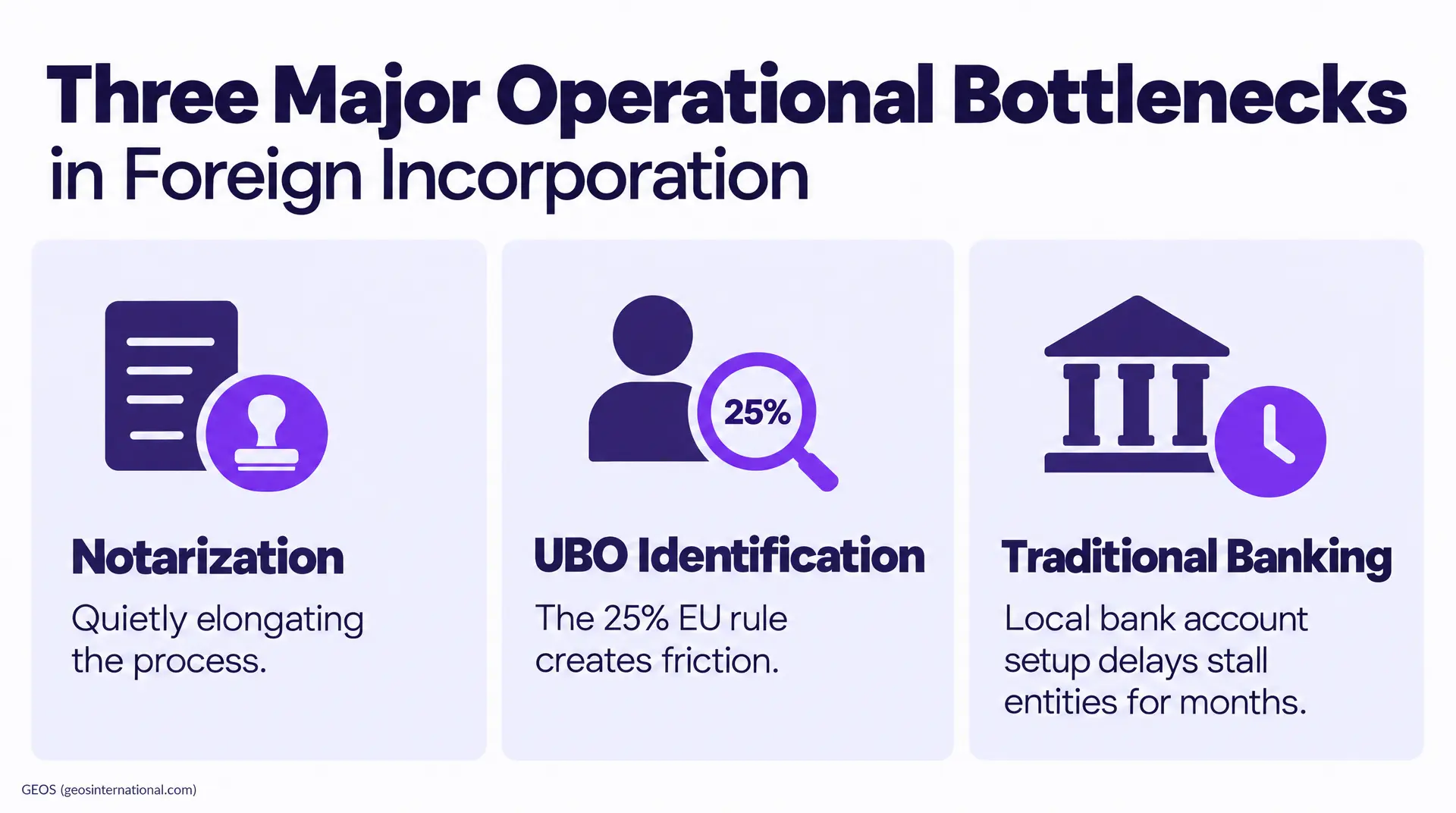
Every one of those requirements originates with a local bank or registry, and no entity gets set up without them. Proof of address is the document that expires most often, since most authorities enforce a 60- to 90-day validity window, and one slow investor can force the entire collection to restart. That is why I make sure the client’s executive team is armed with the right messaging before anyone is asked for anything.
The drip-feed style of most local accountants compounds all of this. The pattern runs “here is the next step, I need 10 documents,” then “now notarize two of the 10,” then “now apostille the rest.” Every step is a surprise. Mapping the full sequence upfront lets you hit steps concurrently instead of learning what each one means after it lands in your inbox.
How Does Local Bank Account Setup Determine the Operational Status of Foreign Subsidiaries?

The post-incorporation phase is where a project that looks finished stalls for months. Foreign subsidiaries need the right rail to make social security and tax payments, and a convenient FinTech account often does not have it. An entity that cannot land its share capital deposit or run payroll starts collecting compliance snags and fines almost immediately.
We had a client’s setup in India go quiet after an initially responsive local bank simply stopped answering. We restarted the application with a new bank, and until it cleared the client could not deposit share capital or run local payroll. In Germany, a US-based client was rejected because the traditional bank would not operate without EU-citizen directors, so we sourced an alternative partner that works with foreign-owned companies. Neither delay appeared in anyone’s original quote.
The tempting shortcut is a patchwork payroll while the bank application clears. Where mandatory pension or social security payments are involved, that shortcut creates compliance problems that follow the entity for years. The sounder pattern is hybrid banking: a FinTech account for daily money movement and a traditional local account strictly for tax and social contributions.
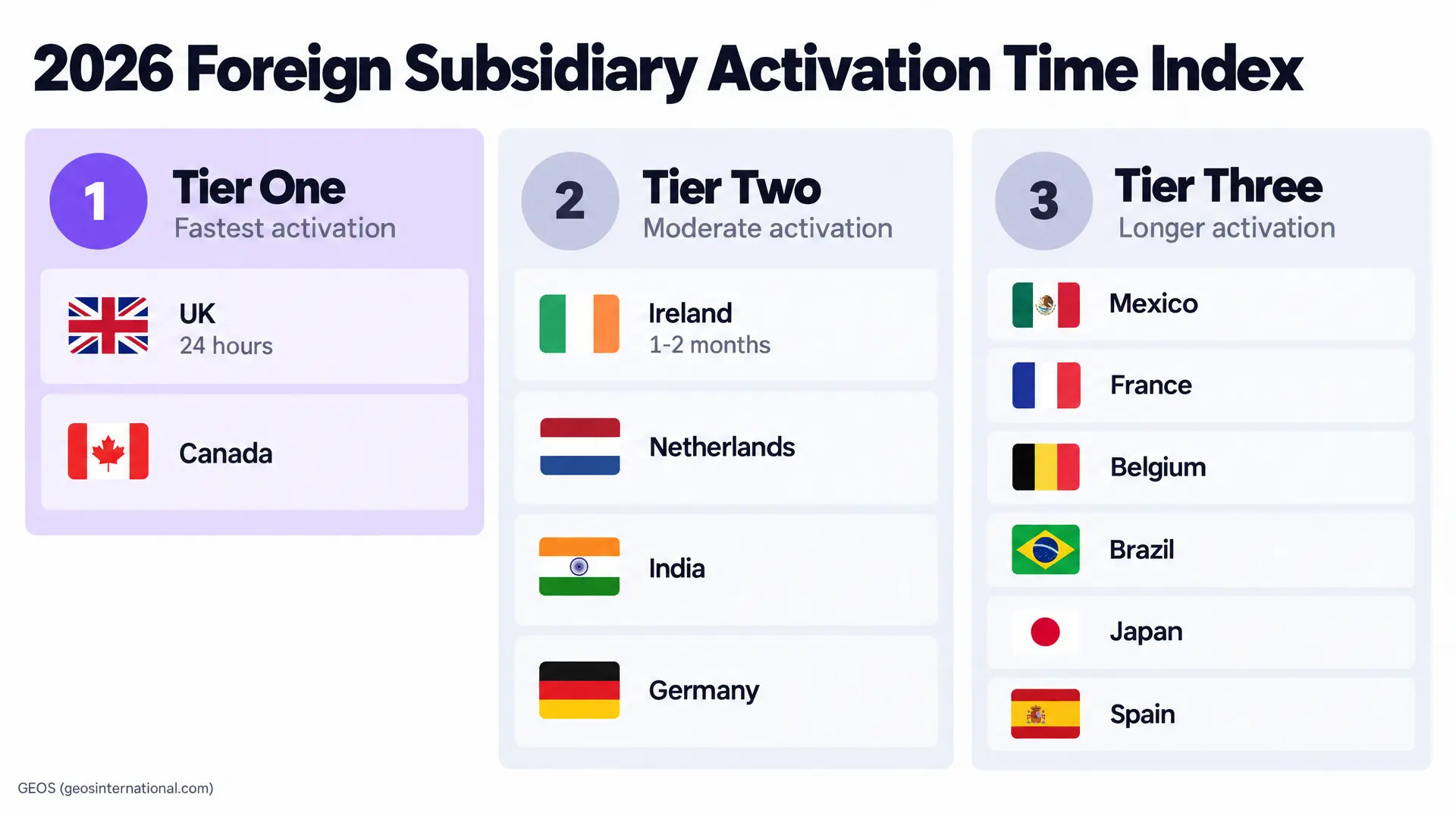
What Are the Difficulty Tiers in the 2026 Foreign Subsidiary Activation Time Index?
Our published Global Subsidiary Index scores 50 countries across 40+ criteria. Internally we also sort countries into three difficulty tiers for foreign-owned setup, built from hundreds of meetings I have personally held with local tax and legal experts in the jurisdictions we serve. What follows is the timeline view of that framework.
Which Countries Qualify as Tier One in the 2026 Foreign Subsidiary Activation Time Index?

The UK stands alone. Companies House will usually have a private limited company registered within 24 hours, with no wet signatures, notarization, or apostilles anywhere in the process. Revolut can often run the entity’s finances end to end. If you need a Barclays or ING account, we appoint a UK-resident nominee director for three to six months. A power of attorney strips their control, they open the account, and we lodge resolutions to remove them once it is live.
The new UK hurdle is identity verification. Companies House made it a legal requirement for directors and people with significant control from 18 November 2025 and expects six to seven million people to verify over the following year. Miss it and a good-standing entity quietly stops being one.
Canada is nearly as fast to form, again with nothing to notarize or apostille. Incorporate provincially, in Ontario for example. Federal rules still require 25% resident Canadian directors, and a board of fewer than four must include at least one Canadian. The operational catch is the Canada Revenue Agency, which states that non-residents do not have the same access to its online portals. Appoint an authorized Canadian representative with a Social Insurance Number, or plan on phone trees and long lag times. Expanding across provinces later means separate extra-provincial registrations, and Quebec runs its own revenue agency entirely.
Which Countries Are Classified as Tier Two in the 2026 Foreign Subsidiary Activation Time Index?

Ireland forms in one to two months. I tell founders to plan for two to three before the entity is operational, once VAT registration and banking are in. With no EEA-resident director, the CRO requires a Section 137 bond, effective from incorporation and running at least two years. Take the bond over a nominee director. It is cheaper and cleaner from a governance perspective. Budget for a physical registered office as well, since a PO box is not accepted.
The Netherlands is a tier two out of three in our framework. A BV cannot be formed without a civil-law notary, and that mandatory review is where foreign applicants lose weeks. Post-incorporation corporate tax filings are complex enough to warrant a specialized local CPA and a traditional bank account for tax and social security payments.
India and Germany sit here for the same reason: the legal step is manageable, the surrounding steps are not. India’s Companies Act requires at least one director present in the country for 182 days in the financial year, plus a traditional bank account on Indian rails before payroll is legitimate. Provident fund enrollment applies at 20 or more employees, a threshold companies building a global command center reach quickly.
Germany’s GmbH is bottlenecked by couriering notarized and apostilled parent documents and by the €25,000 share capital deposit. Under Germany’s limited liability companies act, at least half of that minimum must be paid in before registration, while a UG can start below the threshold by setting aside a quarter of annual surplus. Germany also puts the EOR decision on a fixed calendar. The AUG caps supply of the same worker to the same hirer at 18 consecutive months, and prior assignments count fully unless the gap between them exceeds three months.
Which Countries Qualify as Tier Three in the 2026 Foreign Subsidiary Activation Time Index?

Mexico requires couriering notarized, apostilled, and translated documents and appointing a local legal representative who can wet sign employment contracts and face tax officials. Companies routinely get deep into the process before discovering they cannot pay social security without that representative in place. IMSS also lists just seven traditional banks for its SIPARE payment system, so FinTech workarounds fail here. Payroll is then calculated more like a day rate than an annual salary.
France and Belgium are materially slower and more expensive than Ireland or Eastern Europe for building a European team, and Brazil and Japan belong beside them. Spain’s mercantile registry pauses applications to request more paperwork, and local communication there predictably drops off in August and December. Poland requires certified electronic signatures after incorporation. In any of these countries, if the goal is one to three hires, use an EOR and revisit the entity once you have reached critical mass.
What Should Founders Evaluate Before Committing to a Foreign Subsidiary Incorporation Timeline?

Three questions come before any quote from me: where you want to set up, why and for what reason, and what infrastructure, resources, and partners already exist to support it. The answers can shift the equation. Needing to import or export goods, or to contract with a defense buyer in the US or Canada, pushes toward an entity earlier than headcount math alone would.
The founders most likely to stall are running two or three setups at once. The compounding variance of ad-hoc KYC video calls, wet signatures, and uniquely formatted proof-of-address documents overwhelms even disciplined executives. Without one view of every step, you are playing with a blindfold and taking direction from whoever emailed last. That is why every country’s step-by-step breakdown lives inside the GEOS platform rather than in an inbox. Do not pause Europe for EU-Inc either. It remains an announcement without an operational path.
A subsidiary setup has a beginning, a middle, and an end, and the quoted number almost always describes the middle. Start the document phase this week. A B-plus plan executed today beats an A-plus plan that assumes the notary will cooperate.
Frequently Asked Questions
Will the UK’s new identity verification laws break our 24-hour setup timeline?
It will if your executives delay. From 18 November 2025, directors must legally verify their identities. While initial registry time remains fast, failing this mandatory step quietly strips your new foreign subsidiary of its good standing, immediately halting operational capabilities and regional enterprise sales.
How long can we rely on an EOR in Germany before being forced to incorporate?
You face a strict legal clock. Under AUG §1(1b), you cannot lease the same worker for more than 18 consecutive months. Gaps under three months do not reset this timeline. You must establish a GmbH and deposit the €25,000 capital before this expires to retain mission-critical talent.
Can an entirely foreign board directly manage Canadian corporate tax portals?
No, and this blindsides foreign founders. The CRA explicitly states that non-residents lack access to online portals due to security rules. Without an authorized Canadian representative holding a Social Insurance Number, your tax setup is relegated to analog phone trees, destroying your target incorporation timelines.
Why do fintech accounts fail to operationalize Mexican subsidiaries?
Because fintechs cannot pay the Mexican government. The local social security authority restricts payments strictly through its Nuevo SIPARE system, which currently only supports seven authorized banks. Without a traditional local bank account and a wet-signing legal representative, your entity remains dormant and cannot legally run payroll.
Can we shield our Series B investors from EU beneficial ownership disclosures?
Absolutely not. EU Anti-Money Laundering rules strictly define a UBO as any natural person holding 25% or more of shares. You cannot bypass this. Warn your board immediately: stalling on utility bills and passport scans for KYC checks is the fastest way to derail your foreign incorporation timelines.