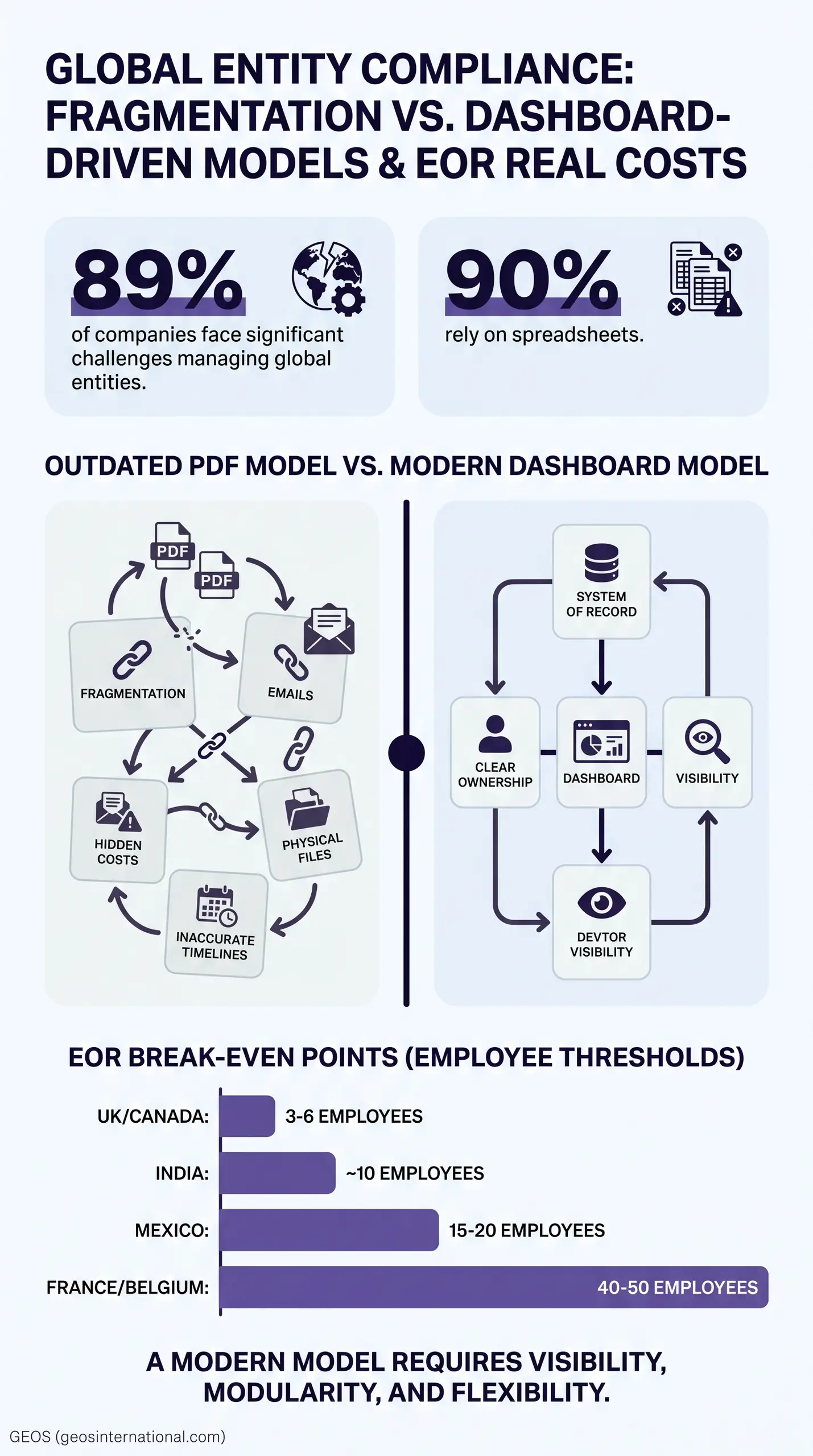
Global entity compliance still operates with a 1990s client experience. Core information is often received piecemeal by email or phone calls. Important records sit in PDFs. Physical mail arrives at a registered address, then gets forwarded through several people before anyone decides what it means.
I have seen this from both sides. At an EOR startup, I was part of an internal team helping set up the company’s own entities globally. We used a Big Four firm. The expertise was there. The experience was fragmented by region, rooted in manual processes, and expensive. The client still had to coordinate multiple teams and re-share the same parent company information country by country.
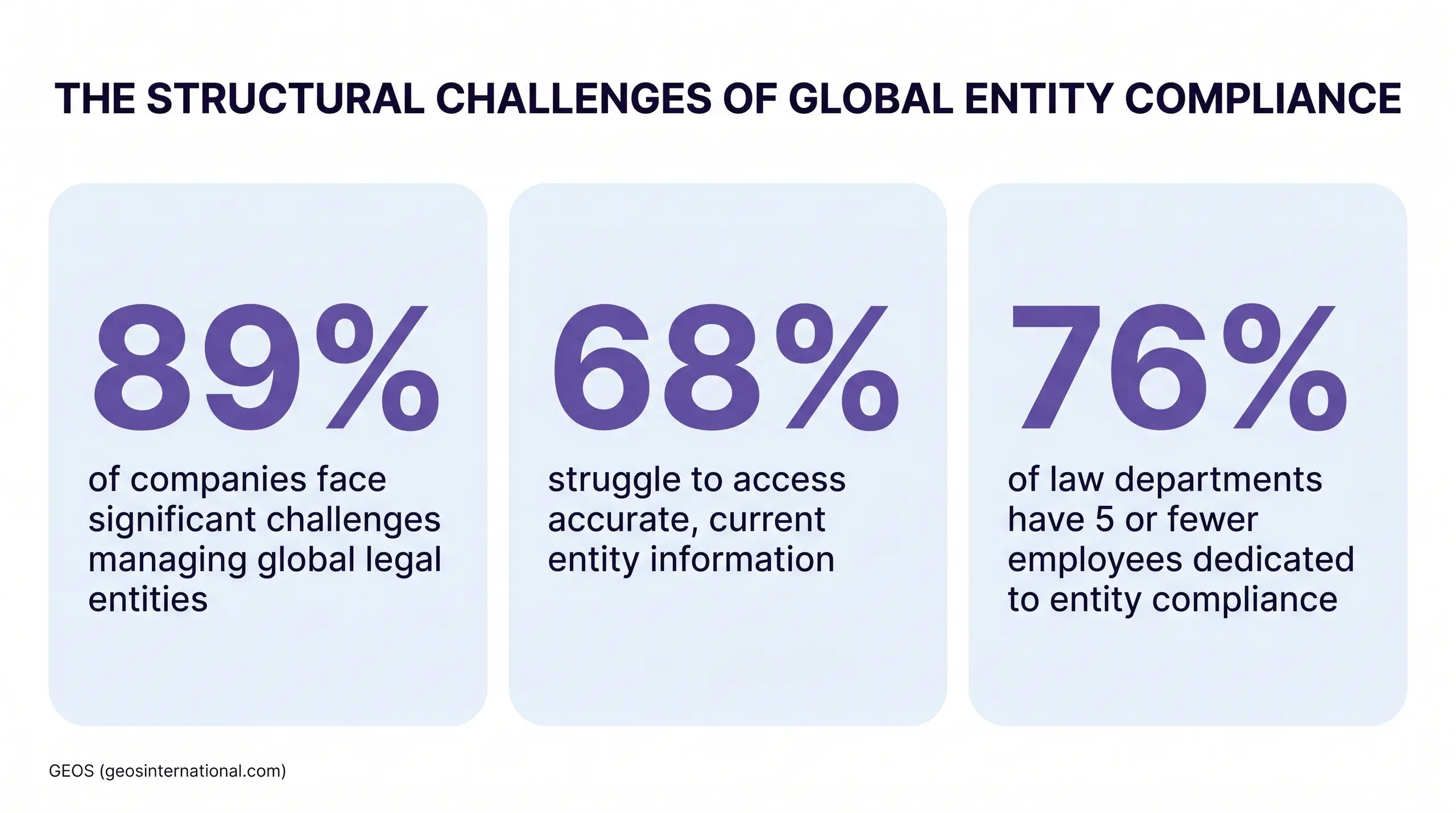
For me, entity management should be an act of mutual problem solving between the finance team and its providers. That requires visibility. Many companies still do not have it. EY found that 89% of companies face significant challenges managing their global legal entities with current systems, while 68% struggle to access accurate, current entity information. EY also found that 76% of law departments have five or fewer employees dedicated to entity compliance management. That is a thin layer of capacity for a process with this much variance across jurisdictions.
The Real Cost of the PDF Model
Fragmentation Hides Accountability

The first problem is fragmentation. A company may work with a local accountant in Mexico, a law firm in Germany, a payroll partner in India, and a larger global provider for annual filings elsewhere. EY notes that about two-thirds of organizations rely on multiple service providers to manage their entities. In practice, that means more invoices, more handoffs, and more chances for a deadline or registration to fall through the cracks.
The second problem is information asymmetry. Many parent company teams only know compliance, finance, and tax in their home country. Everything else becomes a black box in terms of the steps that need to be taken. Providers hold the process knowledge. The client receives invoices and updates, but not a coherent map of the work.
I have worked with companies that had very little visibility into what was being done monthly, quarterly, and annually to keep foreign entities in good standing. One of the clearest examples was a client with more than 30 international entities. Local firms were invoicing subsidiaries directly. The company had effectively lost sight of its total compliance cost base. Untangling that required a dedicated full-time hire on the client side working alongside us.
We also remediated a Peruvian entity that had fallen out of good standing because a departed employee was still listed as the legally required second shareholder. That issue had been sitting quietly in the background. It only became obvious once the entity records and compliance requirements were reviewed centrally.
Timelines Are Often Quoted Incorrectly
The industry also has a bad habit of quoting incorporation timelines too narrowly. A local provider may quote only the government processing window. That is one slice of the process. It is rarely the whole process.
Incorporation timelines are wrongfully quoted almost every time because they often exclude client intake, document collection, UBO verification, notarization, apostilles, translation, couriering, post-incorporation tax registrations, payroll setup, and bank KYB. In some countries, the bank account for the share capital deposit certificate is harder than the incorporation itself.
This is where PDFs and email chains create real operational drag. They separate the steps. The company loses the full workflow.
What a Dashboard Should Actually Do
The first platform dedicated to streamlining entity setup and management.
A modern dashboard should function as the system of record for the global entity footprint. Every entity should have a clear page showing its core attributes, directors, shareholders, registrations, deadlines, documents, and open tasks. Ownership should be visible as well. The finance team should know which tasks sit with internal staff, which sit with outside counsel, and which sit with a local tax or payroll provider.
My view is simple: every single task should be visible and tracked on a dashboard, with clear ownership, status updates, and notifications. That applies during setup. It also applies after the entity is live.
This is where technology belongs in the compliance stack. Technology should be an enabler. It should act as more of a connector between the client, the service provider, and local experts. It should centralize documents, push reminders, maintain an audit log, and surface critical notices quickly. If a tax notice arrives in a foreign market, it should move into the dashboard immediately and, where appropriate, into Slack.
The market data supports this shift. PwC reports that 64% of respondents get better visibility into risk from compliance technology, 53% identify issues faster, and 43% see productivity and cost benefits. At the same time, 90% of organizations still rely on spreadsheets for critical business data. Spreadsheets can organize a list. They do not provide workflow control across countries.
Even companies that already use entity management tools are often dissatisfied. EY found that 96% of organizations using entity management technology still report challenges. That tells me the issue is not the presence of software. The issue is whether the software mirrors the actual workflow in each jurisdiction.
At GEOS, that is what we focused on. We mapped setup and ongoing compliance in 80+ countries because there were no shortcuts. The hardest part to digitize was not the local filing itself. The hard part was documenting the process properly and making the variance from country to country visible to the client.
Where Automation Stops
Global compliance still has stubbornly analog requirements. Mexico often requires a local legal representative to wet sign employment contracts. Germany may require core documents to be notarized, apostilled, and couriered. India requires a traditional local bank account on Indian rails so TDS remittances and provident fund pension payments are recognized locally.
A good platform should organize those tasks and show when client participation is required. It should not pretend to replace local execution. That is where a lot of compliance technology loses credibility.
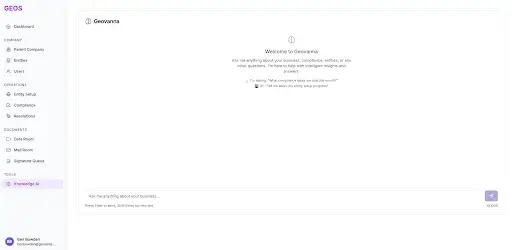
I take the same view on AI. GEOS includes an AI assistant, Geovanna, but it is intentionally limited. It can answer questions about a client’s entities and mapped infrastructure. It does not carry out incorporation work, submit applications, or navigate bespoke government portals. Local nuance changes too quickly. That last mile still requires human judgment and local expertise.
Dashboards Also Clarify the EOR Break-Even Point
This same visibility matters when a company is deciding whether to stay on an EOR or set up its own entity. The EOR model exists for good reasons. About 35% of companies had used an EOR for international hires by 2024. It is usually the fastest and most capital-efficient option when hiring the first few employees in a new country.
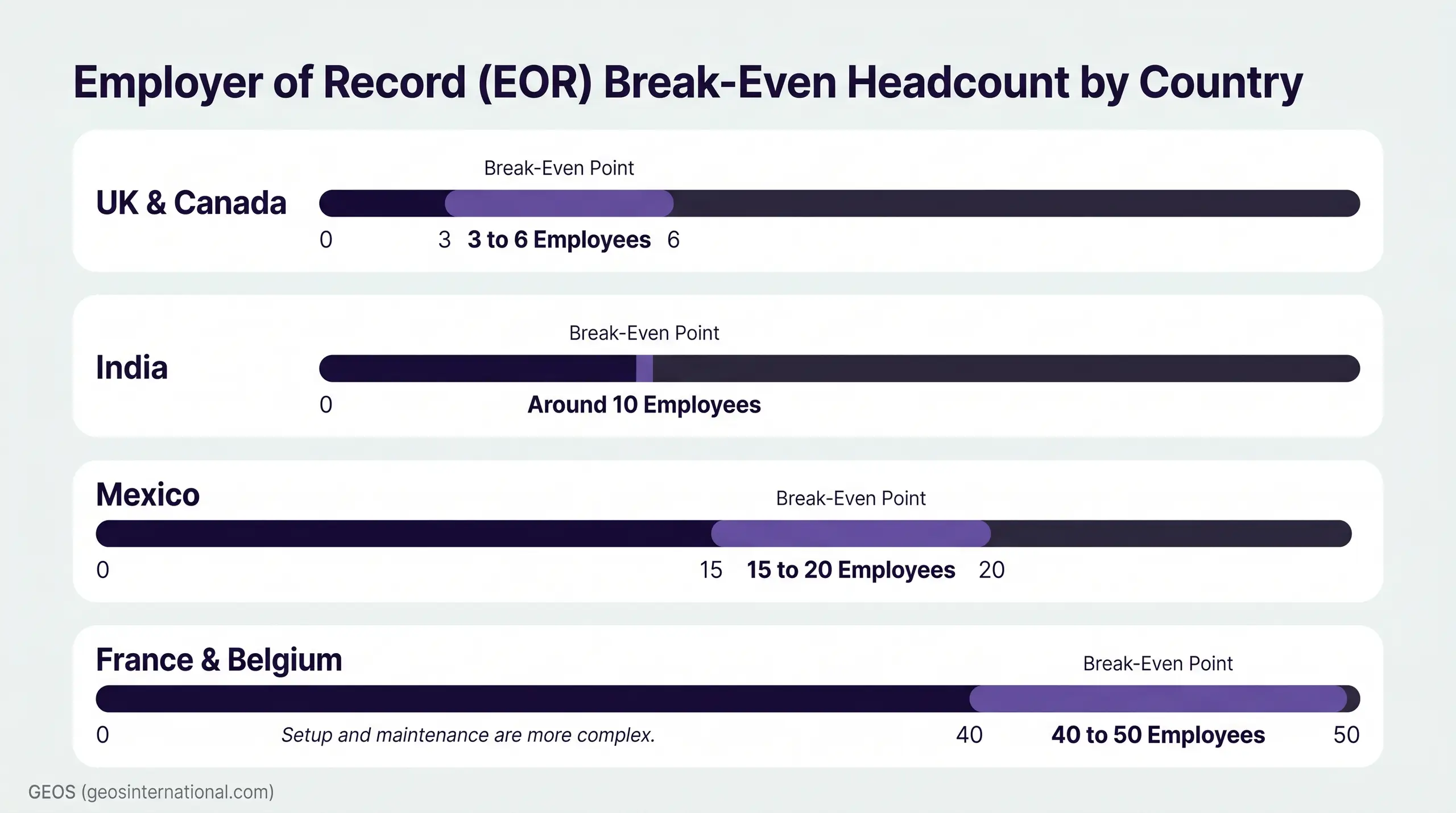
The pressure starts when the company has reached critical mass. At that point, monthly EOR fees, operational limits, and regulatory exposure change the math. In the UK or Canada, the break-even point for an owned entity is often around three to six employees. In India, it is often around 10, especially when a company plans to run a global command center. In Mexico, it is typically 15 to 20. In France or Belgium, it may be 40 to 50 because setup and maintenance are more complex.
Headcount is only one input. The need for local revenue recognition, tax optimization, direct contracting with enterprise or government customers, and more control over benefits and equity can all justify going direct and getting a better ROI. Permanent establishment risk also becomes more relevant as local teams grow. I have seen how an unsavory exit can cause a wrench in things and put a parent company under closer local scrutiny.
A Practical Operating Model

A modern compliance model needs visibility, modularity, and flexibility. Visibility comes from a dashboard that maps the work. Modularity means some entities may only need a system of record, while others need a deeper corporate secretarial service. Corporate secretarial work is the function keeping the lights on from a compliance perspective. It should not sit in the background as an invisible service.
At GEOS, we priced that on a per-entity basis because the need in each country is different. For some entities, a $49-per-month access tier is enough. Others require a more active managed layer. That structure gives finance teams more control over spend and scope.
Flexibility matters just as much. A company with a real global footprint will rarely find one provider that handles tax, legal, payroll, and compliance perfectly in every market. Strong local vendors should be retained. Underperforming vendors should be replaced. The platform should sit above that network and provide scrutiny, oversight, and clear task ownership.
We used that model to migrate a client with four global subsidiaries away from a Big Four firm by showing clearer controls and more transparent pricing. The point was better visibility and a more efficient operating structure.
Closing View
The industry needs a model that is less opaque and more accountable. PDFs, spreadsheets, and scattered email threads leave too much room for delay, duplication, and blind trust. A dashboard does not remove local complexity. It makes it manageable.
That is the shift I believe finance teams need. Clear records. Clear ownership. Predictable pricing. Local expertise fortified by technology, with the full process visible from beginning to end.