
Foreign subsidiary setup is one of the few growth projects where urgency and patience have to coexist. The board wants speed. The market wants local presence. Finance wants control. Local regulators want documents, signatures, and process.
I approach this the same way I approach conflict: as an act of mutual problem solving. The first job is to define what the business actually needs in-country. The second is to choose the lightest compliant infrastructure that can support it. That sounds simple, but it is where most expansion plans start to drift.
I have seen this from several sides. I spent time on the EOR and global payroll side. I was part of the internal task force setting up entities through a Big 4 firm. At GEOS, we have mapped entity setup and management workflows in 80+ countries, and I have personally sat through hundreds of meetings with local tax, legal, and accounting experts to understand where the real delays sit. The lesson is consistent. There are no shortcuts. There is only process, visibility, and local execution.
Why this matters in 2026
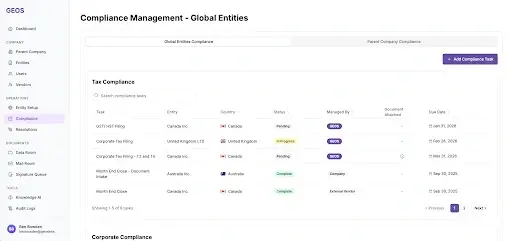
Global expansion is still accelerating. Recent survey data shows that 96% of companies plan to maintain or grow their international footprint. The same research found that 61% of in-house legal teams view local operational infrastructure as the biggest challenge. That gap between ambition and infrastructure is where most foreign subsidiary projects either mature or break down.
EOR has also become a standard part of the global hiring stack. Industry data shows that 41% of companies already use EOR services for international hires. Another analysis projects the market will grow from roughly $5.6 billion in 2025 to $10.46 billion by 2035. That growth makes sense. EOR solves a real problem.
The challenge in 2026 is timing. A company can stay too light for too long, or commit to an entity too early. Both mistakes are expensive. The right move depends on the business objective, the country, the headcount plan, and the level of control the company needs.
The checklist
1. Define the business objective before selecting the structure
In my experience, every serious expansion project should start with three questions. Which country? For what reason? What infrastructure or partners already exist to support the move?
The answer changes everything. A company that wants to hire three employees in France is dealing with a different decision from one that needs an EU hub, wants to reclaim taxes as an e-commerce business, needs a local commercial lease, plans to sign enterprise or government contracts, or wants to build its own internal global payroll infrastructure. The country may be the same. The path should not be.
This is why I push founders to think carefully about what they actually need to do in-country from a business perspective. There are often five, six, or seven ways to accomplish the goal. A local sales presence can sometimes be built without immediately triggering VAT or requiring a full entity. A market test may justify independent contractors or an EOR first. An entity is a bigger commitment. It should usually be supported by multiple concrete business reasons, not just momentum.
2. Decide whether EOR is still the right tool
I am not anti-EOR. EOR is extremely useful, especially at the beginning of a company’s global expansion journey. It is a much safer compliance strategy than hiring people as contractors and treating them as full-time employees. It also reduces setup time and local administration when headcount is still low.
The economics are real as well. Many providers charge $299 to $800 per employee per month, depending on the country and scope. That is often a reasonable trade when the alternative is standing up an entity, bank account, payroll, benefits, and local employment infrastructure for a very small team.
The issue starts when the company has reached critical mass in a country. In easier jurisdictions such as the UK or Canada, the break-even point can be surprisingly low. I would look closely once the business is in the three-to-six-employee range. In more complex countries such as France or Belgium, the break-even can sit much later, sometimes around 40 to 50 employees. More broadly, once a company is in the five-to-15-employee range in one country, the entity discussion should become active.
At that point, cost is only one factor. Control starts to matter more. A company with its own entity has much better flexibility over benefits, HR rules, equity, and local contracting. The permanent establishment question also becomes more relevant. EOR is not a magic shield. It is a shared liability model. When there is an unsavory exit and local officials begin to look closely, a growing team employed through rented infrastructure can draw the wrong kind of attention.
3. Choose the country based on operating reality
Founders often focus on market size, tax headlines, or where they know someone locally. That is understandable. It is also incomplete.
The more useful question is operational. How difficult and expensive will it be to set up and maintain the exact infrastructure the business needs in that country? If the objective is hiring, then the quality of local employment infrastructure matters. If the objective is tax optimization, local tax rules and treaty positions matter. If the objective is revenue, the company may need a local establishment for reputation, contracting, or enterprise procurement.
This is one reason we built the Global Subsidiary Index at GEOS. We wanted a more practical way to compare countries across political stability, economic conditions, banking access, setup complexity, maintenance burden, and talent factors. In Europe, for example, France can make sense for the right reason. It is still a very different operating project from Ireland or some Eastern European markets. The better market is not always the one that looks easiest on a slide. The right market is the one that aligns with the actual business objective and the team’s ability to support it.
4. Separate incorporation from activation
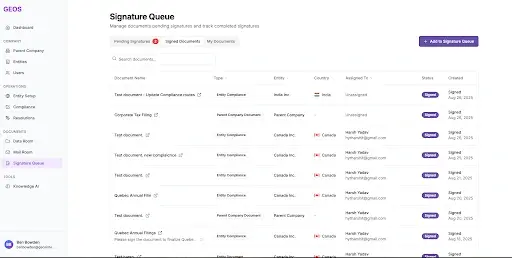
This is where timelines usually get distorted. Incorporation timelines are wrongfully quoted almost every time because they often describe only one slice of the process. They refer to the filing window. They do not describe the full path to an operational entity.
Singapore is a good example. The Economic Development Board notes that a business can be incorporated online in about 15 minutes. That is a real advantage. It is also only one part of the project. A foreign-owned subsidiary still needs the right local structure, supporting documents, downstream registrations, and often more.
The same issue comes up in the UK. Incorporation itself can often be completed in a couple days. In many other countries, the full path to activation is closer to four to twelve months. That longer timeline usually reflects the real work: intake, parent company documents, notarization, apostilles, translations, couriers, local appointments, banking, tax IDs, payroll registrations, and any licensing or employment infrastructure required after incorporation.
This distinction matters because a business cannot hire, invoice, run payroll, or operate locally with a shell alone. A quote that only covers government processing time is often a partial truth. That is how a company gets hooked into a false promise.
5. Treat intake as the first operational milestone
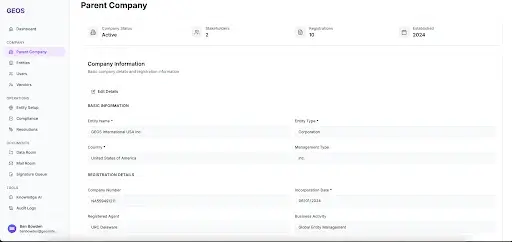
The biggest indicator of speed is not the local registry. It is the intake process.
Foreign subsidiary setup almost always requires parent company documents and information on major owners or ultimate beneficial owners. Those files need to be found, reviewed, and formatted correctly. In many cases they need to be certified, notarized, apostilled, translated, and couriered. Local officials can be very particular. Small issues with file quality or formatting can slow the entire project.
This is why I prefer to assign one internal owner early. That person should coordinate legal, finance, and leadership. The work is cross-functional from day one. If the team is surprised halfway through by how much document coordination is required, that is usually a failure of leadership and communication, not a surprise from the market.
A good setup process starts before any filing. It starts with document control, internal ownership, and realistic sequencing. A B-plus plan executed today usually beats waiting for a perfect internal kickoff that happens three weeks later.
6. Map the hidden blockers before they become delays
Most cross-border setup delays are knowable in advance. They are just not always presented clearly.
A strong setup plan should map the full workflow from the parent company side through local activation. In the Netherlands, for example, that may include confirming the parent company documents, determining the director structure, drafting local corporate documents, arranging notarization, apostilles, translations, and couriers, scheduling a public notary appointment, and then completing the follow-on registrations. Those steps are not exotic. They are simply hard to manage when they are revealed one by one.
Banking is another common blocker. If the jurisdiction requires a share capital deposit certificate, foreign bank KYB can be harder than the incorporation itself. A weak banking plan can stall the whole project. The same applies to registered address requirements, payroll registrations, and local tax accounts.
Then there is the local person requirement. Countries such as Singapore, Mexico, and many others may require a resident director, legal representative, or equivalent local individual. Those people are taking on personal liability. The annual fee attached to that service reflects a real legal burden.
Technology helps with visibility here, but local experts still matter. At GEOS, we digitize and map the process. Local legal, tax, and accounting professionals still handle the filings and local government interaction. That combination is what makes the process workable.
7. Choose a provider model that gives visibility, not just coverage
Two provider mistakes show up repeatedly. One is trying to cheap out on setting up an entity. The other is assuming a large global provider will remove operational friction.
A local lawyer or accountant is often the cheapest path. That can work for a single-country project. The downside is that the process is often a black box. Updates are received piecemeal by email or phone calls. Service levels vary. The provider usually works only in one country, so the model gets hard to scale. If more markets are added later, the internal team becomes the project manager across multiple disconnected vendors.
The large global firms bring a different set of tradeoffs. I understand why companies go that route. I have been on the client side of that experience with PwC. The expertise is real. The difficulty is the operating model. These firms are often fragmented by region, so the client still has to re-share parent company documents, restate context, and manage several teams across several countries. The cost is materially higher, and the technology layer is usually weak. In many cases, the client is paying for a structure that is bloated and stuck in the past. That model needs some refreshment.
My bias is straightforward. The right provider model should combine mapped workflow, centralized visibility, a single point of coordination, and local experts who can execute on the ground. That is the only way to move quickly without sacrificing control.
8. Plan post-incorporation work before incorporation begins
A new entity becomes valuable only when it can actually operate. That means post-incorporation work should be planned at the start, not treated as a second project.
For companies moving off EOR, I think about the transition in four phases. The first phase is entity setup. The second is employment setup, which includes tax registrations, local payroll, benefits, insurance, and local employment documentation. The third is transfer planning, where the company coordinates notice with the EOR, social insurance changes, work permit issues, deposit reconciliation, and employee communications. The fourth is the new-entity HR playbook, where first payroll runs and the ongoing local operating model is established.
The hardest part is usually continuity of employment. Employees are being asked to leave one legal arrangement and enter another. That process requires careful legal support and communication. It also requires decisions that the EOR cannot make on the company’s behalf, including how to handle seniority, vacation accruals, benefits continuity, and the drafting of the new employment contracts.
This is why I do not view EOR and entity setup as competing ideas. They sit on the same global expansion journey that has a beginning, middle and end. The real discipline is knowing when to transition.
9. Put ongoing management on a system of record
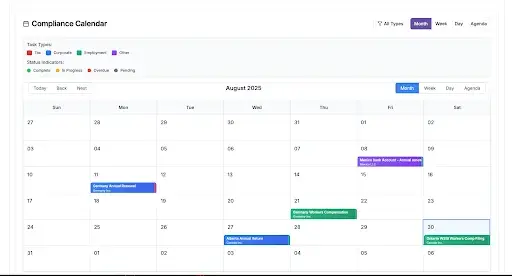
Entity setup gets most of the attention. Ongoing management is where many companies start to lose visibility.
Corporate secretarial work varies by country, but the core function is consistent. Someone has to keep the lights on from a compliance perspective. That includes annual filings, director changes, address updates, resolutions, and coordination with tax, payroll, and legal providers. These tasks cannot live in scattered inboxes or individual memory.
Without a centralized system, managing a global footprint feels like playing with a blindfold. Leadership hears updates from different teammates and local vendors, but no one has a complete view. A proper system of record should centralize entity data, documents, compliance calendars, notifications, and vendor ownership. It should also allow a company to keep good local partners where they exist and replace weak ones where they do not. That oversight layer matters.
At GEOS, we designed the platform to support exactly that model. Clients can bring their own local vendors or use our network. We map expected compliance tasks by country, assign ownership, and provide a visibility layer across the footprint. We also use Geovanna, our AI assistant, in a controlled way. It answers operational questions and helps clients navigate their own entity data. It does not execute incorporation or compliance tasks. In this kind of legal environment, those guardrails matter.
I have also seen what happens when this structure is missing. We had to audit and remediate a client’s Latin American entities after a traditional provider left missing compliance documents and inactive nominee directors behind. The first step was not growth. It was catching up on what had been missed. That work is avoidable when the system is built properly from the start.
Final thought
The 2026 expansion question is rarely whether a company should go global. For most growth-stage businesses, that decision has already been made. The real question is whether the company is using the right structure at the right stage, with enough process and visibility to move at speed.
The strongest subsidiary setups usually share the same pattern. The business objective is clear. Lighter options such as EOR or contractors are used where they make sense. The country is selected based on operating reality, not just market excitement. The activation timeline includes intake, banking, local registrations, and post-incorporation work. Ongoing management sits on a real system of record.
That is the lens I bring to this work at GEOS. We are bootstrapped, so I naturally prefer sustainable operating control over expensive, disorganized flag planting. In practice, that approach moves faster. It also leaves the company with infrastructure that can support hiring, revenue, and compliance long after the launch announcement is over.
Frequently Asked Questions
At what scale does renting EOR infrastructure become a misallocation of capital?
EORs typically charge $299 to $800 per employee monthly. Once you hit 10-15 localized hires, you are bleeding capital to rent infrastructure. A wholly owned foreign subsidiary eliminates these recurring margins, giving your board efficient capital deployment and total control over your global payroll infrastructure.
Can we close regional enterprise contracts using an EOR rather than a subsidiary?
No. Tier-1 enterprise procurement and government agencies rarely contract with rented entities. They demand the reputational and legal security of a permanent, locally established commercial presence. If your mandate is generating net new regional logos, relying on an EOR is a massive strategic bottleneck. Build the subsidiary.
Why can’t I just hire a cheap local lawyer to activate our subsidiary in three weeks?
Filing isn’t activation. A lawyer might incorporate you quickly, but 61% of teams cite local infrastructure as their biggest hurdle. Disconnected vendors won’t navigate UBO apostilles, foreign KYB, or tax registrations. You get a useless shell and zero operational visibility.
Is a wholly owned subsidiary required to distribute real equity to international talent?
Absolutely. You cannot cleanly issue parent-company equity or localized stock options through a third-party EOR because you aren’t the legal employer. If your growth strategy relies on locking in elite international engineers with serious equity upside, establishing your own private limited company is legally non-negotiable.
How do we prevent foreign bank KYB from derailing our aggressive market entry timeline?
Treat banking as the critical path, not an afterthought. You must compile pristine Ultimate Beneficial Owner (UBO) dossiers, apostilles, and parent company documents before filing anything. Without ruthless, centralized document control upfront, local compliance officers will easily stall your foreign subsidiary’s operational launch by several months.