When I speak with growth-stage founders about India, the interest is usually driven by scale. India is one of the few markets where a company can build a serious operating base for product, support, customer service, or broader back-office work. In 2023, India hosted about 1,580 Global Capability Centres. That number is projected to reach ~1,900 by 2025.
The market has depth. It already supports about 1.6 million people in the GCC segment alone. The sector is expected to reach roughly US$110 billion by 2030. For a technology or services scale-up, that is a serious operating case.
India also gets oversimplified.
The front end of incorporation has improved. The SPICe+ online form consolidates several key registrations into one application, and company name approval now runs through a 3-field web form. In Mumbai and Delhi, a pre-registration inspection is no longer required for Shops & Establishment approvals.
Those improvements matter. They do not make India a simple setup.
In my experience, India is one of the clearest examples of why founders need the full process upfront. The act of incorporating the company can be relatively straightforward. The difficult part sits around it and after it. There is the resident director requirement. There are parent company documents, notarization, apostille, and couriering. There is the power of attorney. Then there is the bank account, tax registration, provident fund, payroll, and the ongoing compliance layer. If that sequence arrives piecemeal, every step is a surprise.
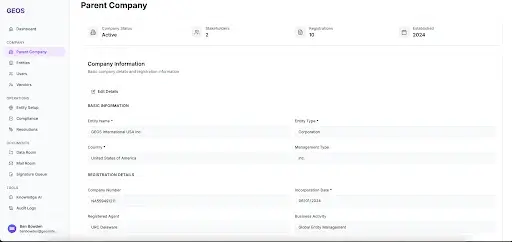
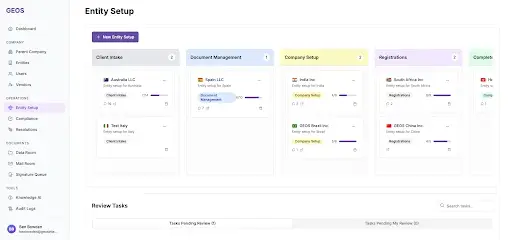
That is a big reason I co-founded GEOS. We spent hundreds of hours mapping entity setup and management across 80+ countries because the old model is still received piecemeal by email or phone calls. India is one of the markets where that lack of visibility shows up fast.
This is the checklist I use when I frame India for scale-ups.
Start with the business case, not the incorporation form
I look at entity setup as a multi step complex process. The structure has to solve a defined business problem. With India, that usually means one of a few things: building a Global Capability Centre, standing up a meaningful operating team, gaining direct control over employment, or creating the local infrastructure needed to scale payroll and benefits properly.
That first step matters because not every India plan should begin with a subsidiary. I am not anti-EOR. Employer of Record is often the right tool when a company is hiring its first few people in a new country. It is faster, lighter, and safer than trying to manage the same situation through misclassified contractors.
The equation changes once India headcount starts moving. In my view, India is often around the 10-employee mark where the owned-entity conversation becomes serious, especially if the company is building a GCC and expects larger growth. At that stage, the monthly EOR fees become harder to justify, control over benefits and equity matters more, and the permanent establishment discussion starts to become relevant. India is rarely a market where companies stay small for long once they decide to invest.
A global expansion journey has a beginning, middle, and end. EOR fits the beginning well. Direct ownership becomes more compelling once the company has reached critical mass and wants a permanent operating base.
The checklist
1. Confirm the scope of the India build
The first item on the checklist is clarity on what the India entity needs to do on day 1 in the first 12 months. Hiring three people creates one kind of setup. Building a 50-person support or engineering function creates another. A sales-led presence may need a different sequence from an internal operations hub.
This determines the rest of the project. The right legal, payroll, tax, and banking setup depends on the operating model. It also determines whether India should be launched now, staged through an EOR first, or paired with another market strategy.
2. Assign internal ownership immediately
The biggest hidden delay in global expansion is often internal. India is no different. Before the filing work starts, the parent company needs a clear owner for legal coordination, document collection, approvals, and banking participation.
I have seen global projects slow down because parent company directors or UBOs did not produce notarized identification or proof of address on time. In some cases, local applications can expire and the process has to restart. Founders tend to focus on the local provider. In practice, the intake side often determines the timeline.
3. Prepare the parent company document package early
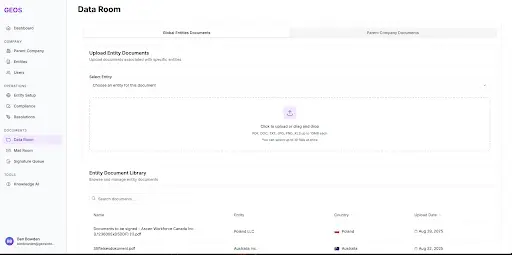
India requires the standard foreign-company intake work that founders often underestimate. Parent company documents need to be gathered. Relevant directors and beneficial owners need to provide personal documentation. Depending on the structure, those materials need to be certified, notarized, apostilled, and couriered.
This is the part that gets omitted in optimistic three-week quotes. The government filing might be fast once the package is ready. Getting the package ready is the project. If the documentation arrives in fragments, the process quickly starts to operate as if it is a black box.
4. Solve the resident director requirement at the beginning
India requires a resident director. This should be treated as a core workstream, not an administrative detail. If the parent company already has the right local person, that simplifies matters. If not, the company needs a vetted solution early in the process.
I am careful on this point because anyone stepping into a resident role is taking on real responsibility. Credible providers treat that accordingly. This is not a process to cheap out on.
5. Handle name reservation, powers of attorney, and incorporation documents in one lane
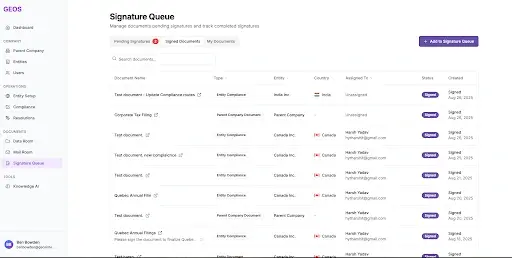
India has become more efficient at the filing layer. Company name reservation is faster than it used to be. The application is lighter, and the online system is better. That is useful progress.
The mistake is assuming that faster name approval means the whole setup is fast. The company still needs to review and approve powers of attorney and incorporation documents. Those steps still require proper legal handling, correct execution, and local follow-up. They should be managed as one coordinated lane rather than as disconnected tasks.
6. Treat incorporation as the midpoint, not the finish line
This is the biggest mindset shift I push in India. A company can be incorporated and still be far from operational. The real objective is not a certificate of incorporation. It is a functioning subsidiary that can receive funds, run payroll, make remittances properly, and employ people compliantly.
India timelines are wrongfully quoted almost every time because many quotes begin at the moment the local filing is ready to be lodged. They ignore the intake work before it and the registrations after it. For a scale-up under board pressure, that distinction matters. Time to activation is the metric that counts.
7. Prioritize the local bank account immediately
In many India projects, the bank account becomes the real bottleneck. Founders often assume this can wait until after incorporation. I do not view it that way. If the company plans to run payroll in India, it needs a traditional local bank account on the Indian rails, often with an institution such as ICICI or SCB.
That banking layer is critical because payroll in India is tied to local tax and pension remittances. The company needs the actual rails to make those payments in a way that is properly recognized by local officials. This is one reason the bank account can be harder than the incorporation itself. Foreign bank KYB is often the step that slows the whole project down.
8. Complete the post-incorporation tax and employment registrations
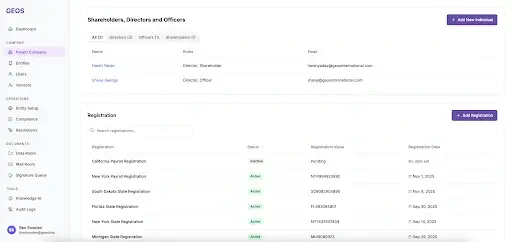
Once the entity exists, the next phase begins immediately. The company needs the registrations that allow it to operate in the real world. In India, that includes Tax Deducted at Source, the related e-filing and TRACES setup, and the provident fund framework for pension obligations.
Some of this has modernized. Employee benefit registrations can now be completed online, with no physical touch-point for EPF and ESIC registration through the Shram Suvidha portal. That helps. It does not remove the need for local banking, payroll coordination, and close attention to how each registration connects to the next.
9. Build payroll and the employment layer properly
A live company and a compliant employer are two different things. Once the registrations are in place, the company still needs the practical employment infrastructure. That includes payroll operations, local employment contracts, benefits setup, and internal rules for how the India entity will be managed.
This is usually where the value of direct ownership becomes clear. The company gains more control over benefits programs, HR policies, and equity strategy. That control is often one of the main reasons companies justify moving off an EOR once the India team has reached critical mass.
10. If there is an EOR transition, plan the employee move carefully
The hardest part of moving from an EOR to an owned entity is usually not the incorporation. It is the continuity of the employee relationship. People are moving from one local employment framework to another. That requires coordinated communication, legal drafting, payroll timing, and decisions around seniority, benefits, and accrued entitlements.
This is where many companies discover that their EOR provider cannot make the key decisions for them. The EOR can support parts of the offboarding process. It does not define the future employment model of the new entity. That still sits with the company and its advisors.
11. Put ongoing compliance into a system of record
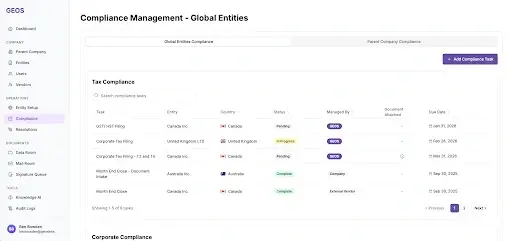
Once the India subsidiary is active, someone has to keep the lights on from a compliance perspective. That work includes annual filings, corporate updates, tax coordination, document management, notices from local authorities, and vendor oversight across payroll, tax, and legal.
This is where companies often lose visibility. They work with a local accountant, a payroll vendor, and perhaps a law firm. Information gets split across inboxes, PDFs, and subsidiary-level invoices. Over time, the setup starts to operate as a black box. For a company with multiple entities, that creates administrative overhead equal to several full-time jobs.
This is also where a vendor-agnostic system helps. It allows the parent team to keep one source of truth while still onboarding existing tax, payroll, or legal partners. In my view, that scrutiny layer matters because it gives the company a way to compare what local vendors are doing against a mapped compliance standard instead of putting blind trust into the local vendors.
What usually drives the timeline
When founders say they need India live in 60 days, I usually break the project into the steps that actually control the clock. The first is document readiness. The second is resident director planning. The third is bank account participation. The local filing itself is important, but it is rarely the only critical path.
This is why I prefer to present the entire process at the beginning. It lowers frustration. It also shows exactly where the parent company will need to participate, especially during banking. In India, that visibility matters because so much of the project sits in the handoff points between legal work, payroll setup, tax registration, and local banking.
At GEOS, that is how we manage it. We map the full sequence upfront and show clients where the dependencies sit. India becomes much more manageable when the work is organized as a process map rather than a string of surprises.
Avoid the two common provider mistakes
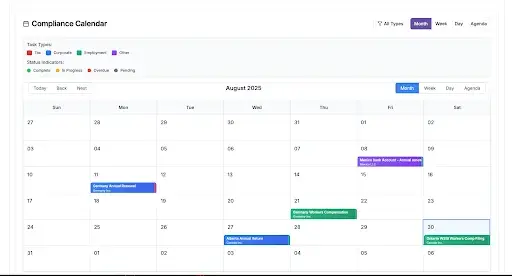
The first mistake is over-rotating toward the cheapest local quote. A low hourly rate can look efficient. In practice, that quote often covers a narrow slice of the work. The intake effort, banking friction, post-incorporation registrations, and ongoing compliance layer show up later. The process becomes reactive, and the parent team ends up playing catch up in terms of what was missed.
There is also a structural issue with hourly billing. It can incentivize dependency rather than proactive efficiency. The parent team often does not know what it does not know in every jurisdiction, which makes it easy to become reliant on a provider that only shares information when asked.
The second mistake is assuming a Big Four logo removes that risk. My view on this sharpened when I was part of an internal task force at Borderless AI setting up the company’s own entities globally with a Big Four partner. The issue was not competence. The issue was fragmentation. The teams were separated by region, context had to be repeated, and the operating overhead was significant. That model can offer safety, but growth-stage companies are often paying for that glut.
The better model is straightforward. Map the full process end to end. Assign ownership clearly. Use local experts where local execution is required. Keep the entire workflow visible in one place.
AI can support the process, but it cannot run the process
There is a lot of noise around AI fully automating global compliance. India is a useful reality check. Key parts of the setup still require mandatory human intervention. Documents still need notarization and apostille. Incorporation documents still need drafting and review. Local applications still need follow-up. Bank account setup still runs through proper banking channels. Much of the work still sits inside bespoke government portals.
That is why I keep AI in an assistive role. At GEOS, our AI helps clients navigate information and answer questions. It does not execute incorporation or compliance tasks. In a jurisdiction like India, that guardrail is necessary.
Final view
India deserves serious consideration from scale-ups that want a durable operating base. The market has talent, depth, and a strong track record as a GCC hub. The filing layer has improved, and some registrations are more efficient than they used to be.
The setup still needs to be treated with discipline. The companies that execute well in India do a few things consistently. They define the business objective clearly. They decide whether the entity is justified now or after a short EOR phase. They move fast on documents and resident director planning. They treat the bank account and post-incorporation registrations as core workstreams. Then they build the compliance layer that keeps the entity healthy after launch.
That approach is less dramatic than a three-week promise from a local lawyer. It is far more reliable. I would still take a B-plus plan executed today over an A-plus promise next week.
Frequently Asked Questions
Why are scale-ups aggressively building Global Capability Centres (GCCs) in India?
It is a pure scale play. India hosted roughly 1,580 GCCs in 2023, projected to hit 2,400 by 2030. For hyper-growth tech companies, tapping into a sector expected to reach US$110 billion by 2030 provides the operational depth an EOR simply cannot support.
Why do local legal vendors promise a three-week subsidiary setup in India?
They are quoting the front-end government filing, completely ignoring the heavy lifting. Actual time to activation – gathering notarized UBO docs, apostilles, foreign bank KYB, and tax registrations – takes months. Expecting a three-week launch is playing basketball with a blindfold. Plan for reality, not the fastest quote.
Can we issue parent-company equity directly to our Indian subsidiary team?
Yes, and this is exactly why founders graduate from EORs. Direct ownership allows you to legally implement Employee Stock Ownership Plans (ESOPs) tied to your parent entity. It gives you total control over global equity distribution, which is virtually impossible to execute cleanly under rented infrastructure.
Do we need physical office inspections to activate our local payroll and benefits?
Not anymore. India’s process is highly digitized. Employee benefit registrations run through the Shram Suvidha portal with absolutely zero physical touch-points. Even major hubs like Mumbai and Delhi have eliminated pre-registration inspections for Shops & Establishment approvals. It is fast, if managed correctly.
What is the fastest way to deploy Series B capital into our new Indian subsidiary?
You capitalize the entity via Foreign Direct Investment (FDI) under the automatic route. The real bottleneck is not the transfer. It is the local bank account setup. Without an operational account at an institution like ICICI, you cannot run payroll or operationalize your capital. Solve banking first.